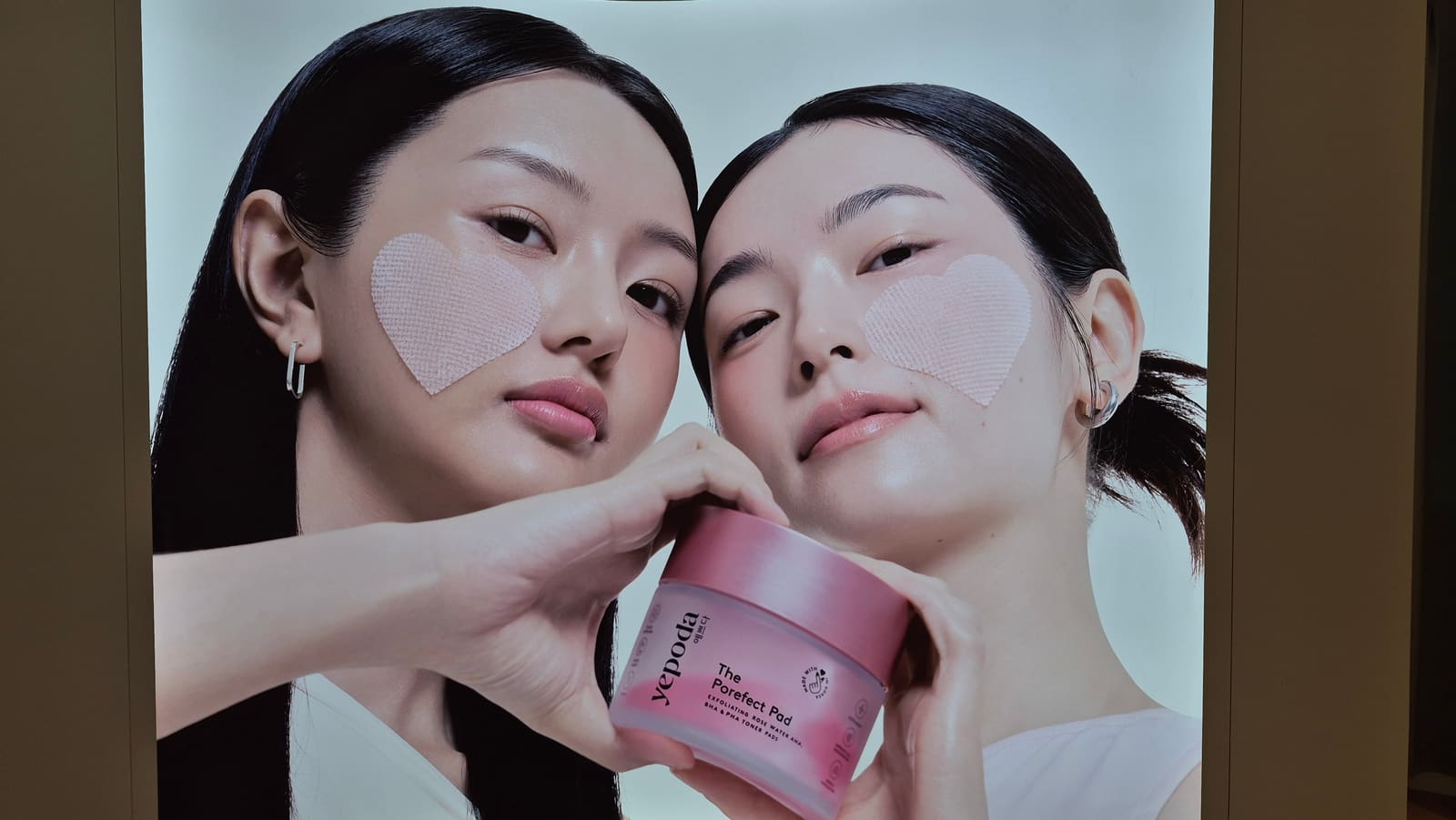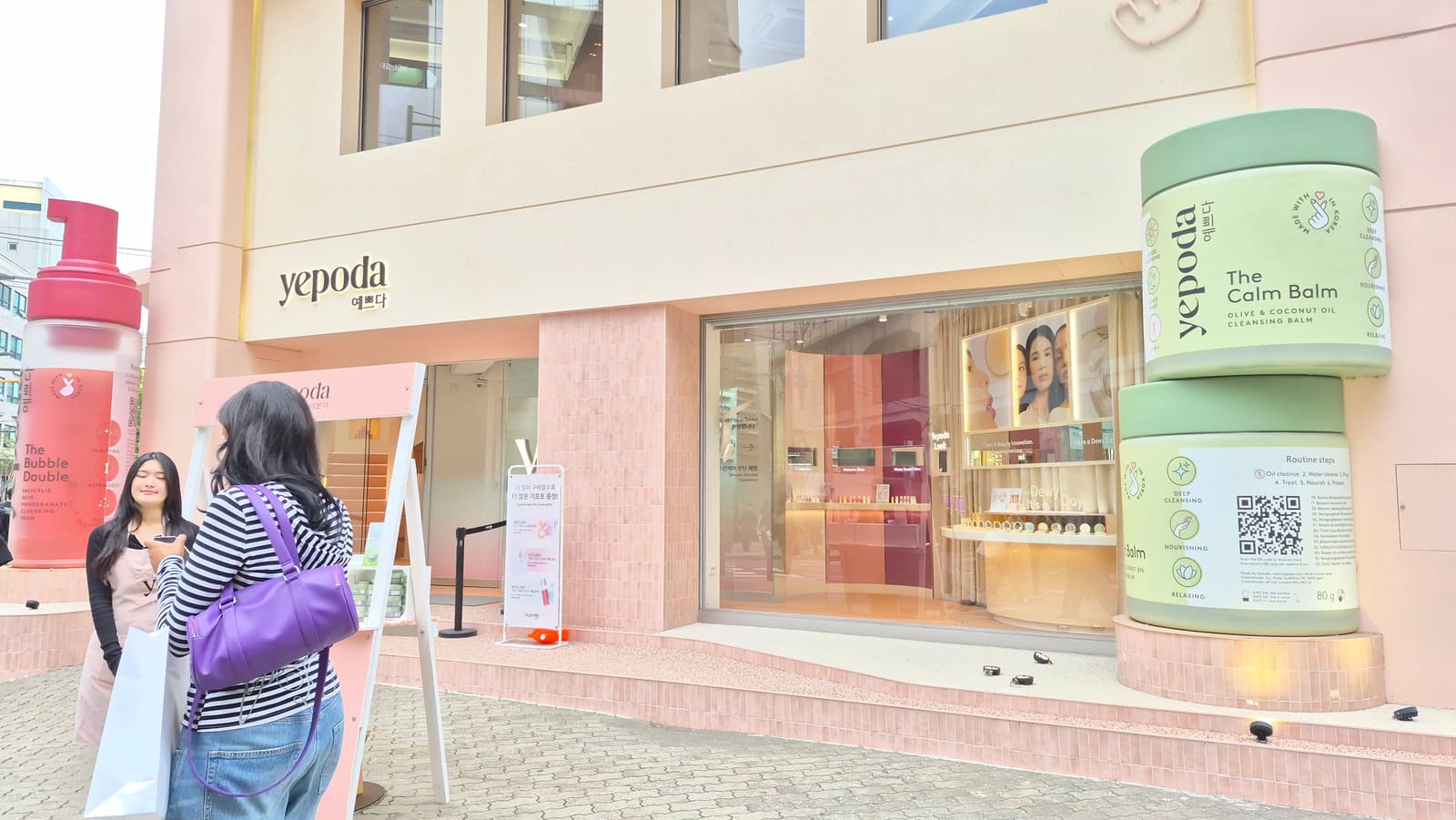
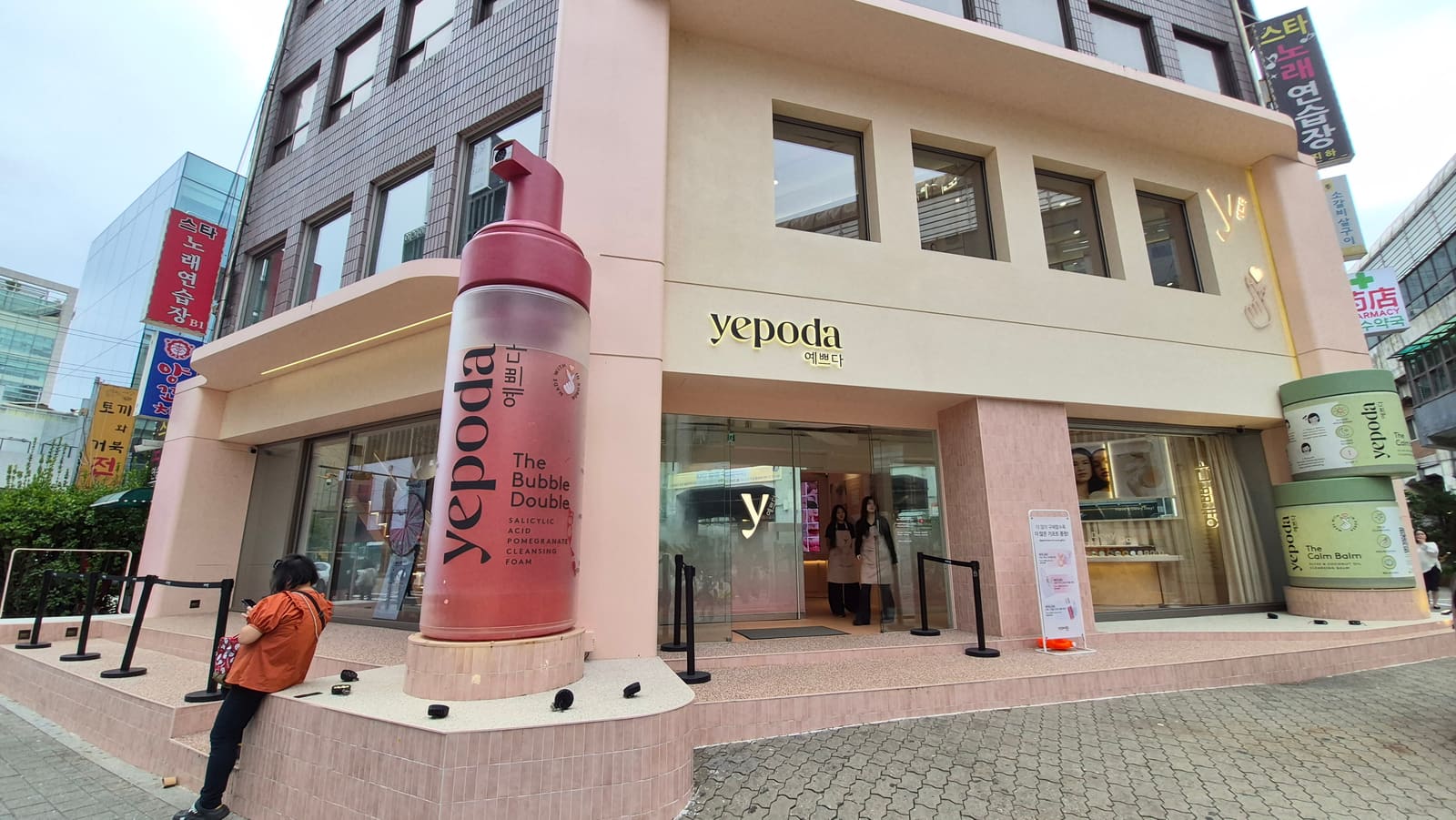
Emblazoned across the exterior and the giant installations is a crystal-clear declaration: "Made with Love in Korea," paired alongside the Korean brand name '예쁘다' (Yepoda). The subtle dissonance one might feel encountering Yepoda in European retail aisles transforms here in Seongsu—the undisputed epicenter of K-beauty—into a masterclass in deliberate brand architecture and calculated commercial mise-en-scène.
Spatial Analysis: "Authenticity Laundering" and the Quest for Legitimacy
Founded in Germany by German entrepreneurs, Yepoda built its initial footprint in the European market, establishing distribution across more than 650 Sephora EU doors. While leveraging Korea’s world-class OEM/ODM manufacturing infrastructure and adopting K-beauty’s hydrating, clean-skincare paradigm, the brand faces an inherent narrative vulnerability: the label of a Western player capitalizing on the K-beauty wave.
The Seongsu pop-up functions as a critical spatial mechanism to resolve this narrative gap. Just as SPC leveraged the semiotic power of Paris to instill Parisian bakery prestige into Paris Baguette, Yepoda deployed significant capital to establish a physical anchor in Seongsu-dong.
This is not merely a domestic market entry strategy. It is a Legitimacy Acquisition protocol. By putting itself on display before Korea’s most trend-sensitive consumers and the global tourists flocking to Seongsu, Yepoda secures "homeland validation." It washes away the opacity of its Western origins in the holy grail of K-beauty, converting high-production spatial experiences into digital brand equity that can be exported back to European and global markets as proof of authenticity.
Spatial Flow & Information Design: Translating K-Beauty UX for the West
Stepping inside, the execution level and attention to detail are striking. For Western consumers, the traditional 10-step K-beauty skincare routine is undeniably allure-rich, yet often perceived as overly complex. Yepoda dismantles this barrier through intuitive spatial UX and clear visual information design.
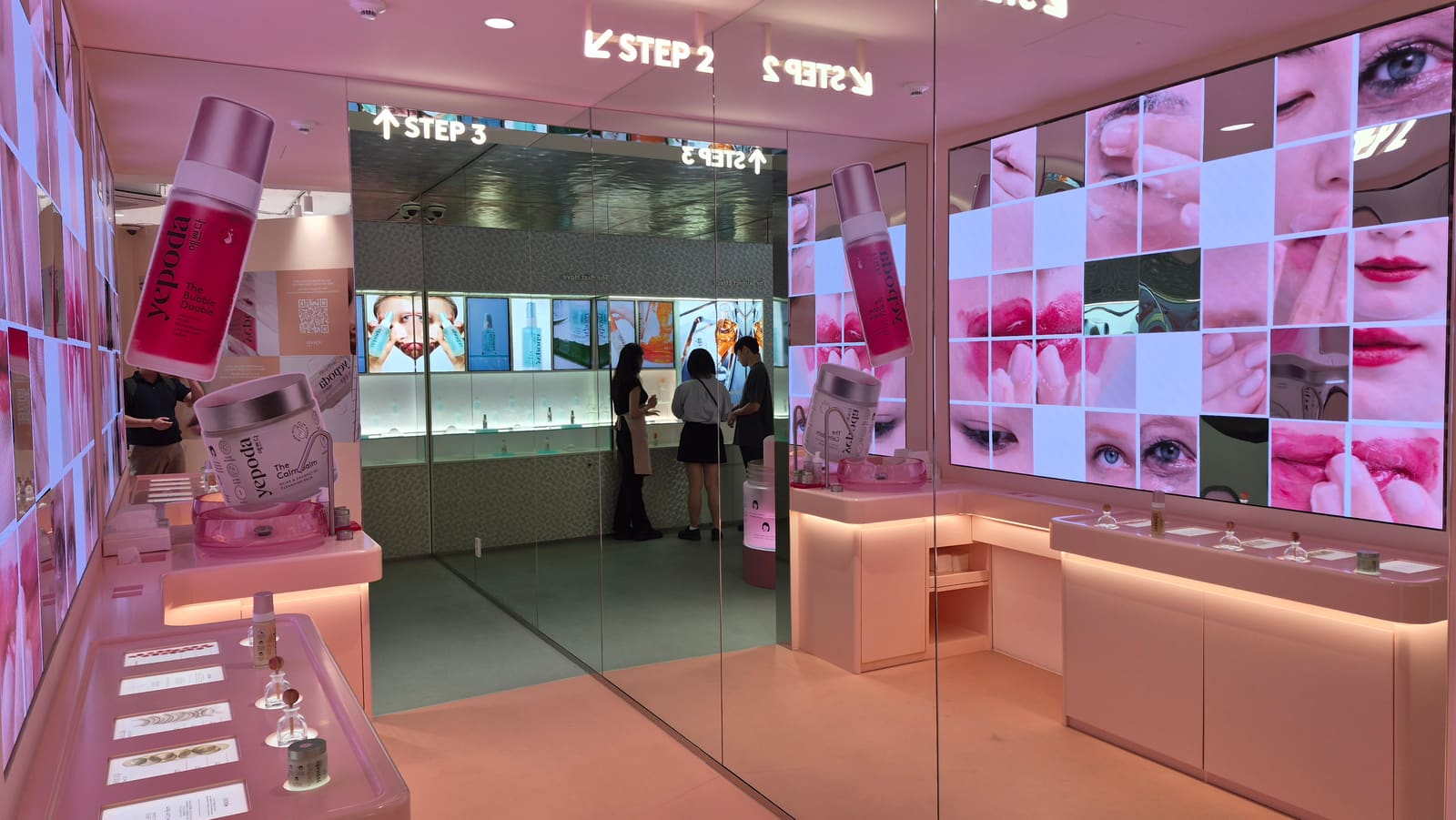
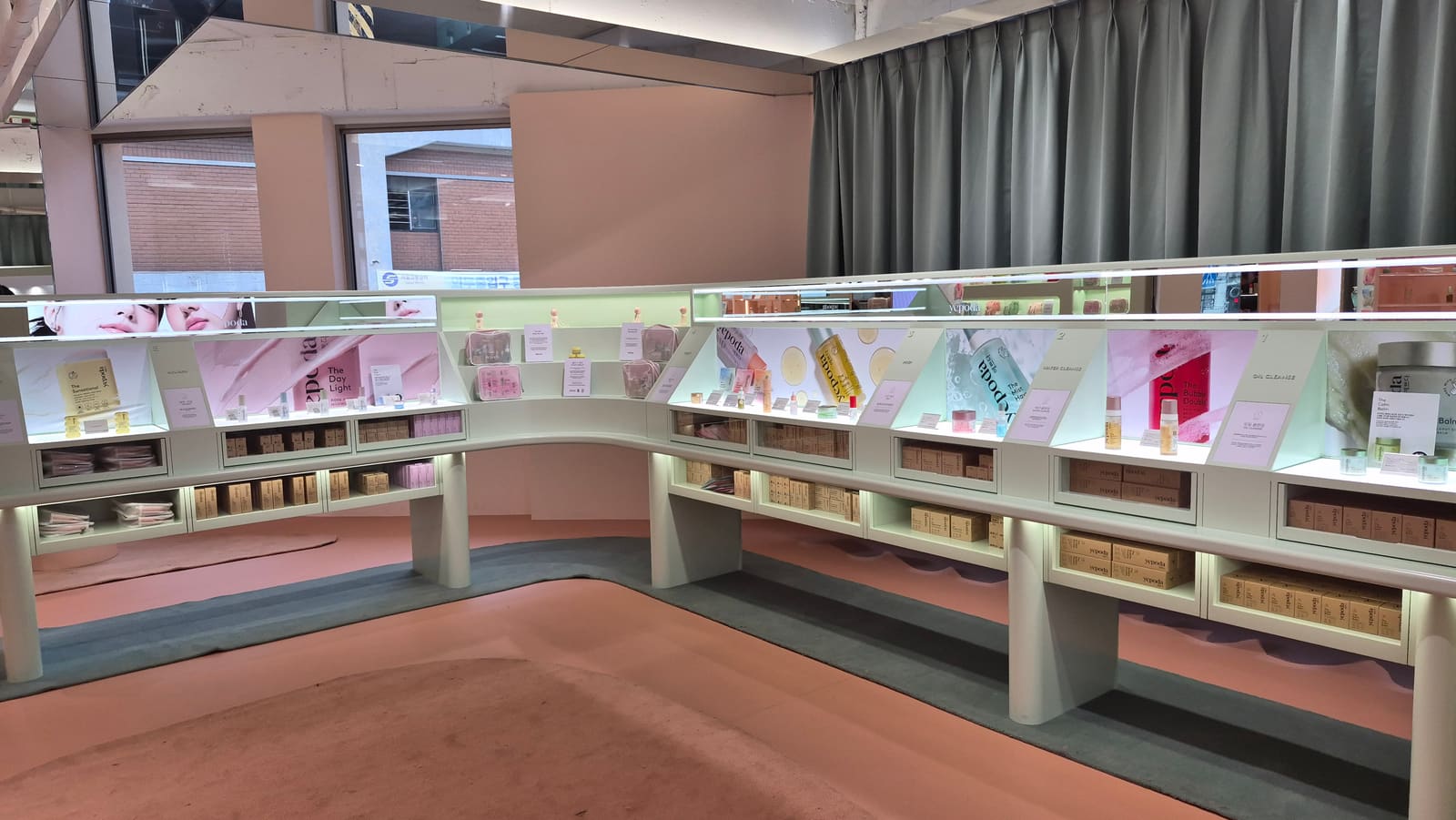
Linear Routine Navigation: From the entryway across the walls, floors, and mirror headers, the space explicitly marks 'STEP 1', 'STEP 2', and 'STEP 3' in arched neon and line work. The physical path naturally aligns with the product progression—from oil cleansers to water-based cleansers, toners, serums, and moisturizers. Uninitiated shoppers absorb the multi-step ritual simply by walking the room.
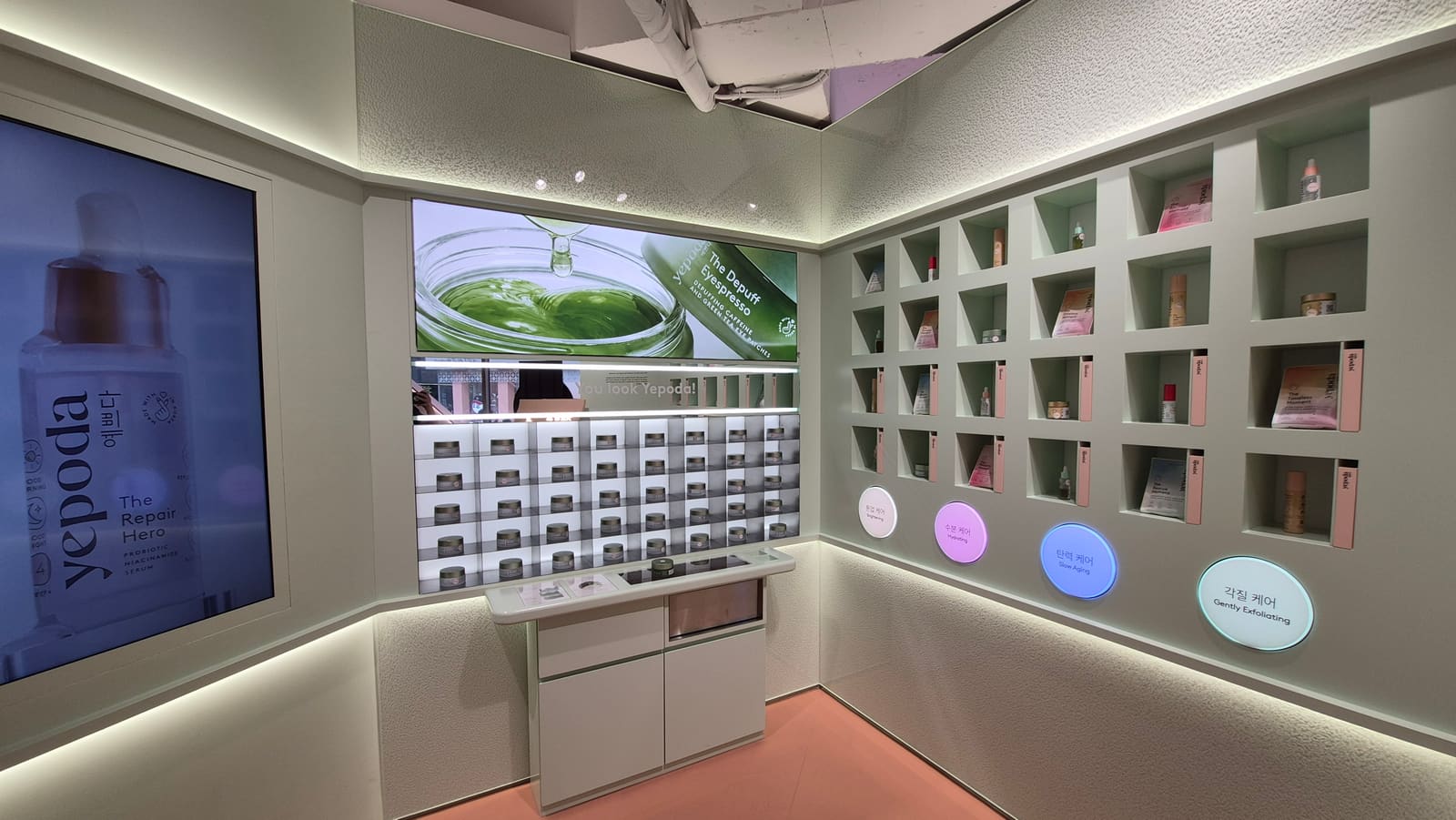
Modularized Visual Hierarchy: One section of the wall utilizes a library-style grid system. At the base, circular backlit icons clearly delineate functional categories: 'Brightening', 'Hydrating', 'Slow Aging', and 'Gently Exfoliating'. The grid shelves above house the corresponding product lines. Each box features English nomenclature paired with Korean text, usage timing (Morning/Night), and step-number icons.
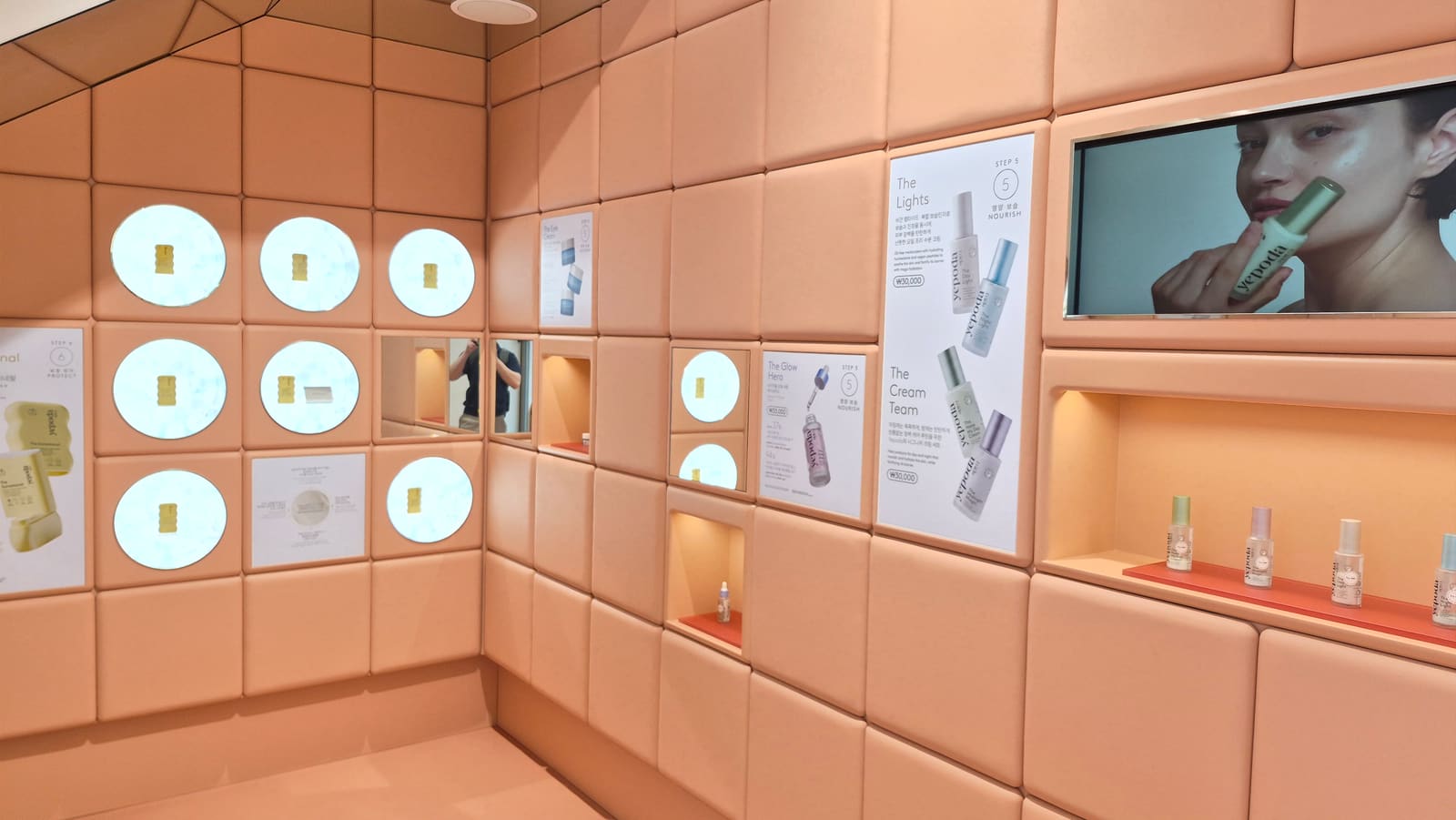
Seamless Phygital Shopping: Product displays feature clear callouts—"Want it? Scan the QR code, create your shopping list, and check out upstairs." By pairing analog texture testing with a digital cart framework, the store mitigates floor congestion while streamlining the path to purchase.
Tactile and Visual Engagement: Sensory Presentation
The interior scenography reflects substantial investment in brand immersion.
Behind 'The Dewy Day' cushion foundation display—arranged along a semi-circular lit counter—lies mirrored lettering reading “Clean K-Beauty Innovation. No compromises.” It organically frames visitors, products, and brand messaging into a single, highly shareable photo-op.
Meanwhile, the mist and serum sections evoke a clinical aesthetic, framed by lab-style beakers, graduated cylinders, and textured glass panels reminiscent of condensation. High-definition artistic media walls continuously loop close-ups of product textures—the richness of the balm, the aerated lather of the foam, the viscosity of the serum. Visitors are not merely trying cosmetics; they are consuming sensory content.
Target Audience & Consumer Psychology
Reframing the primary target audience clarifies the strategic calculus behind this activation.
Target Audience (Global Inbound Travelers): The primary audience here is not local South Korean residents, but rather foreign inbound travelers. Seongsu has become a non-negotiable stop for international visitors looking to experience modern Seoul. For tourists who have already encountered Yepoda in Europe or North America, visiting the Seongsu space feels like a pilgrimage to the source.
The UGC Engine: Every photo and video posted to TikTok, Instagram, or Xiaohongshu from inside the store serves as a badge of honor: "I'm at the Yepoda space in Seongsu, Seoul." This user-generated content morphs into powerful social proof back in their home markets.
Alleviating Authenticity Anxiety: Western consumers purchasing K-beauty often harbor a quiet skepticism: Is this authentic? A physical, high-concept flagship in Seoul permanently erases the subtle doubt of buying a European-founded brand stamped with "Made in Korea." It satisfies the craving for an authentic origin experience, elevating a simple purchase into a narrative event.
The D2C Strategy and the Extension of European Retail Footprints
Bypassing multi-brand beauty retailers or editing shops to sign a standalone Lease in Seongsu reflects three core business rationale:
Extending the European Standalone Retail Playbook: Yepoda isn't just a wholesale brand in Sephora; it has actively rolled out standalone boutique doors at high-footfall European transit and commercial hubs like Rome Termini and Milano Centrale. The same playbook used in Europe—owning 100% of the physical footprint to maximize brand presence—is deployed here in Seongsu.
Total Control of Brand Equity: In a multi-brand retail environment, a brand risks dilution, getting caught in price wars and shelf-space competition. Operating a standalone store ensures 100% control over the narrative environment and the presentation of its 10-step routine UX.
Valuation Maximization & Cross-Border Funnels: Brands reliant strictly on third-party distribution often face valuation caps. In contrast, standalone D2C footprints and owned customer touchpoints drive higher enterprise valuations in M&A and venture capital discussions. Seongsu isn't an operating expense to be recouped via local retail sales; it is strategic CAPEX designed to capture customer data and funnel global travelers back to Yepoda’s international D2C channels and European standalone stores.
Conclusion: Nation Equity Meets Spatial Marketing
The Yepoda Seongsu pop-up illustrates how Nation Brand Equity can be leveraged by global players. As a country's cultural standing rises, international brands can adopt its identity, style, and language to command an instant quality premium. The "developed nation prestige" once held exclusively by Western heritage brands in Asia is now being mirrored globally by Korea and K-beauty.
The substantial rent in Seongsu was never meant to be offset by local retail margins. It is a global marketing investment allocated to generate legitimacy and international content assets. By bringing European retail rollout experience and capital into the heart of K-beauty, Yepoda’s Seongsu activation stands as a remarkably sharp, highly calculated case study in modern global brand strategy.