What did Primark and Five Below actually import?
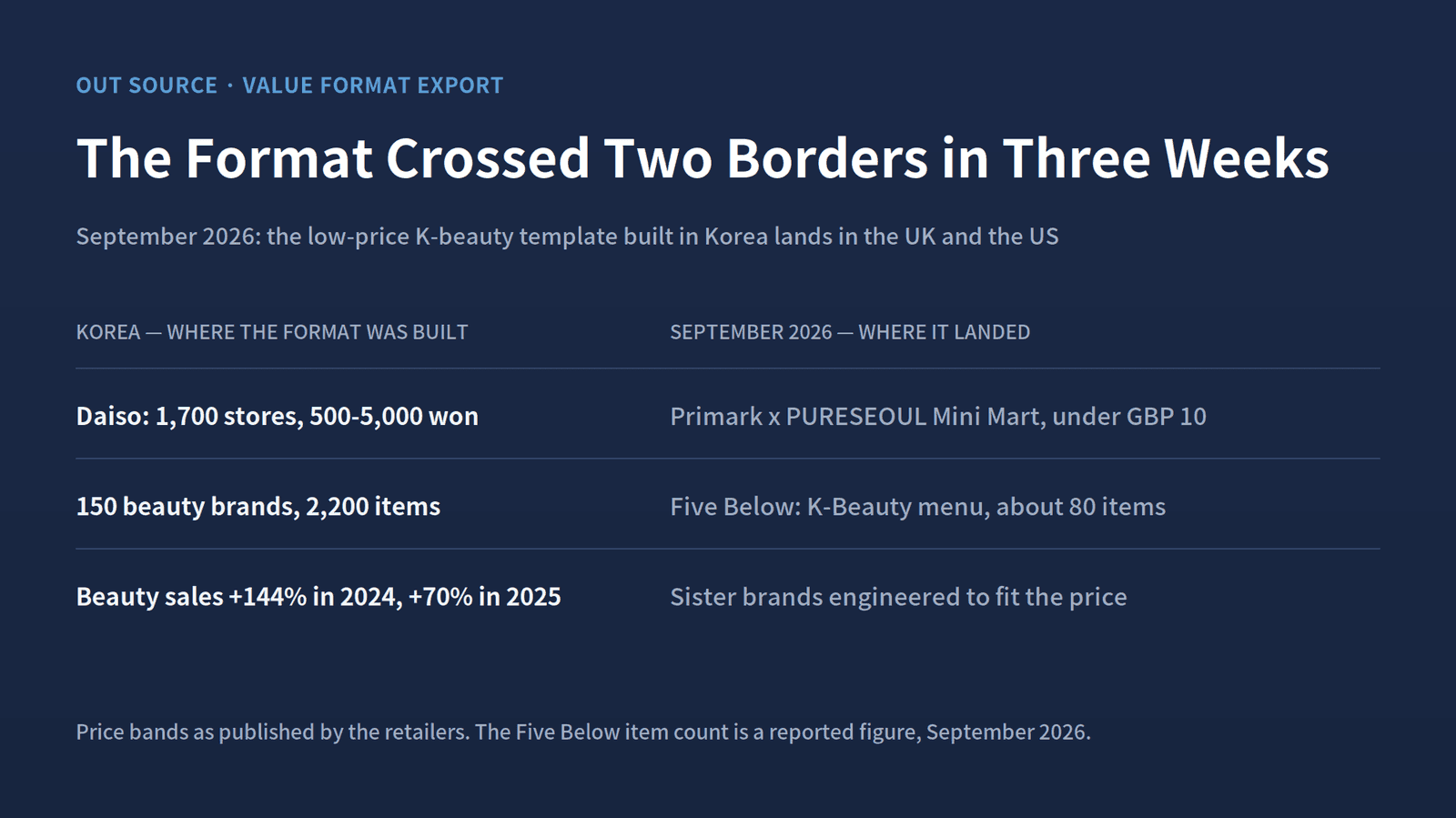
Not a brand, and not a product list. Primark's tie-up with PURESEOUL, the retailer that has been bringing K-beauty to Britain since 2019 and opened its first Scottish store at Edinburgh's St James Quarter in August 2026, installed a fixture called the K-Beauty Mini Mart in Primark stores during the first week of September 2026. Trade accounts of the launch date differ by a few days.
The line-up is the instructive part. Dermablock by Cell Fusion C, The Essential by Ariul, First Edition by Sungboon Editor, CERABASE by Realbarrier, Dropbe by The Saem, Dear Thing by Milktouch. Each is a spin-off of an established Korean brand rather than the brand itself. PURESEOUL's chief executive described the pattern in the launch announcement as Korean brand partners building mini or sister labels to serve demand for more accessible K-beauty, with the UK assortment curated from them.
Primark's own beauty label runs from 0.75 to 5 pounds. The Mini Mart sits under 10 pounds. In the United States, Five Below added a standalone K-Beauty menu inside its online beauty category in the middle of September 2026, carrying roughly 80 items on the count reported at the time; no primary figure has been published.
So what crossed the border is a merchandising template: a hard price ceiling, a curated block of Korean SKUs, and sub-brands engineered backwards from that ceiling.
How big is the format they copied?
Large enough to have its own arithmetic. Daiso runs about 1,700 stores in Korea with every item priced between 500 and 5,000 won ($0.37 to $3.69). Won amounts in this article convert at 1,355 won to the dollar, the mid-market rate on 22 September 2026. Its beauty assortment now runs to roughly 150 brands and about 2,200 items.
The growth curve explains why anyone copied it. Daiso's beauty sales rose 85 percent in 2023, 144 percent in 2024 and more than 70 percent in 2025, then about 30 percent in the first seven months of 2026. In late August 2026 the chain opened its first category-specialist store since it began trading in 1997, near Konkuk University Station in Seoul: 66 square metres, about 1,400 beauty items, roughly 80 percent of the display given to cosmetics.
The suppliers are not obscure. VT Cosmetics brought Reedle Shot to Daiso in 2023 and Nature Republic brought Sikmulwon in 2022; the shelf now carries AHC, DINTO, TAG and Daewoong Pharmaceutical's Patione. E-Mart runs a parallel version, about 120 items across 28 brands under 5,000 won(Approx. $3.69), with skincare sales up 26.6 percent over January to August 2026. This is not a discount bin. It is a channel that established brands now build products for.
Why does a 5,000-won ceiling make verification expensive?
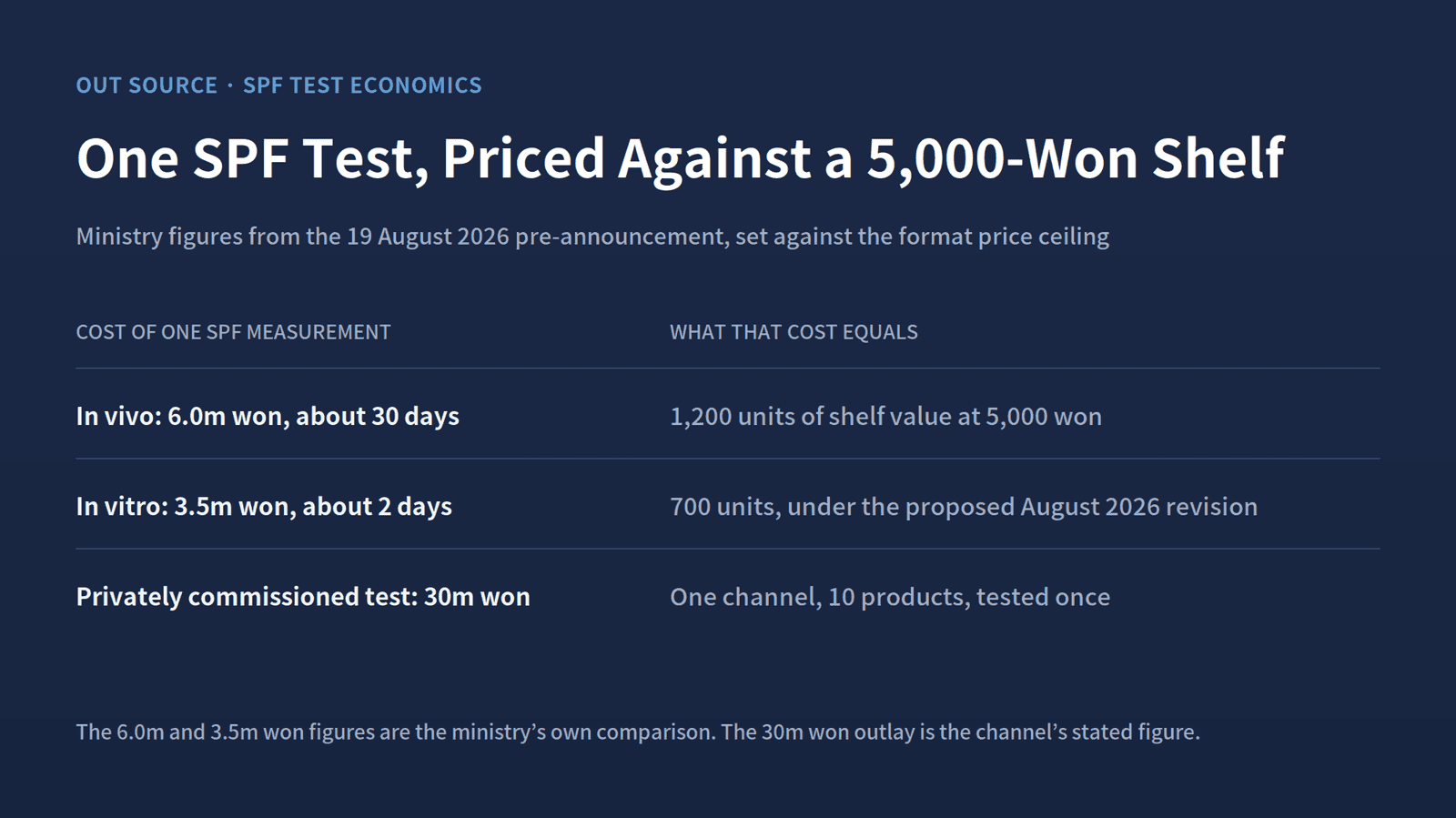
Because the test does not get cheaper when the product does. SPF, the sun protection factor, is the ratio of ultraviolet-B exposure a skin site tolerates with a product applied to the exposure it tolerates without one. Korean rules measure it in vivo, meaning on living human subjects: the product goes onto volunteers and the treated sites are exposed to a lamp. The ministry puts that test at roughly 30 days and about 6 million won ($4,428) per product.
Set that against the format. At the 5,000-won ceiling, one in-vivo SPF test costs the retail value of about 1,200 units. A brand selling a 3,000-won tube needs 2,000 units of shelf value to pay for a single measurement. The test is a fixed cost and the price point is a hard ceiling, so the ratio between the two is the whole problem.
None of this is unique to Korea and none of it implies bad faith. It is the structural reason why claim verification per SKU is thinner in a value channel than in a prestige one, in any market that has a value channel at all.
What happened when someone paid for the test themselves?
In July 2026 a YouTube channel called Pibu-neun Min Dong-seong published its own test of ten sunscreens sold at Daiso and said eight of them fell short of their labelled SPF 50+. The channel put its outlay on clinical testing at about 30 million won ($22,140), five times the cost of a single in-vivo test at the ministry's own figure. The first video went up on 9 July and a follow-up on 20 July.
Daiso answered on 21 September 2026. It commissioned four clinical institutions, the Korean Dermatological Research Institute, the Korea Skin Science Research Institute, P&K Clinical Research Center and HLK Clinical Center, to retest the eight disputed products with ten or more valid subjects per product in line with the ministry's notice, and said all eight met the standard. The eight are Gwail Nara, Kim Jung-moon Aloe, The Lab by Blanc Doux, Dewytree, Bonsep, Befruve, Cynic and VT. Those retest results are the company's own account.
Daiso asked the channel to delete the video, correct the record and apologise, and said it would consider legal measures otherwise. Neither side's test report is public.
What did the regulator actually do?
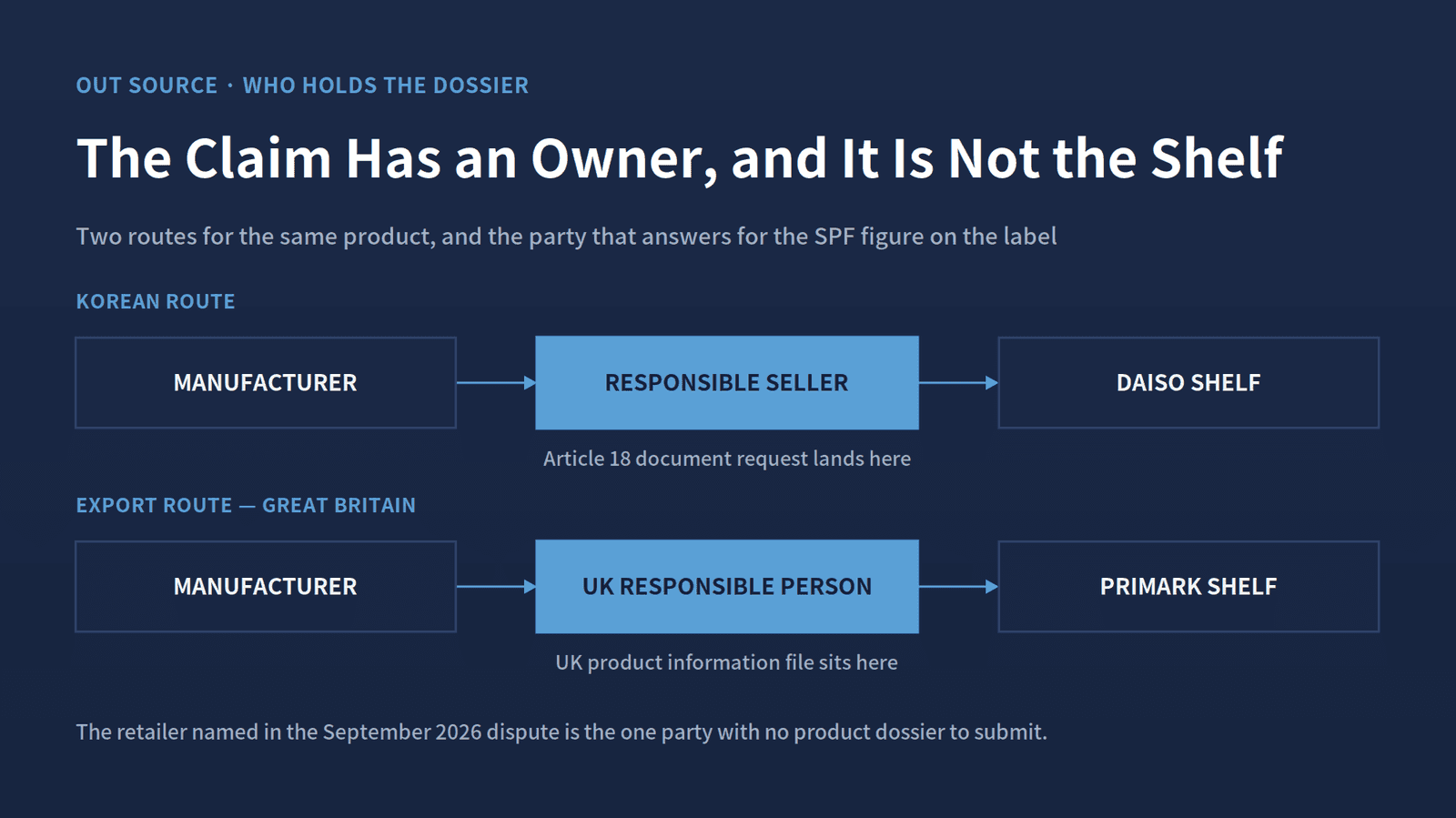
It asked for paperwork. Under Article 18 of the Cosmetics Act, which gives the Ministry of Food and Drug Safety its powers of reporting and inspection, the ministry required the eight responsible sellers to submit copies of their product standards documents, test certificates issued by licensed cosmetics testing institutions, and recent human-application test data to its regional offices. That documentation is what the ministry reviewed. It did not run its own measurement of the products.
The chain of obligation matters here, and it does not run through the shop. Daiso distributes. The manufacturers and the separately registered responsible seller, in Korean regulation the entity that holds the product dossier and answers for the claim, carry the duty. Manufacturers behind the eight products include Welcos and Korea Cosmetic Manufacturing. The retailer whose name is attached to the controversy is the one party with no dossier to produce.
So the confirmed record is narrower than either side's framing. A channel commissioned a test and made a claim. A distributor commissioned four institutions and rejected it. The regulator collected dossiers from the parties that already held them. Nothing in that sequence produced a single independent measurement that both sides were obliged to accept.
Why can two SPF tests on the same product disagree?
Partly by design. Korean labelling permits a product to declare an SPF up to 20 percent below its measured mean, so the number printed on the tube is a floor rather than a reading. Two laboratories can report different figures and both remain consistent with the same label.
Partly by circumstance. The two rounds here differed in batch numbers, production timing, storage conditions, subject composition and test conditions, and the available material does not support a full comparison between them. In-vivo SPF measurement is a biological assay on a small panel, and ten valid subjects is the floor set by the notice rather than a number chosen for narrow confidence intervals.
This is the part that does not resolve into a villain. A test costing 6 million won, running on ten people and permitting a 20 percent labelling discount is a workable compromise for a 40,000-won serum sold across a counter with a brand's reputation attached to it. Applied to a 3,000-won tube moving at volume through a fixture, the same compromise carries more weight than it was built to carry.
What changed in Korea's SPF rules one month ago?
On 19 August 2026 the ministry pre-announced revisions to two notices: the rules on review of functional cosmetics and the rules on substantiation of cosmetic labelling and advertising. The comment period closed on 18 September 2026, three days before Daiso published its rebuttal. The revisions are pre-announced rather than in force.
Two changes matter. The first adopts ISO 23675 and ISO 24443, in-vitro methods, meaning measurement outside the body, on a plate of polymethyl methacrylate, a transparent acrylic substrate that stands in for skin, covering both SPF and PA, the UVA protection grade. The ministry set the comparison at roughly 30 days and 6 million won for the in-vivo route against about two days and 3.5 million won ($2,583) in vitro.
The second is the substantiation rule: an SPF figure can be labelled or advertised only where it has been proven by a human or an in-vitro test. Before the revision the substantiation requirement was unspecified.
Read together, the two changes do something specific to the value format. They cut the cost of a measurement by about 40 percent and the elapsed time by about 93 percent, and in the same motion make the measurement a condition of the claim. That is the regulator's answer to the arithmetic above, and it is a supply-side answer. It does not create an independent retest of a product already on a shelf.
Does the verification travel with the format?
Not the Korean version of it. A product placed on the Great Britain market must have a responsible person established in the United Kingdom, who notifies the product, holds the product information file and keeps supporting evidence for every claim made on it. Efficacy claims are governed by the six criteria carried over from Commission Regulation 655/2013, which require adequate and verifiable evidence. The Korean responsible seller's dossier does not transfer. A UK entity assembles its own.
That boundary cuts both ways. A Korean SPF dossier built to a Korean notice is not automatically a UK claims file, which is friction for any brand crossing over. It also means the format arriving at Primark does not arrive with the Korean dispute attached, because the counterparty answerable for a claim on a British shelf is British.
What does travel is the structure that created the pressure in the first place. A hard ceiling, sub-brands engineered to sit beneath it, and volumes large enough that per-SKU verification cost becomes the binding constraint. Primark's assortment sits under 10 pounds. Five Below's name is its price architecture. Those are the same physics as 5,000 won.
Where does this leave manufacturing, retail and regulation?
Three positions, and they do not agree.
For manufacturers, the August revision is straightforwardly good. A measurement taking two days and 3.5 million won can be run per batch rather than per launch, which is the only version of routine verification a value SKU can carry. The constraint on testing a 3,000-won product was never willingness. It was the cost of a test against the price of a unit.
For retailers and buyers, September moved a merchandising format across two borders inside three weeks, and the format's central promise is a claim on a label at a price that leaves no margin for a second opinion. The party answerable for that claim is the responsible person in the destination market, not the Korean shelf the format was copied from. Diligence belongs where the dossier sits.
For regulation, the gap this dispute exposed is not in the pre-market file. It is in what follows. The ministry's Article 18 power produced documents from the parties that already held them. An independent measurement of a product already on sale happened once, performed by a YouTube channel, at 30 million won of its own money.
The format exported cleanly. The proof did not.