What exactly changed hands on 18 September 2026?
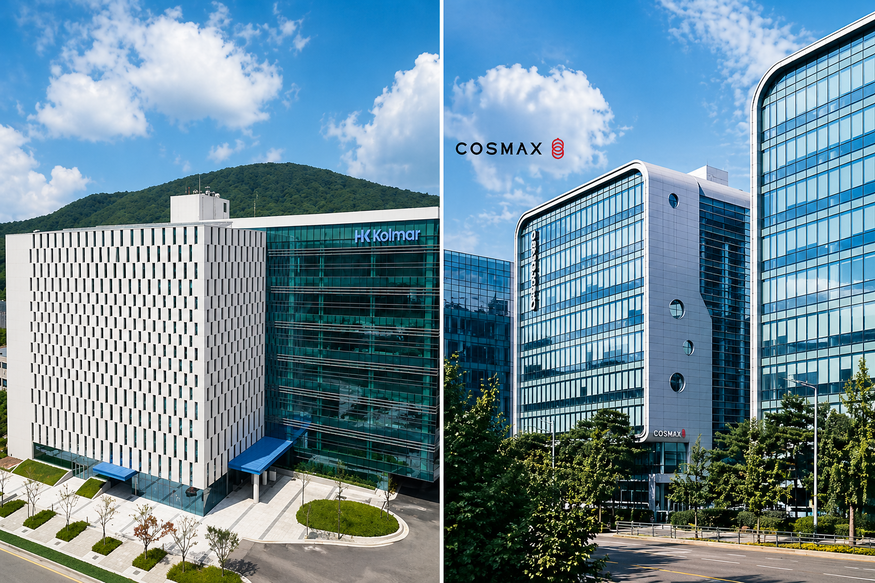
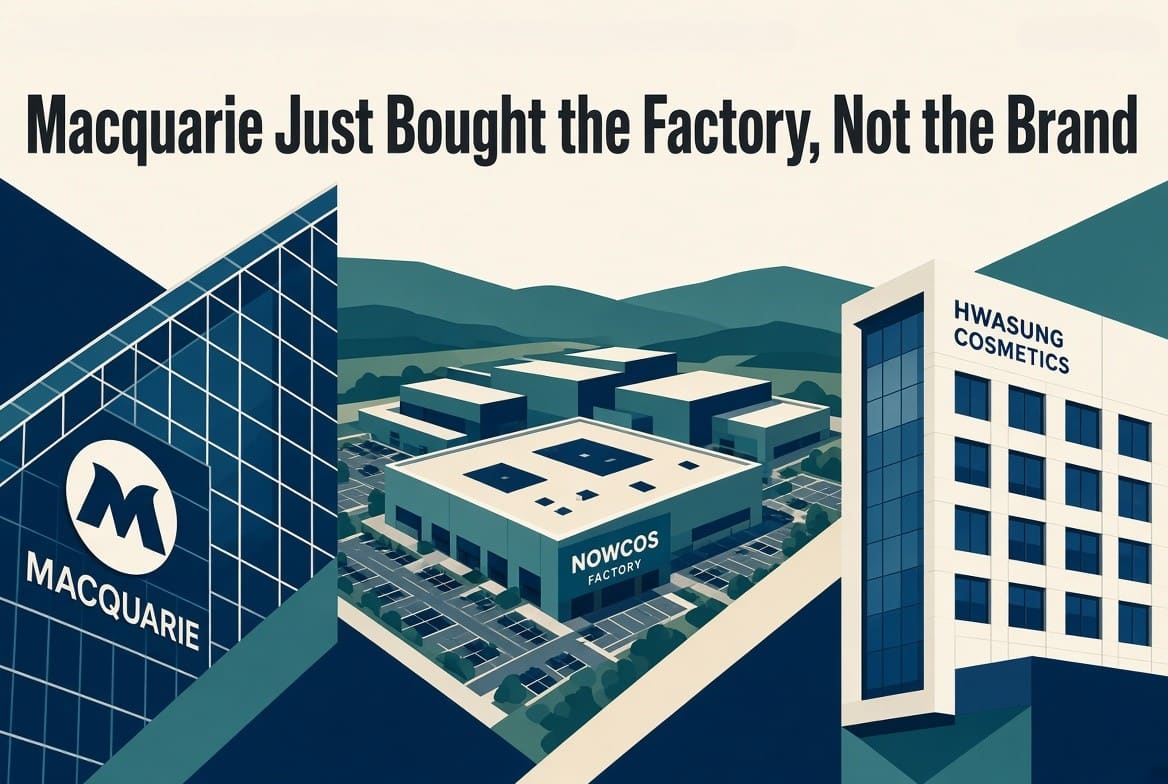
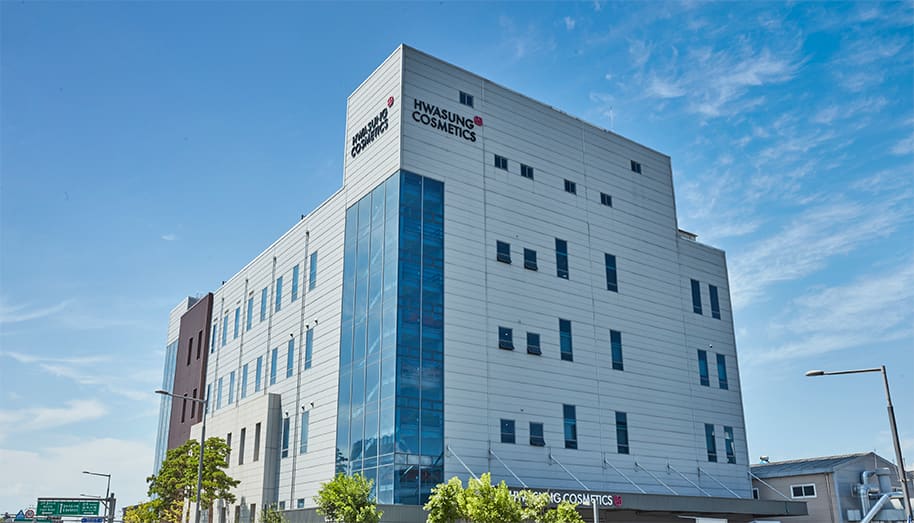
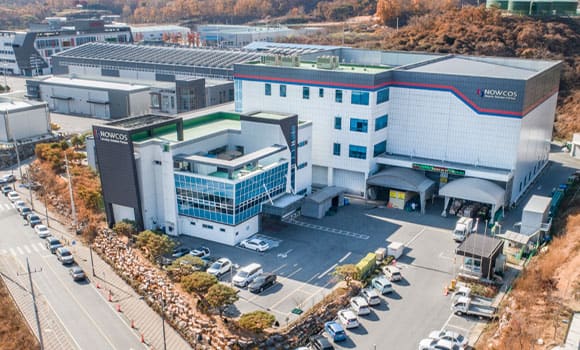
Two contract manufacturers, sold as one package. Hwasung Cosmetics makes color cosmetics on an ODM basis — original design manufacturing, where the factory develops the formula and the specification and the brand puts its name on the finished product. Nowcos makes skincare on the same basis. Affirma Capital, the private equity firm that completed a management buyout of Standard Chartered's private equity business in 2019, held 70 percent of Hwasung through a vehicle called Asterion Holdings and, after a take-private completed in 2026, all of Nowcos.
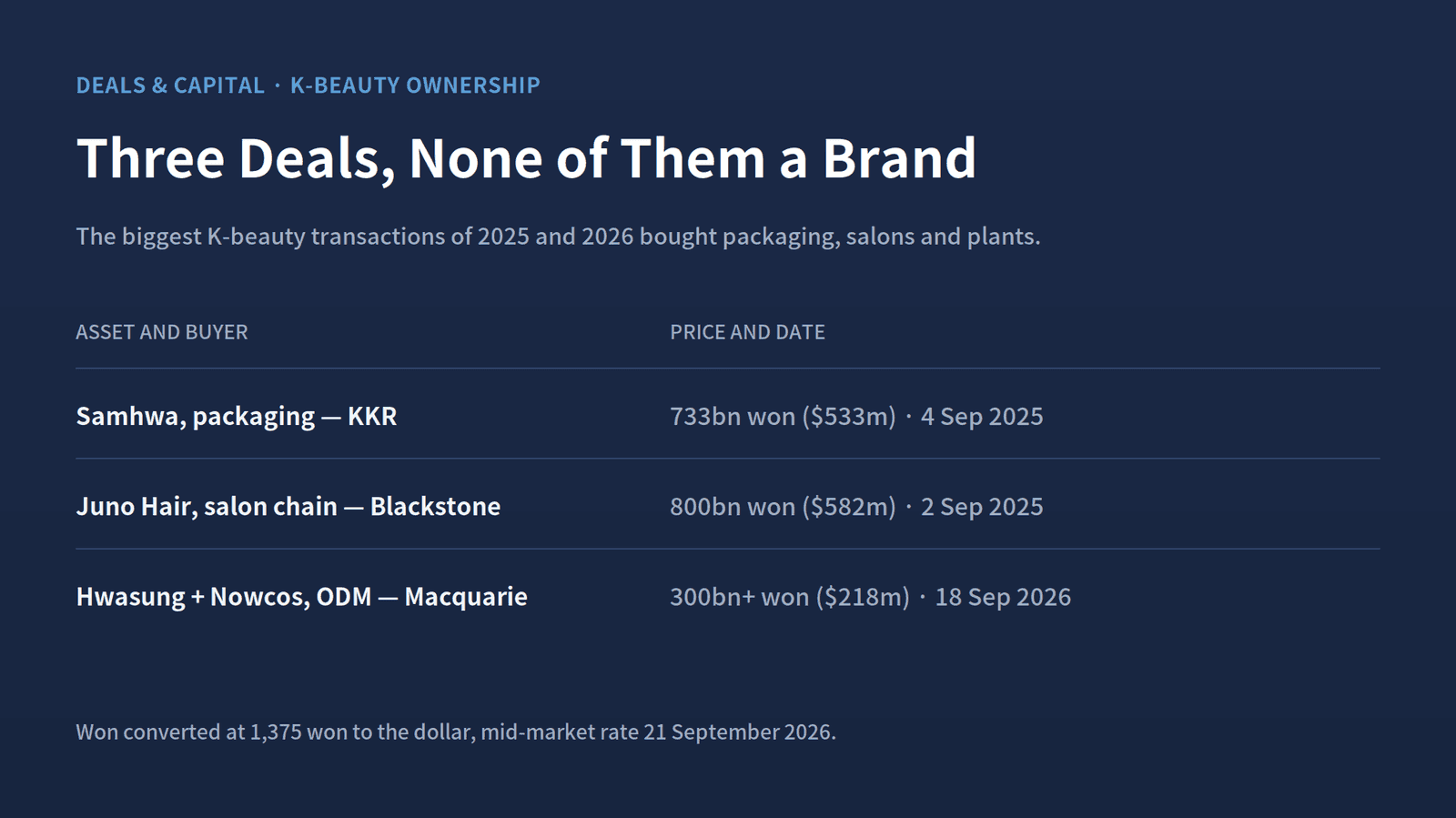
Macquarie was named preferred bidder on 12 August 2026 and signed the sale and purchase agreement on 18 September. The price is put at more than 300 billion won ($218 million); the confirmed figure is not public. Samsung Securities and Rothschild ran the sale. Accounts of the structure differ on whether the founder's remaining 30 percent of Hwasung travels with Affirma's block. Won amounts throughout this article convert at 1,375 won to the dollar, the mid-market rate on 21 September 2026.
Who is the buyer, and what else does it own in Korea?
Macquarie Asset Management describes itself as the world's largest infrastructure manager, citing an IPE Real Assets ranking published in July 2026 that measured infrastructure assets under management as of 31 December 2025. Its own disclosure counts roughly 180 portfolio companies as of 31 March 2026. This transaction does not run through an infrastructure fund. It runs through Macquarie Korea Opportunities Fund VI, a buyout vehicle.
The label matters less than what that vehicle has been buying. Its previous Korean acquisition was Genuone Sciences, a pharmaceutical CDMO — contract development and manufacturing organization, the drug industry's term for a plant that makes other companies' products — purchased from IMM Private Equity and closed on 30 April 2024. In December 2025 Macquarie refinanced Genuone, raising 550 billion won ($400 million), cutting the borrowing rate from the mid-6 percent range to about 5.6 percent, and setting aside 100 billion won ($73 million) as a delayed-draw term loan reserved for facility investment. Debt cost down, capacity up. That is a utilities playbook applied to a factory.
What did Affirma build in seven years of ownership?
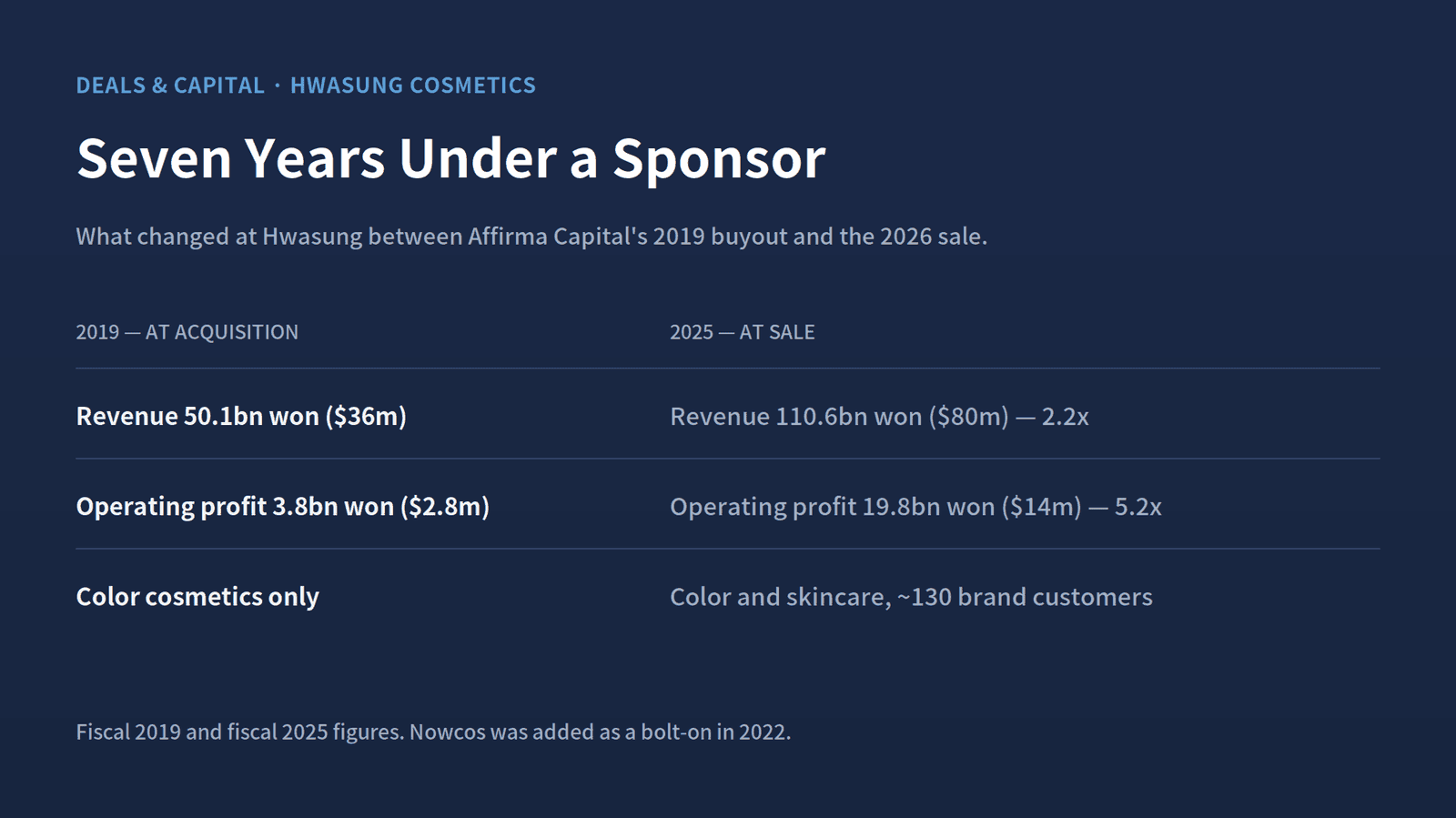
Affirma acquired 70 percent of Hwasung in 2019 for 140 billion to 160 billion won ($102 million to $116 million). Hwasung's revenue that year was 50.1 billion won ($36 million) and its operating profit 3.8 billion won ($2.8 million). By 2024, revenue reached 92.9 billion won ($68 million) and operating profit 15.5 billion won ($11 million). The 2025 accounts show revenue of 110.6 billion won ($80 million) and operating profit of 19.8 billion won ($14 million) — 2.2 times the 2019 revenue and 5.2 times the 2019 operating profit. EBITDA for 2025, meaning earnings before interest, tax, depreciation and amortization, is put at about 24 billion won ($17 million).
The operating changes behind those numbers are specific. Research headcount more than tripled, including through the pandemic period when EBITDA fell 40 percent. The customer base moved from roughly 100 brands before the buyout to about 130 within two years, and foreign brands grew to around 70 percent of the book. The named clients run from L'Oreal and Estee Lauder at one end to US challengers such as Rhode and Makeup By Mario at the other. Those customer counts and shares are the sponsor's own account.
Why did Nowcos have to be delisted before it could be sold?
Because a listed minority complicates a package sale. Affirma bought control of Nowcos in 2022 as a bolt-on — an add-on acquisition folded into an existing portfolio company to widen its range. Nowcos brought skincare to a color-cosmetics platform: 75.7 percent of its 2024 revenue came from basic skincare, and its client list includes LG Household & Health Care. Revenue ran 42.3 billion won in 2022, 52.7 billion won in 2023, 62 billion won in 2024 and above 70 billion won in 2025.
The tender offer ran from 26 January to 19 February 2026, took 1.78 million shares or 30.22 percent, and lifted the holding to 95.02 percent — the threshold for a voluntary delisting. A cash-out share exchange followed for the remainder. The stated purpose at the time was to sell Nowcos and Hwasung together. Seven months later that is what happened. The delisting was not a governance event. It was deal preparation.
Is this the first time global capital has bought K-beauty's supply chain?
No, and the recent record is dense. KKR completed the purchase of Samhwa — a cosmetics packaging maker founded in 1977 that supplies more than 300 brands and ranks among the largest container producers in Asia — on 4 September 2025 for 733 billion won ($533 million). The seller was TPG, which had bought it in 2023 for around 300 billion won ($218 million). Two days earlier, on 2 September 2025, Blackstone announced a majority investment in Juno Hair, not a manufacturer but Korea's largest premium salon chain, with more than 180 locations and about 3,000 staff, at a valuation of 800 billion won ($582 million) and above 20 times EBITDA against a global sector average nearer 13.5 times.
Advisory firm MMP counted six K-beauty M&A transactions worth $1.41 billion in 2025, against a record $1.65 billion in 2024. The largest brand purchase inside that 2025 total was Skinfood, at $108 million. Packaging, salon networks and plants absorbed the rest. Any claim that a global fund has just discovered K-beauty manufacturing fails on the dates.
How fast do these assets turn over?
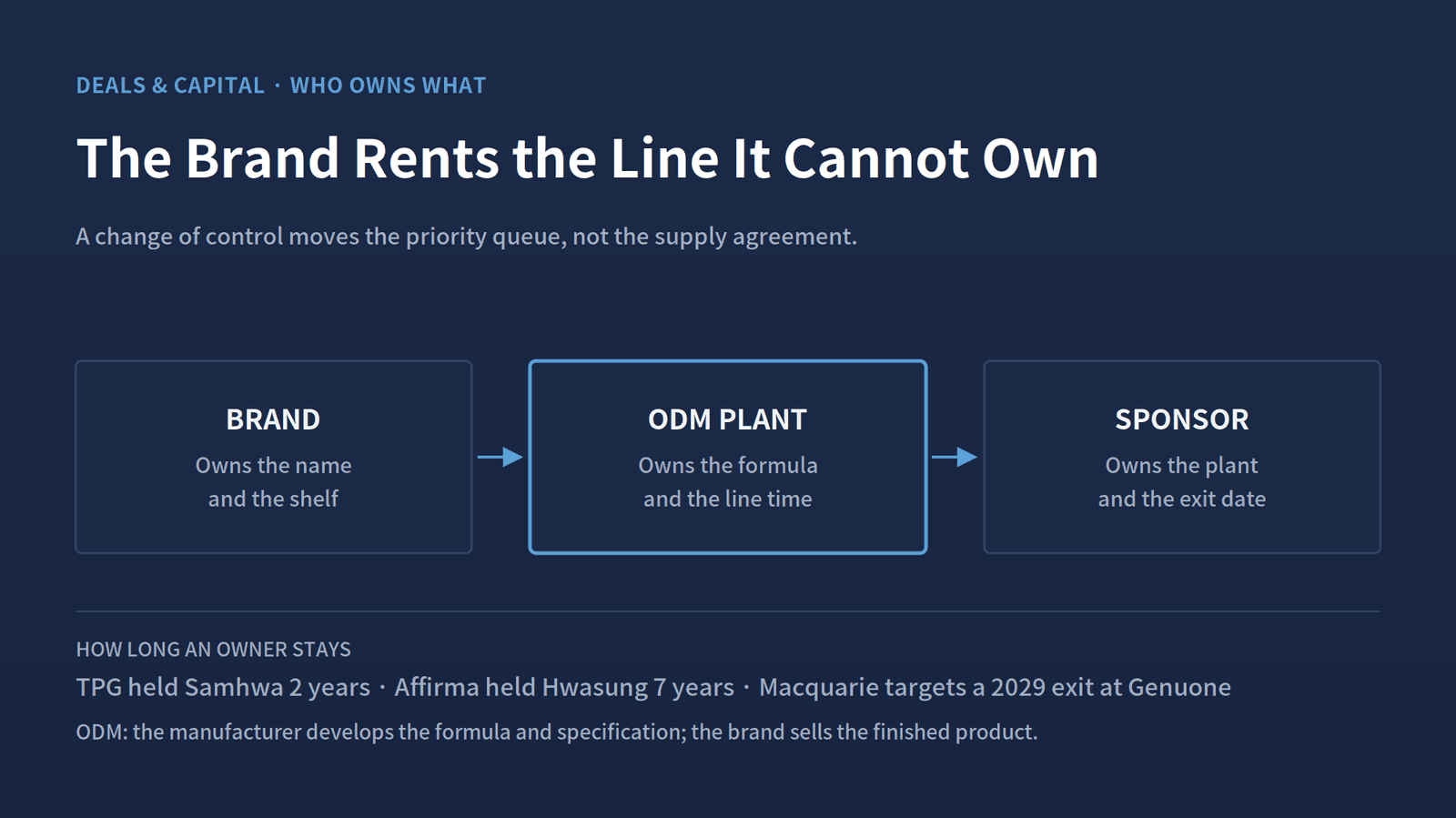
TPG held Samhwa for roughly two years, buying at about 300 billion won in 2023 and selling at 733 billion won in September 2025. Affirma held Hwasung for seven years and Nowcos for four. At the time of the Genuone purchase, Macquarie's plan was reported as an exit in 2029 at a valuation near 1.2 trillion won.
A brand signing a three-year supply agreement with a Korean ODM is therefore signing with a counterparty whose ownership has a defined end date, usually inside five years, and whose current owner is managing toward an exit multiple. That is not a criticism of private equity. It is a property of the ownership form, and that form now covers a meaningful share of K-beauty's manufacturing base.
How does a factory get valued differently from a brand?
A brand is valued on what consumers will keep paying and how long the current preference holds. A contract manufacturer is valued on what a spreadsheet can hold: capacity, utilization, customer concentration, cost per unit, and the length and renewal rate of contracts. The two businesses reward opposite behavior. A brand's value rises when it is scarce and distinctive. A plant's value rises when it is full and its customer list is diversified enough that no single brand's collapse takes the year with it.
That is precisely what Affirma engineered at Hwasung: foreign customers pushed to around 70 percent of the book, a skincare platform added alongside color, the brand count lifted by roughly a third. The combined operations run to about 250 million units a year on a two-shift schedule, by the companies' own account. Nothing in that arithmetic requires anyone to love the product.
What does a brand actually control when its manufacturer changes owner?
Less than the contract implies and more than the alarm implies. Supply agreements survive a change of control. Formulas developed on an ODM basis generally remain the manufacturer's intellectual property, which is why switching plants means requalifying a product rather than moving a file. Regulatory registrations sit with the responsible seller in Korea and with the registered facility in the United States, so an ownership change touches the second of those and not the first.
What does change is the priority queue. An owner underwriting a return sets unit economics, minimum order quantities and the allocation of scarce line time. Whether Macquarie adjusts pricing or reallocates capacity is not known and is not predicted here. What is structurally true is that those decisions now sit with an owner whose return clock started in September 2026. The response that follows is not alarm. It is treating the ownership of the plant as a standing diligence item, the way currency exposure or a single-source ingredient is a standing item.
Where does this leave manufacturing, brands and capital?
Three positions, and they do not agree.
For manufacturers, sponsor ownership has been an upgrade in this sample. Affirma more than tripled research headcount at Hwasung and took revenue from 50.1 billion won to 110.6 billion won across six years. Capital that prices a plant as an asset invests in the plant.
For brands and buyers, the calculation runs the other way. Korea exported $11.4 billion of cosmetics in 2025, second in the world, to 202 destination countries, up from 172 in 2024. Almost none of those brands own their production. The plants they share are held by owners with exit dates, and the schedule of those dates is not published.
For capital, the thesis is arithmetic. Brand risk is fashion risk. Capacity risk is a utilization number. In a category where new brands arrive every quarter and most of them disappear, the durable asset is the one all of them have to rent.
The factory outlasts the brand. That is the whole trade.