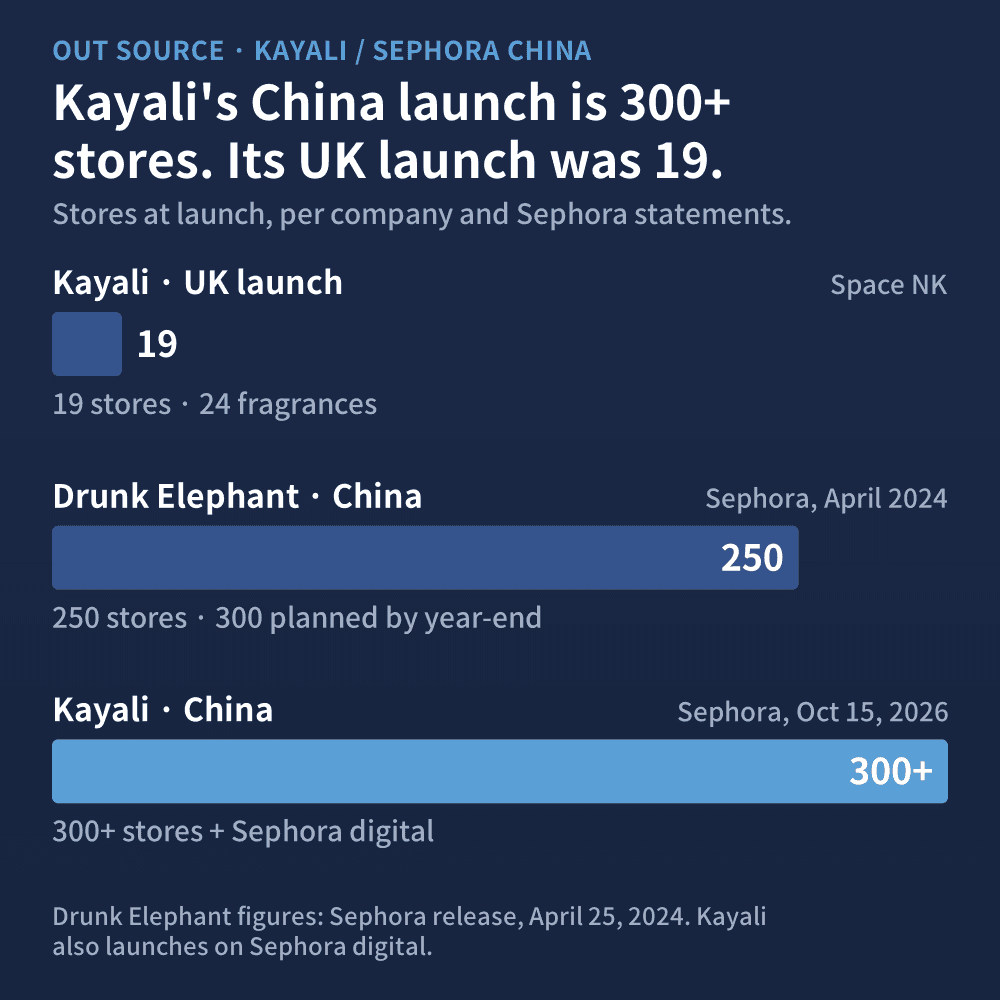
On October 15, 2026, the fragrance brand Kayali launched in mainland China through a single retailer, Sephora, in more than 300 stores and on its digital platforms. Its Space NK launch in the United Kingdom covered 19 stores. Sephora’s April 2024 launch of Drunk Elephant in China began with 250. Kayali, founded by Mona Kattan in 2018, is entering China through one door and at a scale that dwarfs its British debut. The exclusivity is the strategy. It is also the exposure.
What exactly did Kayali launch in China on October 15, 2026?
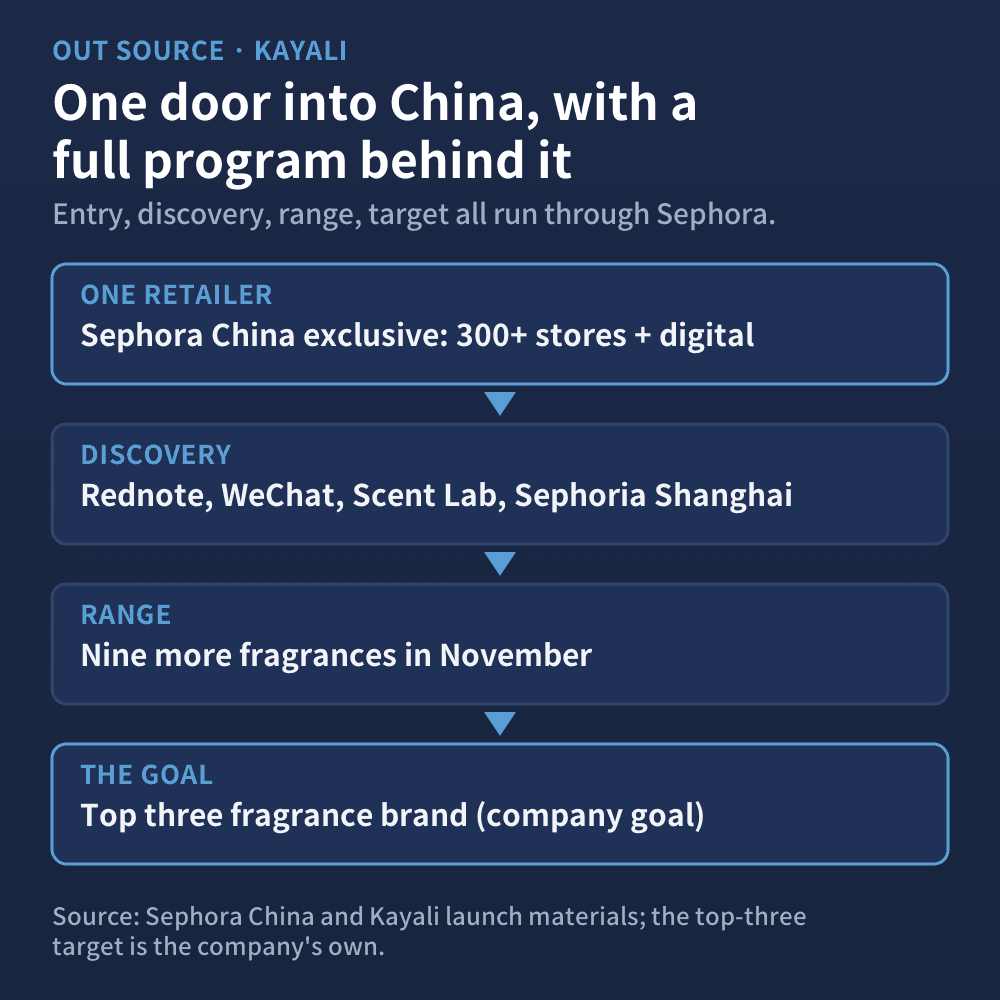
Kayali launched exclusively with Sephora China across more than 300 stores in mainland China and on Sephora’s digital platforms. The brand describes China as one of its most important long-term markets and has set itself the goal of becoming one of the top three fragrance brands at Sephora China. That goal is the company’s own.
The launch has a calendar, not just a date. Kayali presented at Sephoria Shanghai, Sephora’s beauty festival, from October 23 to 25, and Mona Kattan hosted a masterclass on opening day. Nine more fragrances arrive in November. According to the brand, it also runs a Scent Lab in Shanghai and a Kayali Café format at 10 Sephora locations, beginning with the Shanghai flagship.
How big is 300 stores?
Against Kayali’s own history, it is large. The brand’s UK launch with Space NK covered 19 stores and 24 fragrances, according to the company. Against Sephora’s China history, it is above the last comparable launch. When Sephora introduced Drunk Elephant to mainland China on April 25, 2024, it announced 250 stores and a plan to reach 300 by the end of that year.
Kayali starts where Drunk Elephant aimed to finish. Sephora’s global merchandising executive for fragrance and haircare described the entry as significant in scale. Sephora is giving a fragrance brand on day one the allocation it planned to give a skincare brand by the end of its first year.
What does “exclusive” buy a brand at Sephora China?
The word needs care. Sephora’s own Drunk Elephant release called that launch exclusive and, in the same document, referred to the brand’s storefront on Tmall, Alibaba’s marketplace. The release did not define what exclusive covers or which retailers it excludes. Exclusive at Sephora China means exclusive among retailers. It does not mean the brand has no other presence.
For Kayali, the details have not been announced. Currently, the country selector on Kayali’s own website does not list China. The only visible door is Sephora. In exchange, the brand gets full backwalls and dedicated shelf space, depending on the location, an event calendar hosted by the retailer, and access to the retailer’s digital traffic. Sephora gets a launch it can promote as its own, which is what exclusivity is for.
Why does an eight-year relationship matter?
Kayali says its partnership with Sephora spans eight years, more than 30 countries and about 3,000 doors worldwide. Those figures are company statements. The structural point does not depend on the exact count: Sephora already runs Kayali’s merchandising across dozens of countries and knows how its layering message works at the counter.
A new market is the most expensive time to teach a retailer a brand from scratch. Kayali skips that cost by entering China with the retailer that has already run its playbook in dozens of countries. The risk it accepts is that the retailer knows the brand equally well and negotiates accordingly.
How does a fragrance get discovered before it gets bought?
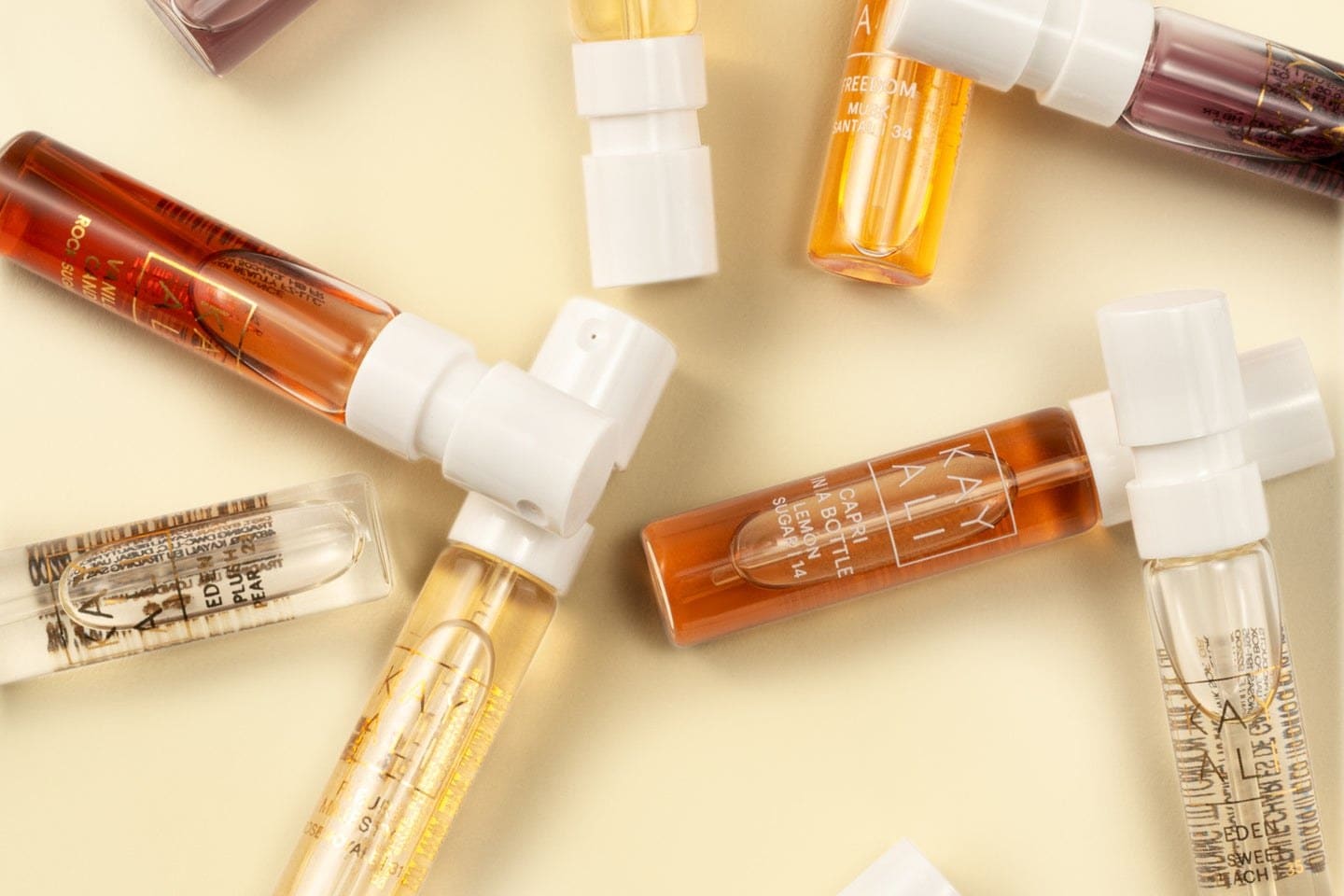
Fragrance sells on smell, and smell does not travel through a phone. Kayali’s answer is a layered program. It names Rednote and WeChat as its main discovery channels in China. It runs a Scent Lab and café experiences that put people in front of the product. It offers 10 ml bottles and curated kits, a format that lowers the price of a first try.
Each piece does a different job. The social channels create the reason to walk into a store. The events and cafés convert curiosity into a first sniff. The small bottle turns a first sniff into a first purchase. A launch with 300 doors and no sampling format fills shelves. A launch with all four builds repeat customers, and repeat customers are what a top-three ranking is made of.
Why does the November drop matter?
The first wave is not the full range. Nine more fragrances arrive in November, weeks after the October 15 launch. The staggered release gives the brand a second news moment inside a single quarter and gives Sephora a reason to refresh displays.
It also sets the production calendar. Whoever fills the bottles carries a 300-store launch and a nine-product release within weeks of each other. In the UK, the brand began with 24 fragrances in 19 stores. In China, it began with fewer products in far more doors. The bet is on depth of distribution first and breadth of range second.
Who owns Kayali, and why does it matter for the China bet?
On February 17, 2025, Huda Beauty announced it would sell its ownership stake in Kayali to Mona Kattan and the growth equity firm General Atlantic. Kayali now operates as an independent company, with Kattan remaining chief executive. No purchase price or stake percentages were disclosed.
The ownership history changes how to read the China move. Kayali no longer shares a balance sheet or a decision calendar with its former parent. General Atlantic is a growth equity firm, an investor that backs expansion. China is a test of that independence: a new market opened on the brand’s own plan with one retail partner.
What is the risk of one door?
Concentration. In China, one retailer sets the shelf, the calendar, and the data. The top-three goal is measured inside Sephora’s own ranking, so the retailer is both the judge and the channel. A change in Sephora’s fragrance priorities moves Kayali’s results directly, and no second retailer cushions it. The brand also has no owned storefront in China to fall back on, at least none that it has announced.
The same structure explains why the brand accepts the risk. Exclusivity buys scale on day one, which a multi-retailer launch would take years to assemble. Kayali is trading optionality for speed.
The trade has a time limit. An exclusive launch is easiest to defend while the brand is new to the market and the retailer is investing to make it work. Once Kayali has a Chinese customer base of its own, the question of a second door arrives, and the terms of the first door decide how that conversation goes.
What does Kayali’s entry signal for the industry?
The three sides of the industry read it differently. Manufacturers see a calendar: 300 stores, then nine more fragrances, with filling and packaging capacity booked against retail dates that do not move. Brands and buyers see a template: a brand that is already inside a retailer’s global system can enter a hard market at scale by borrowing that retailer’s infrastructure. Investors see a test of whether exclusivity converts into rank, and the top-three goal gives them a number to watch.
One door is a strategy only while the door stays open.