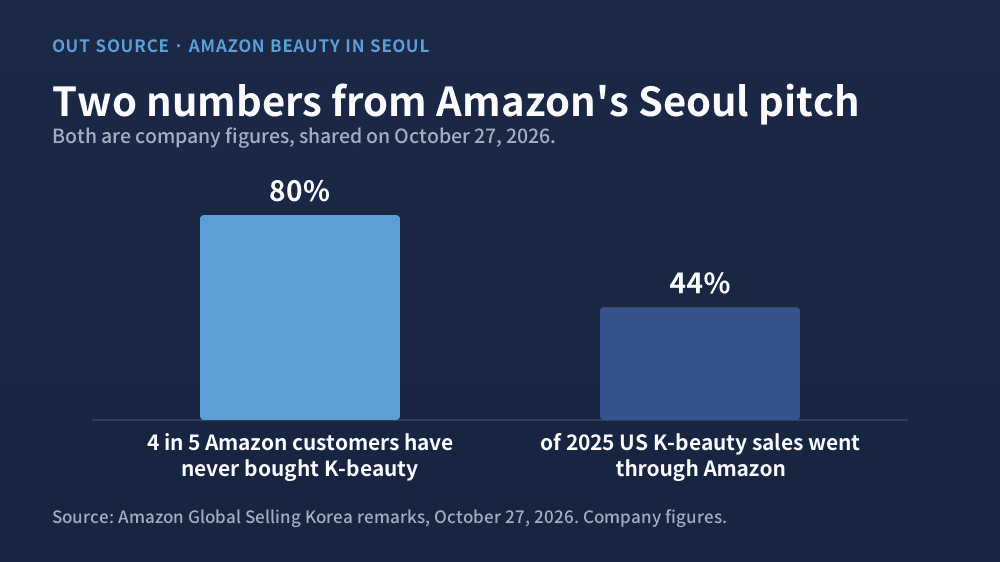
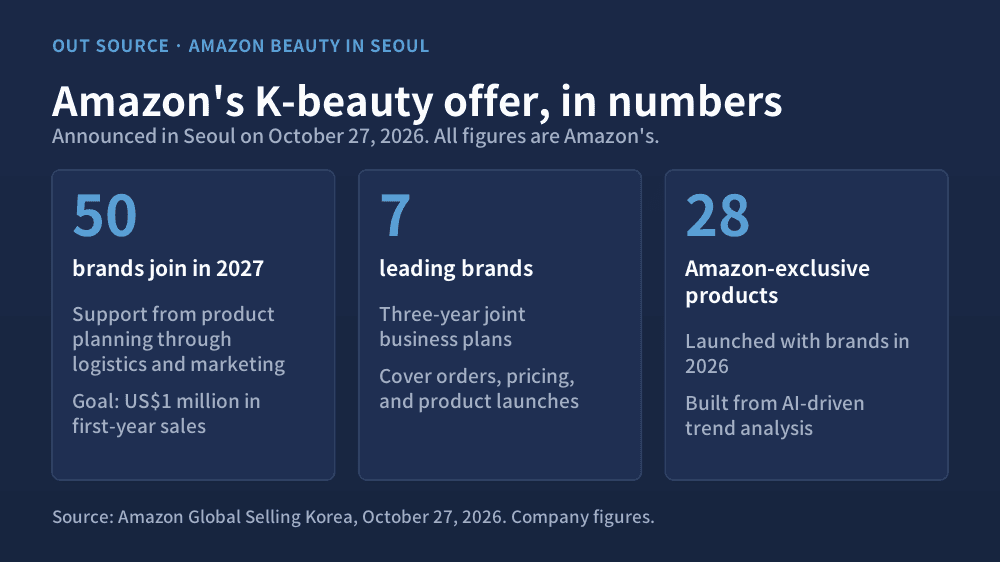
Amazon Global Selling Korea said on October 27, 2026, that four in five Amazon customers have never bought K-beauty, and that 44% of 2025 US K-beauty sales ran through Amazon. Both figures are the company’s own. In 2027, 50 brands get help from planning through logistics, with US$1 million in first-year sales as the goal, and seven brands get three-year joint business plans covering orders, pricing, and launches. The shelf is becoming a partner, and partners have opinions about your price.
What did Amazon announce in Seoul?
On October 27, 2026, at Amazon Beauty in Seoul, an event held at the Grand InterContinental Seoul Parnas, Shin Hwa-sook, head of Amazon Global Selling Korea, laid out the company’s K-beauty plan. It has four parts.
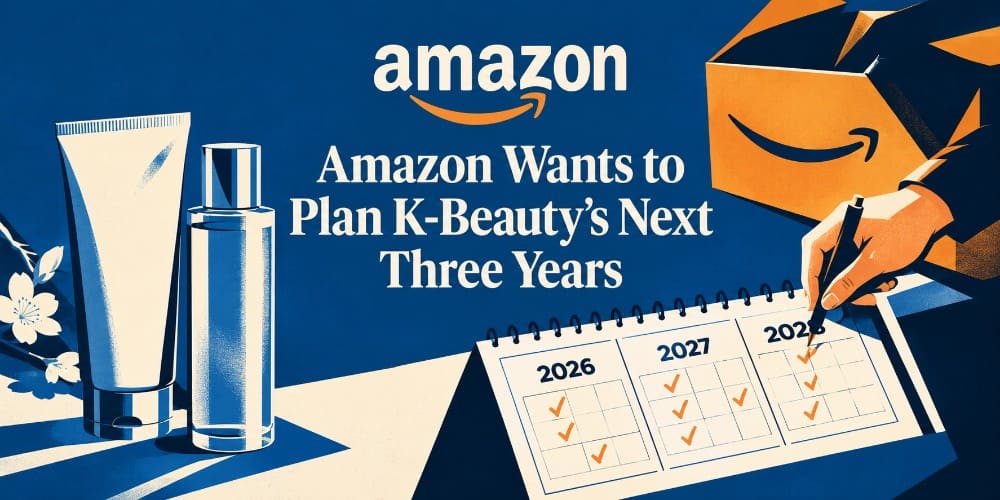
- In 2027, 50 brands join a program with support from product planning through logistics and marketing. The goal is US$1 million in sales in the first year.
- Seven leading brands get three-year joint business plans covering orders, pricing, and product launches.
- Amazon launched 28 Amazon-exclusive products with brands in 2026, built from AI-driven trend analysis.
- K-beauty expands into hair care and wellness, and Amazon steps up regulatory support for brands entering Europe.
Every figure in this story is Amazon’s own. No independent count of any of them was published alongside.
What does “4 in 5 have never bought K-beauty” tell a brand?
Shin said four in five Amazon customers have never bought K-beauty, and framed that as untapped demand. Read it as a sales pitch to brands: your next customer is already inside Amazon. The hard part, finding shoppers, is done. Only the convincing is left.
Read it again with the second number. Amazon says 44% of US K-beauty sales in 2025 went through its store, and that K-beauty sales on Amazon have roughly doubled each year since 2024. A category that already sends 44% of its US sales through one store is not an open field. It is a concentrated one.
What is a joint business plan, and why does it matter?
A joint business plan, or JBP, is a written agreement in which a retailer and a supplier set shared targets for a period: how much will be ordered, what price support applies, and which products launch when. Amazon says its seven plans run three years and cover orders, pricing, and launches.
That changes two things. Forecasting gets easier: a brand sees three years of demand, and its factory can plan production against it. Control gets shared: how much to sell, at what price, and which product comes next now sit on a table where Amazon has a chair. For a factory, a plan like that is a production schedule. For a brand, it is a promise that runs both ways.
In daily practice, a brand’s US team stops negotiating promotions one at a time and starts negotiating a calendar. Fewer surprises, and fewer exits.
The announcement names Anua, Biodance, and Celimax among leading brands whose numbers are growing, and says Medicube, the brand of APR, was the No. 1 search term on Amazon in 2026. It does not say which seven brands get plans.
What does the 50-brand program offer?
Support from product planning through logistics and marketing, with a goal of US$1 million in first-year sales. If all 50 brands hit it, that adds up to US$50 million.
The detail to notice is where the help starts. It starts at planning. Amazon is in the room before the product exists, not after the listing goes live. That is a faster route to a launch, and a shorter distance between Amazon’s data and your formula.
The announcement as reported does not say how the 50 are chosen. That is the first question to ask. A US$1 million target sets an entry bar, and the bar decides whether this is a growth program for brands that already sell or a starter kit for brands that do not.
Why do 28 exclusive products matter?
An Amazon exclusive is sold nowhere else. Amazon says it launched 28 of them with brands in 2026, using AI-driven trend analysis to decide what to make. Whose idea was the product? In these cases, Amazon’s data pointed to it.
For a brand, an exclusive is a launch with an audience attached. It is also a product with one customer. The brand cannot spread the launch across channels, and cannot move the product if the terms change.
So what is the catch?
There are three questions to ask before signing any multi-year plan. Who sets the shelf price? Who owns the customer relationship and the data? What happens in year four? A plan that covers orders, pricing, and launches is generous in exactly the places where a brand would otherwise keep control.
Year four is the real test. A three-year plan ends. What the brand owns on that day, its customer data, its price position, its launch calendar, is what it carries into the next negotiation. Those terms are settled in year one, not year four.
Concentration is the second issue. When 44% of the category’s US sales already pass through one store, a brand that also plans orders, pricing, and launches with that store has tied its US business to one customer. A three-year plan puts that tie in writing.
Amazon also pledged a zero-tolerance policy on counterfeits, enforced with AI, and said it will work directly with major brands. That is a real benefit for brands that fight fakes. It is also a company promise, not a measured result.
Does Europe offer a way out?
Amazon says it will step up regulatory support to help brands enter Europe, and that K-beauty growth in Europe, the Middle East, and Australia outpaced the US during Prime Day in June 2026. The announcement gives growth rates, not sales figures. Faster growth is not bigger sales.
Europe is a new customer base but the same store. Regulatory support means Amazon helps with each market’s rules, and the label question from the FDA’s recall guidance returns in every one of them: whose name is on the pack, and who answers for it? A route that leads to a new country through the same platform spreads brands across geography. It does not spread them across channels.
What should each side do with this?
The answer depends on where you sit.
- Manufacturers. A three-year plan is a three-year production commitment. Ask the brand to share its forecast, and write down who absorbs the miss if orders fall short.
- Brands and buyers. Take the plan if the numbers work. Keep one channel where you set the price yourself, and keep a copy of your customer data outside Amazon’s walls.
- Investors and lenders. A brand’s Amazon plan is a revenue forecast and a dependency disclosure in the same document. Ask for both numbers.
Amazon is no longer just where K-beauty sells. It is where K-beauty gets planned.