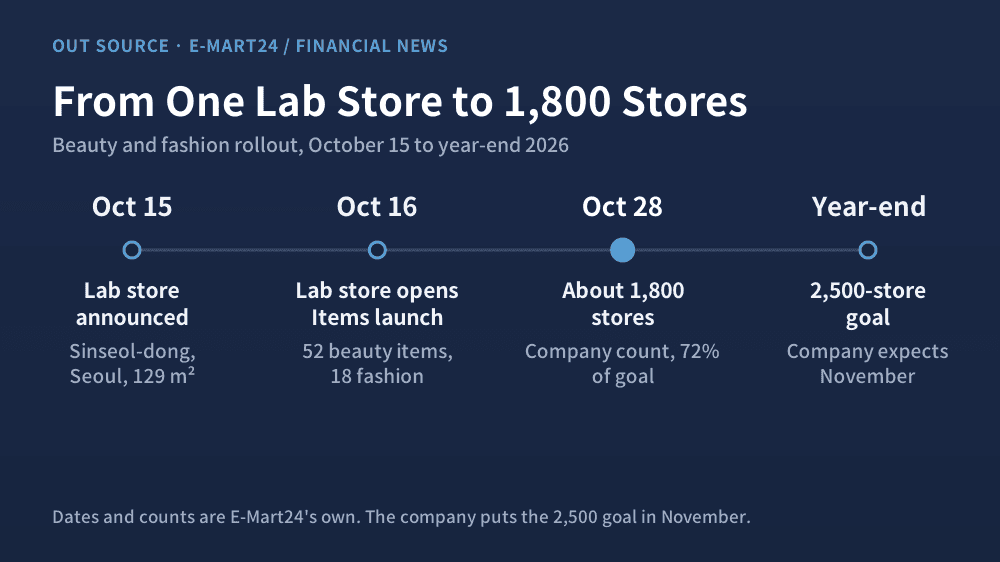
E-Mart24 introduced beauty and fashion goods on October 16. By October 28 the company counted them in about 1,800 stores, 72% of a 2,500-store goal for year-end. The chain has 5,514 stores, 11 straight quarters of losses through the first quarter of 2026 and a first-half operating loss of 12.9 billion won (US$9.7 million). The beauty range is 52 items. A shrinking convenience chain is using K-beauty to change what a visit is for, and the brands that fit are built for a shelf the size of a lip balm.
What did E-Mart24 launch on October 16?
A beauty and fashion assortment, rolled out across the network at once. The company's launch count is 52 beauty items: 32 color cosmetics (lip, cheek and eye makeup) and 20 skincare items. The color range centers on lip balms and tints from four brands, Rawdew, Tony Moly, Dinto and 2ªN, and some of it ships in E-Mart24-only shades and dedicated sets. Skincare comes from six brands, including Isntree, Mediheal and It's Skin.
Fashion is a separate 18-item line made with W Concept, a fashion platform and Shinsegae Group affiliate. It covers socks, T-shirts, bra tops, mesh pouches and umbrellas.
The stores also received a dedicated tester fixture for color products. That fixture is the signal. A shelf that lets a customer try a lip tint is a shelf built for a planned purchase, not a grab.
How fast is 1,800 stores in 13 days?
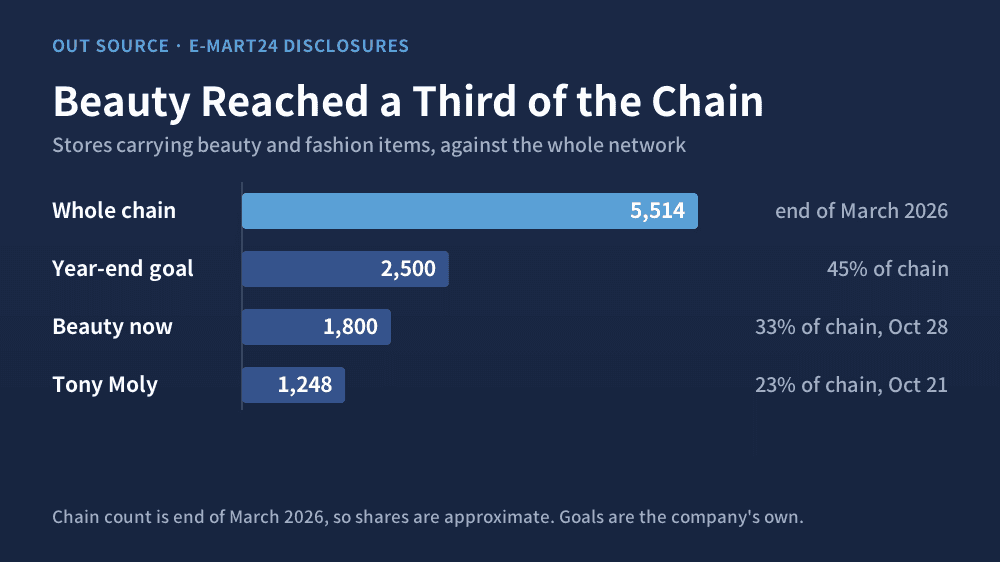
Fast against the launch date, moderate against the network. E-Mart24 says the goods reached about 1,800 stores as of October 28, 13 days after the October 16 launch, and expects to reach 2,500 in November, ahead of its year-end goal. Those figures are the company's own.
The chain counted 5,514 stores at the end of March 2026, so 1,800 is roughly a third of the network and 2,500 is roughly 45%. The shares are approximate because the store count is dated March. Tony Moly gives a second reading: its products were in 1,248 E-Mart24 stores as of October 21, about 23% of the chain.
One limit applies to all of these numbers. They count stores that introduced the goods. No sales, sell-through or reorder figures have been published.
Why does a shrinking chain need this?
Because the base business is not growing. E-Mart24 had 6,140 stores in 2024, 5,510 at the end of 2025 and 5,514 at the end of March 2026. Its market share was reported at 11.8% in 2022 and 10.4% in the first quarter of 2026. The first quarter was its 11th straight quarterly loss.
First-half 2026 revenue was 990.8 billion won (US$742 million), down 0.7% from a year earlier. The operating loss narrowed from 14.9 billion won (US$11 million) to 12.9 billion won (US$9.7 million), with the second quarter alone at a 2.3 billion won (US$1.7 million) loss on 532.5 billion won (US$399 million) of revenue. Dollar figures here use 1,335.3 won per dollar, the Seoul Money Brokerage Services rate on October 30, 2026.
The company's stated plan is store efficiency and stronger product and space competitiveness, not new openings. Beauty and fashion are the product half of that sentence.
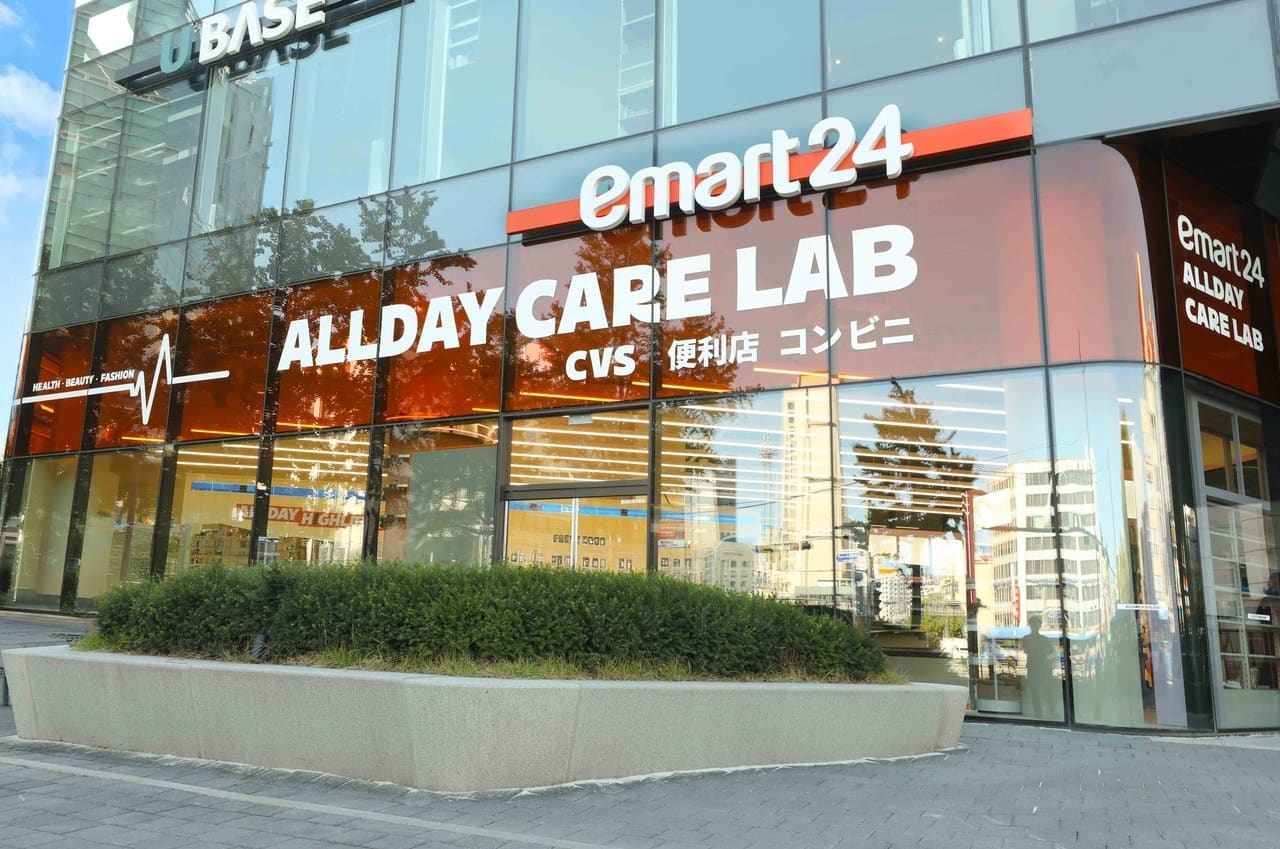
What is the Allday Care Lab, and what does it test?
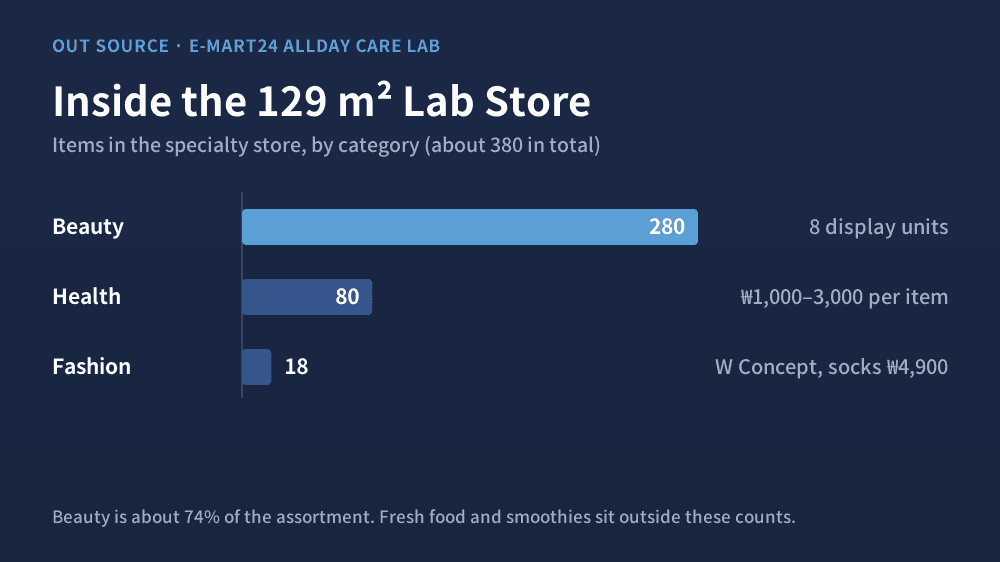
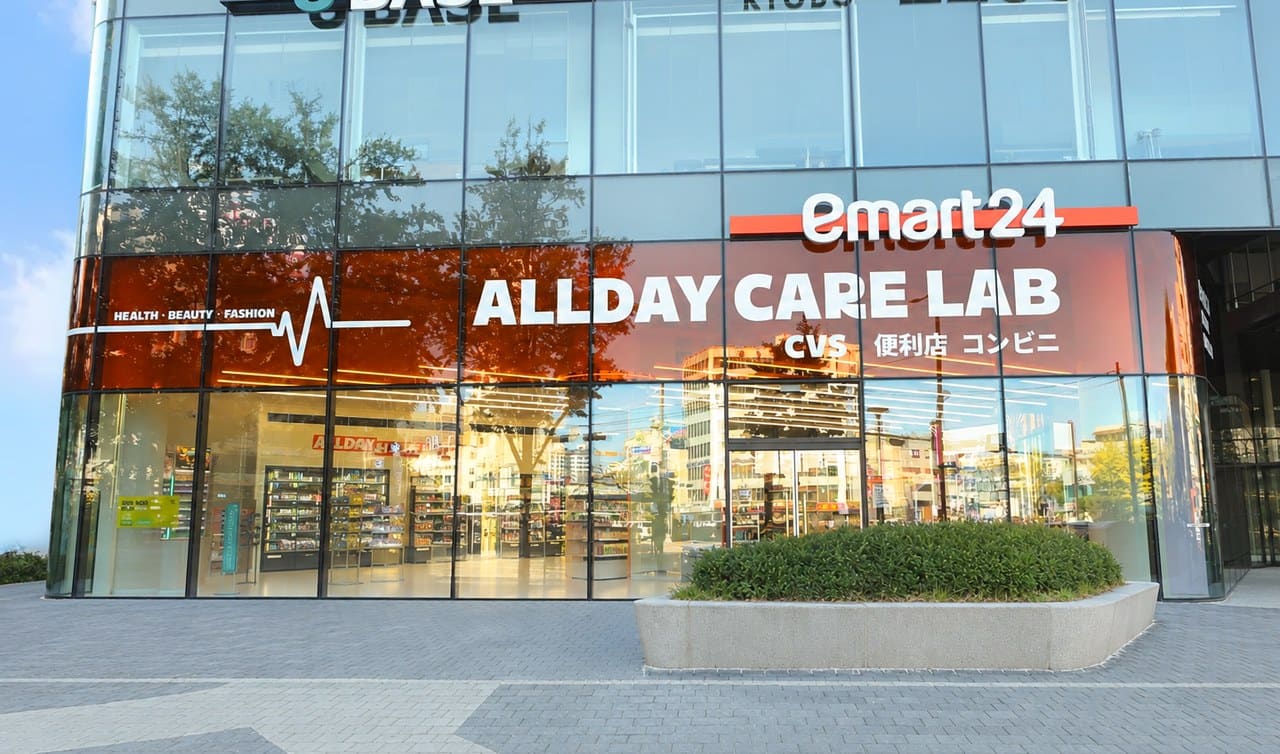
It is the third specialty format after the K-Food Lab in Myeongdong and the Dessert Lab at Seoul Forest. The Allday Care Lab opened on October 16 in Sinseol-dong, Jongno-gu, Seoul, on 129 square meters and open 24 hours. It carries about 380 health, beauty and fashion items, roughly 10 times a standard E-Mart24 store.
Beauty is about 280 of them across eight display units, health is about 80 (vitamins, minerals and functional products at 1,000 to 3,000 won (US$0.75 to US$2.25) each) and fashion is the same 18 W Concept items. Beauty is 74% of the assortment. Rawdew's Vita Butter Lip Balm series is sold through E-Mart24 as its exclusive convenience-store retailer.
The lab is where the network-wide 52-item range is stretched to 280. The company says it will roll out to more stores in phases after testing consumer response.
What does a brand have to build for this shelf?
Small sizes, low prices and a shade the customer cannot get elsewhere. In the lab, travel-size color cosmetics average about 8,000 won (US$5.99), lip and cheek products sit at 6,000 to 7,000 won (US$4.49 to US$5.24), and skincare tops out at 12,000 won (US$8.99), with The Saem serums around 10,000 won (US$7.49). E-Mart24 describes the range as small-size versions of brands the public already trusts.
The price ceiling is set by a neighbor. Daiso sells cosmetics at 5,000 won (US$3.74) or less. A brand at 8,000 won (US$5.99) has to justify the gap with shade, brand recognition or the tester.
Exclusive shades and dedicated sets do the same work. They give the store something to say that Daiso and Olive Young cannot, and they give the brand a controlled SKU (a single sellable product variant) that does not compete on price with its other channels.
Is E-Mart24 early, or catching up?
Catching up. CU, the chain run by BGF Retail, began selling nine Tony Moly color products on May 28 at about 400 beauty-specialty stores, all priced at 9,000 won (US$6.74) or less. CU's cosmetics category sales grew 20.9% in 2025, and customers in their teens and twenties account for about 70% of them, as reported at that launch.
Tony Moly sits on both shelves. Its first E-Mart24 listing came with eight lip shades, 48 color items in the lab store and six mask-sheet types, and the brand plans to extend displays into the household-goods sections of regular stores. Tony Moly's own description is that convenience stores are becoming the channel where young consumers and foreign tourists try K-beauty at an accessible price.
A brand that supplies two chains is the one that sets terms. Exclusive colors are how a chain keeps terms of its own.
What does E-Mart24 still not say?
Almost everything that decides whether the shelf pays. No report on the rollout publishes margin, payment terms, return rules or inventory responsibility. Sales per store, repeat orders and the number of the 1,800 stores with the tester fixture are not published either. Reporting on the rollout points to the operational gap: beauty and fashion run on different purchase cycles from food, so inventory control and sales tracking matter more.
The reported brand counts also differ by source. The launch count lists four color brands and six skincare brands. The lab store lists beauty brands that overlap but are not identical. Counts of brands and items depend on which store format is being measured.
What does this change in the K-beauty channel map?
It adds a third volume channel with its own rules. Specialty retail sells discovery, discount retail sells price, and the convenience store sells proximity at a fixed price ceiling. The same 8,000 won (US$5.99) lip tint is a different business in each.
Manufacturers see short runs of small formats and exclusive shades, which means more line changeovers per unit shipped. Brands and buyers see a channel that rewards recognition and shade control over launch novelty, and that sets a price band below the specialty stores. Retail investors see a chain with 11 straight quarterly losses that has chosen a product bet over a store-count bet, with no sales data yet to price it.
The rollout is measured in stores. The result is measured in reorders. Right now only the first number exists.