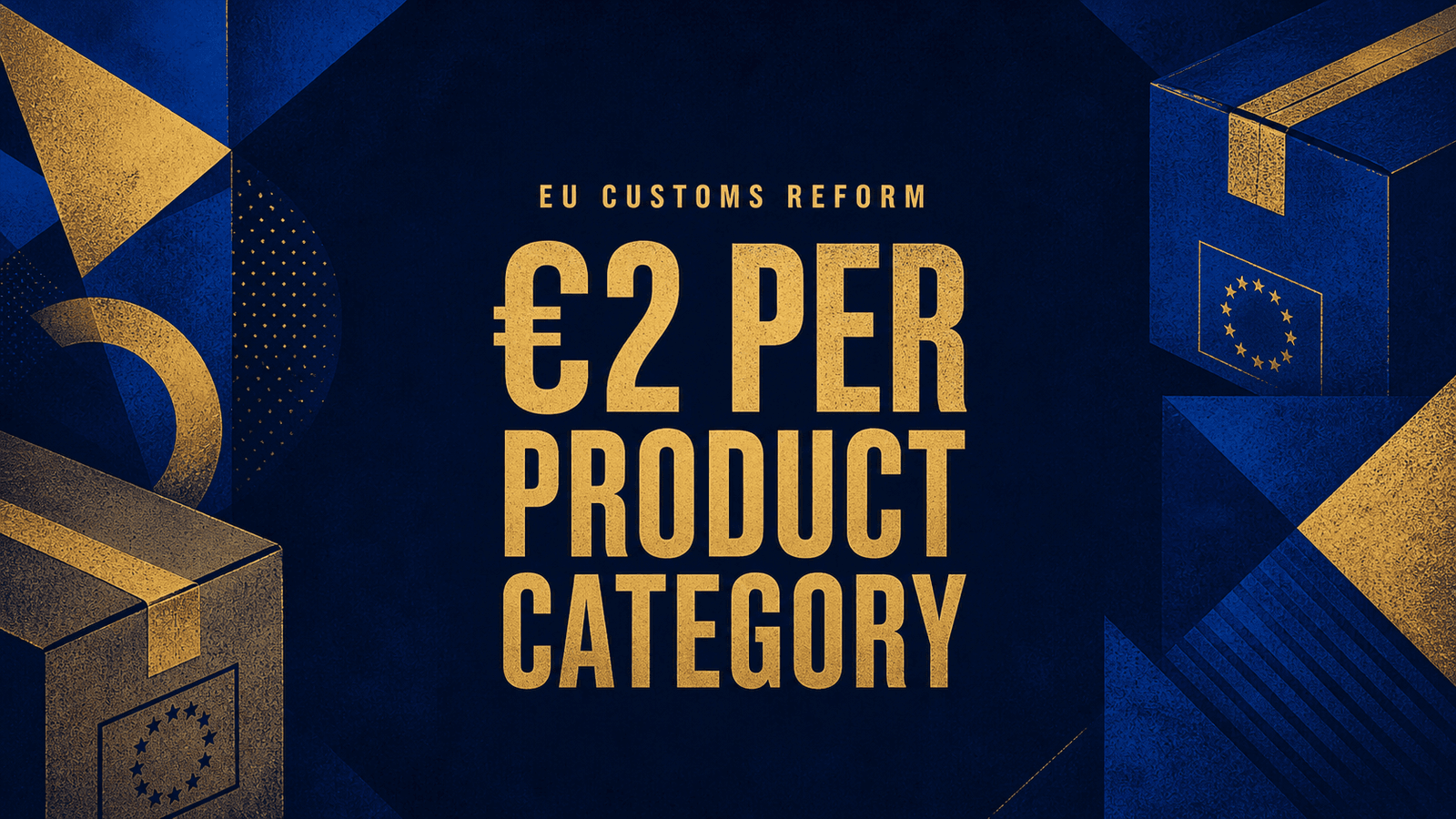
Since November 1, 2026, the EU charges a €2 handling fee on every product category in a low-value parcel, on top of a €3 customs duty per category that began on July 1, 2026. The unit that matters is not the parcel. A box holding one category pays €5 at the border, and a box holding three pays €15. The Commission counted 5.9 billion low-value items entering the EU in 2025, over 90% from China. A brand that ships mixed sets direct to European shoppers now pays for assortment, not for volume.
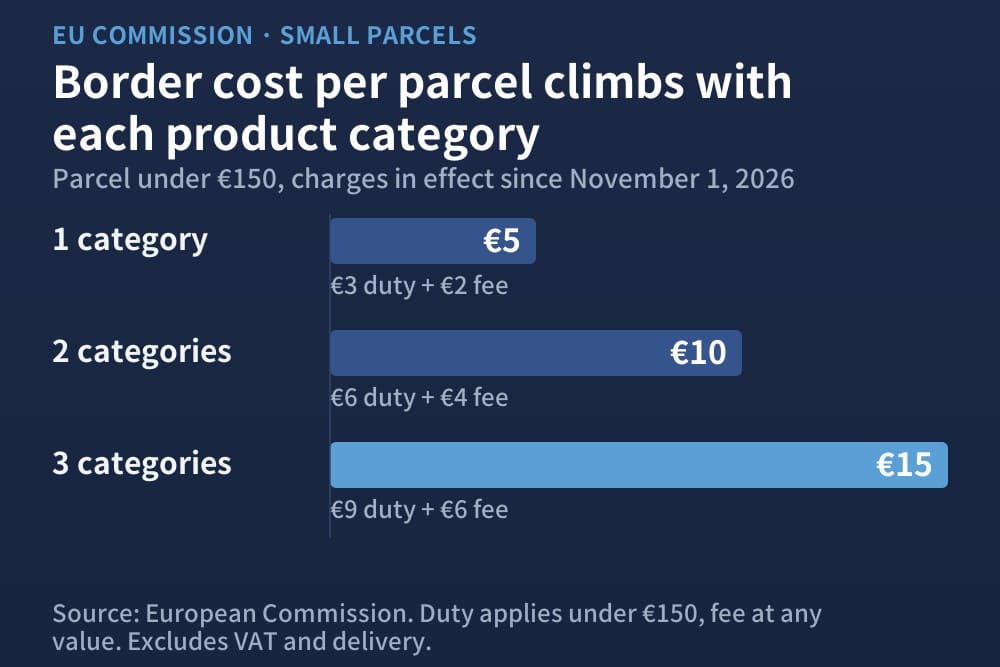
▲ Pay per category, not per parcel: a parcel under €150 owes €5 with one product category, €10 with two and €15 with three. Excludes VAT and delivery.
What exactly did the EU start charging in 2026?
Two charges now stack at the EU border. From July 1, 2026, the EU applies a temporary customs duty of €3 per item on low-value consignments, meaning goods under €150 bought online from outside the bloc. A customs duty is the tax a country levies when goods cross its border. Before the reform, goods under €150 entered without it, and the Commission's customs reform page says the new duty applies until July 1, 2028.
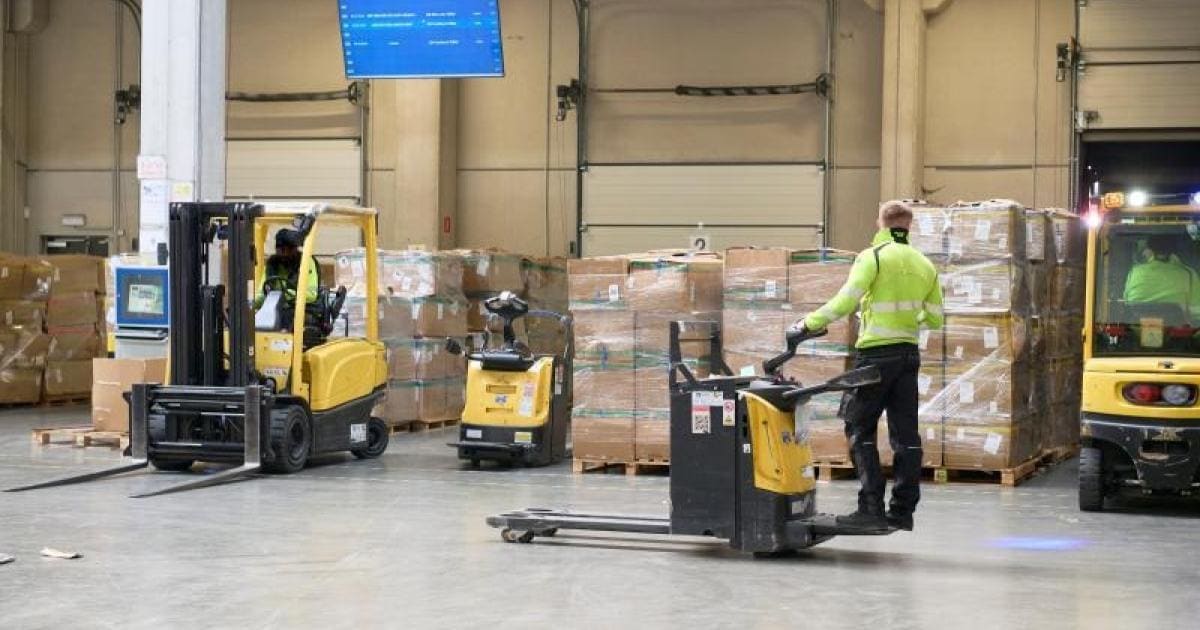 ▲ EU customs parcel handling and logistics hub (European Commission, ec.europa.eu)
From November 1, 2026, a €2 Union handling fee sits on top. The Commission describes the fee as covering the cost of customs supervision, and it fixed the amount in a delegated act, a secondary regulation the Commission adopts under powers granted by the main law.
The two charges differ in reach. The duty applies to goods under €150. The handling fee applies to goods sold at a distance to EU customers at any order value, so a €400 order pays it and a €15 order pays it.
Why does the unit of count matter more than the amount?
Both charges attach to an item, and an item here is a customs classification category. Goods in the same consignment that share a tariff subheading count once. A tariff subheading is a line in the customs nomenclature, the numbered list that classifies every traded good.
A November 3 report gave the cleanest illustration. Ten T-shirts in a parcel incur a €2 fee. Ten T-shirts and five hats incur €4. Add the €3 duty per category and a parcel under €150 holding T-shirts and hats pays €10: €6 in duty plus €4 in fees.
The amount, €5 per category, is small. The structure is not. The charge scales with how many different kinds of goods the box holds, and it ignores how many units, how much weight or how much value the box holds.
How does a mixed beauty box get priced?
The count follows the tariff line, not the brand, the box or the retail price. A cleanser, a cream and a sheet mask carry names a shopper sees on the shelf. Customs reads the classification each product falls under, and every additional classification adds €5 for goods below €150.
A reorder of twelve units of one cream pays €5 for the whole parcel. A discovery set that spreads across several tariff lines pays €5 for each line it touches. Two parcels of identical weight and identical retail value can owe a different amount at the border.
That inverts a common assumption in cross-border direct-to-consumer (DTC) selling, where a bigger and more varied basket raises average order value and improves the economics of each shipment. At the EU border, variety is now the cost driver.
What did the first months of the duty do to parcel volume?
The duty moved the market before the fee began. A November 3 report put the fall in low-value e-commerce parcels at about 64% after the €3 duty took effect in July. EU authorities said it was too early to attribute the drop to the duty alone.
The scale explains the design. The Commission counted 5.9 billion low-value items entering the EU in 2025, four times the 2022 volume. A volume that size, once taxed, produces revenue: a Commission document cited in an October 30 report estimated about €6 billion a year from tariffs and fees on small parcels from 2028 to 2034.
The charge is built as a standing revenue line with a two-year duty runway, not as a temporary deterrent.
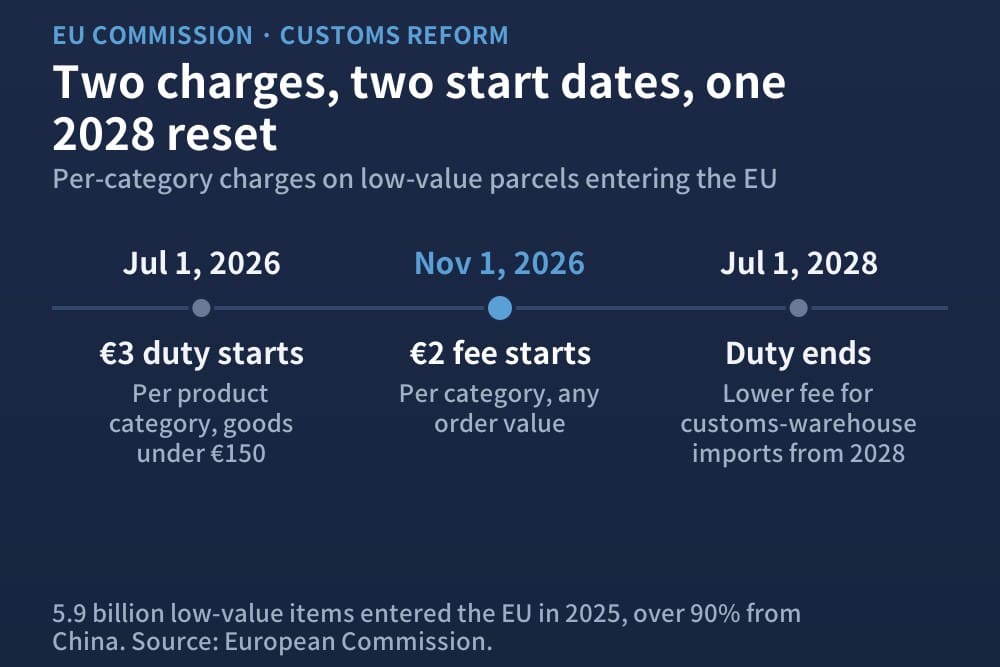
▲ Two charges, two start dates, one reset: the €3 duty starts July 1, 2026, the €2 fee starts November 1, 2026, and a lower warehouse fee follows from 2028.
Who pays, and who counts as the importer?
The EU says the handling fee falls on import-side businesses such as platforms, sellers and carriers, not on consumers. Under the reform, non-EU platforms selling into the EU are treated as the importer of the goods, which makes them responsible for customs declarations and duties.
For a DTC seller, the practical meaning is direct. The seller or the platform carrying its listing owns the declaration and the charge, and the consumer-facing price either absorbs it or shows it.
BEUC, the EU's consumer group, warned that EU law requires consumers to see the total price before payment, so fees added after checkout create a compliance problem. Pricing that embeds the €5 per category in the listed price avoids the problem and moves the cost onto margin.
Why does 2028 matter for where inventory sits?
The reform already prices the alternative route. The Commission's customs reform page states that from 2028, where the importer operates a customs warehouse, the fee will be lower because customs checks are easier. A customs warehouse is a site where goods wait under customs supervision before release into the market.
Until then, every parcel pays the fee for each category it holds. Goods released from a warehouse move under a separate and lower fee, and the amount of that fee is still to be set.
The direction is clear. From 2028 the stocked route is priced below the parcel route, and the gap widens with every category a brand adds to its assortment.
What changes for a brand selling skincare into Europe?
Two decisions change for any brand, from any country, that ships skincare direct to European shoppers.
Assortment per parcel becomes a pricing input. Bundles built within one tariff line pay once, while bundles built across product types pay per type. Sample programs, minimum order values and free-gift thresholds all change the number of categories in the box.
Channel economics move too. A shopper who buys one product pays the same border cost as a shopper who buys twelve units of it, so the charge weighs most on small baskets and on varied ones. The stocked route in 2028 is the second decision: the more categories a brand ships, the sooner a local warehouse pays for itself.
What does the design say about where EU customs is heading?
The charges are one piece of a larger rebuild. The same Commission page lists a new EU customs authority and an EU Customs Data Hub, a shared system for customs data. Platforms become importers, and the product line becomes the unit of record.
For the parcel, the old logic was a threshold: below €150, nothing was counted. The new logic is classification: every line of goods is counted, whatever the value.
Border logic in Europe now follows the product, not the box. The brands that treat the tariff line as a design variable will own the cost curve.