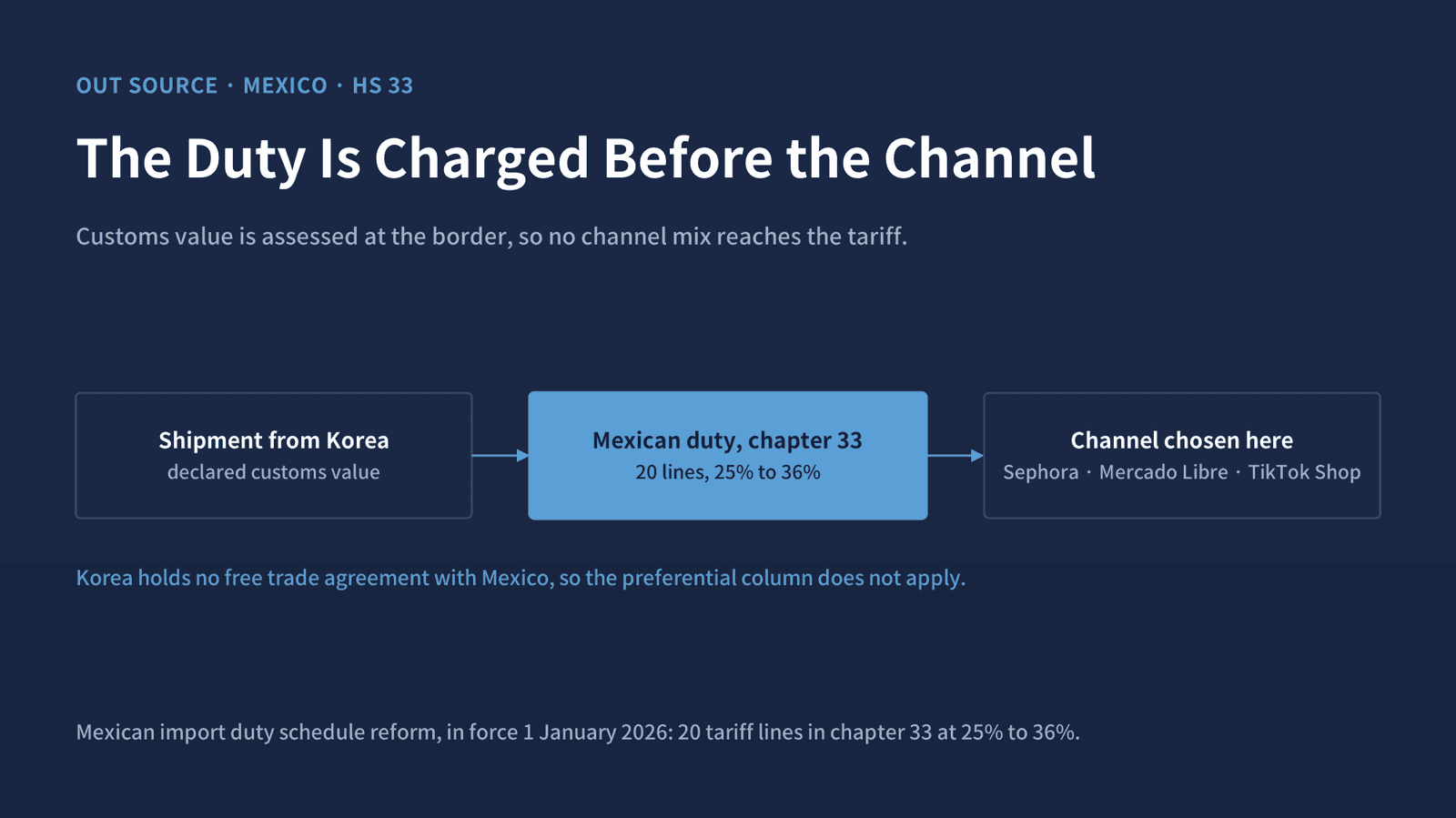
Mexico's import duty schedule changed on 1 January 2026, and 20 tariff lines in chapter 33 — perfumery and cosmetics — now carry rates of 25 to 36 percent on goods from countries that hold no free trade agreement with Mexico. Korea is one of those countries. Nine months later, at a trade fair in Mexico City, Amorepacific's chief executive set a target of more than tenfold growth within five years. The duty is charged on customs value, before any channel is chosen.
What changed at Mexico's border on 1 January?
The reform of Mexico's general import and export duty law cleared both chambers of Congress on 10 December 2025, was published in the Diario Oficial de la Federación on 29 December 2025, and took effect on 1 January 2026. It covers 1,463 tariff lines — the individual product codes at which a national schedule sets a rate — across seventeen sectors, 316 of which had previously entered duty free. Rates run from 5 to 50 percent, with the largest clusters at 25 and 35 percent.
It applies to goods originating in countries without a trade agreement with Mexico. Published analyses name Korea alongside China, India, Vietnam, Thailand, Brazil, Indonesia, Chinese Taipei, the United Arab Emirates and South Africa. Goods qualifying under an agreement — the USMCA, the CPTPP, the European accord, the Pacific Alliance — keep their preferential rates, provided they satisfy the rules of origin.
Which cosmetics lines moved, and by how much?
Within the reform, chapter 33 of the harmonised schedule — perfumery, cosmetic and toilet preparations — accounts for 20 tariff lines, at new rates of 25 to 36 percent. The figure the Korean industry repeats is an increase of roughly 10 percentage points, which is also the answer Amorepacific's chief executive gave when the Korean president asked him directly how much duties had risen.
One point in the decree is read differently by different advisers. Some trade analyses treat the new schedule as a temporary measure running to 31 December 2026; others describe it as open-ended with no sunset. The decree text is the only document that settles this, and a company budgeting landed cost into 2027 has to read it rather than the commentary.
What did the September summit actually deliver?
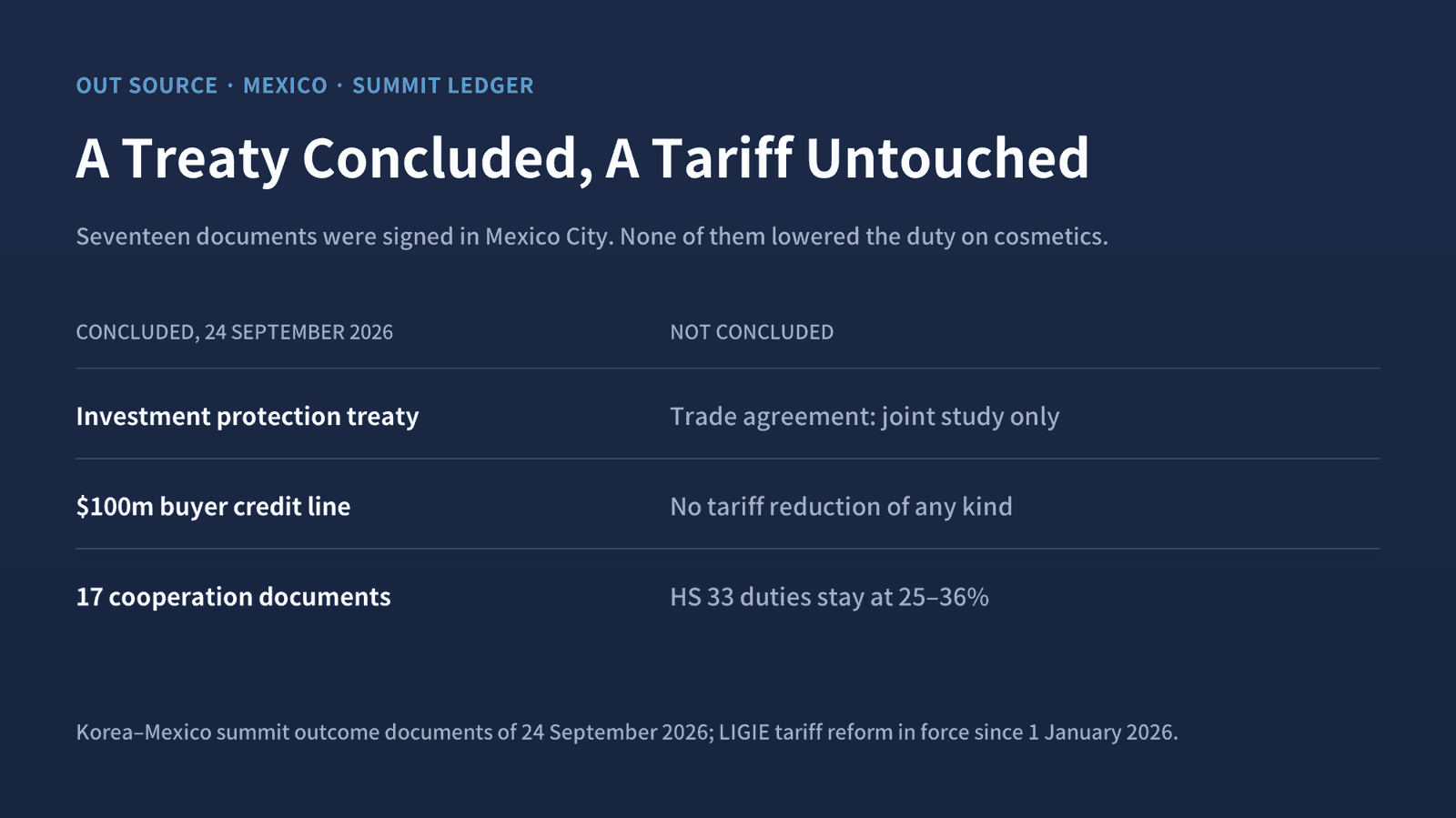
President Lee Jae-myung met President Claudia Sheinbaum on 24 September 2026. The two governments concluded a bilateral investment protection agreement after seven years of negotiation, which still requires signature and legislative ratification before it binds. Seventeen cooperation documents were produced in total, among them a $100 million credit facility for Mexican buyers of Korean goods and services, protocols on intellectual property and customs enforcement, a supply chain dialogue covering crude oil and critical minerals, a social security agreement addressing duplicate pension contributions, and memoranda on artificial intelligence, aerospace and defence.
On trade, the two sides agreed that their trade authorities would conduct joint research toward an eventual agreement. No negotiation was launched and no duty was reduced.
The following day, 25 September, the president toured the 2026 K-Expo at the World Trade Center in Mexico City, running 25 to 27 September. At the Amorepacific booth he asked how much tariffs had gone up. The chief executive answered that they had risen about 10 percentage points, said the local response to K-beauty had been strong, and named the five-year, tenfold target. LG H&H staff at the same event identified tariffs as their principal issue; the company reported roughly 5,000 visitors a day to its booth.

Why does the channel question not reach the tariff?
An ad valorem duty is a percentage assessed on the declared customs value of goods at the moment of importation. It attaches once, at the border, to the consignment. Whether those units are later sold through a Sephora door, through a Mercado Libre listing or through a TikTok Shop seller, the duty has already been paid and sits inside the cost base of every unit.
Changing the channel changes who captures the retail margin and how much marketing spend is required to move the unit. It does not change the landed cost. The only two variables that move the duty itself are the tariff classification of the product and its country of origin.
Which channels are Korean companies actually using in Mexico?
Amorepacific entered Mexico with Laneige through Sephora, online on 8 September 2023 and then in 36 physical doors from 22 September 2023, with more than 20 products. APR distributes through Sephora and Ulta Beauty. LG H&H has named Mercado Libre, the region's largest marketplace, as an expansion route. Silicon2 completed its Mexican subsidiary in May 2026 and began operating it in June on a direct purchase basis, describing Mexico as a forward base for Central and South America, with a Brazilian subsidiary targeted within the year. TikTok Shop has been live in Mexico since February 2025.
That is not a picture of large Korean companies anchored to department store counters while growth happens somewhere else. Specialty beauty retail, marketplace e-commerce, social commerce and a wholesale distribution subsidiary are all in use at once. The channel mix is already dispersed. Its effect on the duty is zero.
What does the regional growth figure measure, and where?
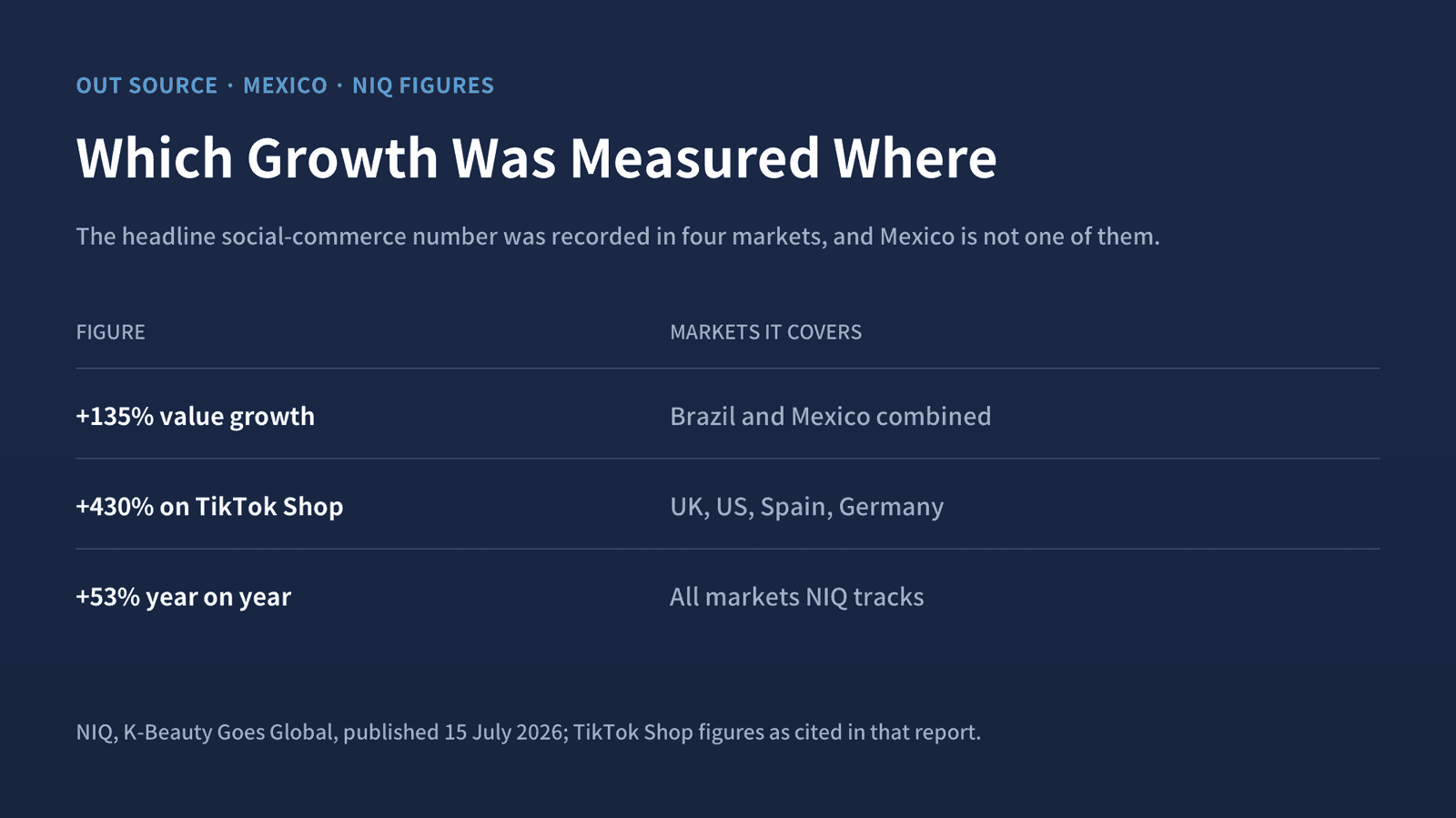
NIQ's K-Beauty Goes Global, published on 15 July 2026, reports K-beauty value sales up 53 percent year on year and 131 percent over two years. Brazil and Mexico together grew 135 percent in value. Western Europe grew 58 percent, with Korean brands at roughly 10 percent of online skincare sales and 15 to 20 percent in Italy, Spain and France. In the North American region covered, e-commerce accounts for 76 percent of K-beauty sales.
The social commerce number that travels furthest needs its geography attached. The 430 percent rise in K-beauty brand value sales on TikTok Shop covers the United Kingdom, the United States, Spain and Germany, and comes from the platform's own published data. It is not a Mexican figure. The Latin America number does not separate Mexico from Brazil and does not attribute either country's growth to a channel. The regional growth is documented. The channel attribution for Mexico is not.
Who absorbs 25 percent?
There are three places the duty can land: the Korean exporter's margin, the Mexican importer's margin, or the shelf price. Korean trade reporting carries an account of a Mexican buyer asking its Korean supplier to cut the export price and warning that orders would otherwise stop. Beauty companies at the expo indicated they were not planning price increases, which locates the absorption upstream for now.
The constraint on that is a pricing one. A supplier that cuts its export price for Mexico pulls against a global price list it maintains for every other market, and a concession granted in one territory is visible to buyers in the rest. The negotiation is therefore not only about 25 percent in Mexico. It is about whether the Mexican rate becomes the reference point for the next buyer asking.
Is Mexico large enough to justify the cost?
Mexico is the second-largest beauty market in Latin America, put at $17.64 billion in 2026 and projected at $22.36 billion by 2031. Korean cosmetics exports to all of Latin America passed $200 million for the first time in 2025 and reached $168.06 million in the first half of 2026. Against total Korean cosmetics exports of $11.1 billion in the first nine months of 2026, the whole region is a low single-digit share.
That gap is what makes a tenfold target arithmetically ordinary rather than heroic, and it is also why a 25 percent duty is a growth tax rather than a siege. The same arithmetic explains the corporate attention. LG H&H reported second-quarter 2026 North American revenue of 205.8 billion won, up 47 percent year on year, exceeding its China revenue of 176 billion won for the first time — about $152 million against $130 million, converting at 1,350.60 won to the dollar, the rate on 2 October 2026. Korea's cosmetics industry is rebuilding its geography around the Americas, and Mexico is the part of that build where the trade terms are worst.
What actually moves the number?
Two instruments, and neither is a channel. The first is classification: the chapter 33 lines are set, and arguing a product into a different code is a compliance exercise with a narrow range and a penalty attached if it is wrong. The second is origin. A good that qualifies under one of Mexico's existing agreements enters at the preferential rate, which means manufacturing or substantial transformation inside a partner territory. The USMCA is the obvious candidate, and Korean beauty manufacturing capacity has already been moving into the United States for reasons that have nothing to do with Mexico.
The third route, a Korea–Mexico agreement, currently exists as a joint research exercise between trade authorities. An investment protection treaty protects capital once it is in the ground. It does not set a rate on a carton of sunscreen.
Where does this leave the parties?
For manufacturing and ODM suppliers — the contract developers that formulate and produce for a client's brand — origin is now part of the product specification. A line inside a USMCA territory converts a 25 to 36 percent Mexican duty into a preferential one, and that calculation sits alongside the United States tariff case that already pulled Korean capacity across the Pacific. Mexico supplies a second reason for the same decision.
For brands and the buyers who stock them, the live negotiation is about who carries the duty, and it is happening in purchase orders rather than in trade policy. A buyer demanding a lower export price and a supplier defending a global price list are arguing over the same 25 percent.
For regulators and investors, the ledger from Mexico City reads as an investment treaty, a credit line and seventeen documents. None of them reaches a customs schedule. The instrument that would was deferred to a study.
Growth targets are set in boardrooms. Rates are set in the Diario Oficial. Only one of those moved in 2026.