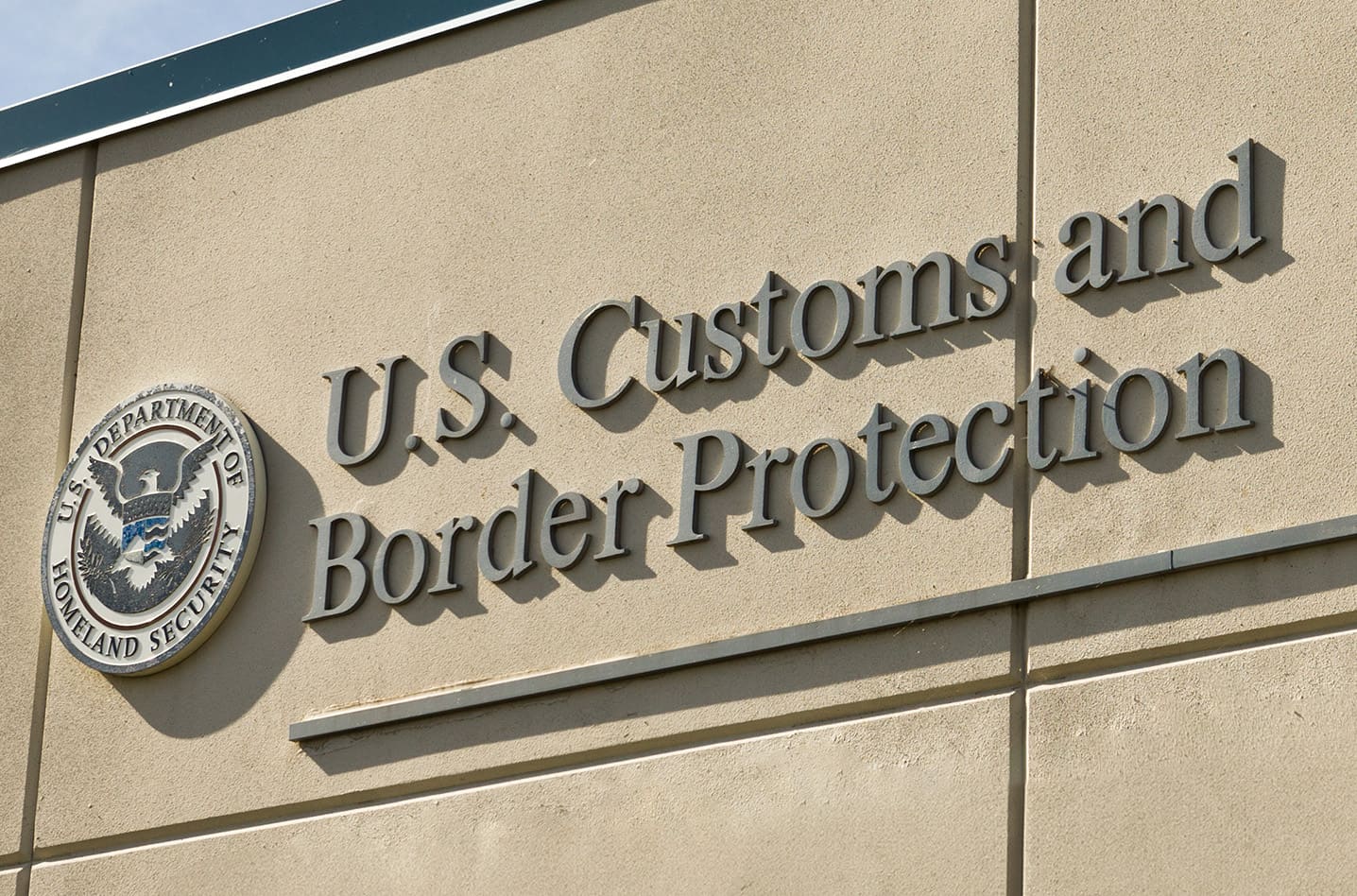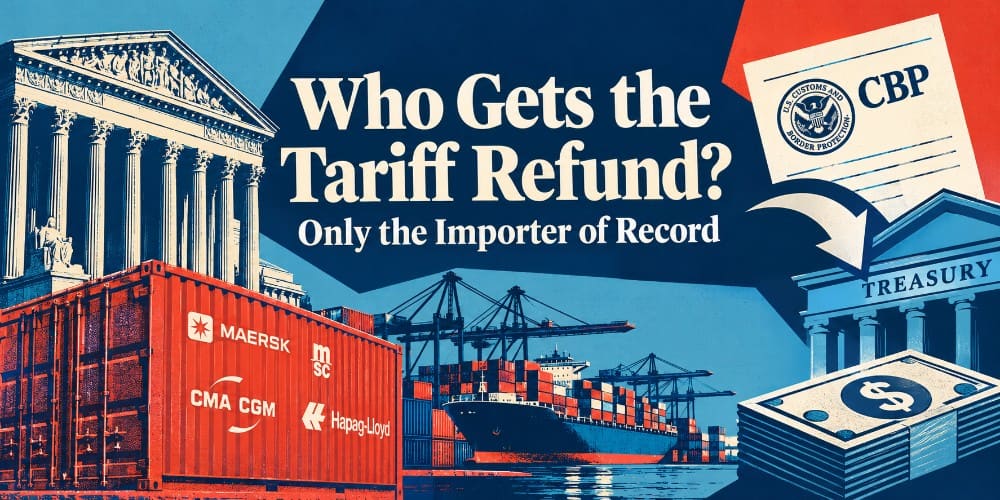
The US Supreme Court struck down the IEEPA tariffs on February 20, 2026, and the money is moving. US Customs and Border Protection had accepted about US$136.6 billion of refunds into its processing system as of October 2 and sent about US$126 billion to the Treasury for payment. e.l.f. Beauty holds about US$50 million of it. None of that money follows the company that absorbed the tariff. It follows the name on the customs entry.
What did the Court actually strike down?
The decision in Learning Resources, Inc. v. Trump, consolidated with V.O.S. Selections v. Trump, came down on February 20, 2026 by a vote of 6 to 3. The holding is that the International Emergency Economic Powers Act does not give the President the power to impose tariffs, which makes the tariffs collected under it unlawful from the beginning rather than unlawful from the date of the ruling. The ruling reaches every tariff imposed under that statute, not only the two programs argued before the Court.
Duties under those orders were still being collected through February 23, 2026. That end date matters later, because the refund class is defined by the dates on which duties were paid.
What the decision leaves untouched is the larger half of the story. Section 232, Section 301 and Section 122 all remain available. The Federal Circuit upheld the Section 301 tariffs on List 3 and List 4A Chinese goods in HMTX Industries v. United States, a decision now awaiting Supreme Court review. Section 122 permits a temporary import surcharge of up to 15 percent for up to 150 days. Administration officials have said the same tariff structure can be rebuilt under these authorities. A refund is a repayment, not a policy reversal.
Who holds the claim?
The importer of record holds it. That is the party named on the customs entry, the party that paid CBP, and the party CBP pays back. Nationality is not the test and neither is who ultimately bore the cost.
The class certification order issued by the Court of International Trade on October 8, 2026 in Freestyle World, Inc. v. CBP puts the point in writing. Judge Richard K. Eaton certified a class of all importers of record who paid duties imposed by the challenged tariff orders between February 1, 2025 and February 19, 2026. Companies that filed their own suits are excluded, as are the IEEPA tariffs on Brazilian and Indian goods, which sit outside the challenged orders. The certification carries no opt-out, so leaving the class means filing an individual case. No classwide relief order has been issued yet, and the government is expected to appeal the certification itself.
For everyone else, the guidance from trade counsel has been consistent since February: parties that did not pay CBP directly should review their supply contracts. That sentence is doing more work than it appears to. It means the remedy is contractual, and a contract that never contemplated a refund of duties contains no remedy at all.
What does a DDP sale do to that claim?
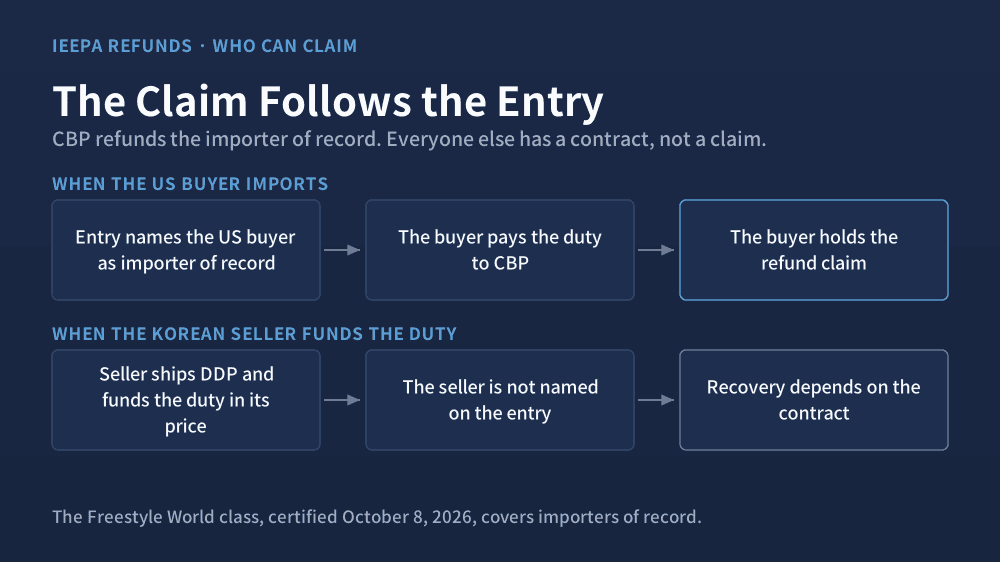
DDP, delivered duty paid, is the Incoterm under which the seller clears the goods through customs and bears the duty. Korean suppliers used it widely through the tariff period because it let a US buyer quote a landed price without touching customs. The term settles who pays. It does not by itself settle who is named on the entry, and the refund tracks the name.
So a Korean manufacturer that funded a US tariff inside its DDP price, and whose customer or customer's broker was the importer of record, has no claim against CBP. Its position is a commercial one against its buyer, governed by whatever the contract says. The reverse also holds, and this is the part worth stating plainly: a Korean company that acted as importer of record in the United States, through a US entity or as a foreign importer of record, holds the claim itself and sits inside the certified class on the same terms as any US company.
Four contract facts decide the outcome in any given relationship: who is named importer of record on the entries, which Incoterm governed the shipments, whether a duty-sharing or duty-refund clause exists, and whether price concessions granted during the tariff period were documented as tariff-contingent. An email agreeing to split a cost increase because of tariffs is evidence of a discount. It is not a refund-sharing term.
How much money is moving, and through what?
CBP is processing the refunds through CAPE, the Consolidated Administration and Processing of Entries system. In a declaration filed with the Court of International Trade and reported in September, CBP accounted for more than 286,000 declarations submitted and more than 201,000 accepted, covering about 27.2 million entries, with about US$134.7 billion accepted into the system and about US$122 billion, interest included, certified and transmitted to the Treasury for payment. By October 2 those figures had risen to about US$136.6 billion accepted and about US$126 billion sent to the Treasury.
Nothing in that flow is automatic. Refunds run on declarations that importers file. Phase 3 of the process, which covers finally liquidated entries subject to court-ordered reliquidation, deployed on October 6, 2026, and only importers that had given CBP a valid importer-of-record number by July 30, 2026 were able to file from that date. Phase 3 addresses about US$11.4 billion, roughly 6.9 percent of the IEEPA total. On its first day, 477 Phase 3 declarations covering 425,517 entries had been accepted.
Interest is included in the amount certified to the Treasury. No rate or calculation basis has been published alongside it.
Why does one importer wait while another is paid in four days?
The most mundane reason is banking detail. About 20,184 refunds worth roughly US$1.3 billion sit on hold because the importer of record has not given CBP its ACH information. The money is certified and the payee file is incomplete.
The structural reason is procedural position. Importers that filed individual actions at the Court of International Trade have seen refund orders issue within four business days of filing, according to practitioners handling those cases. Class members wait for a classwide relief order that has not issued, and the government's partial appeal of the underlying order, arguing that it should reach only the parties that sued, is pending at the Federal Circuit. The limitations period for a refund action under the court's residual jurisdiction runs through February 4, 2027 at the earliest.
The practical consequence for a supply relationship is timing asymmetry. A US buyer that sued early has its cash. A buyer that waited does not. A supplier negotiating with both is negotiating with two different balance sheets.
What did e.l.f. do with US$50 million?
The company received about US$50 million in refunds and, as reported in October 2026, put the money into two places. It permanently lowered prices on about 10 percent of its portfolio after running price tests, and it increased marketing in the United Kingdom, Canada and Germany. Marketing spend for the year ending March 2027 is expected at the upper end of its guidance range of 23 to 25 percent of net sales.
The test result is the interesting number. A US$4 reduction on one complexion product raised unit sales by close to 40 percent, according to the company's chief financial officer, Mandy Fields, as reported in August 2026. Net sales for the quarter ended June 30, 2026 rose 36 percent to US$479.4 million. A refund of this kind funds an elasticity experiment that a company would otherwise have to charge against its own margin.
Industry analysts have cautioned that some announced reinvestment reflects spending that was already planned. That caution applies to every company in the next section.
Does a refund become a price cut or a margin?
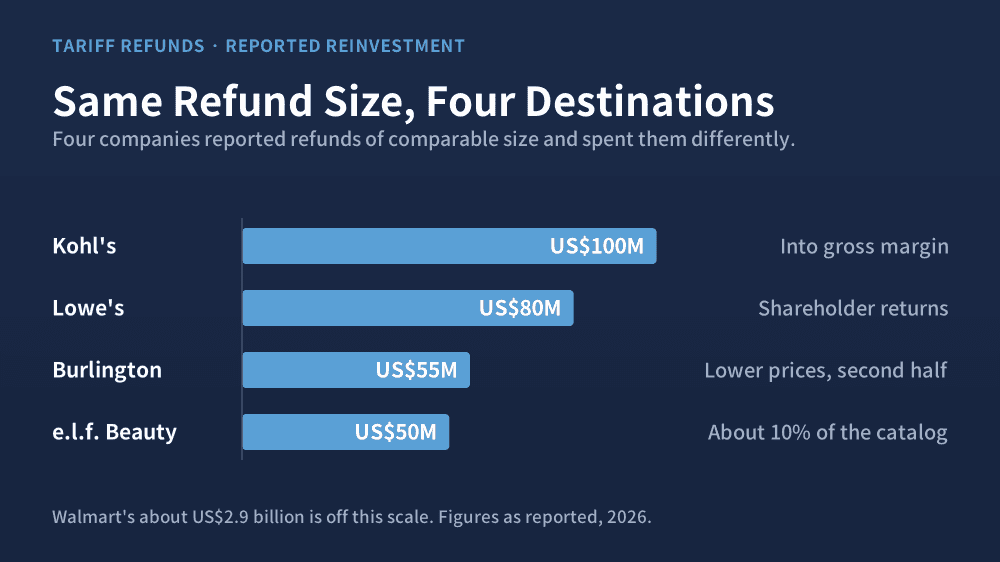
It becomes whatever the recipient decides, and the recipients have decided differently. As reported in August 2026, Kohl's put US$100 million into gross margin, Lowe's directed about US$80 million to shareholder returns, Burlington committed all US$55 million to lower prices in the second half of its fiscal year, and Tractor Supply applied an undisclosed amount against freight and fuel costs. Walmart, at a different scale entirely with about US$2.9 billion, rolled back prices on 11,000 items.
For a brand on those shelves, a competitor's refund is a price point regardless of whether the brand received one. A Korean brand selling through a US distributor that put its refund into margin faces a competitor whose distributor put its refund into price. Neither outcome is visible from Seoul without asking.
Retail analysts have also noted that tariff costs were absorbed into general cost structures rather than tracked product by product, which makes it impossible for a shopper to match a price cut to what they overpaid. The same opacity runs upstream. A company that never traced the cost to a product line has a hard time proving to a supplier what either side is owed.
What happens to the supplier that already gave the discount?
Through the tariff period, cost-sharing was the norm in Korean beauty supply: unit price concessions, absorbed freight, split increases, DDP terms that moved the duty onto the seller's invoice. Those concessions are recorded in last year's pricing. The refund is this year's cash, and it sits in one party's account.
Without a clause that addresses the repayment of duties, the money stays where the entry put it. This is not a loophole. It is the ordinary result of writing a price concession as a price rather than as a conditional rebate.
Three checks are worth running on any US-facing relationship from this period. Identify which party is named importer of record on the actual entries rather than in the sales agreement. Determine whether the counterparty's entries fall inside the certified window of February 1, 2025 to February 19, 2026, since entries outside it need their own route. And decide now, in writing, how a refund of duties is treated in the next contract, because the authority question that produced this one is still open.
How should the refund be read from three seats?
For a manufacturer or ODM, the refund is not yours unless the entry or the contract says so, and no amount of having borne the cost changes that. The usable lesson sits in the next agreement, not this one.
For a brand or a buyer, this is a one-time cash item with a permanent competitive effect, because price cuts funded by it reset reference prices that outlast the refund. Deciding deliberately between price, margin and marketing is the decision; defaulting into margin is also a decision.
For an investor or a policy reader, about US$126 billion has been sent to the Treasury for payment, interest included, while Section 232, Section 301 and Section 122 remain in force and the Section 301 question sits with the Supreme Court. The cash is settled. The policy is not.