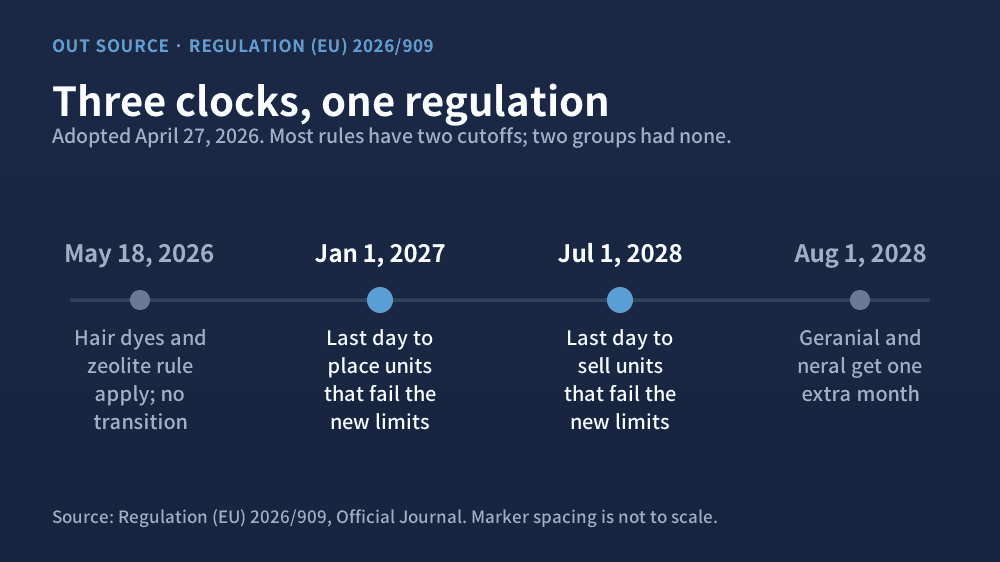
Regulation (EU) 2026/909 amends four annexes of the EU Cosmetics Regulation and reaches twelve substances, yet it runs on three clocks. Hair dyes and silver zinc zeolite changed on May 18, 2026 with no transition. Everything else stops being placeable on the EU market on January 1, 2027 and sellable on July 1, 2028, except geranial and neral, which get August 1, 2028. The cliff is not the sales date. It is the supply date: a unit first supplied after January 1, 2027 must already comply.
What did the Commission actually change?
The regulation amends Annexes II, III, V and VI of Regulation (EC) No 1223/2009, the EU Cosmetics Regulation. Annex II is the list of banned substances, Annex III the list of restricted ones, Annex V the list of permitted preservatives and Annex VI the list of permitted UV filters. Twelve substances or substance groups move at once.
Triphenyl phosphate is banned outright in Annex II. Benzyl salicylate, citral, water-soluble zinc salts, acetylated vetiver oil and a new catch-all entry for aluminum-containing ingredients receive category-by-category concentration caps in Annex III. Four hair dyes (HC Blue No 18, HC Yellow No 16, HC Red No 18 and hydroxypropyl-p-phenylenediamine) enter Annex III with caps of their own. Silver zinc zeolite leaves the ban list and enters Annex V as a preservative. The UV filter DHHB stays authorized but gains an impurity limit.
The regulation entered into force on May 18, 2026. What it changed on that day and what it changed later are two different questions.
Why does one regulation have three deadlines?
Two terms from the Cosmetics Regulation carry the answer. Placing on the market means the first supply of a product unit onto the EU market. Making available means any later supply for distribution or sale in the course of commercial activity. Each unit is placed once and made available many times.
The footnotes in the annex split the substances by those two terms. For triphenyl phosphate, benzyl salicylate, citral, zinc salts, aluminum, acetylated vetiver oil and DHHB, a non-compliant product cannot be placed on the Union market from January 1, 2027 and cannot be made available from July 1, 2028. Geranial and neral, the two isomers of citral, share the January 1, 2027 date but carry August 1, 2028 for making available.
The hair dyes and silver zinc zeolite carry no footnote at all. Their only clock is the entry into force on May 18, 2026. A hair color already on a shelf with a non-compliant dye has no transition period to lean on.

What does the January 1, 2027 date mean for a shipment?
It is a production and shipping date, not a retail date. A unit released onto the EU market after January 1, 2027 must meet the new limits whether it was filled in September 2026 or in March 2027. Units already supplied into the EU before that date are not touched by the first cutoff. They face only the July 1, 2028 end of sales.
That makes the exposure a matter of where inventory sits. Stock still at a factory in Korea or at a freight forwarder on January 2 is new supply and must comply. Stock already sold to a European distributor on December 30 has until July 2028. The exposed volume is the finished goods that have not yet crossed into the EU market.
Korea's cosmetics exports reached US$11.42 billion in 2025, up 12.2%, according to Ministry of Food and Drug Safety and Korea Customs Service data. Trade statistics list Poland (US$282.4 million), the Netherlands (US$137.7 million) and France (US$134.1 million) among the European destinations.
Why is aluminum the entry to watch?
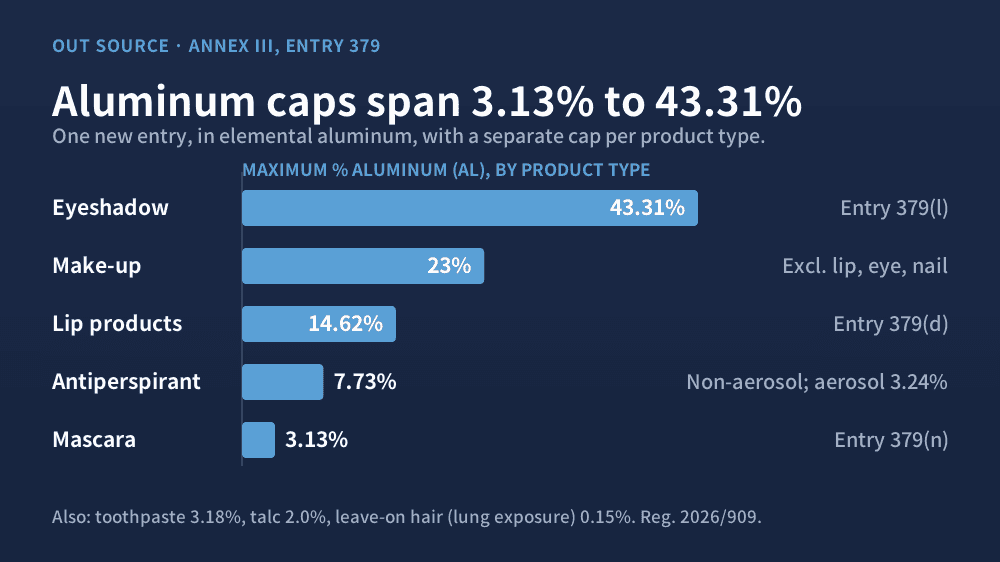
Entry 379 is new, and it is broad. It covers every aluminum-containing ingredient not already listed under entries 34, 50, 189, 190 and 192, and it expresses each cap as a percentage of elemental aluminum, not of the ingredient. A formulator working from a compound has to convert before comparing.
The caps differ sharply by product. Eyeshadow is capped at 43.31% aluminum and mascara at 3.13%. Non-aerosol antiperspirants and deodorants are capped at 7.73%, aerosol versions at 3.24%, toothpaste at 3.18% and leave-on hair products that expose the lungs to inhalation at 0.15%. Make-up outside lip, eye and nail categories is capped at 23%, and lip products at 14.62%.
One further line is easy to miss. The entry for other leave-on skin products, capped at 3.81%, carries the condition that it is not to be used in sunscreen products that lead to exposure of the lungs by inhalation. A spray sunscreen formula that relies on an aluminum-containing ingredient is a formula to re-check first.
How tight are the fragrance limits?
Two fragrance allergens carry new numbers. Benzyl salicylate is capped at 4% in fragrance products, 0.7% in body lotion, 0.5% in most leave-on skin and hair products, 0.2% in face make-up and make-up removers, 0.91% in spray deodorants and 0.004% in oral products. Rinse-off skin and hair products are capped at 0.5%, and shower gels and bath products at 1.3%.
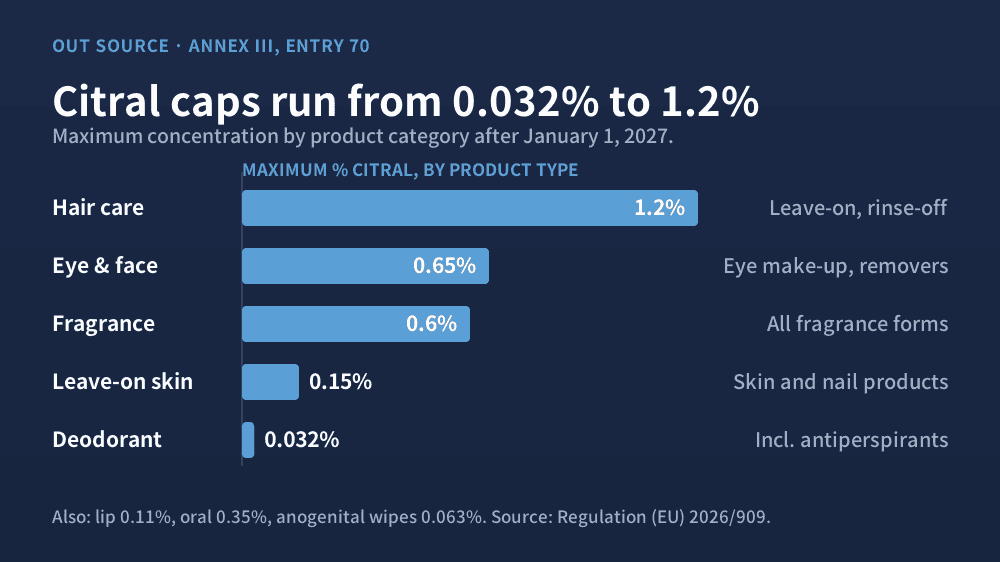
Citral is capped between 0.032% and 1.2%. Deodorants and antiperspirants sit at the bottom at 0.032%. Anogenital wipes are capped at 0.063%, lip products at 0.11%, leave-on skin and nail products at 0.15%, oral products at 0.35%, fragrance at 0.6%, eye and face make-up at 0.65%, and leave-on hair and rinse-off products at 1.2%.
The labeling thresholds for both allergens are unchanged: the name must appear on the label above 0.001% in leave-on products and 0.01% in rinse-off products. A fragrance compound that passed under the old rules at a given dose now has to be checked against a category cap, because the same oil can pass in a rinse-off shampoo and fail in a deodorant.
What changed for sunscreen filters?
DHHB, the UV-A filter formally named diethylamino hydroxybenzoyl hexyl benzoate, is not banned. It stays authorized. What changed is a condition on its purity: the impurity di-n-hexyl phthalate must not exceed 10 ppm. A ppm is one part per million, and the limit is written for an unavoidable trace impurity.
The practical effect sits upstream. A sunscreen formula can be unchanged on paper and still fail, because the compliance question moves to the raw material supplier. For each lot of DHHB, the brand needs a specification and an analysis that show the impurity below 10 ppm. The same two clocks apply: January 1, 2027 for placing and July 1, 2028 for making available.
What does not wait?
The hair dyes and silver zinc zeolite changed on May 18, 2026. HC Blue No 18 is capped at 0.35%. HC Yellow No 16 is capped at 1% in oxidative products and 1.5% in non-oxidative ones, and HC Red No 18 at 1.5% and 0.5%. Hydroxypropyl-p-phenylenediamine is capped at 2% in oxidative products. Oxidative products are the kind mixed with a developer before use.
Silver zinc zeolite moved in the other direction. It left the ban list and became a preservative in Annex V, permitted at up to 1% in spray deodorants and powder foundations, provided the silver content stays at or below 2.5%. Every other product type stays outside the permission.
Who carries the work before the cutoff?
Three positions meet the same regulation differently. A manufacturer or ODM, the contract developer that formulates and fills products for other brands, carries the reformulation and testing. Its work is converting aluminum compounds to percent aluminum, rechecking fragrance oils against category caps and collecting purity data for DHHB lots.
A brand or buyer carries the inventory and the calendar. It needs a list of every SKU, the date each lot ships to the EU, and a sell-through plan that ends before July 1, 2028. The responsible person, the EU-based legal entity accountable for each product under the regulation, must hold a safety assessment that matches the new limits when the product goes on the market.
A regulator-minded investor reads the date as a write-off line. Finished goods that arrive after January 1, 2027 in non-compliant form cannot enter the market that was meant to buy them. The regulation is short on rhetoric and exact on dates, and the dates decide the cost.