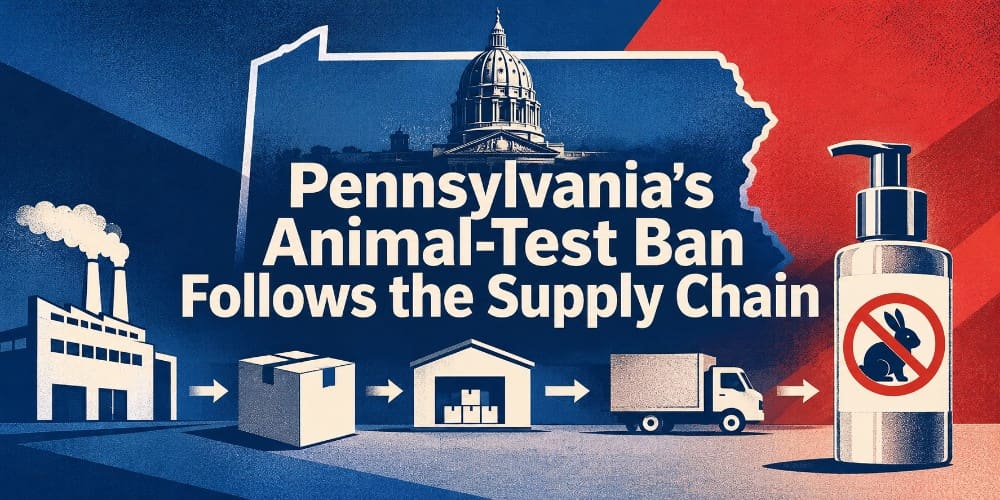
Pennsylvania's Act 92 of 2026, signed October 22, 2026, bars the sale of cosmetics developed using animal tests that the manufacturer or any of its suppliers conducted or contracted on or after January 1, 2027, and it takes effect on April 20, 2027. An animal-testing ban reads like a rule about what a brand does. This one is a rule about what an ingredient chain does, and it names the party on the label as the one that answers for it.
What does Pennsylvania's Act 92 prohibit?
Act 92 of 2026 is Senate Bill 381, known as the Beagle Bill. The House passed it 203–0 on October 19, 2026, the Senate concurred 50–0 on October 20, and Governor Josh Shapiro signed it on October 22. The act also creates an adoption pathway for research dogs and cats and sets limits on state research funding. One subchapter addresses cosmetics.
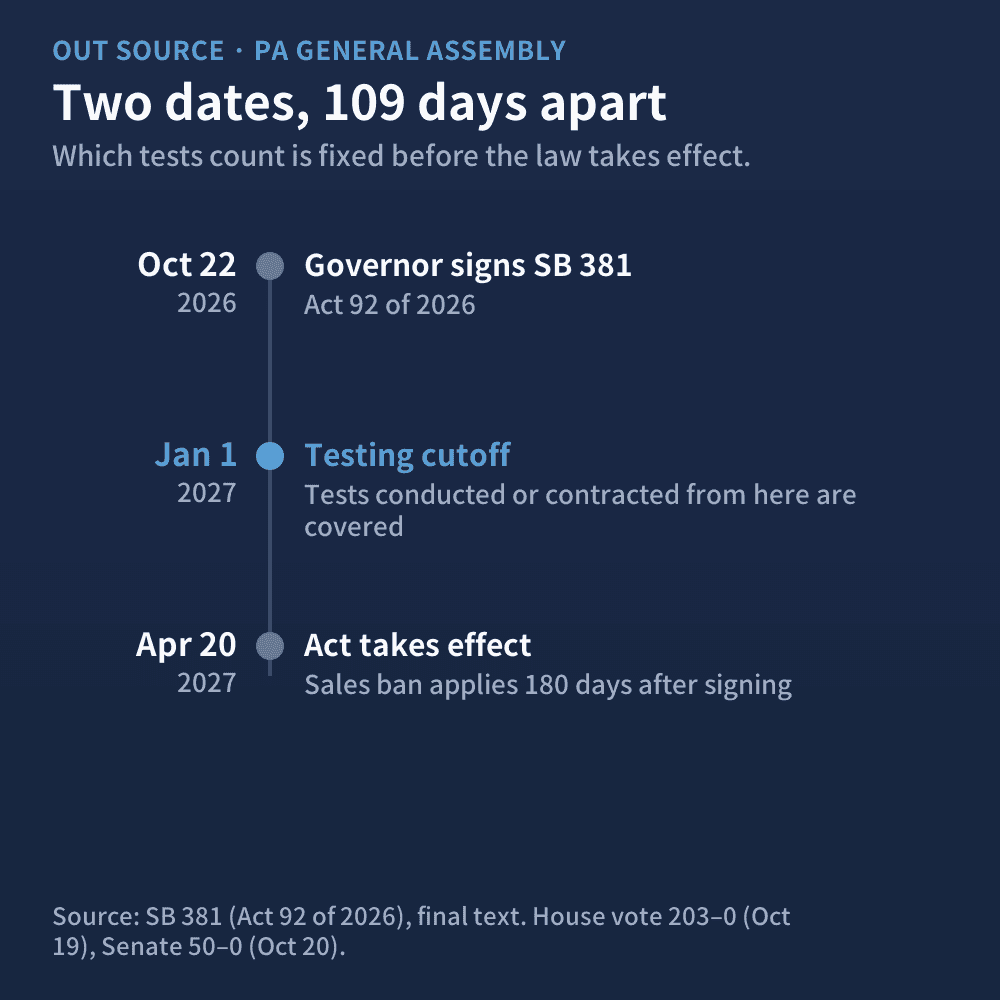
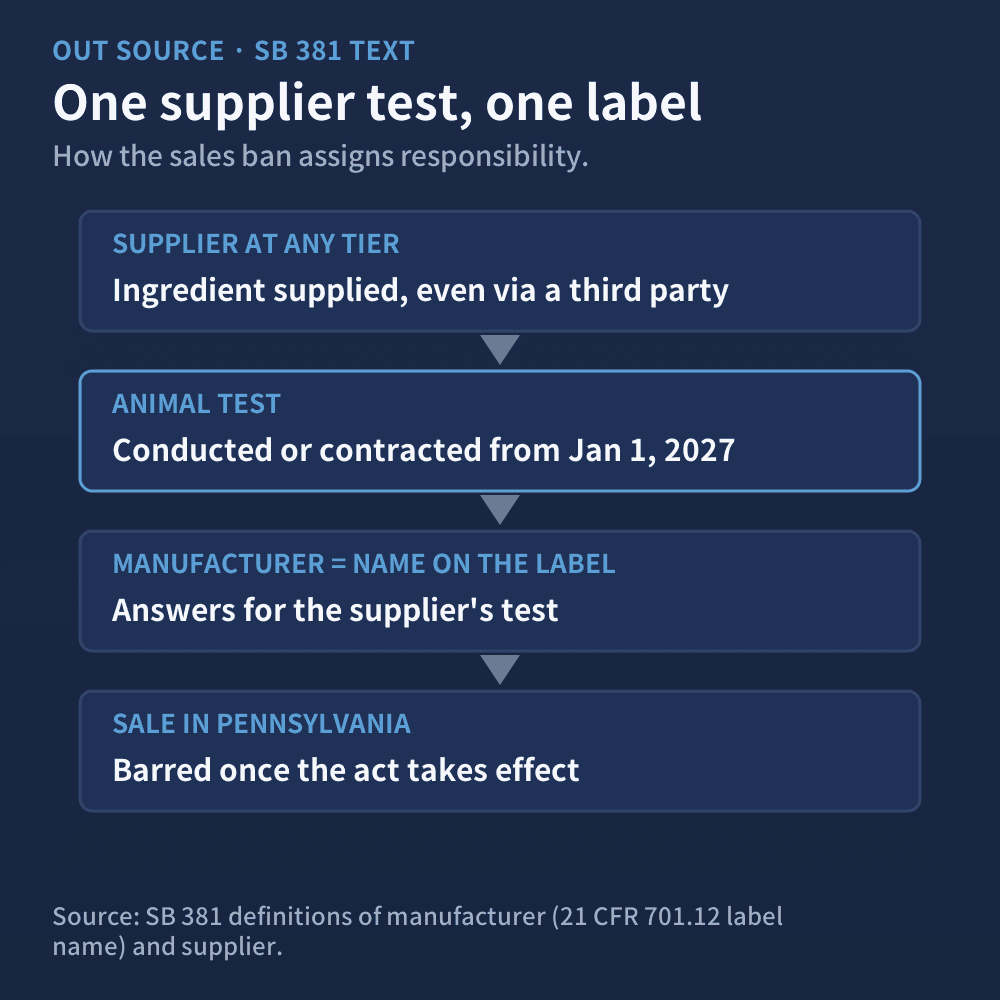
That subchapter bars a manufacturer from selling or offering for sale in Pennsylvania a cosmetic developed or manufactured using an animal test, where the manufacturer or any of its suppliers conducted or contracted the test on or after January 1, 2027. An animal test, in the act's terms, is the internal or external application of a cosmetic or any of its ingredients to a body part of a live vertebrate other than a human. The act takes effect 180 days after signing, which falls on April 20, 2027.
Which tests count, and from what date?
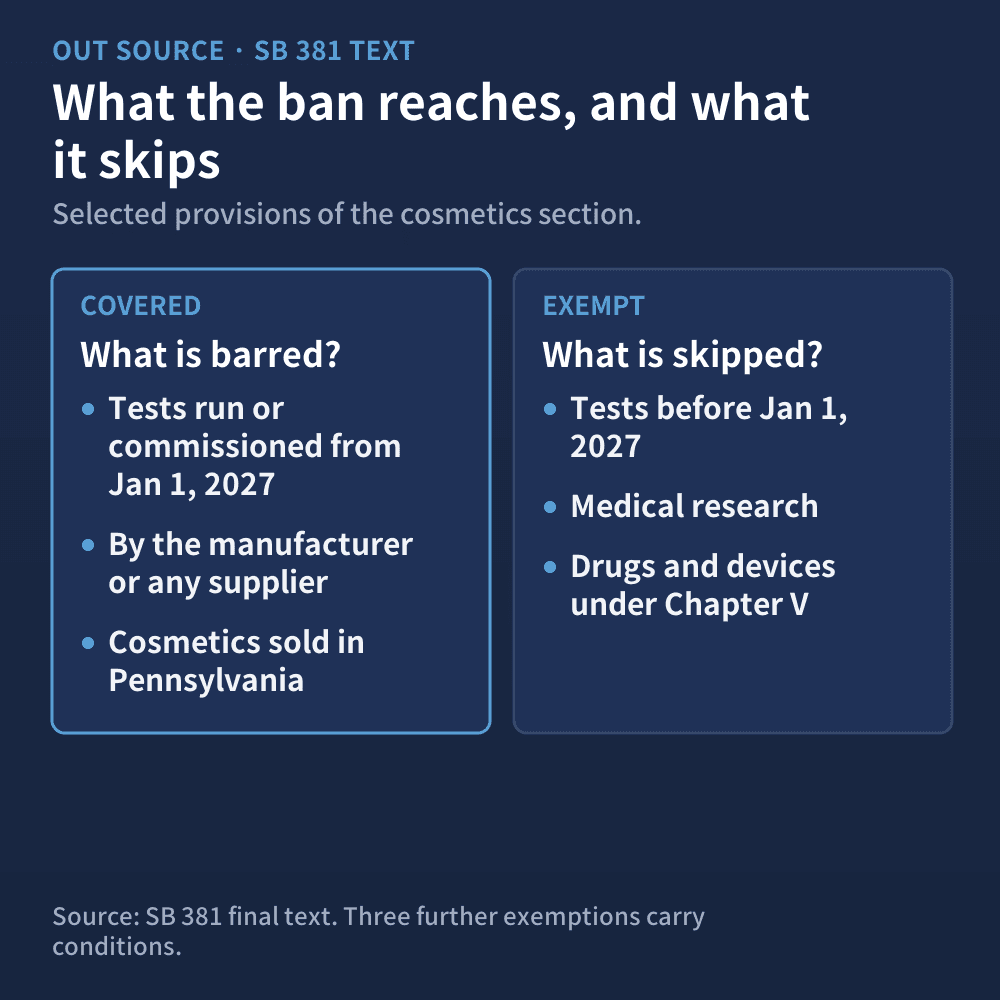
The trigger is the date of the test, not the date of the sale. A test conducted or contracted before January 1, 2027 falls outside the prohibition, and the act states that a manufacturer can keep reviewing, assessing, and retaining data from earlier testing. A cosmetic sold in Pennsylvania in 2028 can rest on a 2024 animal study without violating the act.
Two dates therefore sit apart. The testing cutoff is January 1, 2027. The act takes effect on April 20, 2027, which is 109 days later. A test commissioned in February 2027 is already a covered test, although the sales prohibition has not yet started. The product that test supports falls under the prohibition on the day the act takes effect.
A supply chain that waits for the effective date to review its testing contracts has waited past the date that fixes which tests count.
Who is the manufacturer?
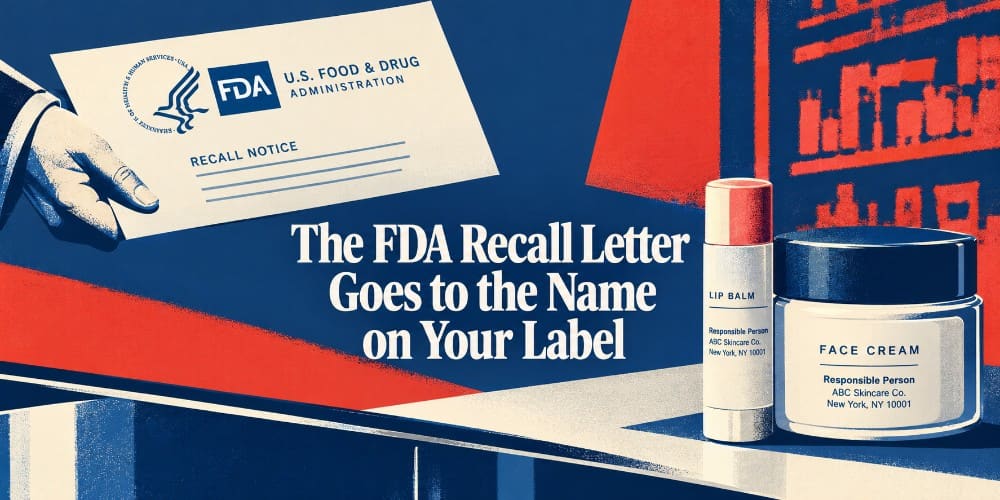
The act does not use the word in its everyday sense. A manufacturer is a person whose name appears on the label of the cosmetic under the federal labeling rule, 21 CFR 701.12. That rule requires the label to state the name and place of business of the manufacturer, packer, or distributor, and a party that did not make the product adds wording such as Manufactured for or Distributed by.
The result is a label test. A brand owner that outsources production is the manufacturer under the act. So is a distributor whose name appears on the pack. The factory that filled the jar is not, unless its name also appears on the label. Liability follows the label, and the label follows the commercial relationship.
How far down the chain does a supplier reach?
A supplier is an entity that supplies, directly or through a third party, any ingredient used in the formulation of the manufacturer's cosmetic. The phrase through a third party carries the reach. Read as written, the producer behind a raw material distributor is a supplier, because it supplies the ingredient through a third party. An ingredient, in turn, is any component of a cosmetic as defined in 21 CFR 700.3.
One animal test on one ingredient at one tier of the chain, conducted or contracted after the cutoff, is enough to reach every finished cosmetic formulated with that ingredient. The prohibition sentence names no concentration threshold and no volume threshold. The manufacturer on the label answers for a decision made several steps upstream.
What does the act exempt?
Five categories sit outside the prohibition. Animal research conducted for medical research is exempt. So are products and ingredients subject to Chapter V of the federal Food, Drug, and Cosmetic Act, the chapter covering drugs and devices, which reaches items such as over-the-counter sunscreens.
A test required by a federal or state regulator is exempt only when three conditions hold together: the ingredient is in wide use and cannot be replaced by another ingredient; a specific human health problem is associated with the ingredient and the test is justified and supported by a research protocol; and no nonanimal method is accepted by the relevant regulator for gathering the data.
A test run for a noncosmetic purpose under a federal, state, or foreign requirement is also exempt, with a catch. Data from such a test after January 1, 2027 cannot establish the safety of a cosmetic unless three things are shown: no nonanimal method is recognized by a federal agency or the OECD, the intergovernmental body that publishes internationally accepted test guidelines, for the relevant safety endpoints; the noncosmetic intent is documented; and the ingredient has been used outside cosmetics for at least one year before the data is relied on.
Why does a foreign regulator's test get its own exemption?
The act exempts an animal test conducted outside the United States to comply with a requirement of a foreign regulatory authority, on one condition: no evidence from that test is relied on to substantiate safety. Safety substantiation is the documented basis a company holds for stating that a cosmetic is safe. Federal law and FDA regulations do not require specific tests to demonstrate that safety, and FDA advises manufacturers to use whatever testing is necessary to ensure it. The file is the manufacturer's own.
That makes the exemption a rule about documents, not only about tests. A study can sit in a foreign filing and stay out of the file that supports sales in Pennsylvania. A brand that sells across several jurisdictions now keeps files whose contents have to stay apart, and document control becomes a compliance function.
How is the act enforced?
The Attorney General can bring a civil action in Commonwealth Court or a court of common pleas for injunctive relief to restrain a violation and for other relief the court considers proper. The act creates no private right of action. Consumers and competitors cannot sue under it.
The remedies section states no fine amount. An injunction operates on a sale, and the party it reaches is the manufacturer as the act defines it: the name on the label.
What does the text leave open?
The act does not define offer for sale. It does not say whether a listing visible to Pennsylvania buyers, but fulfilled from outside the state, is an offer for sale in the Commonwealth.
It does not say where an ODM sits. An ODM, short for original development manufacturer, is a factory that develops and produces a formula that another company sells under its own label. The supplier definition turns on ingredients, not finished formulas. Whether the ODM counts as a supplier of the brand, or only its ingredient sources do, is not addressed.
The sales provisions also contain no certification or recordkeeping requirement. Nothing in them says what document proves that a covered test never happened.
Who carries the cost of proof?
The act turns ingredient test history into a supply-chain asset, and the three sides of that chain read it differently.
Manufacturers and ODMs hold the formulation files and the supplier relationships. For them the act turns a purchasing question into a documentation question: which tier tested what, and when, with January 1, 2027 as the dividing line. Brands and buyers hold the labels. The party named on the pack is the one the Attorney General can reach, so the label name and the contract behind it carry the exposure. Regulators and investors see a regime with a single enforcer, injunctive remedies, and no stated fine, so the exposure is an injunction on a product, and the diligence question is the supplier record behind it.
The test date fixes what counts. The label name fixes who answers. The supplier definition fixes how far back the record runs.