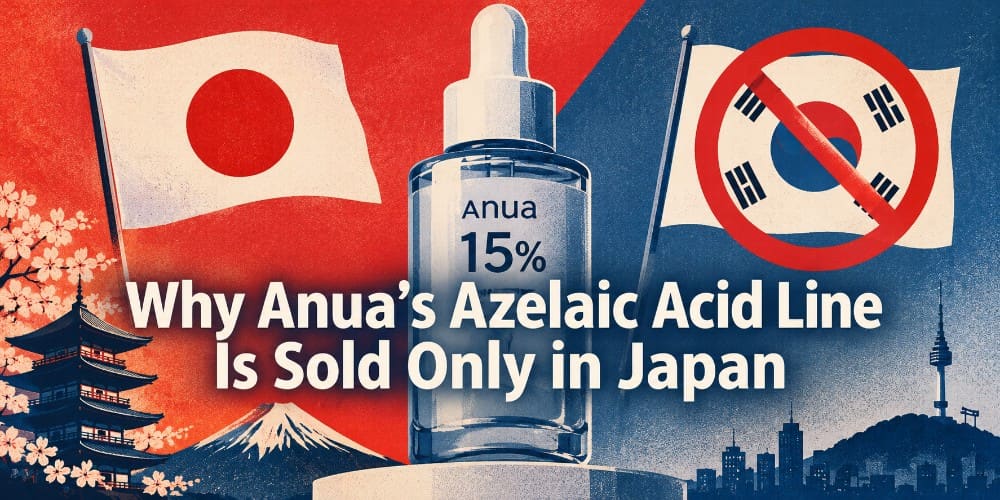
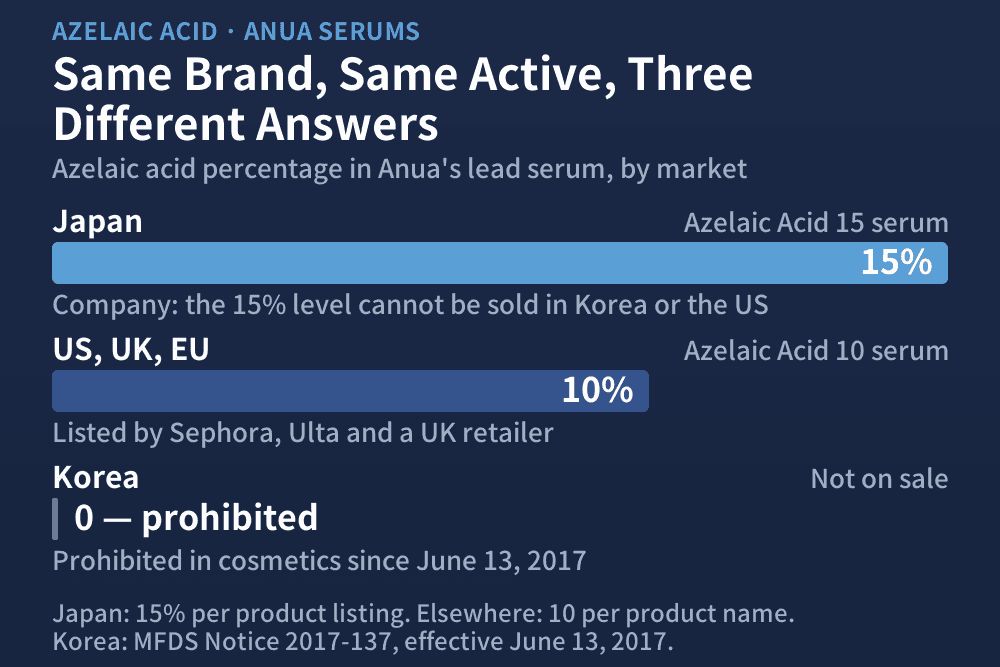
Anua's azelaic acid serum is a 15% product in Japan and a 10% product outside it, and neither version is on a shelf in Korea. South Korea's Ministry of Food and Drug Safety proposed adding azelaic acid to its prohibited cosmetic ingredient list on March 21, 2017, and the ban took effect on June 13, 2017. A November 3, 2026 report from Tokyo lists Anua's eight-item azelaic range among Japan-only products and gives no reason for its absence from Korea. The rulebook drew that line first.
What does Anua sell in Japan that it does not sell elsewhere?
A report from Tokyo published on November 3, 2026 describes an eight-item azelaic acid range from Anua, operated by The Founders, sold exclusively in Japan. It spans serums, toners and lotions, and its lead product is the Azelaic Acid 15 Intense Calming Serum. Azelaic acid is a naturally occurring dicarboxylic acid used in skincare for oily and blemish-prone skin, and the 15 in the product name is its concentration in percent.
The same report puts cumulative Japan sales of the range above 8 million units. No filing backs that count, and it carries no period, price or revenue, so it stands as the company's claim. Anua's Japanese online shop currently lists an azelaic acid three-step set of toner, serum and emulsion.
Outside Japan, Anua's azelaic product is a different item. Sephora and Ulta in the United States, and Sephora and a UK retailer in Europe, list the Azelaic Acid 10 Hyaluron Redness Soothing Serum, where the 10 is again the concentration. Same brand, same active, two concentrations, split by market.
Is Japan-only a design choice or a legal fact?
Anua's own account, published on June 16, 2025, is that the 15% concentration cannot be sold in Korea or the United States, and that the serum was developed for Japanese customers. That is a company statement, and it names two markets where the product is absent.
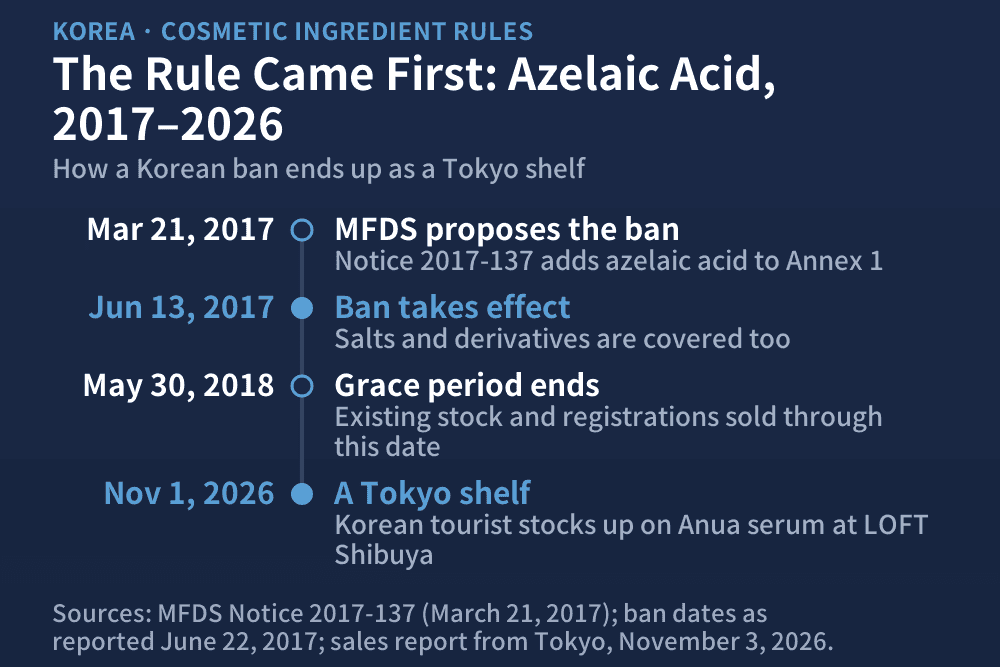
For Korea, the rulebook is on the record. Notice 2017-137 from the Ministry of Food and Drug Safety (MFDS), dated March 21, 2017, proposed adding azelaic acid, with its salts and derivatives, to Annex 1 of the Cosmetic Safety Standards. Annex 1 lists the ingredients that cannot be used in cosmetics at all. The ban took effect on June 13, 2017, and products already manufactured, imported or registered stayed on sale until May 30, 2018. The listing carries no concentration threshold. The ingredient is barred, not capped.
Nothing in the November 3 report ties Anua's range to that rule. The report frames Japan-only lines as products built for local taste. The rule and the line coincide all the same, and the rule came first: Anua launched in April 2019, nearly two years after the ban.
What does a Korean shopper do when the product is not on a Korean shelf?
The shopper travels. On November 1, 2026, on the second floor of LOFT, a lifestyle store chain, in Tokyo's Shibuya district, a 31-year-old Korean tourist told the Tokyo report that the Anua serum is not sold in Korea and that she stocked up in Japan because of its reviews. The report says Korean tourists buy the flagship serum there, and that it spread through social media.
That inverts the usual export logic. A Korean bestseller normally travels outward from a Korean shelf. Here the Korean consumer is the one crossing the border, and the price she pays is a Japanese price, set in a Japanese channel, with Japanese promotions. Korea sees none of it in its own retail data.
Is every Japan-only line a response to a rule?
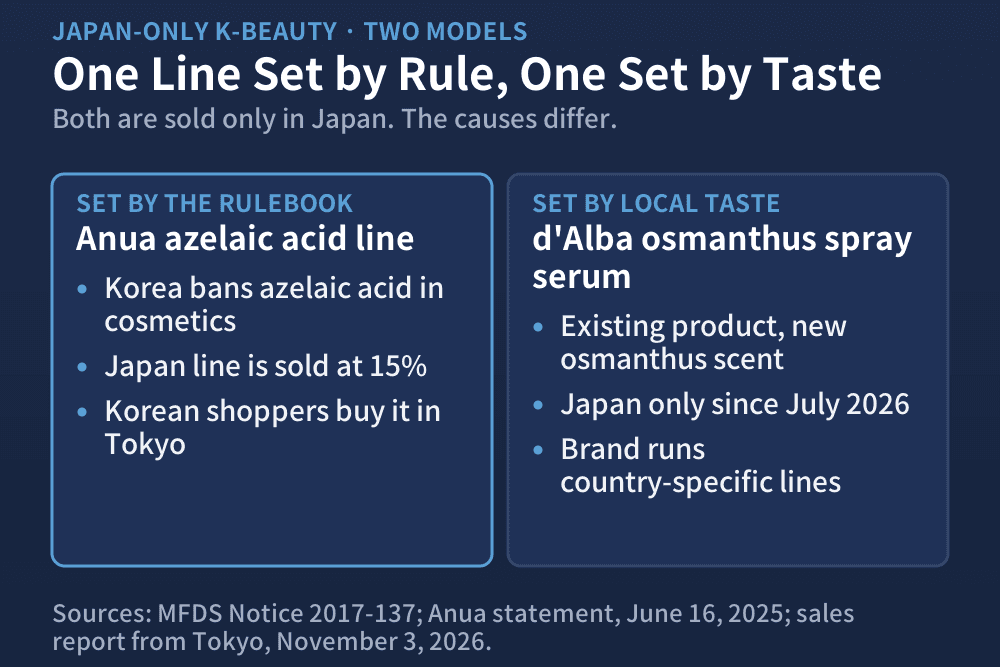
No. The same report names lines that exist for taste. D'Alba Global formally launched the White Truffle First Spray Serum Peptide Osmanthus in July 2026, sold only in Japan. It adds an osmanthus scent to an existing product. A company official told the report that d'Alba offers country-specific products in markets including Japan and Russia, plus exclusive gift sets for each sales channel. The rationale given is local preference, not a prohibition.
According to the report, APR has two further Japan-only lines, a placenta and ceramide line launched in December 2025 and a glycylglycine line, built on a dipeptide of two linked glycine units, launched at the end of May 2026, with no launch planned in other markets. Skinfood shows the reverse path: its Lemongrass lineup was co-developed with a Japanese influencer, launched in Japan first and then came to Korea. A launch in which a product debuts abroad and then returns home is a reverse launch.
The two kinds of Japan-only differ in one respect that matters. A boundary set by taste moves when the market does, and Skinfood's lineup moved. A boundary set by a rule moves only when the regulator does.
What does a single-market line change inside the company?
Formulation, labeling and documentation are built for one market's rules alone. A Japan-only formula is not a Korean formula with a different box. It is its own product, with its own development file and its own approvals.
Inventory carries one market's demand risk. A line with no second market has nowhere to send overstock, so the planning error costs the full amount. Pricing follows the same logic: the Japanese channel sets the price, and no home-market price anchors it.
An industry official quoted in the report said that mapping local preferences and purchase patterns at the product-planning stage is becoming a core competitive edge. For a market-specific line, that planning step is the whole business case.
What does the 8 million figure prove, and what does it leave open?
It proves that Anua claims a large Japan business in one range. It leaves open the period, the revenue, the split between the 15% serum and the other seven items, and the share of buyers who are visiting Korean tourists. The count is cumulative units, and a unit count with no price is not revenue.
Anua's other Japan figures are also company statements. In the June 16, 2025 account, Anua said Japan sales had grown 65 times over five years and that its offline presence passed 3,000 stores within a year of its 2022 offline launch. The company's 2025 results, reported on May 4, 2026, break out no Japan revenue or share. The business looks large. Its size is unaudited.
Who reads this differently: manufacturers, brands and buyers, or regulators and investors?
Manufacturers read a country-by-country map of runs. An ODM, an original design manufacturer that develops and produces formulas for brands, plans one global run for a world formula and several smaller runs for market-specific ones. Each Japan-only item is its own SKU with its own batch volume.
Brands and buyers read an assortment problem. A Japanese buyer gets a range no other market has. A buyer in the United States, the United Kingdom or the EU gets the 10% serum. Comparing Anua's azelaic acid across markets means comparing two different products.
Regulators and investors read a revenue-location problem. Korea's rulebook decides what Korean cosmetics can be sold at home. Revenue from an ingredient Korea bars is earned abroad, so Korean domestic sales data understates what the brand sells. An analyst values Japan as its own business.
Japan-only is two things that look alike. One is a taste. The other is a rule. Taste moves with the market. A rule moves only when the regulator does.