Directive (EU) 2024/825 applies from 27 September 2026, and the words it puts on the EU's blacklist of banned commercial practices are named in its own recitals: eco-friendly, green, ecological, climate friendly, biodegradable, biobased. Clean beauty is not among them. Neither is natural. Korean trade coverage has reported both as prohibited. What the directive outlaws is narrower and harder to work around — the environmental word left unexplained.
Which EU rule actually takes effect on 27 September?
Two instruments have been circulating under one shorthand. The one that takes effect is Directive (EU) 2024/825 of 28 February 2024, on empowering consumers for the green transition, which amends the Unfair Commercial Practices Directive 2005/29/EC and the Consumer Rights Directive 2011/83/EU. Its final articles set two dates: member states adopt the measures by 27 March 2026 and apply them from 27 September 2026.
The other is the Green Claims Directive, a separate 2023 proposal that would have built a substantiation and third-party verification procedure for explicit environmental claims. The Commission announced its intention to withdraw that proposal on 20 June 2025, the third trilogue scheduled for 23 June 2025 was cancelled, and the file has not moved since. Korean coverage of the September date has carried the name of the proposal that stalled while describing the directive that did not.
The distinction decides what a compliance team is reading. The operative text is an amendment to consumer-protection law, enforced by national consumer authorities against traders. It is not a cosmetics regulation and it is not a claims-substantiation regime.
What exactly lands on the blacklist?
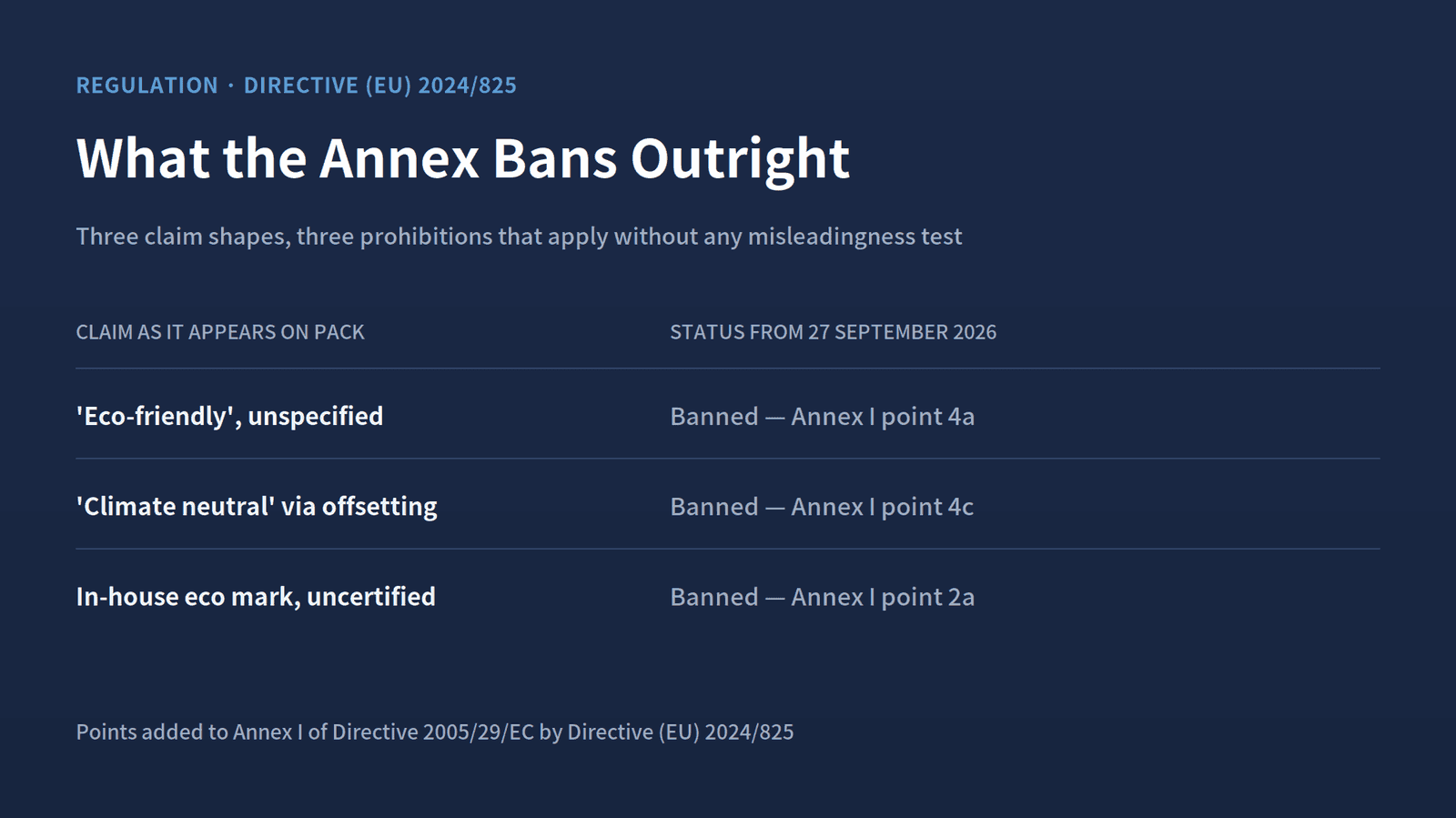
Annex I of the Unfair Commercial Practices Directive lists practices banned in all circumstances. Practices on that annex require no case-by-case assessment of whether a consumer was actually misled — the conduct is the infringement. The directive adds four points to it.
Point 4a bans making a generic environmental claim for which the trader is not able to demonstrate recognised excellent environmental performance relevant to the claim. Point 4b bans making an environmental claim about the entire product or the trader's entire business when it concerns only a certain aspect. Point 4c bans claiming, on the basis of offsetting greenhouse gas emissions, that a product has a neutral, reduced or positive impact on the environment. Point 2a bans displaying a sustainability label that is not based on a certification scheme or not established by public authorities.
Point 4c is the hardest of the four because it removes the substantiation route altogether. The directive's recital on the point names the caught expressions — climate neutral, CO2 neutral certified, carbon positive, climate net zero, climate compensated — and reasons that offsetting outside a product's value chain is a different thing from reducing the product's own impact. A trader with a purchased-credit portfolio has no evidence file that rescues the claim, because the evidence is not the problem.
Two further changes sit outside the annex and still bite. A new point in Article 6(2) makes it a misleading action to claim future environmental performance without clear, objective, publicly available and verifiable commitments set out in a detailed and realistic implementation plan, regularly verified by an independent third-party expert. An addition to Article 7 requires a trader comparing products on environmental or social characteristics to disclose the method of comparison, the products compared and how the information is kept current. Korean beauty groups have carried sustainability commitments in ESG reports for years; the change is that a commitment becomes a consumer-protection representation the moment it appears in commercial communication.
Why is a generic claim defined by what sits next to it?
The directive's definition of a generic environmental claim is a claim not included on a sustainability label and where the specification of the claim is not provided in clear and prominent terms on the same medium. The test is not the word. The test is whether the qualifier travels with it.
Biodegradable alone on a tube is generic and therefore caught. Biodegradable with the standard, the conditions and the component it refers to, set out in clear and prominent terms on that same tube, is a specific claim governed by the ordinary misleadingness rules rather than the blacklist. The directive's own recital on partial claims uses the example of a product marketed as made with recycled material when only the packaging qualifies.
This is why the fix is expensive rather than difficult. Specification consumes packaging surface, and a Korean cosmetic sold across the EU already carries an ingredient list, a responsible-person address, a period-after-opening mark and translated copy across a dozen languages. The words that survive 27 September are the long ones, and long words need room.
How high is the bar for keeping the bare word?
Point 4a leaves one route to an unqualified environmental claim: recognised excellent environmental performance. The directive defines that as performance compliant with Regulation (EC) No 66/2010, the EU Ecolabel, or with national or regional EN ISO 14024 type I ecolabelling schemes officially recognised in the member states, or top environmental performance under other applicable Union law.
Korea operates exactly such a scheme. The Korea Eco-Label, established under Article 17 of the Environmental Technology and Environmental Industry Support Act and run by the Korea Environmental Industry and Technology Institute, is an ISO 14024 type I programme. The definition, however, is drafted to schemes officially recognised in the member states, and a Korean certificate is not one. A product carrying the Korea Eco-Label clears nothing under point 4a.
The EU Ecolabel route is narrow by design. Commission figures for March 2026 put the whole scheme at 3,541 licences covering 116,692 products across every product group, with paints and paper accounting for more than half the products. Cosmetic products became a single group in 2021, merging the former rinse-off category with leave-on. Against a Korean export catalogue running to tens of thousands of listings, licensing is not a volume answer. Specification is.
What happens to a brand's own clean-beauty mark?
The directive defines a sustainability label broadly: any voluntary trust mark, quality mark or equivalent, public or private, that promotes a product by reference to its environmental or social characteristics. Point 2a then requires that mark to rest on a certification scheme or on a public authority. Third-party vegan and cruelty-free marks that run an audited scheme sit on the right side of that line. In-house leaf logos and retailer-defined standards do not.
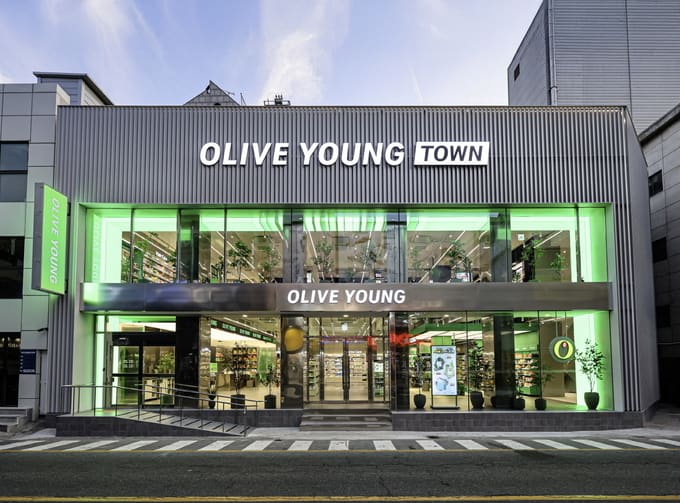
The vocabulary in question has a documented Korean origin. CJ Olive Young built its own clean beauty standard in 2020, requiring the exclusion of 16 ingredients and recommending the exclusion of four more, launching with 12 brands and roughly 160 products, and framed the standard around kindness to the planet, to animals and to the user. That standard is a retailer's own criteria applied to its own shelves. It was built for a Korean chain, not for the EU, and it travelled outward because the products did.
Nothing about that history makes any particular product non-compliant, and no reported case ties a named Korean brand to this directive. The structural point is narrower: a private mark whose criteria belong to the party benefiting from it is the exact shape point 2a addresses, and a large part of the K-beauty sustainability lexicon was written in that shape.
Who is the trader the rule actually binds?
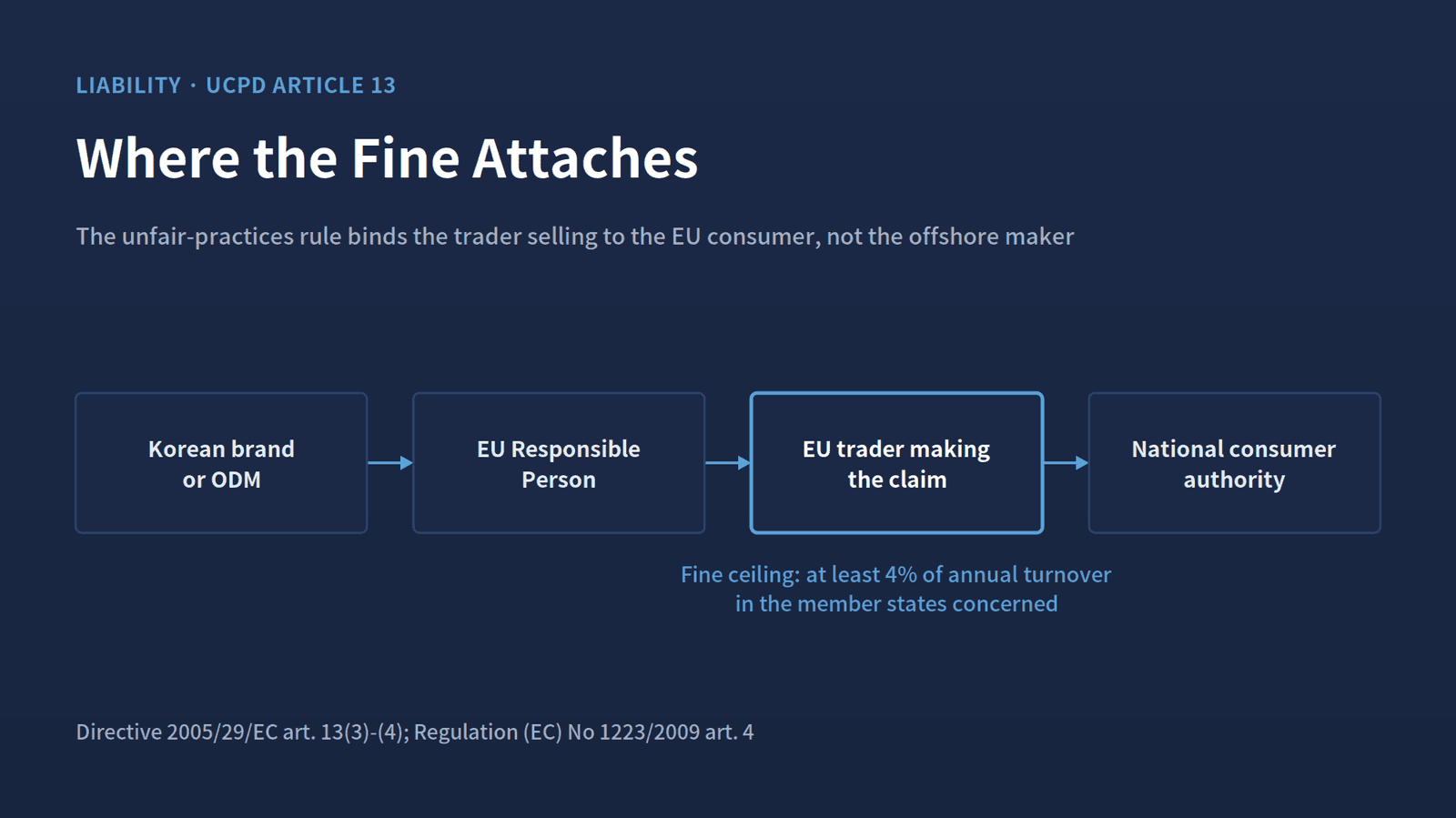
The Unfair Commercial Practices Directive regulates traders in their practices toward consumers in the EU. The party making the claim to an EU consumer is the importer, the distributor, the marketplace seller or the own-brand retailer. Cosmetics law already points the same way: Regulation (EC) No 1223/2009 requires a responsible person established in the Union for every product placed on the market.
The Korean manufacturer sitting offshore has no direct exposure under this directive. Its exposure is contractual, and the contract is about to be rewritten, because the numbers on the other side are large. Article 13 of the Unfair Commercial Practices Directive requires member states, where penalties are imposed under the consumer-protection cooperation procedure in Article 21 of Regulation (EU) 2017/2394, to make the maximum fine at least 4% of the trader's annual turnover in the member states concerned, and at least EUR 2 million where turnover information is unavailable.
A distributor carrying a turnover-based ceiling prices that risk into the agreement. What follows is warranty language on claim substantiation, indemnity for label copy, and approval rights over marketing assets the Korean side has historically controlled outright. The regulatory event is European; the commercial event is a shift in who holds the pen.
Is the rule in force in the markets Korean brands actually sell into?
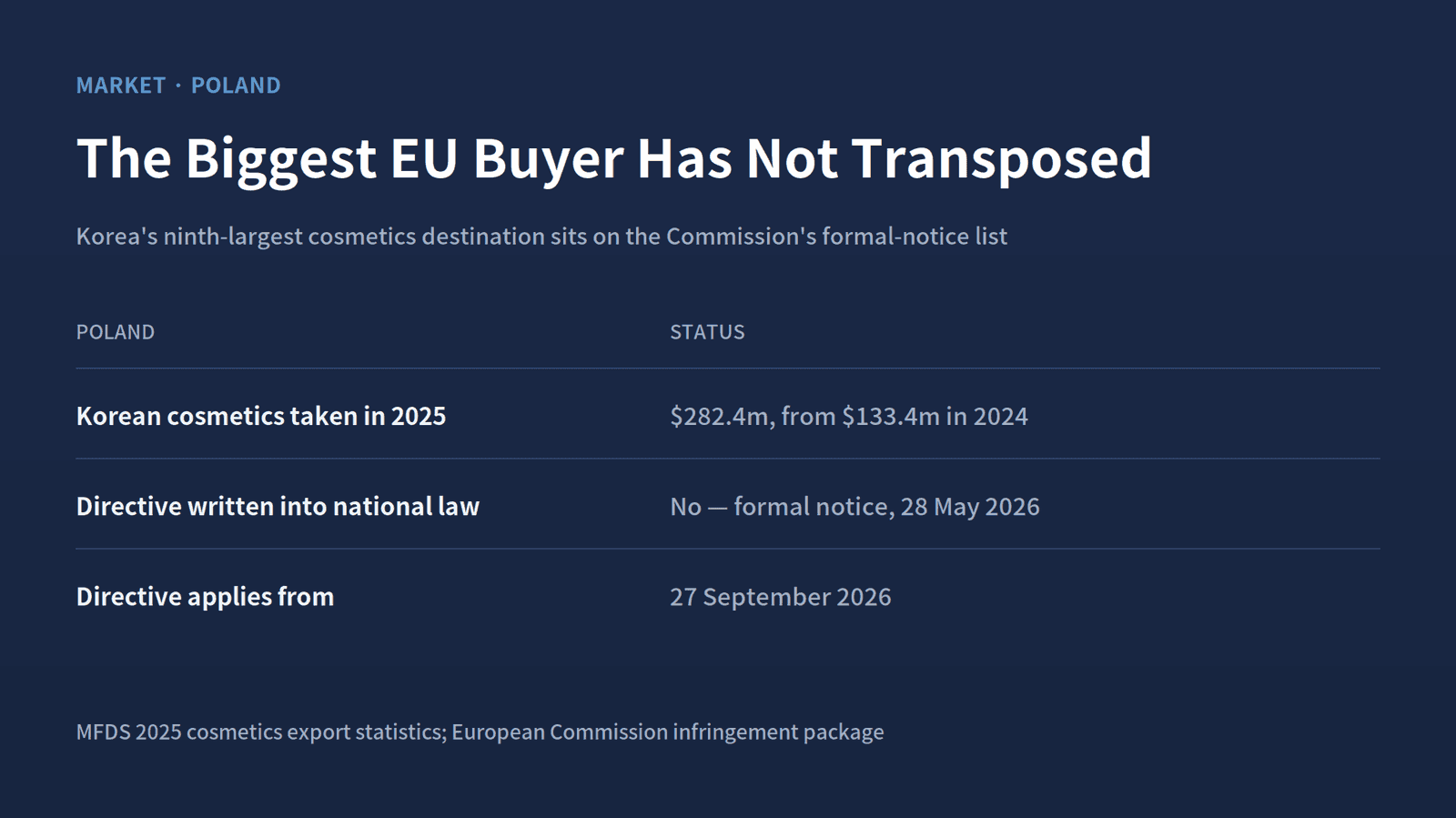
Seven of the 27 member states met the 27 March 2026 transposition deadline. On 28 May 2026 the Commission sent letters of formal notice to 20 of them — Belgium, Bulgaria, Czechia, Estonia, Greece, Spain, France, Croatia, Cyprus, Latvia, Luxembourg, Hungary, Malta, the Netherlands, Austria, Poland, Portugal, Slovenia, Finland and Sweden — with two months to respond. Germany transposed through an amendment to its unfair competition act published on 19 February 2026, Italy through Legislative Decree 30/2026 published on 9 March 2026, and Ireland through S.I. No. 124 of 2026.
Read that list against where Korean cosmetics go. Ministry of Food and Drug Safety statistics put 2025 exports at $11.4 billion, up 12.2% and second worldwide behind France at $24.28 billion. Poland was the ninth-largest destination at $282.4 million, up from $133.4 million in 2024. The United Kingdom took $231 million, the Netherlands $138 million and France $134 million. Three of Korea's four largest European destinations are member states, and the largest of the three has no national law in place. The United Kingdom sits outside this directive entirely and answers to its own competition authority's regime.
The application date is uniform across the single market. The enforcement machinery behind it is not. A brand planning for 27 September is planning for a rule that arrives everywhere at once and is prosecuted unevenly for some time afterwards.
How much of this is new for cosmetics at all?
Cosmetic claims in the EU have been regulated since long before this directive. Article 20 of Regulation (EC) No 1223/2009 prohibits claims attributing characteristics a product does not have, and Commission Regulation (EU) No 655/2013 sets six common criteria every claim must satisfy: legal compliance, truthfulness, evidential support, honesty, fairness and informed decision-making. The technical document agreed under that regulation, applicable since 1 July 2019, restricts free-from claims and hypoallergenic claims and does not accept free from parabens.
So the half of the clean-beauty sentence that trades on absence has been constrained in the EU for seven years. What 27 September adds is the other half — the sentence about the planet rather than the sentence about the skin. A brand that cleared its free-from copy in 2019 and closed the claim file is reopening it for a different reason, in front of a different authority, under a different law.
Does Korea's own law say anything different?
Article 3 of the Act on Fair Labeling and Advertising prohibits false, exaggerated, deceptive, unfairly comparative and denigrating labelling and advertising. Article 7 gives the Fair Trade Commission corrective orders. Article 9 sets a surcharge of up to 2% of the revenue defined by presidential decree, or up to 500 million won — about $365,000 at the 23 September 2026 rate of 1,368 won to the dollar — where revenue cannot be computed. Article 17 provides up to two years' imprisonment or a fine of up to 150 million won (about $110,000). Article 16-10 of the Environmental Technology and Environmental Industry Support Act prohibits improper environmental labelling and advertising separately, with corrective orders under Article 16-12 and a surcharge under Article 16-13.
The text is not permissive. The distance is in application. Figures the Korea Environmental Industry and Technology Institute supplied to the National Assembly in 2025 recorded 4,935 detections of improper environmental labelling and advertising in 2023, of which 17 drew corrective measures and 4,918 were closed as administrative guidance. The 2024 count was 2,528 detections and 114 corrective measures. A marketing team writing eco in Seoul has been operating in a system where the modal outcome is a letter.
The EU annex removes the step where that letter gets written. There is no assessment of consumer impact to argue about, no guidance stage to absorb the first offence, and a ceiling expressed as a share of turnover rather than a fixed sum.
What does a blacklist change that a guideline does not?
For manufacturing and ODM, claim substantiation becomes a deliverable rather than a courtesy. The evidence behind a biodegradability figure or a recycled-content percentage sits with the formulator and the packaging supplier, not with the brand's copywriter. An ODM that hands a client a substantiation file alongside the batch is selling something the client now has to buy from someone.
For brands and buyers, the negotiation moves from who writes the claim to who warrants it. European distributors carrying turnover-linked exposure will ask for the file before the first order, and the brands that have it will clear onboarding while the brands with a leaf logo renegotiate their packaging.
For regulators and investors, the EU has chosen per-se prohibition for a defined set of claims while the substantiation regime that would have governed everything else sits paused. That is an enforcement design rather than a scientific one, and it rewards documentation over performance. Korea's own statutes already reach the same conduct and its own institute counts thousands of detections a year against a handful of orders.
A guideline asks whether the consumer was misled. A blacklist does not ask. That is the whole of what changes on 27 September, and it is enough.