South Korea entered Colliers' ranking of origin markets for new Central London store requirements for the first time in January 2026, in third place behind the United States and the United Arab Emirates. The number of requirements that earned it that place was four. Landlords now issue press releases naming K-beauty tenants, and leasing agents log Korean demand as a line of its own. The category is real. Its scale, measured in signed requirements, is smaller than the announcements make it sound.
What did Colliers actually count in January 2026?
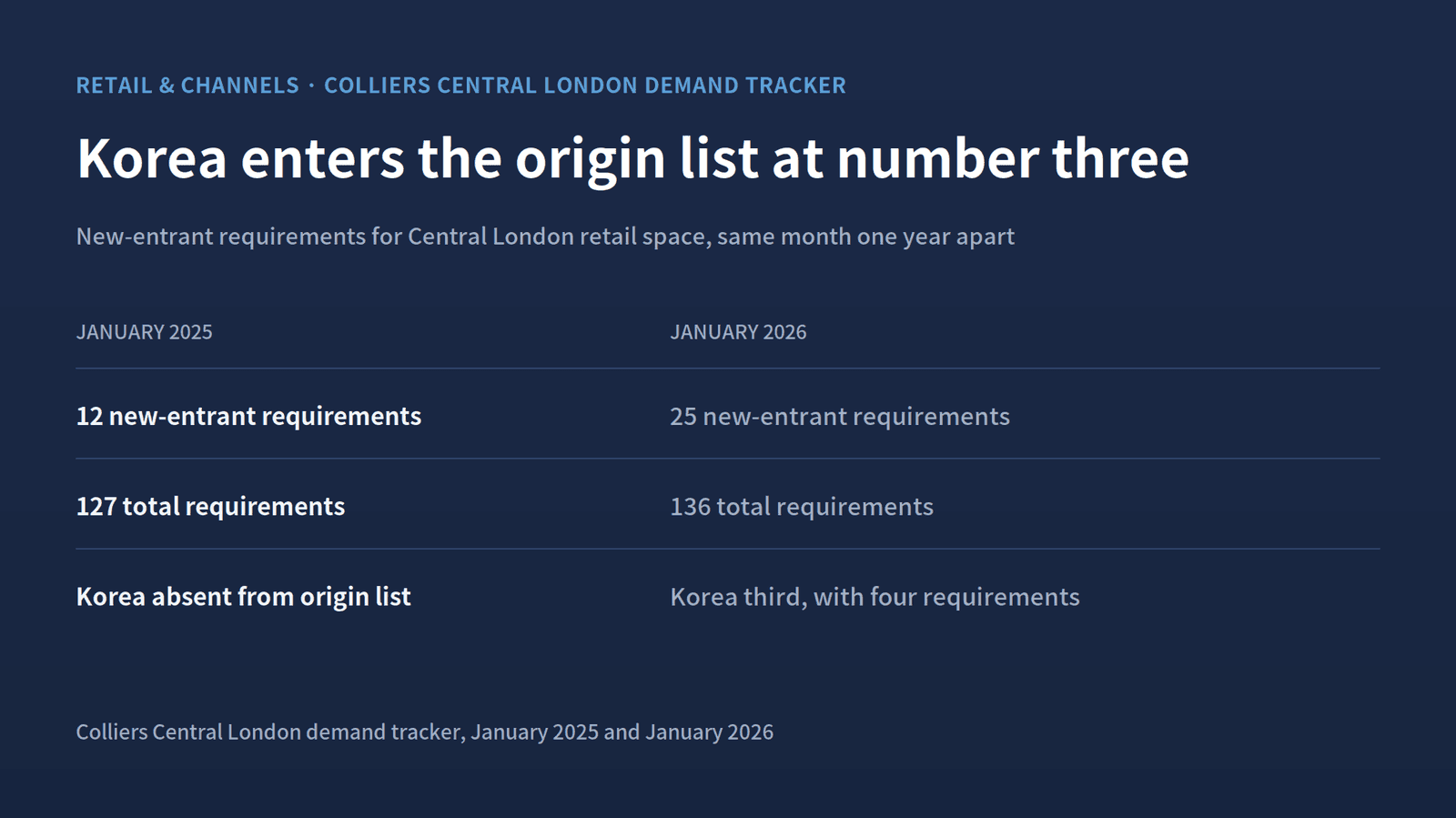
The Colliers demand tracker records requirements — a retailer's stated brief for space in a given market, logged by the agency before any lease is signed. A requirement is an intention, not a transaction. In January 2026 the tracker held 136 requirements across Central London, against 127 in January 2025. Inside that total, new entrants — operators with no existing Central London store — rose from 12 to 25, the 108 percent increase that supplied the headline.
The origin ranking sits within that new-entrant figure. The United States led with six requirements, the United Arab Emirates followed with five, and South Korea came third with four. Colliers' co-head of London retail described January as the first month South Korea had appeared on the firm's top origin list, and attributed the entry to the run of K-beauty brands taking space in London. The tracker named PURESEOUL, Moida and Skin Cupid among the operators behind it.
Four is a small number, and the comparison inside the same month makes that plain. Food and beverage operators accounted for 57 of the 136 requirements. Leisure operators accounted for 27, fashion and accessories for 13. K-beauty's arrival on the origin list is a threshold event in a ranking that turns on single-digit counts, not a shift in the composition of London demand.
Why are West End landlords announcing beauty tenants by name?
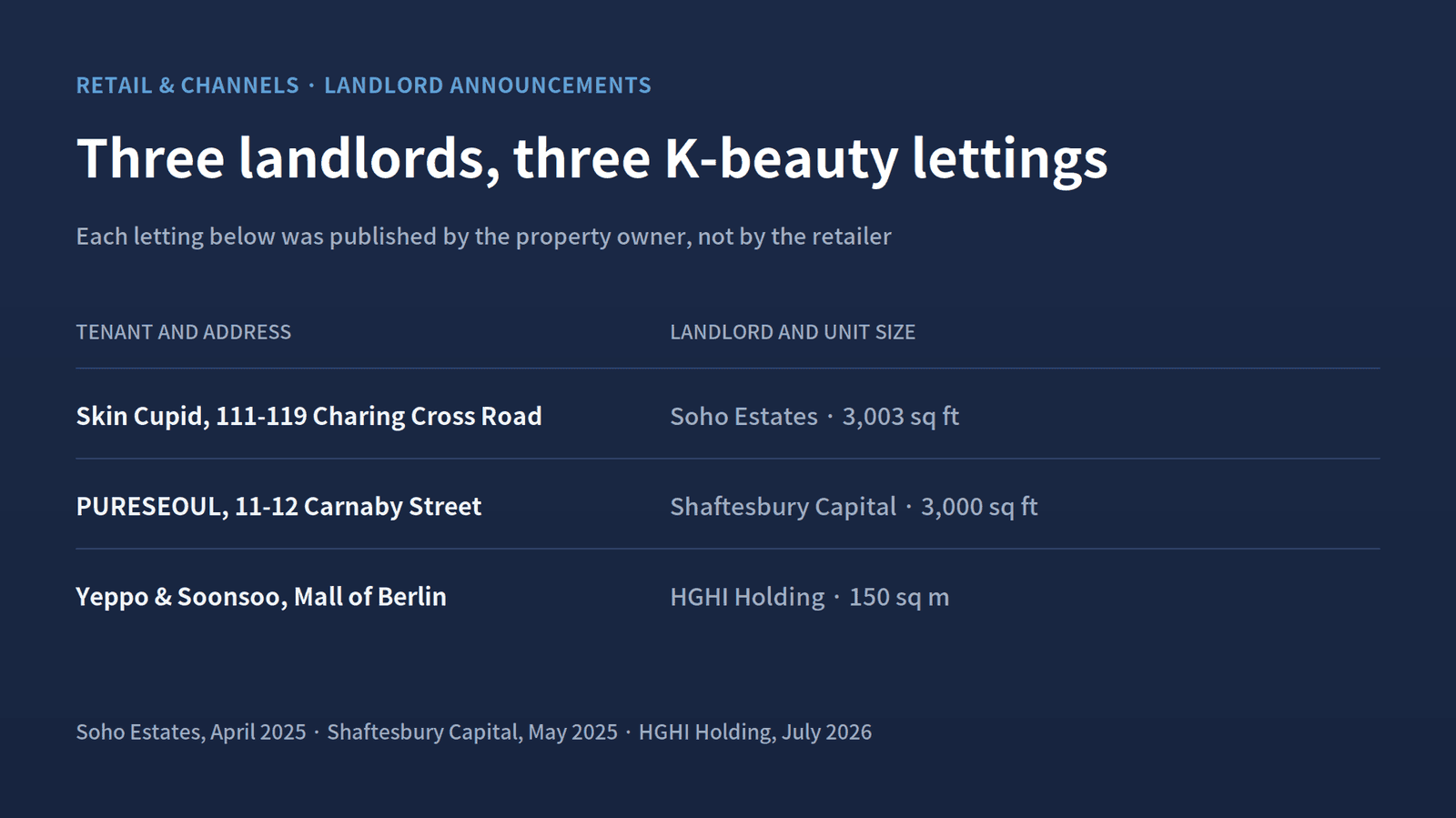
Two London estate owners have published standalone press releases for K-beauty lettings. Soho Estates announced in April 2025 that Skin Cupid would take 3,003 square feet at Ilona Rose House, 111–119 Charing Cross Road, for the retailer's first permanent store. A director at Soho Estates said in that announcement that Skin Cupid's arrival was "a great example of the kind of curated retail that helps keep Soho vibrant and relevant." The letting followed a Skin Cupid pop-up at The Outernet in December 2024.
Shaftesbury Capital announced in May 2025 that PURESEOUL would open a 3,000 square foot flagship across two floors at 11–12 Carnaby Street that June. The release carried a comment from the company's director of retail and restaurant leasing on the retailer's choice of Carnaby Street for its largest store, and one from PURESEOUL's chief executive.
A landlord press release is a leasing signal, not a financial one. Estate owners publish them for tenants they expect to pull footfall across a whole estate rather than fill one unit, because the announcement itself becomes a line in the pitch to the next tenant. That is what separates these two lettings from the rest of the eighteen Korea-linked leases signed in Britain in the nine months to September 2026, none of which an owner announced.
Who actually signs a K-beauty lease in Britain?
Not, in most cases, a Korean company. PURESEOUL was founded in 2019 by Leslie Tang, Gracie Tullio and Wing-Sze Tang, and runs as a British retailer with a London office and staff in Seoul. Its co-founder has described it as a British-born start-up with no parent company behind it. It reached 15 UK stores by May 2026, when it opened in Bath, and has said it intends to double that estate by the end of 2026, with roughly five stores under construction and three further leases signed. Those expansion figures are the company's own.
Skin Cupid was founded by Melody Yuan and trades as an Asian beauty retailer rather than a single-brand outlet. Moida, which trades as a K-beauty chain, opened at Westfield White City in February 2025, Manchester Arndale in January 2026, Bullring in Birmingham in April 2026 and Battersea Power Station in June 2026.
The distinction matters for anyone reading this as a Korean export story. The party taking the lease, paying the rent and carrying the covenant is a European multi-brand retailer. A brand stocked on Carnaby Street has not taken a Carnaby Street lease, and does not hold the option to renew one.
How much space has the category taken?
An agency count of Korea-linked lettings in Britain put 18 K-beauty leases in the nine months to September 2026, covering roughly 55,000 square feet, or about 5,100 square metres, across major retail districts. Those are the agency's own figures rather than a public register. They divide to about 3,000 square feet a store, which matches the two documented Soho lettings almost exactly, and describes a format closer to a specialist chain unit than to a department store concession.
The clustering is the part leasing agents emphasise. Moida, PURESEOUL and Skin Cupid all trade within a short walk of Charing Cross Road, alongside Korean food operators including Bunsik, Oseyo and Seoul Plaza. A researcher at Cushman & Wakefield has characterised the pattern as a structural feature of the European retail market rather than a passing one, on the argument that adjacent Korean beauty and food outlets extend dwell time and generate repeat visits.
Dwell time is the argument that converts a small tenant into a desirable one. It is also the argument an estate owner makes about any cluster it has already assembled, and it is untested for this category over a full lease cycle. The first of these London stores opened in 2025.
What does the German build-out look like at street level?
Moida took roughly 1,200 square metres at Spitalerstraße 10 in Hamburg, in the Semperhaus building, in an expansion reported in May 2026. That is the largest single K-beauty unit documented in Europe and roughly four times the size of the London flagships.
Berlin is a different scale. HGHI Holding, which owns the Mall of Berlin, announced in July 2026 that Yeppo & Soonsoo would open a flagship there in a 150 square metre unit. The owner and managing director of HGHI framed the arrival of brands of that kind as evidence of the centre's pull, and set it inside a wider programme of restructuring space and adding international names. The Mall of Berlin draws around 22 million visitors a year.
A 150 square metre unit inside a centre of that size is a test, not an anchor. German retail commentary circulating in Korea has gone further, describing K-beauty as having displaced carmakers and electronics brands as a source of demand for prime German retail space since 2025. That comparison does not appear in any published brokerage report this article was able to obtain, and it is not relied on here.
Where does K-beauty sit in a landlord's own accounts?
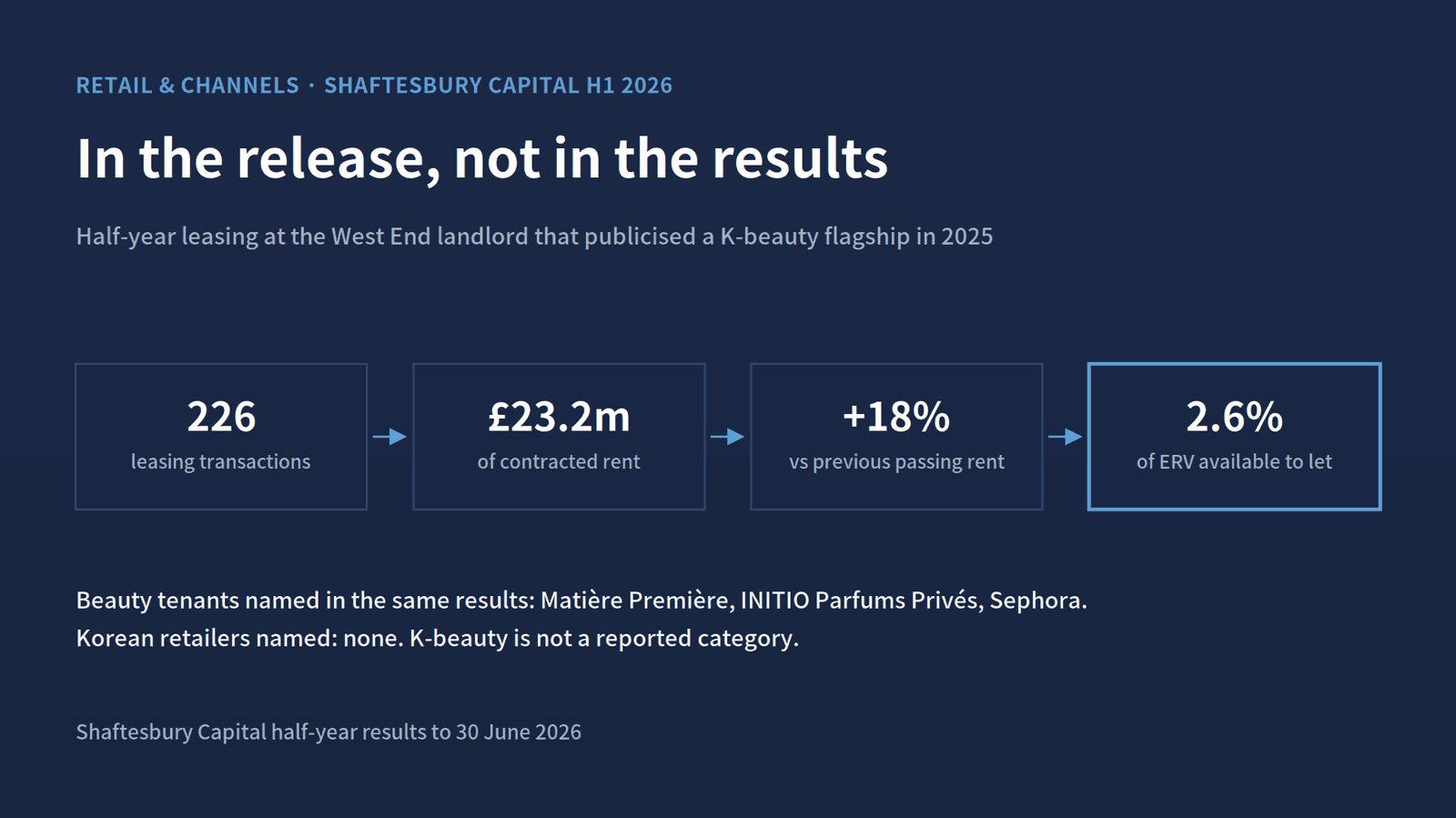
Shaftesbury Capital's half-year results to 30 June 2026 record 226 leasing transactions representing £23.2 million of contracted rent, 5 percent ahead of the December 2025 estimated rental value and 18 percent ahead of previous passing rents. At period end, 2.6 percent of estimated rental value was available to let.
The beauty tenants those results name are Matière Première, which opened its first UK store, INITIO Parfums Privés, which opened its first standalone UK boutique in the Market Building, and Sephora, which launched its new boutique format and first West End store on the estate over the summer. K-beauty appears as no category, and no Korean retailer is named — in the same portfolio whose leasing team put out a press release for PURESEOUL the year before.
That gap is the honest measure of where the category stands in European retail property. It is large enough to be worth announcing and too small to be worth reporting. Estimated rental value, the figure landlords use to describe what a unit should earn at market terms, is where a tenant category registers once it starts setting rents. K-beauty has not reached that line.
Is this K-beauty demand, or London supply?
Colliers' co-head of London retail set out the market condition alongside the origin ranking: appetite for London space is strong, supply in prime locations is low, and there is competitive tension for the best units. Shaftesbury Capital's 2.6 percent availability is the same condition stated as a portfolio number.
In a market with that little slack, a landlord's willingness to court an unfamiliar category is not primarily a judgement about the category. It is a function of how many alternatives are bidding for the same unit and how much the owner needs a name that reads as new. The full-year 2025 tracker showed Central London requirements up 37.9 percent on 2024, with leisure operators up 60.1 percent and fashion and accessories up 53.6 percent. K-beauty entered a market that was already bidding itself up, and its four January requirements were counted against that backdrop.
The corollary holds in the other direction. A category that gets its pick of units in a tight market has not proved it can hold them in a loose one.
What do the export numbers underneath the leases show?
Korean cosmetics exports reached $11.4 billion in 2025, the highest annual total recorded by the Ministry of Food and Drug Safety. The three largest destinations were the United States at $2.2 billion, China at $2 billion and Japan at $1.1 billion. Europe did not appear among them.
Europe's position changed in the first half of 2026. Korea Customs Service figures put shipments to 58 European countries at $1.596 billion against $1.570 billion to the United States and Canada, the first half-year in which Europe outranked North America as a destination for Korean cosmetics. The margin was $26 million, under 2 percent of either figure.
That is the same shape as the leasing data. Europe passed North America; it did not pull away from it. A category that leads by two percent on exports and holds third place on four London requirements is at the point where the direction is clear and the position is not yet secure. Both numbers reverse on a single bad quarter.
What does the category look like from three sides?
For a landlord, a K-beauty letting is a 3,000 square foot bet on dwell time in a market with almost nothing left to let. The downside is ordinary covenant risk on a small unit. The upside is a cluster that prices the next letting. That trade favours the owner at current availability and stops favouring it the moment availability widens.
For the European retailers signing these leases, the category is the business rather than a line inside it. Doubling a fifteen-store estate inside a year is a retail rollout with retail rollout economics: rent, staffing, and the question of what like-for-like sales do in each catchment once the novelty premium is spent. These operators carry the property risk that the Korean brands on their shelves do not.
For Korean suppliers, the leases sit on someone else's balance sheet. Shelf space in Soho, Hamburg and Leipziger Platz is distribution won without capital committed, and distribution that ends on a buyer's decision rather than a lease break. The brands with the most European visibility currently hold the least European property, and the least say over what happens to the shelf.
The announcements are running ahead of the accounts. That is normal at this stage of a category. It is also the reason to read the leasing trackers rather than the press releases.