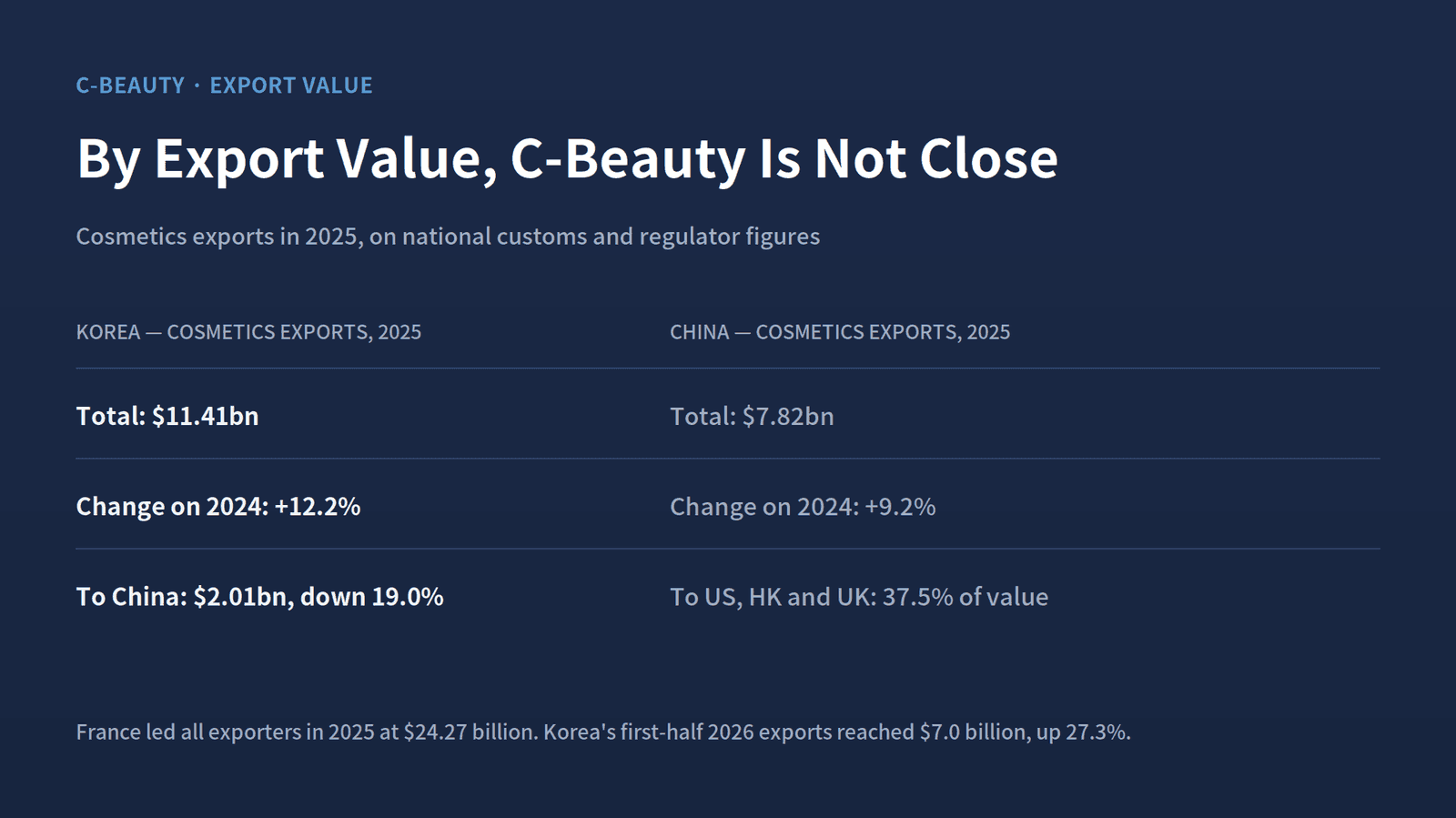
China exported $7.82 billion of cosmetics in 2025, against Korea's $11.41 billion and France's $24.27 billion. By export value C-beauty is not close. What has changed sits in a different ledger: Jinbo Bio holds three Class III medical device registrations for injectable recombinant collagen, and L'Oreal's SkinCeuticals has been selling a product built on one of them since April 2024. The asset crossing the border is the ingredient, not the brand.
What did C-beauty actually win, and where?
The win is domestic, and it is decisive. The 2026 Chinese beauty industry white paper puts first-half 2026 retail sales for domestic brands at 268.67 billion yuan ($40.0 billion), up 7.89%, against 250.23 billion yuan ($37.3 billion) for foreign brands, up 1.2%. Domestic growth ran 6.5 times the foreign rate. Domestic brands first passed foreign brands in China in 2022 and have added more than 16.6 percentage points of share over five years. Yuan figures convert throughout at 6.7133 to the dollar, the 25 September 2026 rate.
That is the first thing the playbook comparison gets wrong. K-beauty's story was always an export story, told about a home market too small to matter on its own. C-beauty's story so far is a home market story, told about the largest single beauty market outside the United States. The two are not the same shape, and one does not become the other by adding overseas shipments.
Is this the export story people assume it is?
Chinese cosmetics exports reached $7.82 billion in 2025, up 9.2% on customs figures. Korean cosmetics exports reached $11.41 billion, up 12.2%, moving Korea to second place among exporting countries behind France at $24.27 billion and ahead of the United States at $10.75 billion. Korea's cosmetics trade surplus passed $10 billion for the first time, at $10.12 billion.
The first-half 2026 figures widen the gap rather than closing it. Korea shipped $7.0 billion in six months, up 27.3%, which is close to China's entire 2025 export year. China's own export value concentrates in three destinations: the United States, Hong Kong and the United Kingdom together accounted for 37.5% of it in 2025.
Where did Korea's China business go?
It went to Chinese brands inside China, not to a Chinese export machine. Korea's cosmetics exports to China fell 19.0% in 2025 to $2.01 billion, dropping China to second place behind the United States at $2.18 billion. In the first half of 2026 exports to China fell a further 6.6% to $1.01 billion. The share path is the clearest number in the whole picture: China took 46.5% of Korean cosmetics exports in the first half of 2022, then 34.7%, then 25.2%, then 19.6%, and 14.4% in the first half of 2026.
Two separate things happened in the same window and get reported as one. Korean brands lost a market they had held on Chinese shelves. Korean exports overall grew 27.3%. A collapse in one destination and a record year are both true, and treating the first as evidence of Chinese export strength confuses a domestic displacement with an international one.
What is recombinant collagen, and why does its registration matter?
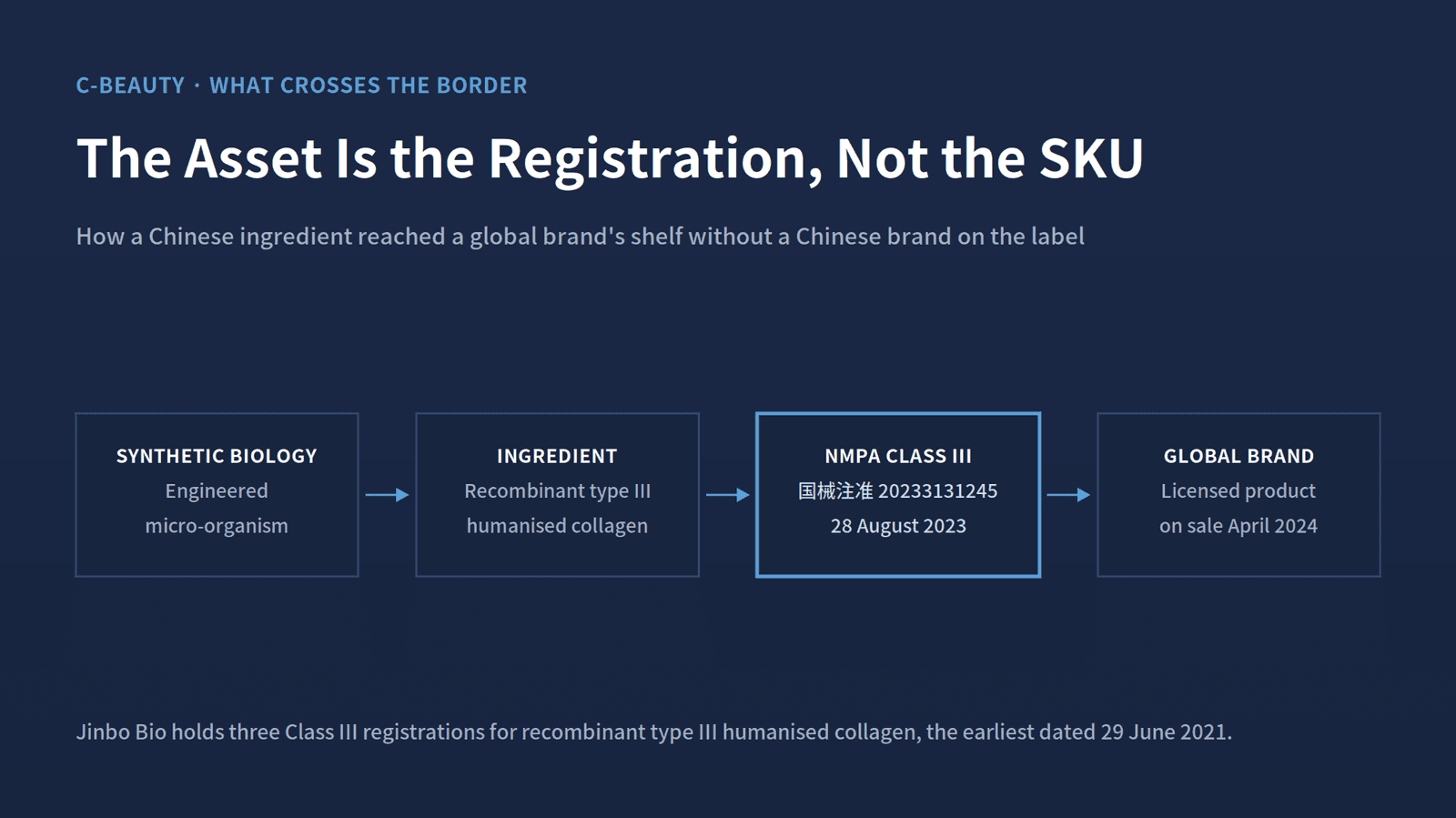
Recombinant collagen is collagen protein produced by engineered micro-organisms rather than extracted from animal tissue — a synthetic biology product rather than a rendered one. In China the injectable forms are regulated as Class III medical devices, the highest risk class, which requires clinical evidence and a numbered registration certificate rather than the notification a cosmetic receives.
Jinbo Bio's certificates are specific and dated. Registration 国械注准20213130488, a recombinant type III humanised collagen freeze-dried fibre, was approved on 29 June 2021 for facial dermal filling and wrinkle reduction. Registration 国械注准20233131245, an injectable recombinant type III humanised collagen solution, was approved on 28 August 2023 for facial wrinkle correction. A gel formulation followed. The company holds three.
The commercial consequence is what makes this different from a product launch. A registration certificate is scarce, dated, numbered and slow to replicate, because the clinical file behind it cannot be bought. A skincare formulation is none of those things: the standard K-beauty export asset is a finished item built on an ODM's formulation — an original design manufacturer being the contract developer that owns the recipe — and a competitor can order a near-identical one from the same ODM. Jinbo Bio's 2024 revenue was 1.447 billion yuan ($216 million), up 85.40%, with net profit of 733 million yuan ($109 million), up 144.65%. First-quarter 2025 revenue was 366 million yuan ($54.5 million), up 62.51%.
What does a global major licensing that ingredient signal?
SkinCeuticals, L'Oreal's professional skincare brand, has commercialised a product built on the August 2023 registration since April 2024. The direction of travel is the point. For two decades the flow ran one way: global majors licensed formulations, technology and manufacturing standards into China, and Chinese companies paid for access. Here the Chinese registration holder is the licensor and the global major is the route to market.
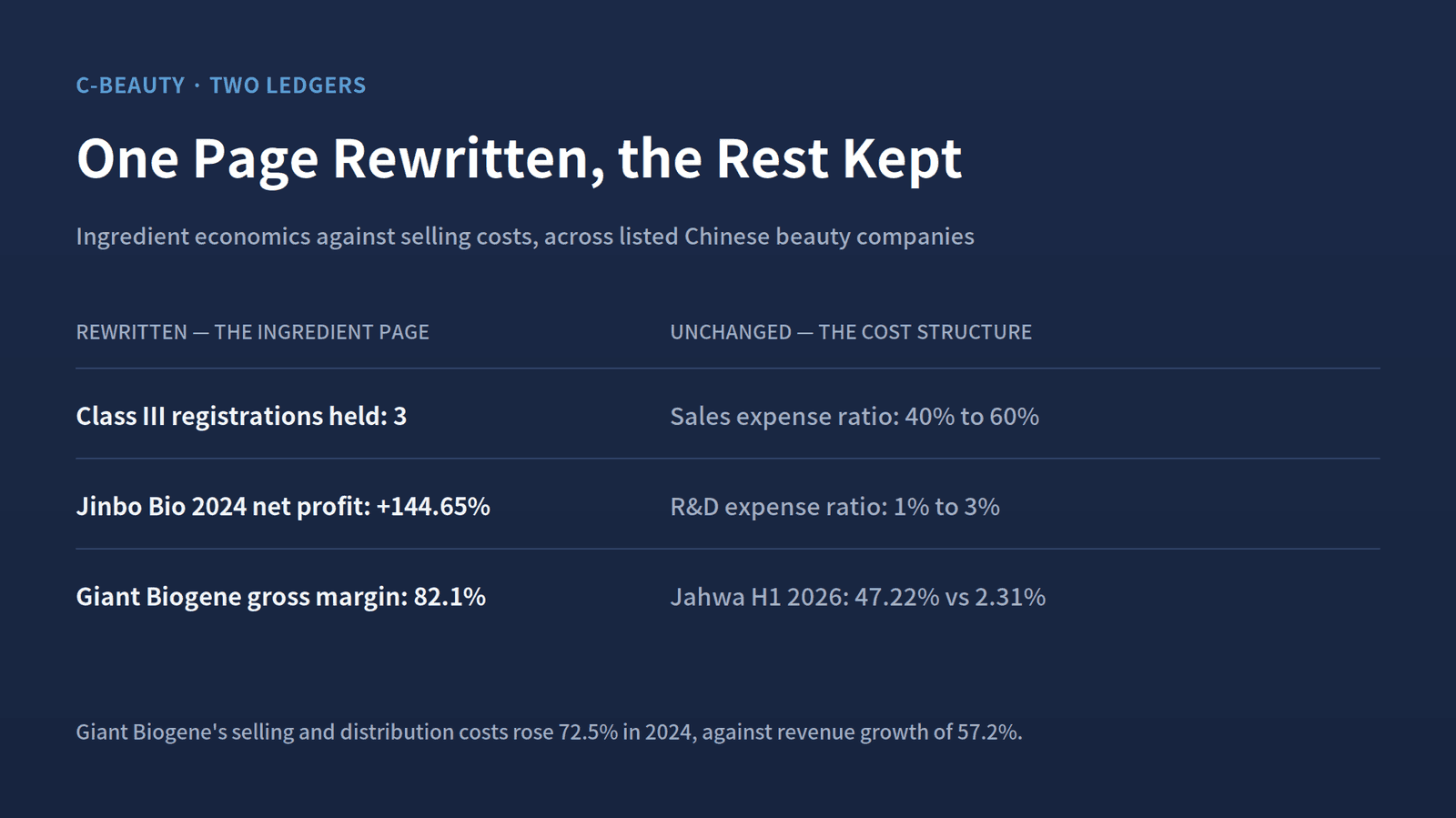
Giant Biogene, the other company operating at scale in the category, reported 2024 revenue of 5.539 billion yuan ($825 million), up 57.2%, and net profit of 2.062 billion yuan ($307 million), up 42.2%, on a gross margin of 82.1%, down from 83.6% in 2023. One brand, Comfy, accounted for 82% of revenue at 4.54 billion yuan ($676 million). Those are pharmaceutical gross margins attached to a consumer skincare label.
Which page of the old playbook did C-beauty keep?
The cost structure, in full. Across listed Chinese beauty companies, sales expense ratios — selling and marketing costs as a share of revenue — run above 40% and reach 60%, while research and development sits between 1% and 3%. Shanghai Jahwa's first-half 2026 accounts show a 47.22% sales expense ratio against 2.31% on research.
That is the marketing-led model K-beauty ran through its own Chinese boom, and it produces the same result: share without margin. The pattern reaches the ingredient companies too. Giant Biogene's selling and distribution costs rose 72.5% in 2024 to 2.008 billion yuan ($299 million), outpacing its 57.2% revenue growth, and the company subsequently reported its first simultaneous fall in revenue and net profit since listing.
So the accurate version of the claim is narrower than the headline version, and more useful. C-beauty has rewritten one page, the ingredient page, and left the rest of the book where it found it.
Why Southeast Asia before the West?
Euromonitor figures put the compound annual growth rate for Chinese colour cosmetics in Southeast Asia at 70% between 2019 and 2024, and for skincare at 115%. Proya, Florasis, Judydoll, INTO YOU and Focallure are among the brands expanding there. Joy Group, which owns Judydoll and Joocyee, reported 2025 retail sales above $730 million with $87 million from overseas markets and Vietnam as its largest, having set up a Singapore regional hub in 2024.
The reasoning is proximity, young populations and a channel that already works. It is not the sequence K-beauty ran. Korean brands went to China first, at scale, and reached Western markets afterwards through distributors, specialist importers and Amazon. Chinese brands are skipping the large adjacent market they already own and going straight to the one where their existing selling method transfers without translation.
What does the channel change about who owns the customer?
Growth there runs on social commerce — selling inside a content feed rather than on a storefront a shopper navigates to — through TikTok Shop and Shopee rather than conventional retail expansion. Chinese brands arrive having run exactly this model domestically on Douyin for years, at a scale no other market has produced.
The consequence for everyone else is a change in gatekeeper. The decision-maker is not a retail buyer with a category plan; it is a ranking. A brand that can buy traffic and produce content at volume gets distribution without a distributor, which removes the step where a foreign brand historically needed an importer, a local marketing partner and a negotiated shelf. It also removes the asset that step created. Shelf position compounds. A ranking resets every day.
What does the industry downstream do with this?
For manufacturers and ODMs, the differentiator moves upstream, from formulation to registration. A contract developer that can only formulate competes on price against every other contract developer. One that holds a registration certificate sells something its customer cannot re-source elsewhere. Korea's ODM sector is built at the formulation layer by design, and that design was an advantage when speed to shelf was the binding constraint.
For brands and the buyers who stock them, the evidentiary floor rises. A buyer weighing clinical claims now has a second country of origin offering a numbered certificate and a clinical file instead of a chart that looks clinical. Anyone selling into the same category answers that comparison whether or not they compete with a Chinese brand directly.
For regulators and investors, the accounting is the anomaly worth watching. A beauty company whose core asset is a device registration is being valued on pharmaceutical logic — scarcity, clinical data, a certificate with a date on it — while its expense lines read like a consumer marketing business. Those two rarely survive in the same set of accounts for long.
C-beauty did not out-export K-beauty. It changed what counts as an exportable asset. That is the smaller claim, and it is the one that holds.