Goodai Global's consolidated revenue rose from 373.1 billion won to 1.4717 trillion won ($1.06 billion) in a single year, and its KOSPI preliminary review filing has been prepared on an underwriter target of about 10 trillion won ($7.2 billion). One subsidiary, Craver, supplies 46.06% of that revenue, and it is being restructured for a listing of its own in Tokyo. What investors are being asked to buy is a platform whose largest single component already has a scheduled exit from it.
What is actually being listed here?
Goodai Global is a roll-up: a company that grows by buying finished brands rather than building them, a structure consumer-goods investors call an aggregator. It was founded in 2016 as a cosmetics distributor and bought the herbal skincare brand Beauty of Joseon in 2019. Three acquisitions followed in 2024 — Theraphyto, which operates TirTir; the colour brand Laka; and Craver, which operates Skin1004. Serin Company, which operates Round Lab, and Skin Food followed in 2025. In February 2026 the group bought Hansung USA, a North American distributor, for a reported 100 billion won ($72 million). Counts of the resulting portfolio run between eight and eleven brands depending on which entities are treated as separate.
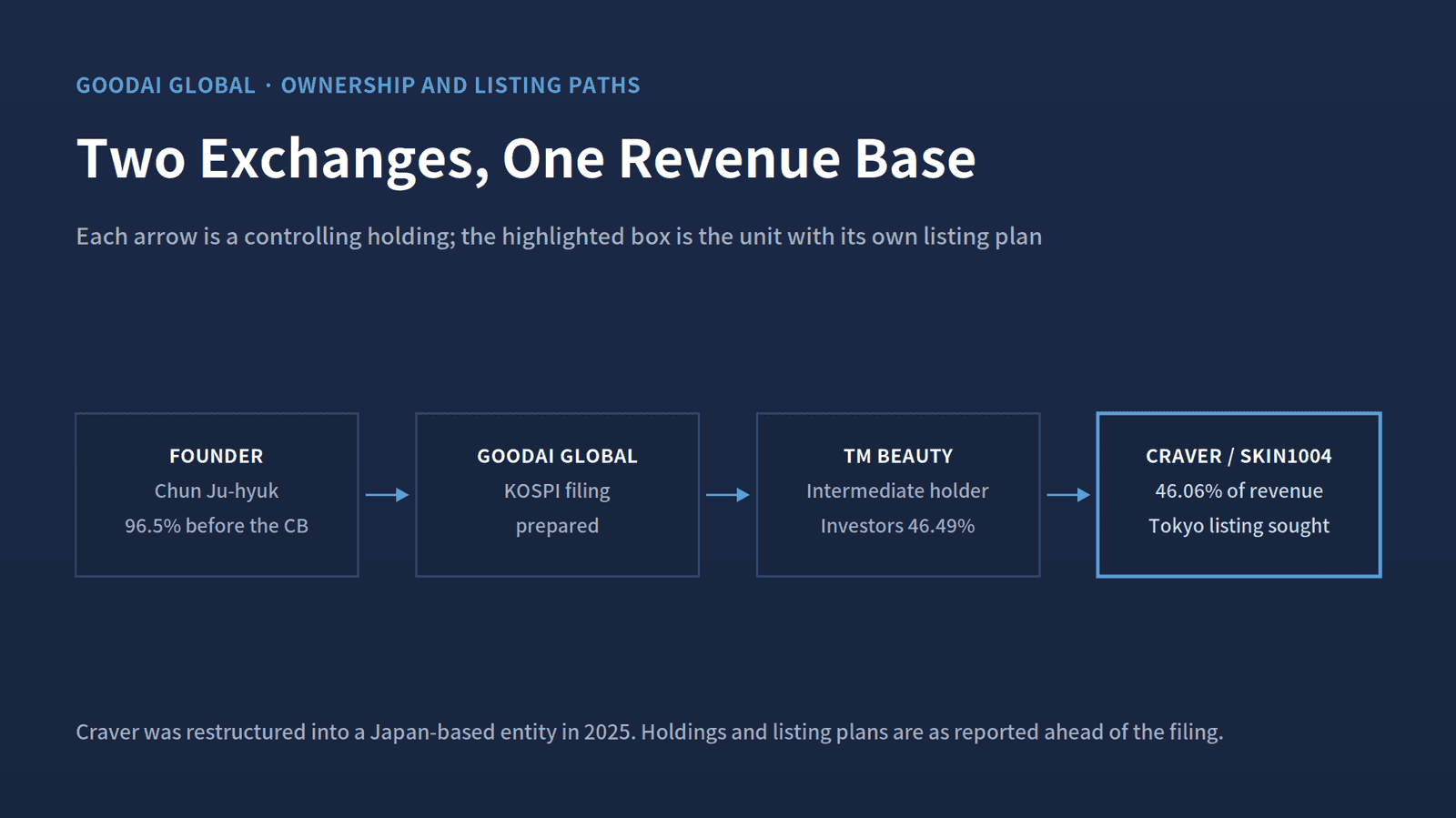
The listing vehicle is the parent. Mirae Asset Securities is lead underwriter, with NH Investment & Securities, Citigroup Global Markets Securities and Morgan Stanley alongside it. The company completed a 50-to-1 stock split and appointed Koo Chang-gun, formerly chief executive of CJ Olive Young, as co-chief executive. Founder Chun Ju-hyuk held 96.5% before the convertible bond round described below.
A preliminary review filing is the Korea Exchange's eligibility screen, submitted before any public offering. It matters here for a reason beyond procedure. It is the first point at which the group's revenue split, its subsidiary shareholdings and the terms its financial investors negotiated enter the public record rather than circulating as reported figures.
Where does the group's revenue actually come from?
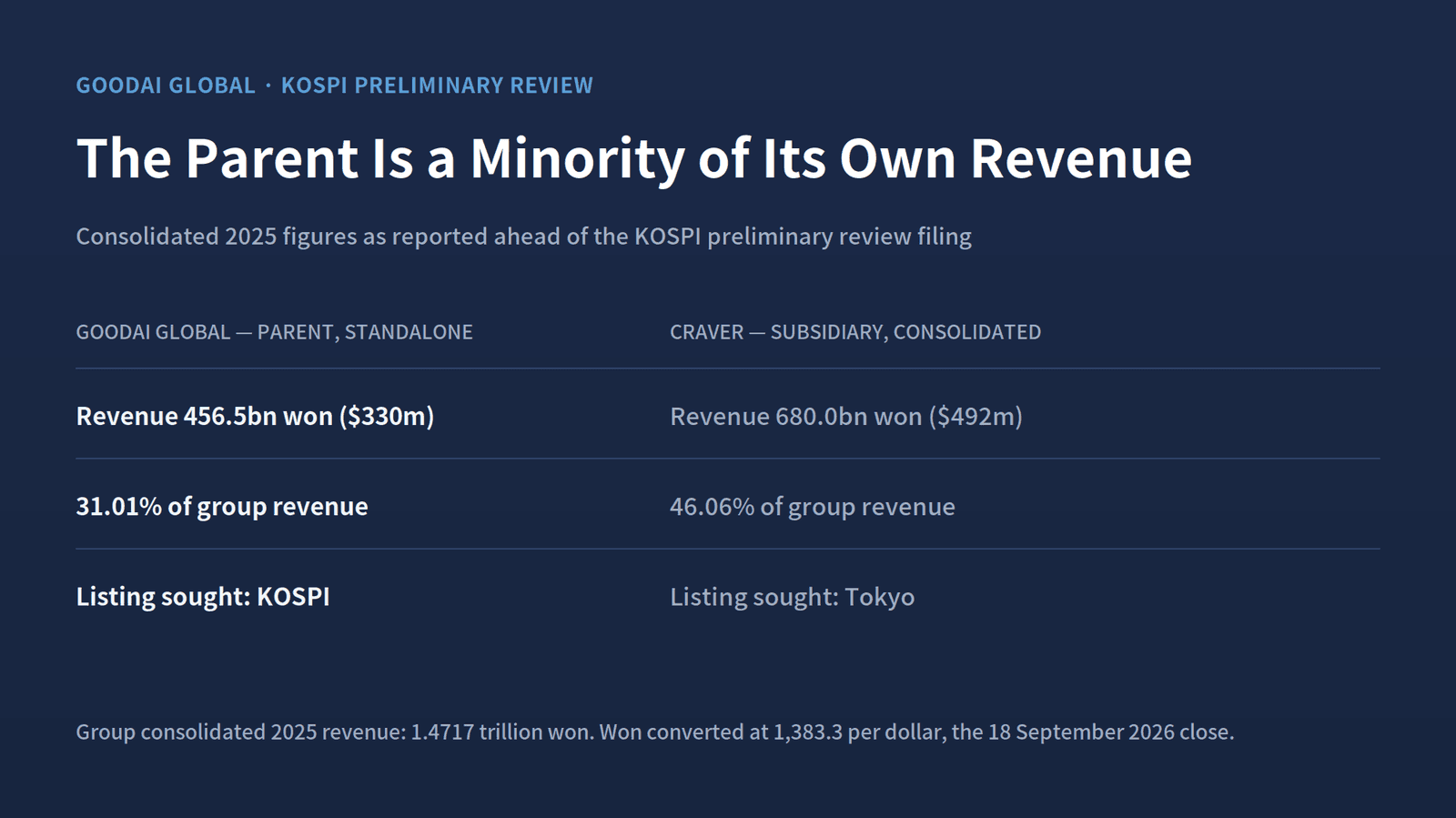
The 2025 consolidated accounts show revenue of 1.4717 trillion won and operating profit of 273.4 billion won ($198 million). Goodai Global's own standalone revenue was 456.5 billion won ($330 million), or 31.01% of the consolidated total. Craver's consolidated revenue was 680 billion won ($492 million), or 46.06%, on a disclosed holding of 97.29%. Serin Company contributed 305.3 billion won ($221 million) and TirTir 226.9 billion won ($164 million). Won figures convert throughout at 1,383.3 to the dollar, the 18 September 2026 close.
The ownership chain runs Goodai Global to TM Beauty to Craver. TM Beauty is an intermediate holding company, and coverage of the IPO preparation puts Goodai Global's stake in it at 53.51%, with financial investors holding 46.49%. The largest single revenue line in the group therefore sits two levels down, behind outside shareholders at the level above it.
Is the growth curve a business curve or a consolidation curve?
On a standalone basis the company reported 139.5 billion won ($101 million) of revenue and 68.9 billion won of operating profit in 2023. For 2024 the consolidated accounts show 330.9 billion won ($239 million) of revenue and 130.5 billion won of operating profit. Coverage of the IPO preparation uses 373.1 billion won as the 2024 base, and that is the figure that produces the widely repeated 294.5% increase. The two 2024 numbers are not reconciled anywhere in public reporting.
The accounting treatment explains why the question arises. Analysis of the 2024 filings describes TM Beauty being consolidated on a substantial-control basis at a 24.21% holding, while Theraphyto and Laka were treated as joint ventures under common control and carried as securities rather than as consolidated revenue lines, using the reduced reporting latitude available to smaller Korean companies. A KOSPI listing removes that latitude. Full consolidation under K-IFRS applies.
Part of the step from hundreds of billions of won to 1.47 trillion is brands being bought. Part of it is entities crossing the line into the consolidated accounts. Preliminary review is where those two get separated, and the separation is the first real test of the valuation.
What did the roll-up cost, and who financed it?
The three 2024 acquisitions totalled roughly 438 billion won ($317 million). Craver was bought at 85% on a 3.4 times EBITDA multiple in December 2024 — the EBITDA multiple being the price paid divided by earnings before interest, tax, depreciation and amortisation, the standard yardstick for pricing private companies. Theraphyto was bought at 49.9% on 9.1 times in April 2024, and Laka at 88% on 10.3 times in June 2024. The average across the three was 7.6 times, well below what listed K-beauty names trade on.
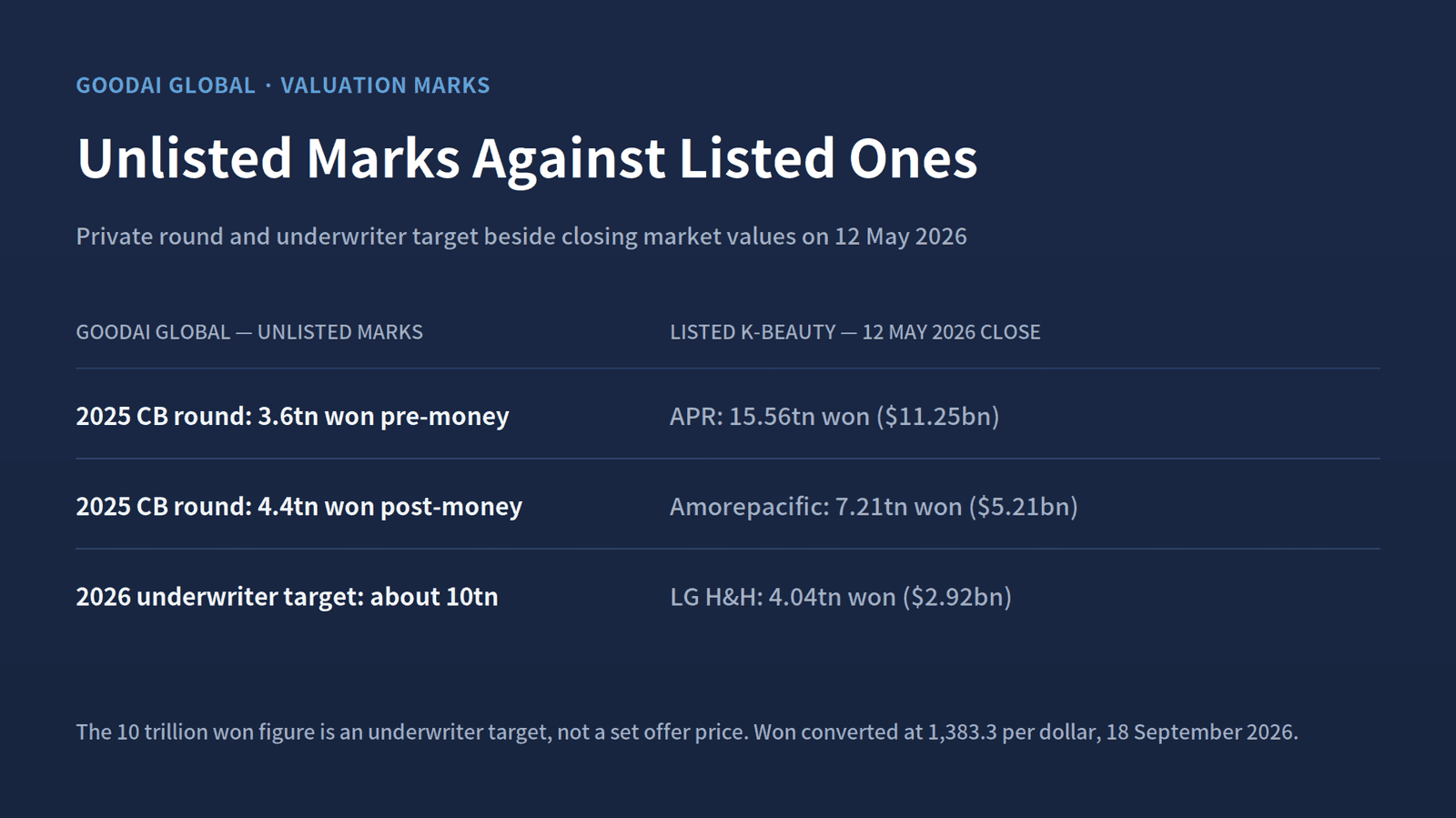
The cash did not come from operations. Operating cash flow in 2024 was 129.5 billion won against 482.4 billion won of investing outflow, with the gap covered by 270.2 billion won of additional borrowing and 141.6 billion won raised at subsidiary level. In 2025 six private equity firms — IMM Private Equity, Premier Partners, IMM Investment, Kiwoom PE, JKL Partners and Company K Partners — subscribed about 800 billion won ($578 million) of convertible bonds, debt that converts into equity at a set price. IMM PE's 280 billion won was the largest ticket. The round was struck at roughly 3.6 trillion won ($2.60 billion) pre-money and 4.4 trillion won ($3.18 billion) after. Cash and equivalents stood at 267.5 billion won at the last year-end.
The structure that produced the growth is the structure that now complicates the listing. Financial investors entered at subsidiary level on nearly every major acquisition, and they entered expecting exits through individual listings or stake sales.
Why does a Tokyo listing for one subsidiary matter to a Seoul valuation?
Craver was restructured into a Japan-based entity, Craver Holdings LLC, in 2025, and a Tokyo Stock Exchange listing is reported as targeted for the third quarter of 2027, after the parent. The Turning Point and Mirae Equity Partners hold positions in Craver; Company K Partners holds one in Serin Company.
The objection to this is mechanical rather than reputational. When the subsidiary carrying the growth and the margin lists separately, investors gain a direct route to it and lose a reason to hold the parent. The Korea Capital Market Institute's study of parent-subsidiary dual listings between 2010 and 2021 found parent company valuations averaging 27% below those of their subsidiaries. Applied here, that discount attaches to the unit supplying 46.06% of consolidated revenue.
What does Korea's dual-listing guideline actually require?
The Financial Services Commission and the Korea Exchange announced the guideline on 6 July 2026, with a comment period running to 14 July. The regime is prohibition in principle with exceptions permitted on conditions: a subsidiary is not listed unless the parent board has discharged five specified duties and adequate shareholder protection is demonstrated.
For subsidiaries created by physical division, shareholder approval is required under the 3% rule, which caps holders above 3% at 3% of voting rights, together with a majority of attending shares and assent from at least a quarter of total issued shares. Where approval is not sought, the board must document why and evidence alternative protections, and the exchange applies stricter scrutiny.
The guideline reaches overseas exchanges, not only KOSPI and KOSDAQ. A Tokyo listing does not sit outside it. Responses reported as under consideration include buying subsidiary stakes outright, swapping financial investors into parent equity, and arguing that separate business domains and separate geographies distinguish this from a spin-off listing, with a Korean industrial group's planned overseas listing of a robotics subsidiary cited as precedent.
What does the single-brand comparison show?
APR listed on KOSPI in February 2024 on a portfolio built in house. At the close on 12 May 2026 its market capitalisation was 15.56 trillion won ($11.25 billion), against Amorepacific at 7.21 trillion won ($5.21 billion) and LG Household & Health Care at 4.04 trillion won ($2.92 billion) — more than the two legacy houses combined. APR's first-quarter 2026 revenue was 593.4 billion won ($429 million) with 152.3 billion won of operating profit, 89% of it from overseas and 248.5 billion won from the United States alone.
A target of about 10 trillion won places Goodai Global below APR and above Amorepacific. APR's number rests on one operating company with a margin record visible quarter by quarter. Goodai Global's rests on a portfolio whose components were priced at an average of 7.6 times EBITDA and whose combination has three reporting years behind it.
Why do the investors' terms set the timetable rather than the market?
The reported structure of the convertible bonds is that a public offering priced below the target converts the financial investors' instruments into a larger number of shares. A weaker offer dilutes the founder rather than the investors. That is ordinary downside protection, and it means the 10 trillion won figure is not a forecast. It is the price at which the existing cap table stays where it is.
Which is why the filing date matters more than the listing date. Preliminary review forces the subsidiary shareholdings, the conversion terms and the accounting basis into documents that can be read rather than briefed. Whatever the exchange concludes about Craver, it will conclude it on a record that does not currently exist.
What does this settle that the last wave of K-beauty listings did not?
Korea exported more than $11 billion of cosmetics in 2025, a record. The listings that followed asked the market to price brand operators. This one asks it to price an acquirer, and the answer travels well beyond one company.
For manufacturers and ODMs — original design manufacturers, the contract developers that own the formulations behind most indie labels — a listed roll-up with equity to spend becomes a permanent bidder, and order books concentrate around buyers who can pay in stock. For brand owners and the buyers who stock them, the exit changes shape: the counterparty stops being a strategic acquirer or a fund and becomes a listed vehicle whose currency is its own multiple. For regulators and the investors who financed the wave, the July 2026 guideline decides whether subsidiary-level exits survive the parent's listing at all. If they do not, an acquirer has to buy out the financiers who paid for the acquisitions before it can go public.
The brands sell. The export figures settled that. What this filing tests is whether the holding company above them is worth paying for.