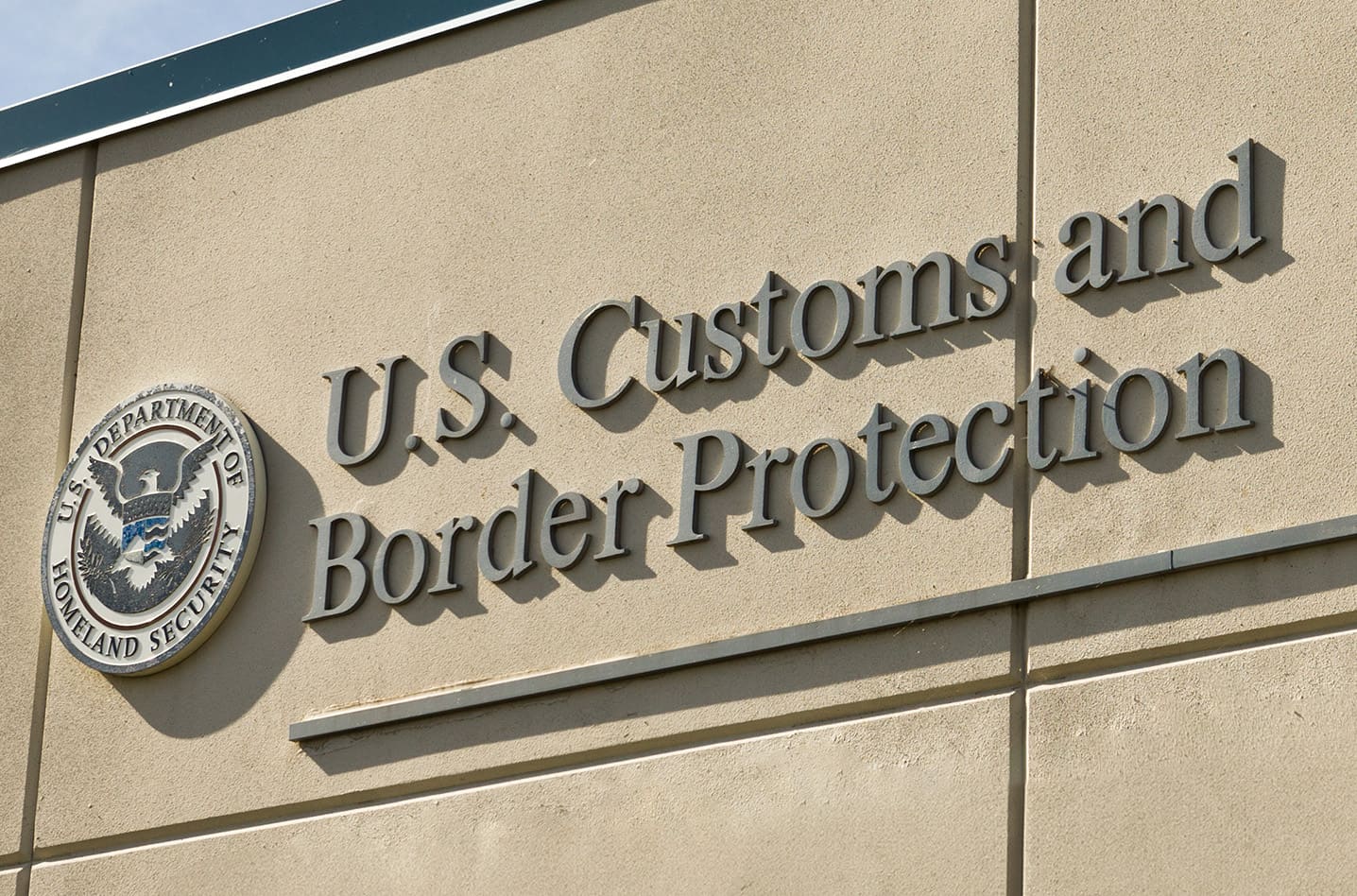
Import Alert 53-06 authorizes FDA to hold a cosmetic at the U.S. border without opening a single box. The alert page carries a publication date of October 29, 2026, three charge codes, and one trigger: a product that appears to contain an unsafe or undeclared color additive. FDA's Korea listing shows two cosmetics alerts, 53-06 and the microbial-contamination alert 53-17. At this border the question is not whether the formula is safe. It is whether the paperwork proves it before anyone tests it.
What does Import Alert 53-06 actually authorize?
An import alert is an FDA notice that identifies problem products or shippers and tells the agency's field divisions how to treat them at entry. Alert 53-06 is titled "Detention Without Physical Examination of Cosmetics That Are Adulterated and/or Misbranded Due to Color Additive Violations." FDA's color additive enforcement page describes the same alert in shorter form, as the alert for cosmetics containing illegal colors.
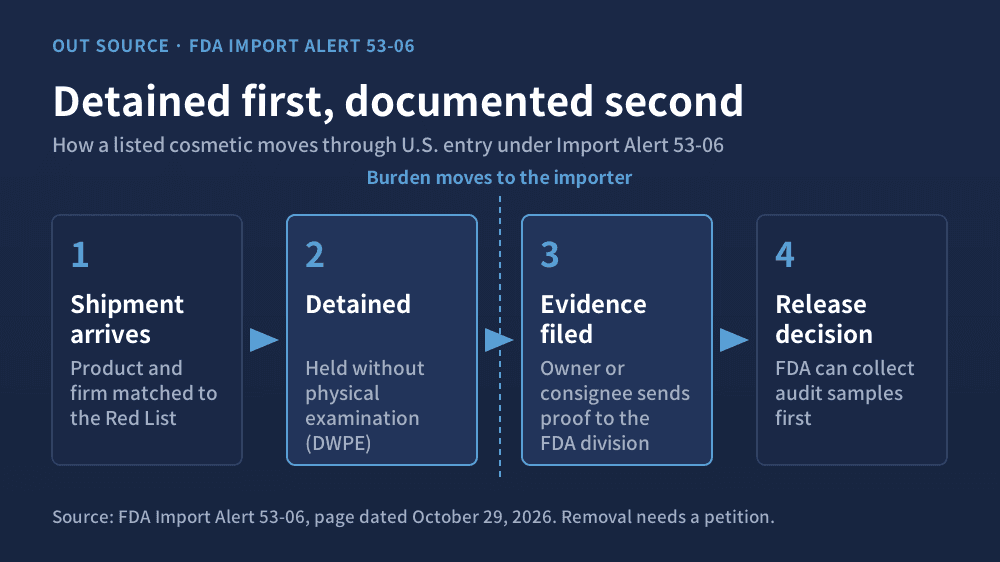
Detention without physical examination, abbreviated DWPE, means a shipment is held on the strength of a listing alone. The guidance authorizes divisions to detain, without physical examination, shipments of the products identified on the alert's Red List. No inspector opens the carton first. Any audit sampling comes during the release decision, not before the hold.
What is the Red List, and what does it name?
The Red List is the alert's roster. The guidance directs that firm listings state which type of violation each entry carries: non-permitted, uncertified, undeclared, or a combination. That designation decides which charge applies to the shipment.
The public page organizes entries by country. The Korea portion of the Red List was not readable in full for this analysis, so no Korean firm is named here. What the page does establish is the mechanism, and the mechanism applies to every origin.
What are the three color additive violations?
A color additive is any dye, pigment, or other substance that gives a cosmetic its color. U.S. law requires FDA pre-approval for color additives, and many require batch certification before they ship. The alert sorts failures into three types.
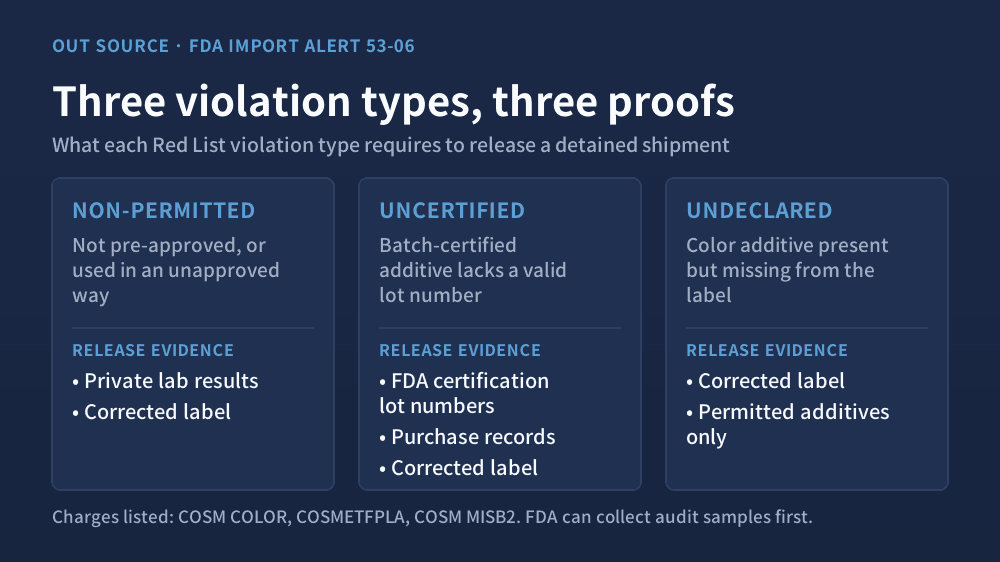
A non-permitted additive is not pre-approved, or is used in a way FDA has not approved. An uncertified additive requires batch certification and lacks a valid certification lot number. An undeclared additive is present in the product but missing from the label.
The alert attaches three charges, each tied to a code in OASIS, FDA's import entry system. Charge 1 (COSM COLOR) says the article appears to contain a color additive that is unsafe under section 721(a) of the Federal Food, Drug, and Cosmetic Act, which makes it adulterated under section 601(e). Charge 2 (COSMETFPLA) says the article appears misbranded under the Fair Packaging and Labeling Act because it appears to contain an undeclared color additive. Charge 3 (COSM MISB2) says the labeling is false or misleading in any particular under section 602(a).
Why does the word "appears" carry the alert?
Every charge is worded as an appearance. The article appears to contain an unsafe additive. The article appears misbranded because it appears to contain an undeclared one. DWPE does not require a finding that the product is illegal. It requires that the product and firm sit on the list.
That is a design for speed. FDA cannot physically examine every shipment of a listed product, so the listing substitutes for the examination. The burden of proof moves to the party that holds the documents. The agency's evidence is the listing. The importer's evidence is what releases the shipment.
How does a detained shipment get released?
The owner, consignee, or other responsible party submits evidence to the compliance office of the relevant FDA division. The evidence must show that the product does not contain an unsafe or undeclared color additive, or that its label is not false or misleading.
What counts depends on the violation type. For a non-permitted additive, the alert lists private laboratory results and a corrected label. For an uncertified additive, it lists valid FDA certification lot numbers, purchase records, and a corrected label. For a permitted additive that appears undeclared, a corrected label is the remedy. FDA can collect audit samples before it decides.
Release moves one shipment. The next shipment of the same listed product meets the same detention until the firm leaves the list.
How does a firm leave the Red List?
Removal requires a showing that the firm has resolved the conditions that gave rise to the appearance of the violation. Petitions go to FDA's Division of Import Operations. The alert points to Chapter 9 of FDA's Regulatory Procedures Manual, section 9-8, for DWPE procedures.
A petition fixes the cause, not a single entry. A release answers one detention. A removal answers the listing.
Where does Korea sit in the alert?
FDA's Korea country listing carries two cosmetics alerts. Alert 53-06 shows a publication date of October 29, 2026. Alert 53-17, detention of cosmetics for microbiological contamination, shows September 30, 2026. The listing does not say whether either entry reflects a named Korean firm or a country-level classification, and the alert titles describe product-based criteria.
The 53-06 page also carries a revision line dated November 17, 2023, which is earlier than its publication date. The page does not say whether October 29 marks a new designation or a republication. Nothing on these pages establishes that a specific Korean exporter is detained right now.
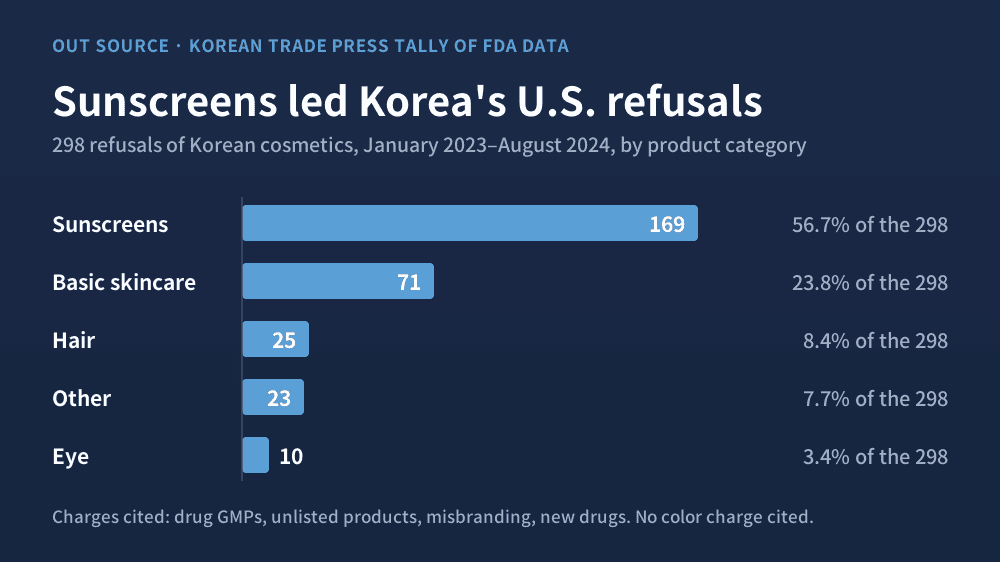
Refusal history is the other half of the picture. Korean trade press, tallying FDA refusal records, counted 298 refusals of Korean cosmetics between January 2023 and August 2024: 188 in 2023 and 110 in the first eight months of 2024. Sunscreens accounted for 169. The reasons cited were drug good manufacturing practice, products not listed under the registration rules of the Modernization of Cosmetics Regulation Act of 2022 (MoCRA), misbranding, and unapproved new drugs. The tally cites no color additive charge, and it ends in August 2024.
What does the refusal data say about color?
FDA's color additive enforcement page states that color additive refusals are listed by product category and that cosmetics are not broken out as a distinct count. Detentions appear on the monthly import refusals list. The public record that would show color-driven cosmetic refusals by country is therefore not on the alert pages.
Third-party tallies of FDA refusal records fill part of the gap. One counts 1,300 batches of imported cosmetics rejected in 2024 from 42 countries, 723 of them, about 56%, for drugs misclassified as cosmetics. Another counts 103 batches from 17 countries in February 2026 and names noncompliant color additives as the leading cause. China supplied 19.4% of those batches, Canada, France, and Poland 12.6% each, and Israel 11.7%. Korea is not among the origins that summary names.
Color is a leading cause in recent monthly counts and absent from the Korean tally above. Both statements hold. The data that would reconcile them, monthly refusal records filtered to Korean cosmetics and color charge codes, sits in FDA's refusals list, not in either alert.
Who carries the burden at the U.S. border now?
Under DWPE the burden sits with whoever holds the paperwork, and the three sides of the supply chain hold different parts of it.
Manufacturing. A contract manufacturer's color additive file, meaning certification lot numbers, purchase records, and private laboratory results, becomes the document that releases a client's shipment. It stops being an internal record.
Brands and buyers. The owner, consignee, or responsible party files the evidence and the petition. A label that omits a permitted color turns a compliant formula into a misbranding problem, and the fix is a corrected label, not a new formula. The cost is time in detention.
Regulators and investors. The alert measures enforcement by listing rather than by inspection, and the public refusals list does not separate color charges for cosmetics. Exposure by country is priced on partial data.
Border enforcement runs on the file. The formula is the last thing anyone checks.