Vietnam notified the WTO of a draft cosmetics decree on October 2, 2026; comments close November 1. The proposed start has moved from July 1, 2026 to January 1, 2027, and the article count fell from 69 to 60. The 2011 circular it replaces already required a Certificate of Free Sale and a Vietnam-based filer for imports. The new draft adds, per one compliance summary, GMP proof from the foreign factory and a customs check on a number, not a dossier. The paper trail now runs through the factory.
What exactly did Vietnam put in front of the WTO?
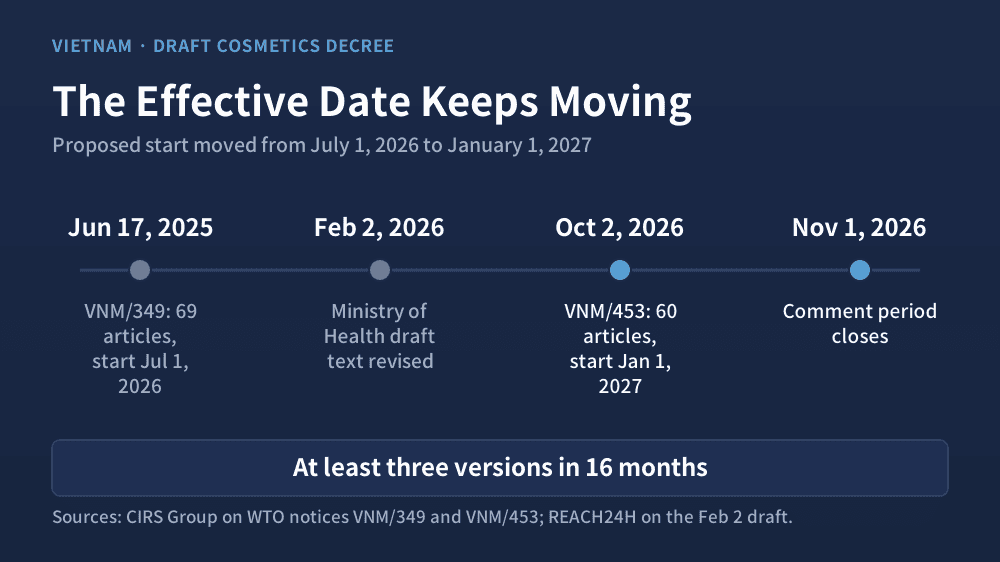
On October 2, 2026, Vietnam filed notification G/TBT/N/VNM/453 under the WTO's Technical Barriers to Trade agreement, the mechanism that requires members to publish draft product rules so trading partners can comment before adoption. The draft was written by the Drug Administration of Vietnam (DAV), the regulator inside the Ministry of Health. It replaces Decree 93/2016 and Circular 06/2011. CIRS Group's summary counts 10 chapters and 60 articles, sets the comment deadline at November 1, 2026 and gives a proposed effective date of January 1, 2027.
The draft text itself was not available for this analysis. Every provision below comes from published summaries by compliance consultancies and is attributed to them. Read each requirement as a summary, not as statute.
Why does the start date keep moving?
The October draft is not the first. On June 17, 2025, Vietnam notified an earlier draft as G/TBT/N/VNM/349, with 69 articles, a 60-day comment window, expected approval in September 2025 and a proposed start of July 1, 2026, according to CIRS Group. A Ministry of Health text dated February 2, 2026 followed, according to REACH24H's guide. In April 2024, Vietnamese state press had reported that the decree was expected to be consulted on and issued by 2025.
Each version moved the finish line, and the substance moved with it. A 2025 analysis by the law firm DFDL of an earlier draft described product announcement certificates valid for three years instead of five. The October summary says a Management Number stays valid until withdrawn. The 2011 circular, an earlier draft and the new draft give three different answers to the same question.
What does an importer already have to prove?
A 2021 compliance guide to Circular 06/2011 describes the existing regime. Only a company in Vietnam can file a product notification. The notification receipt number issued by the DAV is the document customs asks for. Imported products need a Certificate of Free Sale (CFS), a document from the exporting country showing the product is sold freely there, with exemptions for products made in CPTPP member states or already notified in ASEAN states. The CFS must be consular-legalized, meaning authenticated by a Vietnamese consulate, and the manufacturer's letter of authorization must be notarized and legalized the same way. The receipt number is valid for five years.
Circulars in 2019 and 2025 amended parts of that regime, and the guide is dated April 2021, so it describes the structure, not the current text. The structure is the point. A Vietnam-based filer, a CFS and an authorization letter are already in the import file. A summary that lists them is describing continuity, not a new burden.
What does the October draft change at the border?
According to CIRS Group, customs will no longer ask for notification dossiers or Product Information Files (PIFs), the formula and safety dossier that ASEAN rules require for every cosmetic. Customs instead verifies a Management Number online. The number is issued within three working days after the DAV accepts a dossier and stays valid until withdrawn. Products fall into risk Group A (high), B (medium) or C (low). Group A faces batch-level traceability and enhanced pre-market testing, and any product not listed in the A or B catalogs defaults to C.
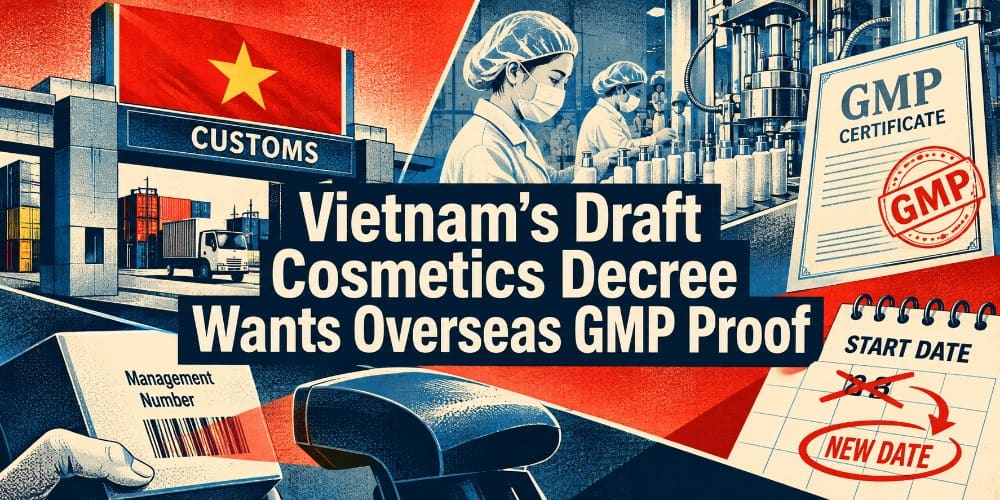
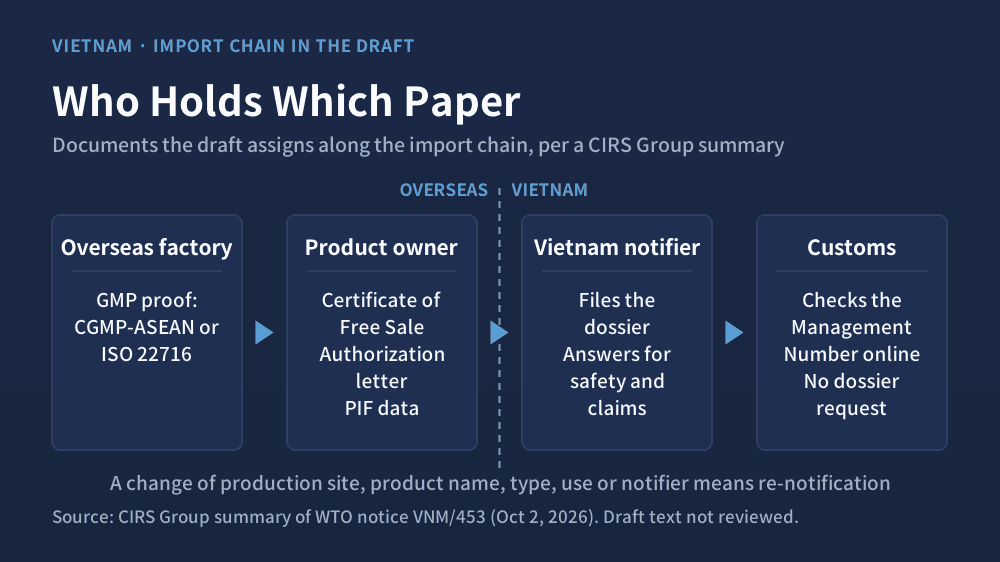
The new document at the border belongs to the foreign factory. The summary lists GMP evidence for the overseas manufacturing facility, with CGMP-ASEAN or ISO 22716 given as examples, alongside the CFS. ISO 22716 is the international standard for good manufacturing practice in cosmetics. Foreign documents need consular legalization or an Apostille, a single-stamp international authentication, unless they can be verified online.
Cisema, a compliance consultancy that tracked the February draft, also reads the draft as requiring PIF and GMP proof. Two summaries point the same way. Neither is the text.
Who ends up holding the proof?
The draft splits the file across three parties. The notifier must be a trader with cosmetics business functions in Vietnam and answers for product safety and claims. The product owner must authorize the filing by letter and supply the PIF data. The factory holds the GMP evidence. Customs sees one number.
Change control raises the stakes. According to the summary, a formula change needs only a system update, but a change to product name, type, intended use, notifier or production site requires re-notification. A brand that moves a product from one ODM to another files again in Vietnam. An ODM (original design manufacturer) is a factory that develops and makes products under a brand's name. Switching factories becomes a regulatory event, not a purchasing decision.
The summary also sets transition terms. Existing receipt numbers and Certificates of Eligibility stay usable through the end of 2028, with notification numbers converted free of charge. Labels and packaging printed before the effective date can be used for up to 36 more months. Import notifications stay with the Ministry of Health through the end of 2027 and then move to provincial authorities.
Is Vietnam enforcing the paper it already has?
A January 29, 2026 report said the Drug Administration ordered a nationwide recall and destruction of six cosmetics imported from South Korea. Trinh My Co., Ltd. marketed the products. Their PIFs were incomplete and their actual formulas did not match the approved declarations. The Ho Chi Minh City health department had already fined the company. The report names no Korean manufacturer or brand. The order went to the Vietnamese distributor.
That is the structure the draft formalizes: the notifier answers. The regulator's own numbers show why GMP evidence is on the list. In April 2024, state press quoted the head of the ministry's cosmetics management board saying that about 70% of cosmetics sold in Vietnam are imported and that only 35 of 965 domestic production facilities met ASEAN GMP standards. A regulator with 35 compliant factories out of 965 is now writing factory evidence into the import file.
What is at stake for Korean exports?
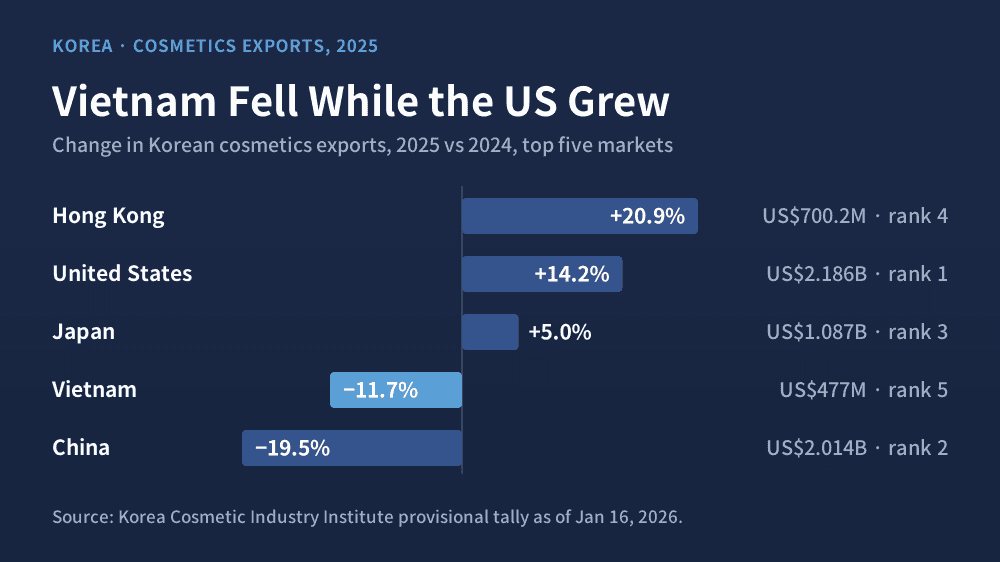
Vietnam was Korea's fifth-largest cosmetics export market in 2025 at about US$477 million, down 11.7% from 2024 and 4.2% of the total, according to the Korea Cosmetic Industry Institute's provisional tally as of January 16, 2026. The decline ended a run of annual growth that lasted from 2012 through 2024. The US (US$2.186 billion, up 14.2%), China (US$2.014 billion, down 19.5%), Japan (US$1.087 billion, up 5.0%) and Hong Kong (US$700.2 million, up 20.9%) filled the top four.
For any brand that sells through a Vietnamese distributor, the distributor is the notifier, and the factory's GMP evidence has to travel from Korea to that distributor. The documents sit in two Korean hands, the brand's and the factory's, and one Vietnamese hand files them.
What does the draft leave unresolved?
The summaries do not say whether the GMP requirement reaches all three risk groups or only the high-risk ones. They do not agree on every term, and some omit the Management Number entirely. The comment period closes November 1, and the text has already changed at least twice. The WTO document, not a summary, settles each point.
How do the three sides read it?
Manufacturers read a GMP certificate as a sales document. An ISO 22716 audit becomes something every buyer's Vietnamese filing asks for.
Brands and buyers read the contract with the Vietnamese notifier. That contract now governs who holds the PIF, the authorization letter and the GMP copy, and a change of factory costs a new filing.
Regulators and investors read the date. Three versions in 16 months make January 1, 2027 a proposal, not a schedule.
The shelf in Vietnam is decided by the paper behind the product.