1. What was established
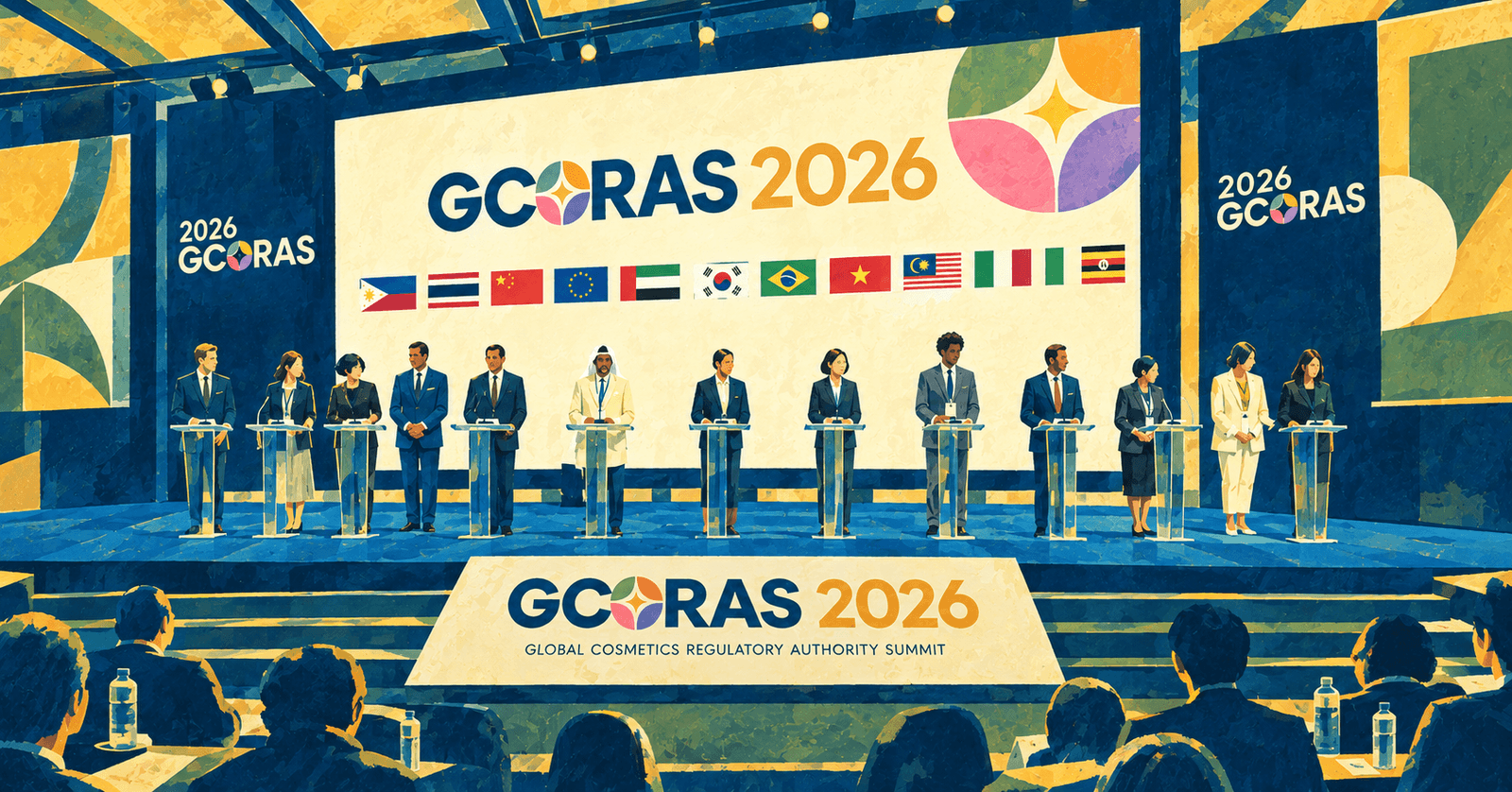
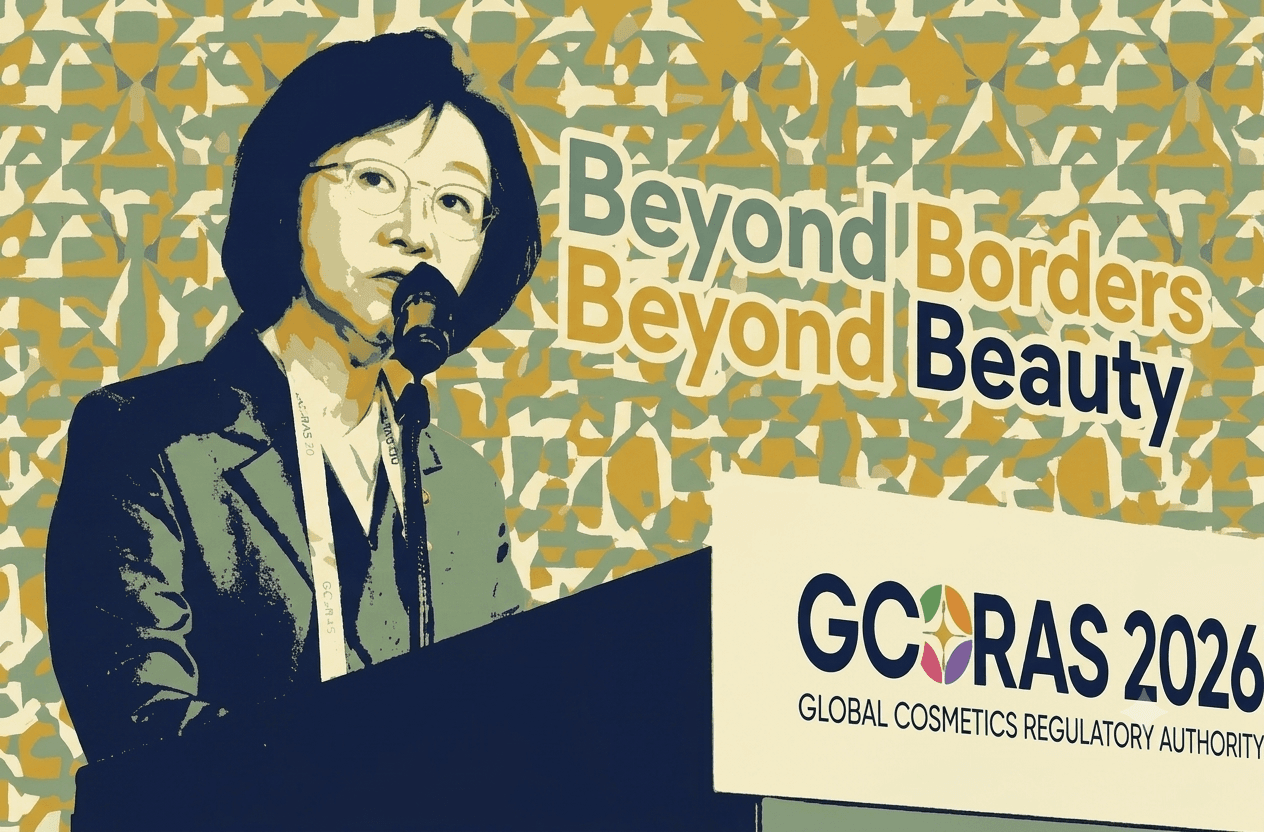
The Global Cosmetics Regulatory Authority Summit (GCORAS) was founded at The Plaza Hotel Seoul over three days beginning 7 September, convened by the Ministry of Food and Drug Safety.
Three outcomes were confirmed after the closed plenary. Korea was elected inaugural chair. The permanent secretariat will be established in Korea. The second summit, in 2027, will also be held in Korea. Delegates adopted a declaration and agreed a framework for expanding cooperation through working groups on regulatory information and scientific and technical developments.
The participants are described as twelve countries together with industry associations from Asia and Europe, totalling fifteen organisations. Korean coverage names Vietnam, Thailand, Indonesia, Malaysia and the Philippines among the ASEAN participants, the UAE in the Middle East, and Brazil and Mexico in Latin America. A complete roster has not been published.
The distinction between countries and associations matters, and early reporting blurred it. Fifteen is not fifteen regulators. It is twelve national regulatory authorities plus trade associations — the European and Australian cosmetics associations took part in the industry consultation sessions, and Australia and New Zealand appeared on the day-one forum programme as presenters rather than as members.
The launch was reported in Korea and barely registered outside it. What none of the coverage does — Korean or English — is set the summit beside the obligation Korea places on its own industry from 2028.
2. Background: three convergent changes
2.1 The export base changed composition, not only scale
Korea exported $11.42 billion of cosmetics in 2025, ranking second worldwide, up from third the previous year. France remains first at $24.28 billion and the United States third at $10.75 billion. The 2015 figure was $2.5 billion, making the decade's growth roughly fourfold. For the first time, Korea's largest single destination was the United States, at $2.18 billion, ahead of China at $2.02 billion.
The scale figures are the ones customarily reported. The compositional change matters more, and MFDS identifies it directly: demand has become hyper-personalised, distribution has shifted to high-mix, low-volume, and cross-border commerce is increasingly influencer-led.
In commercial terms, Korea's export engine is no longer a small number of large houses moving large volumes into a single market. It is several thousand small brands, most manufacturing through ODMs, selling modest volumes into many markets simultaneously, frequently through channels that postdate the statutes governing them.
That structure is commercially formidable and regulatorily fragile. A large firm absorbs twelve registration regimes as a cost of doing business. A twenty-person brand cannot. Korea's growth is now concentrated in precisely the firms least able to carry compliance load.
2.2 Technical barriers have replaced tariffs
MFDS is explicit on the second change: technical barriers to trade are rising as major markets tighten safety, environmental and quality requirements, with mandatory safety assessment, GMP and halal certification named specifically.
None of these is a tariff. Each functions as one, and each falls disproportionately on small exporters, because the cost of a compliance dossier scales weakly with volume.
2.3 Korea has joined the countries raising them
This is the element that reframes the summit, and it appears in a footnote of the MFDS release rather than its headline.
Korea's amended Cosmetics Act was promulgated on 30 December 2025. Under it, cosmetic safety assessment becomes mandatory: a documented demonstration that a product is safe under normal or reasonably foreseeable conditions of use, prepared by a qualified assessor and retained by the responsible seller. Reported phasing begins in 2028, covering firms above KRW 1 billion in annual production or import value together with new products, widening annually, and applying to all companies and all products from 2031. The dossier requires quantitative and qualitative composition data including impurities, preservative efficacy testing, and packaging compatibility review.
The threshold is the operative detail. KRW 1 billion in annual production or import value is under one million US dollars — not a large-enterprise trigger, but one that reaches well into the indie tier responsible for Korea's export growth.
Taken together: Korean exports now depend on small firms; small firms are the most exposed to technical barriers; and Korea is about to become one of the jurisdictions imposing them.
3. The case for reading GCORAS as risk management
From 2028, Korean brands will pay for safety assessment irrespective of whether any foreign authority recognises it. That cost is sunk domestically. Its value abroad turns on a single question: whether Vietnam, Indonesia, Malaysia, the UAE, Brazil and Mexico accept the resulting dossier, or require a second one.
If accepted, the 2028 mandate becomes an export asset — one dossier serving many markets, and a compliance burden converted into an advantage, since Korean firms will have paid it and competitors in other origin countries will not have.
If rejected, the mandate is overhead layered atop every existing foreign requirement, borne by the smallest firms in the export base.
The summit's agenda is consistent with the first objective. Its stated items — safety assessment, GMP, halal certification, digital distribution, cross-border commerce — are not a generic list. They are the same barriers MFDS identifies as rising, with safety assessment at the head of both. The day-one forum programme points the same way: alongside sessions on EU regulatory change and the Australian and New Zealand frameworks, it carried a session on the use of artificial intelligence in cosmetic safety assessment — which is to say, on how to make the 2028 dossier cheap enough to produce at the scale Korea's indie tier would require.
So does the timing. Detailed rulemaking for the 2028 phase-in is underway now. A working group convened in 2026 has approximately the runway required to matter by then; one convened in 2029 does not.
Intent cannot be established from a press release. But the shape of the initiative fits a specific purpose: Korea appears to be pre-building mutual recognition for a compliance regime it is about to impose on itself.
The domestic industry reads it the same way. Welcoming the outcome, the Korea Cosmetic Association — chaired by Suh Kyung-bae, who also chairs Amorepacific — said it expected GCORAS to develop beyond information exchange into substantive regulatory cooperation, and committed to ensuring that the difficulties Korean firms encounter reach foreign authorities in concrete form and translate into eased regulatory burden. That is not ceremonial language. It is an industry telling its government what the body is for.

4. Why a second forum: GCORAS and ICCR compared
International cooperation on cosmetics regulation is neither new nor new to Korea.
The International Cooperation on Cosmetics Regulation (ICCR) has existed since 2007. Its members are the regulatory authorities of Brazil, Canada, Chinese Taipei, the European Union, Israel, Japan, the Republic of Korea, the United Kingdom and the United States. It convenes annually, pursues regulatory convergence, and works to minimise technical barriers to trade. MFDS is not merely a member; it sits on the steering committee.
The "world's first" characterisation therefore holds in a narrow sense — a standing council at the level of agency heads, as distinct from a working-level convergence forum. The more instructive question is why a country already holding a seat would construct a second body.
The rosters answer it. Of the GCORAS participants Korean coverage names — Vietnam, Thailand, Indonesia, Malaysia, the Philippines, the UAE, Brazil, Mexico — exactly one, Brazil, is also an ICCR member. The agencies that anchor ICCR, the US FDA and Japan's MHLW among them, do not appear.
The distinction is sharper than a division between West and rest. ICCR is where the rules Korea must follow are debated. GCORAS is where the rules Korean exports encounter are debated. These are different problems, and the second has had no dedicated forum.
The difference in standing is now settled rather than pending. At ICCR, Korea is one of nine members. At GCORAS, Korea convened the body, chairs it, houses its secretariat, and hosts its second meeting. Those are the three levers that determine what an international body actually does, and Korea holds all three.
5. Implications by segment
Korean brands. The planning date is the KRW 1 billion threshold, not 2031. Crossing it, or launching a new product within the phase-in window, brings a firm into the first wave. Qualified safety assessors are a finite population against a fixed statutory date; firms contracting capacity early will pay less for it than those that wait.
Indie founders. Safety assessment approximates a fixed cost. A dossier for a brand producing $1 million costs broadly what it costs for one producing $100 million. Fixed costs favour scale. The reasonable expectation is that this pushes small brands further toward ODM partners, where the regulatory science capability already resides, and raises the floor for launching a brand at all. A material part of Korea's indie boom rested on how inexpensive entry was; that changes from 2028. The AI-assisted assessment work now being discussed at regulator level is the main variable that could soften it.
ODMs and their customers. This is the structural consequence with the longest tail. From 2028, Cosmax, Kolmar Korea and their peers will not only manufacture a formula but hold and maintain the data establishing its safety. Regulatory dossier capability becomes a service line, and a more durable form of lock-in than manufacturing has ever been. It is consistent with the direction of recent activity: on 8 September in Paris, Cosmax and L'Oréal signed an MOU covering joint development of ingredients, formulations and formats — a research relationship rather than a supply contract, twenty years after supply began.
Overseas buyers. Safety-assessment readiness is worth raising with Korean suppliers now rather than in 2028. It is a serviceable proxy for operational maturity, and responses will differentiate the field faster than a factory visit. Should GCORAS deliver even partial recognition, a Korean supplier's dossier becomes portable into ASEAN, the Gulf and Latin America, making Korean suppliers structurally cheaper to onboard than suppliers from origin countries without such a framework. That is the upside case and merits tracking.
Firms selling into ASEAN or the Gulf. The working groups, not the declaration, are the object of attention. The industry consultation format used in Seoul — national tables at which Brazilian, Emirati, Malaysian, Indonesian and Vietnamese regulators answered questions submitted in advance — is the more replicable precedent, and worth requesting through trade associations.
6. Failure modes
Divergence rather than convergence. A second bloc can entrench two standards as readily as it can reconcile them. Should GCORAS settle on requirements meaningfully different from EU or ICCR practice, Korean exporters would serve two regimes rather than one, doubling the compliance cost instead of halving it. Korea's dual membership hedges this but does not resolve it.
Convening power is not authority. What the summit produced are containers: a chair, a secretariat, a declaration, working groups. None shortens a registration timeline. The base rate for international bodies that produce a declaration and thereafter an annual meeting is not low.
Asymmetry, now on the record. Korea convened the body, holds the chair, houses the secretariat and hosts the next meeting. That concentration is efficient in year one and a liability by year three. The other eleven members will expect reciprocity — regulatory science capacity, assessor training, inspection recognition, technical assistance — and the first real test of GCORAS will be whether the chair rotates and the agenda accommodates a priority Korea did not set. What Korea offers is the price of the arrangement, and it will appear in MFDS budget lines before it appears in declarations.
7. A note on the 46 percent figure
MFDS states that participating countries account for approximately 46 percent of the global cosmetics export market and provides no methodology. Every subsequent report repeats the figure without one.
As exporters, these countries are not large. Korea itself accounts for $11.42 billion and France alone for $24.28 billion; Vietnam, Thailand, Indonesia, Malaysia, the Philippines, the UAE and Mexico do not close that gap. The figure may refer to destination markets rather than countries of origin, or may depend on participants not yet named. It cannot be reconstructed from public trade data.
The point is practical rather than pedantic. The number is doing rhetorical work, and any executive who repeats it should expect to be asked for its basis.

8. Assessment
There are two routes from taking rules to making them: promotion within an existing body, or establishment of a new one.
Korea's beauty industry has a long record of the second. It did not secure shelf space at incumbent Western retailers and scale from there; it built Olive Young and is now exporting the format. Its manufacturers did not wait for invitations into global brand development; they built ODM capability deep enough that the invitations followed.
GCORAS applies that approach to regulation, and the timing is the most telling element. The body was not established in 2029, after the mandate had taken effect and exporters had begun reporting duplicated dossiers. It was established two years ahead, while the rulemaking is still being drafted and the terms remain movable — and Korea secured the chair, the secretariat and the next venue in the same week it opened the doors.
Whether it succeeds is an open question. Whether it was deliberate is not.