Japanese haircare has held shelf space inside Ulta Beauty since April 2021, when NatureLab Tokyo's full collection entered more than 700 stores. Two Japanese haircare launches in September 2026 read as J-beauty following K-beauty onto American shelves. The shelf was there first, and the US import table for hair products ranks Korea tenth. What September tested was not national order. It was who owns the fixture.
What happened in the two weeks after Target opened its new beauty fixture?
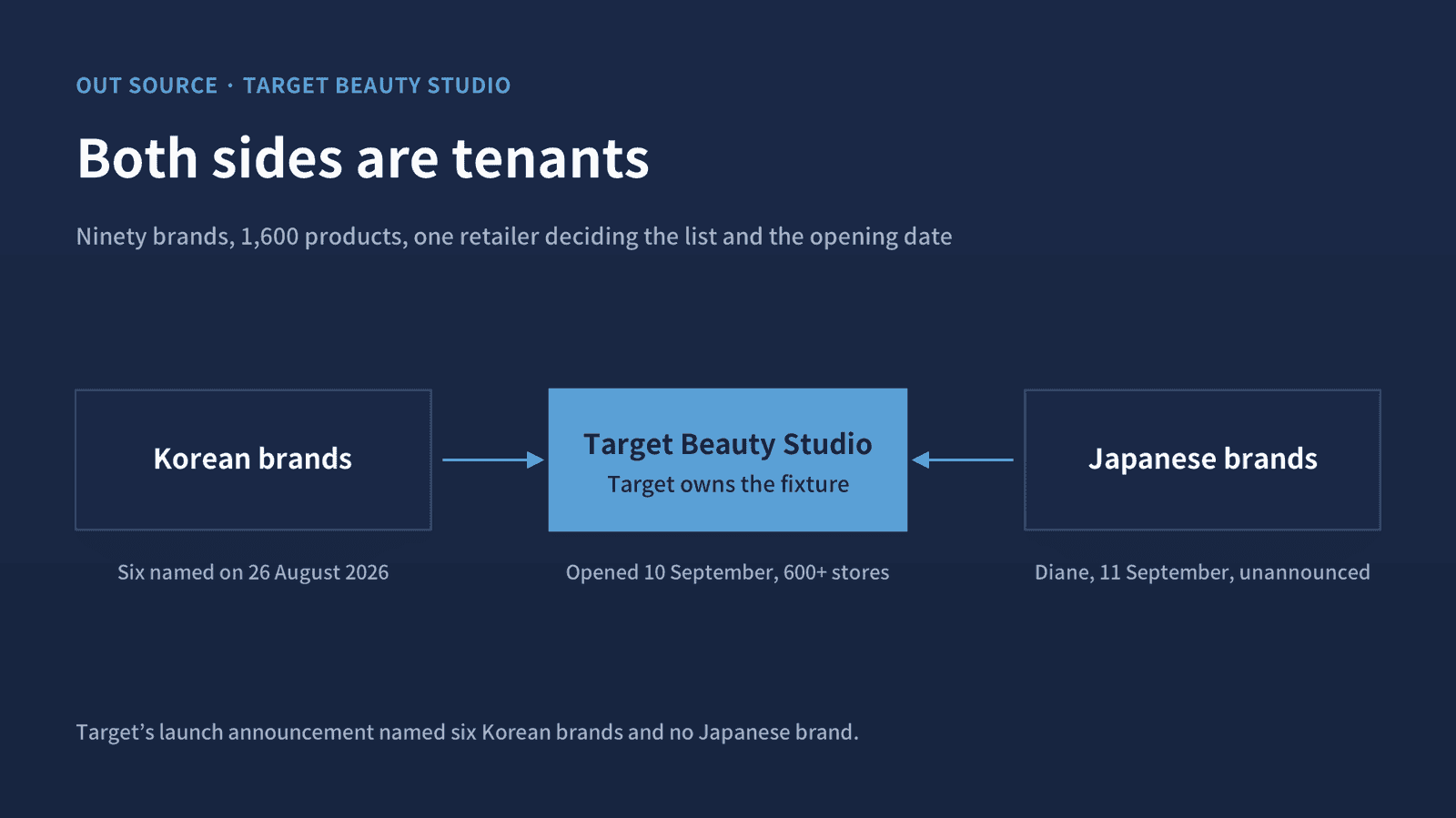
Target's announcement, dated 26 August 2026, set the opening of Target Beauty Studio for 10 September 2026 across more than 600 stores, with 90 brands and over 1,600 products. The release names 26 of those brands. Six are Korean: Amuse, Kaja, Rom&nd, Dr. Melaxin, Purito Seoul and Sungboon Editor. None is Japanese.
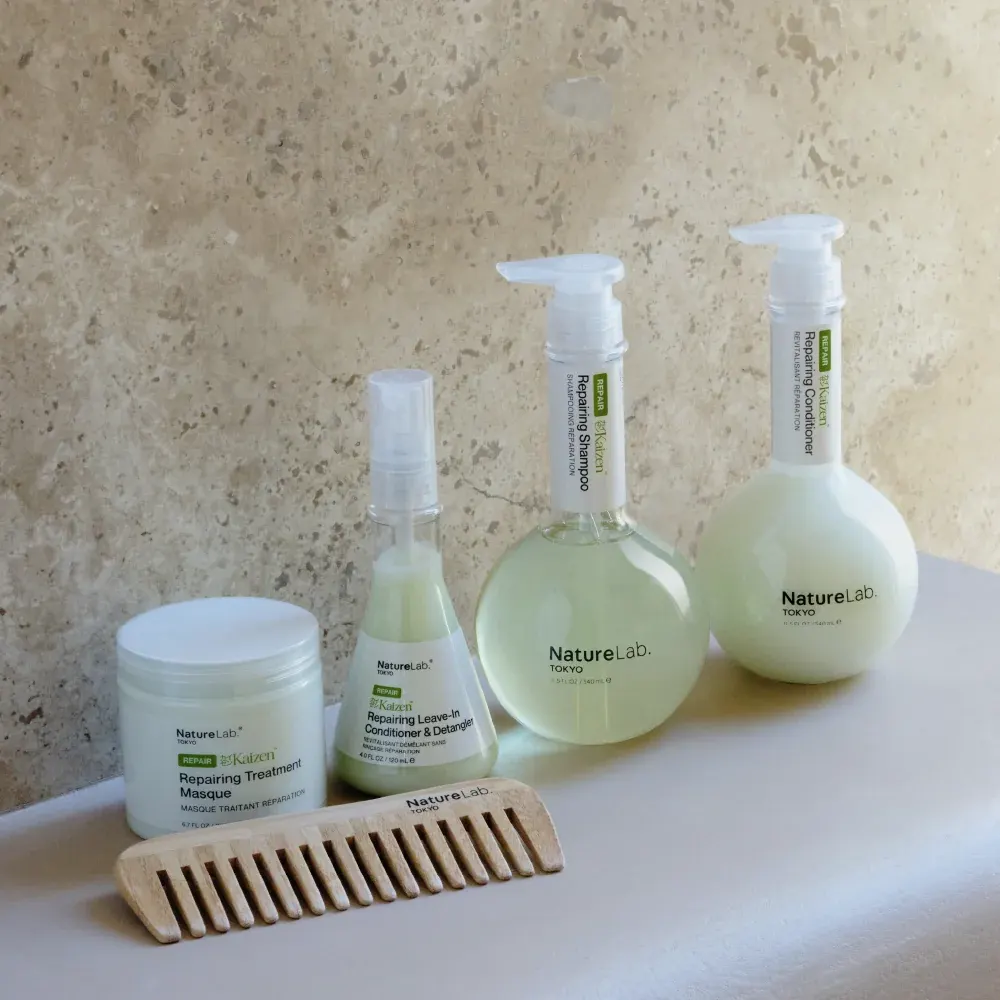
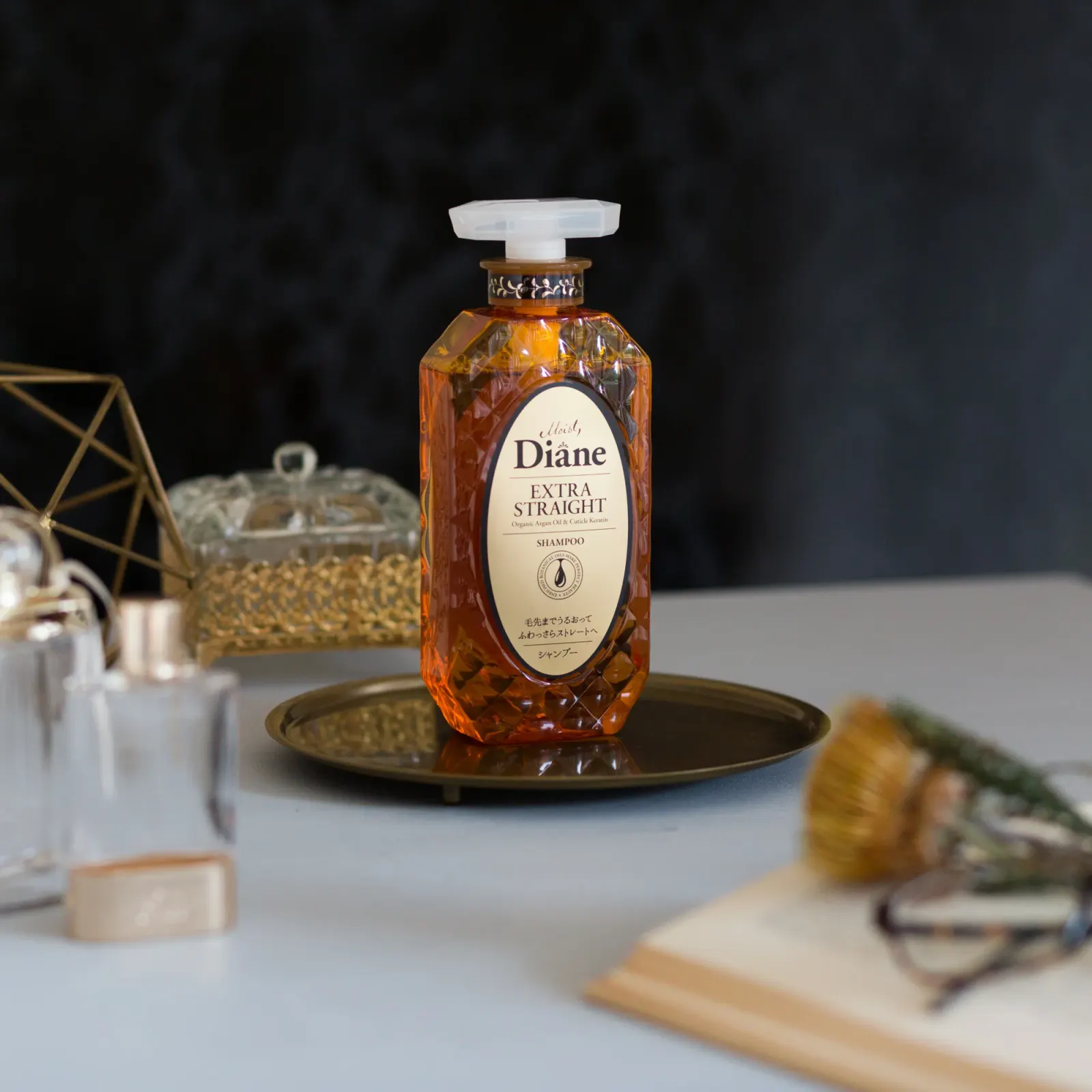
On 11 September, one day after the fixture opened, Diane Perfect Beauty announced its launch into Target Beauty Studio and Target.com nationwide — five collections, ten shampoo and conditioner products, each at $15. The brand describes itself as born and made in Japan, part of the Nature Lab family of brands based in Tokyo, with its bottle a staple since 2013.
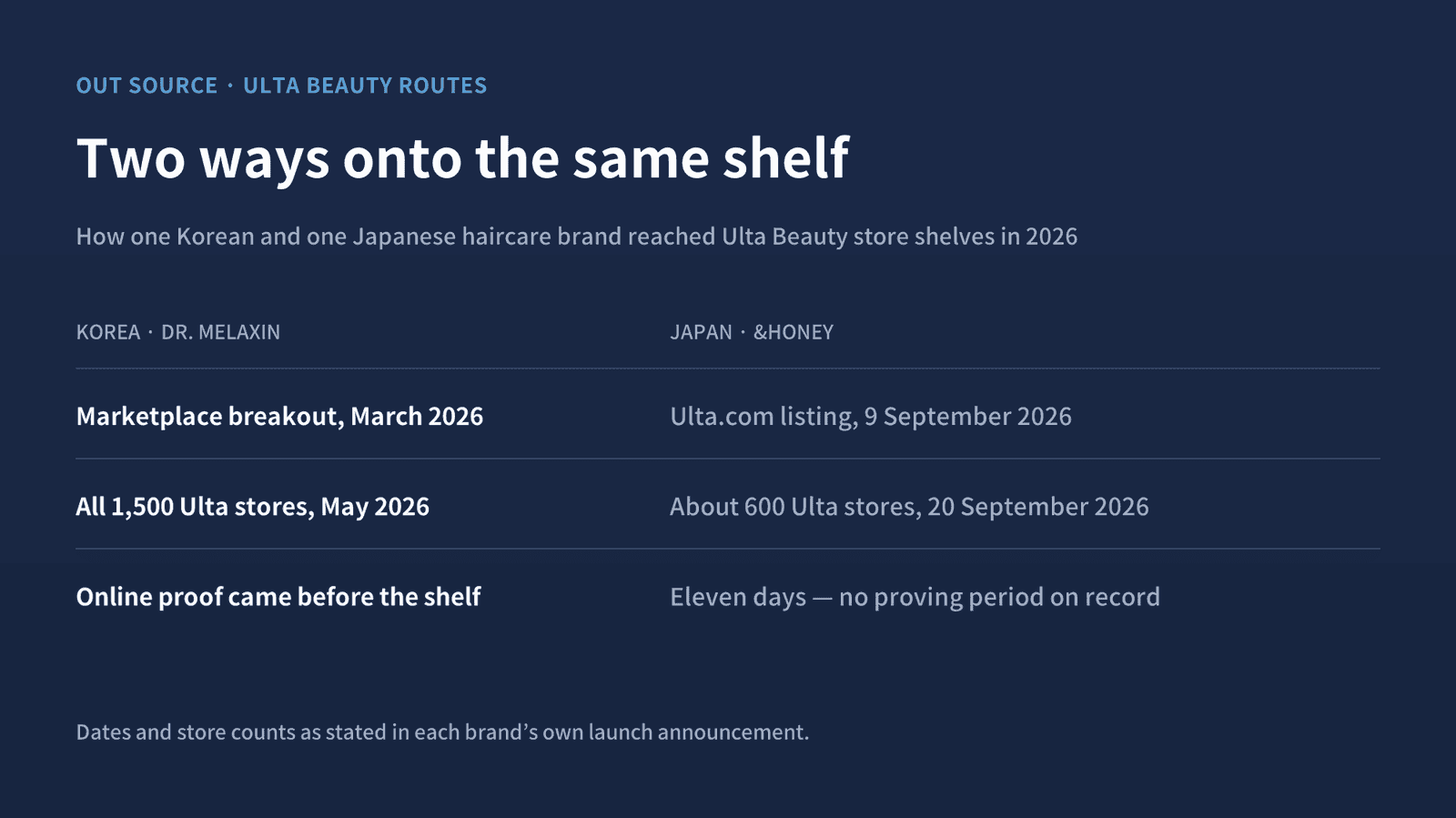
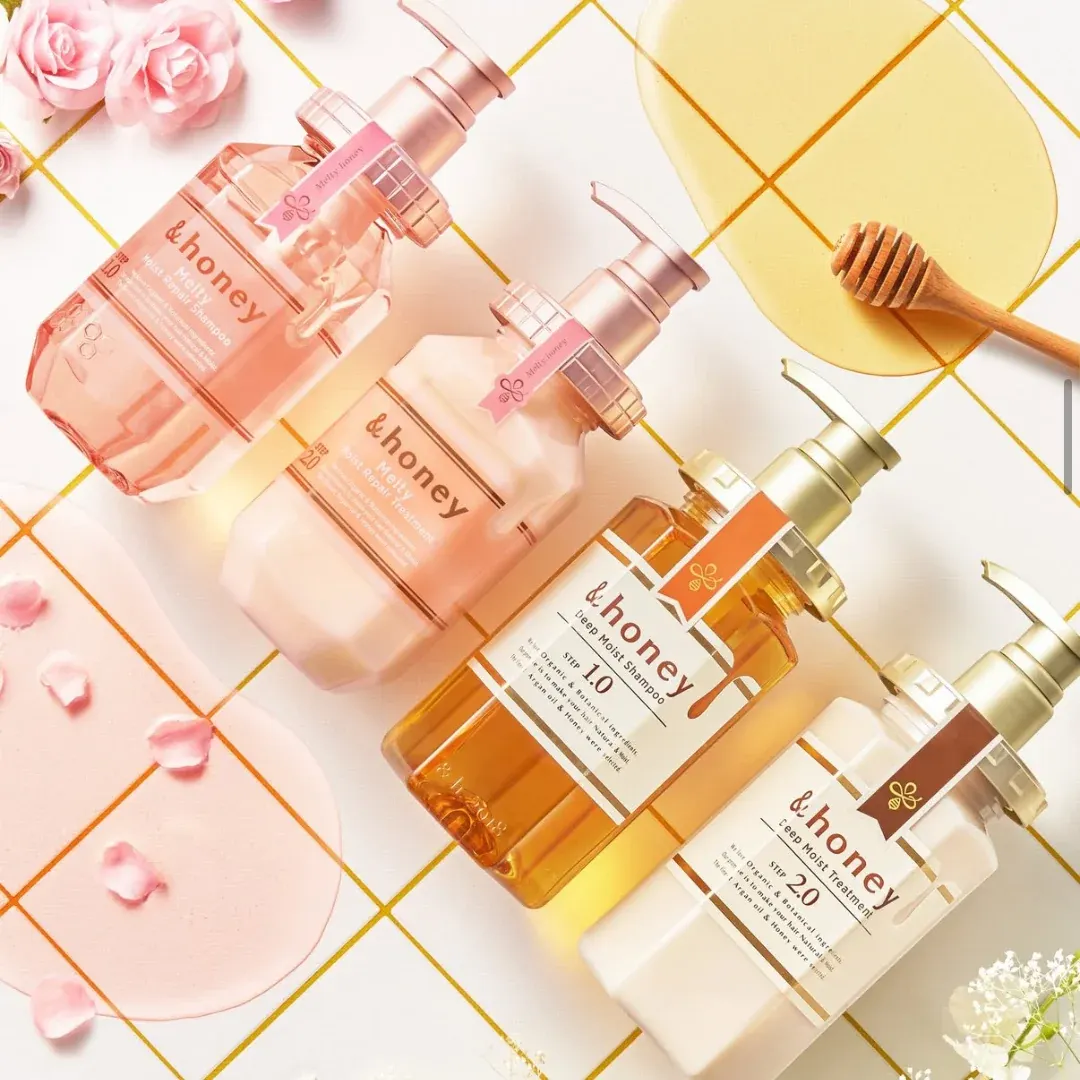
The second launch ran on an overlapping clock. &honey went live on Ulta Beauty's site on 9 September and reached approximately 600 Ulta stores on 20 September, with six products across two collections at $23 each. The announcement calls the brand a Japanese hair care brand and does not name a parent company.
So within eleven days, two Japanese haircare brands entered the two US retailers that have carried the heaviest Korean beauty expansion of the past two years. One of them entered a fixture whose own launch announcement had named six Korean brands and no Japanese one.
Was any of this a US debut?
For neither brand. &honey was already selling on Amazon in the United States: a separate announcement on 29 September 2026 introduced a cherry blossom collection described as the brand's latest product introduction for the US market, at $44 for a shampoo and treatment set and $25 for a hair oil. The Ulta announcement itself frames the launch as a step in an expansion already under way rather than an entry.
Diane's position is older still. NatureLab Tokyo, a brand from the same Tokyo parent, put its full collection into more than 700 Ulta Beauty stores in April 2021, building on an existing online partnership with the same retailer, and its managing director described the move at the time as the next wave of a US retail expansion. That is a Japanese haircare brand holding mass specialty shelf space in the United States five years before Target Beauty Studio existed, and before Korean cosmetics shipments to the US reached their current scale.
The sequence that makes J-beauty a follower does not survive the dates. What changed in September 2026 is the route, not the presence.
Does the trade data support a shelf built by Korean volume?
Partly, and only in cosmetics as a whole. Korea's Ministry of Food and Drug Safety reports cosmetics exports of $11.1 billion for January to September 2026, up 31.1%, against a full-year 2025 total of $11.42 billion. The United States took $2.35 billion of that, up 40.6%, and 21.1% of all Korean cosmetics exports — ahead of China at $1.58 billion and a 14.2% share, down from 18.5% in 2025. Shipments to Japan reached $889 million, up 8.6%.
The Japanese figure moving the other way is an order of magnitude smaller. The Personal Care Products Council's US-Japan cosmetics trade sheet puts total two-way cosmetics trade at $577 million in 2025, of which $332 million was US exports to Japan, leaving roughly $245 million arriving from Japan. Korea sold more cosmetics into Japan in nine months of 2026 than Japan sold into the United States across all of 2025.
Those two numbers come from different reporting systems and different product baskets, so the ratio is indicative rather than exact. The direction is not in question.
How large is Asian haircare inside the US hair category?
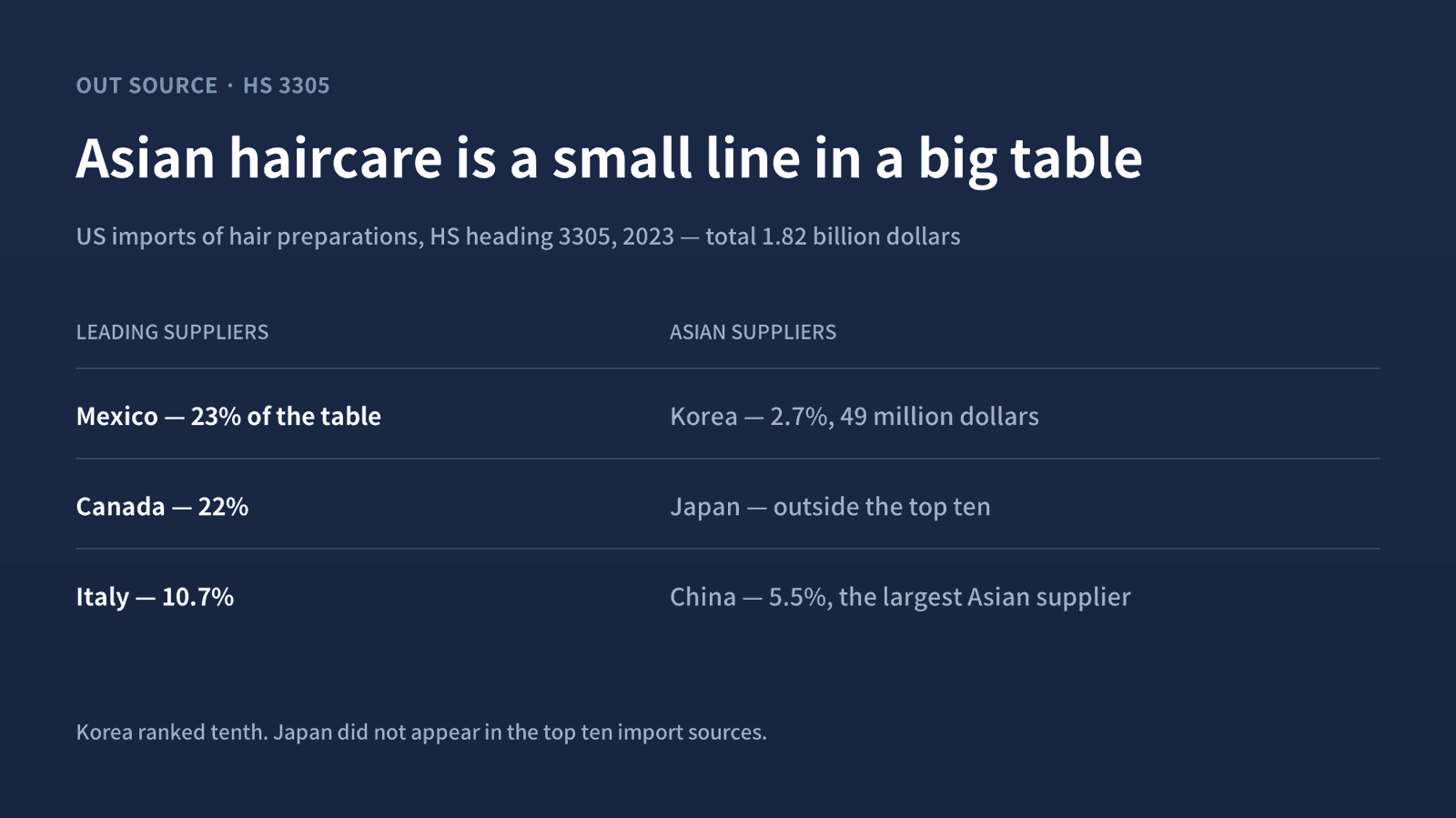
Small, on both sides. Hair preparations clear US customs under HS heading 3305, the tariff line — the customs classification that sets duty and reporting for a product type — covering shampoos, conditioners, hair oils and styling products. US imports under that heading totalled $1.82 billion in 2023, the most recent year with a full partner breakdown in standard trade tabulations. Mexico supplied 23%, Canada 22% and Italy 10.7%. Korea ranked tenth at $49 million, or 2.7%. Japan did not appear in the top ten at all. The largest Asian supplier in that table is neither of them: China, at 5.5%, in fourth place.
Korea's own haircare numbers confirm the scale. Korea Customs Service data records 2025 hair care exports of $478 million worldwide, up 15.7%, and Korea International Trade Association figures put the first eight months of 2026 at $403.26 million, up 33.7%. Against 2022's $341.86 million, that is growth of 4.8% in 2023, 15.3% in 2024 and 15.8% in 2025 — real compounding from a base that remains a rounding error inside a US hair category dominated by North American and Italian supply.
This is the part the shelf photographs do not show. Both countries are marginal suppliers to the US hair aisle. What is being contested is placement and visibility, not tonnage.
How does a Korean haircare brand actually reach a US shelf?
Through a staged route, with an online proving ground in front of it. K-Beauty World's expansion on the Ulta Beauty marketplace, announced 19 March 2026, added 17 Korean brands, twelve immediately and five more by May. The announcement states the mechanism plainly: a marketplace launch takes as little as nine weeks against nine months for traditional retail.
Dr. Melaxin is the case that completes the route. The same announcement describes it as a breakout performer on the marketplace and commits it to all 1,500 Ulta Beauty stores in May. By 26 August, Dr. Melaxin is one of the six Korean brands named in Target's fixture announcement. One brand, two retailers, with an online test between the marketplace listing and the shelf.
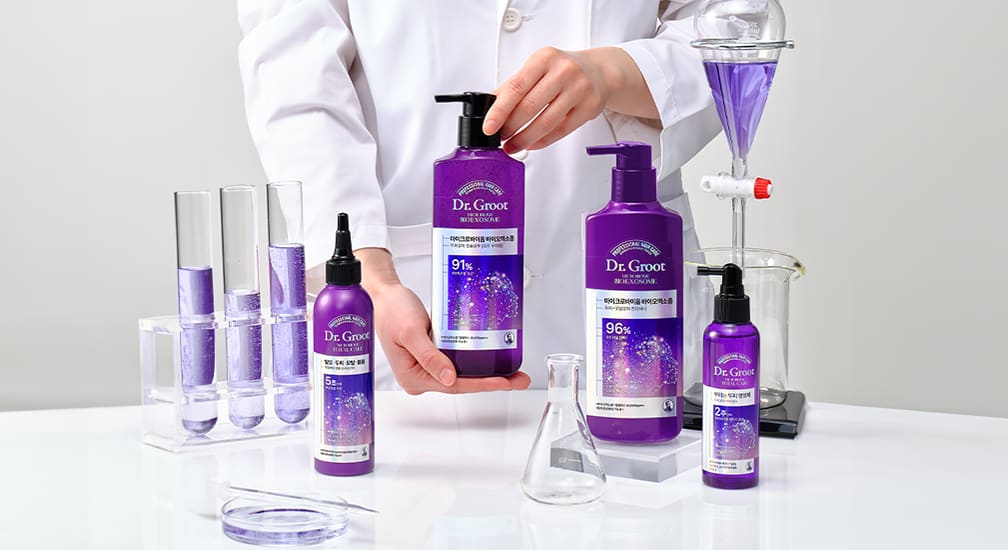
Dr.Groot ran a comparable sequence at a third retailer, entering Sephora online in March 2026 and physical stores in August, after placement in more than 680 Costco locations in North America.
How did the Japanese brands reach theirs?
Directly into a finished fixture. &honey moved from a site listing on 9 September to approximately 600 Ulta doors on 20 September — eleven days, with no marketplace graduation visible in the record. Diane Perfect Beauty appeared inside Target Beauty Studio on 11 September, one day after the fixture opened, without having been among the 90 brands Target announced two weeks earlier.
Those two paths are not equivalent, and the difference is not national character. A marketplace-first route is what a brand uses when a retailer requires proof of sell-through before committing shelf space. A direct placement is what a retailer grants when it has already decided the category works. The Korean brands bought the category proof. The Japanese brands arrived after it had been bought.
Who owns the shelf, then?
The retailer. Target Beauty Studio is Target's fixture: Target set the opening date, selected the 90 brands, defined the 1,600-product assortment and chose which brands to name in its own announcement. Ulta's marketplace-to-store pipeline is Ulta's instrument, and the nine-weeks-against-nine-months gap it advertises is a retailer's lever over a supplier's timeline, not a concession to one.
That is how a Japanese brand entered the fixture on day two while being absent from the launch list. Inclusion in the announcement is a marketing decision the retailer makes; inclusion on the shelf is a buying decision, and the two run on separate clocks. A brand that reads the announcement as the roster has misread what the document is.
Neither Korean nor Japanese brands own the asset that matters here. The asset is a named destination inside 600 stores with a footfall the brands did not generate, and it belongs to the company that built it.
What transfers between the two, if not credit?
Category literacy, and this is interpretation rather than documented fact. No announcement from Target, Ulta, Diane Perfect Beauty or &honey states that Japanese haircare benefited from Korean groundwork, and none of them frames the two countries as related at all. What the record supports is narrower: a US shopper in September 2026 encountered an Asian haircare proposition inside a mainstream fixture without needing it explained, and the spending that produced that familiarity is documented on the Korean side — $2.35 billion into the US in nine months, 40.6% growth, a marketplace pipeline with published cycle times.
Consumer education of that kind cannot be owned. It has no contract attached and no exclusivity, and it accrues to the shelf rather than to the supplier that paid for it. A brand investing in explaining a category is funding an asset its competitors will use for free, and the retailer is the party that monetises it.
The Japanese launches are the clean demonstration. Eleven days from listing to 600 doors, $15 and $23 price points sitting directly beside Korean products, no proving period on record.
Where does this leave the three sides?
For manufacturers and their ODM partners — contract developers that design and produce under another company's brand name — the category argument is now a commodity. Scalp and moisture positioning that required explanation three years ago requires none, which compresses the premium on being early and raises it on cost and lead time.
For brands and the buyers who source them, the lesson is about what a retailer announcement is worth. A launch list is not a closed roster, and the gap between the announced assortment and the shelved assortment is the window a competitor uses. Sourcing teams reading Target's 90 brands as the field missed a Japanese line arriving the next day.
For regulators and investors, the national label is doing less work than the numbers imply. K-beauty and J-beauty share a fixture, a price band and a customs heading in which both rank below Mexico, Canada and Italy. A thesis built on either label is a bet on placement inside retailers neither country controls.
Japanese haircare did not follow Korean haircare onto the American shelf. It arrived on a shelf a retailer built, at a moment that retailer chose, next to Korean products priced within $8 of its own.