Korean cosmetics exports set a monthly record in September 2026, reaching $1.51 billion, up 31.4%. Over the same month APR fell 21.2%, d'Alba Global 15.2% and LG H&H 14.1%, while the ODM manufacturers that produce for all three fell less than half as far. A US asset manager has a registration statement on file to sell every one of these companies under a single ticker. The month that basket sat waiting for approval is the month its contents stopped moving together.
What is actually on file in Washington?
Guinness Atkinson filed a registration statement on 10 July 2026 for the Guinness Atkinson K-Beauty ETF, ticker KBTY, to list on NYSE Arca. The filing commits at least 80% of net assets, plus any borrowing for investment purposes, to securities of "K-Beauty Companies." The prospectus defines one as a company organised, headquartered, or principally listed on a securities exchange in South Korea whose principal business is the development, manufacture — including ODM or OEM work, where a factory designs and produces a product that another company sells under its own name — distribution, or sale of beauty, personal-care, cosmetics, or aesthetic and dermatological products.
The fund is not trading. The manager's own fund page states that the registration statement is not yet effective and that shares cannot be purchased. The index the fund would track is left blank in the prospectus, and so is the expense ratio. What exists so far is the definition, and the definition is the part worth reading closely.
What does that definition sweep into one basket?
Four segments, named in the filing: brand owners; manufacturers, meaning ODM and OEM firms along with component and ingredient suppliers; distribution and retail; and aesthetics and dermatology, covering both products and devices. Coverage of the filing named Hugel, which makes botulinum toxin and fillers, and PharmaResearch, which makes the Rejuran skin booster, as expected holdings.
An NH Investment & Securities analyst described the filing as the first case of K-beauty being incorporated as an independent investment theme inside the US capital market, and expected it to improve supply and demand over the medium to long term. Shin Min-soo of Kiwoom Securities read it as a signal that K-beauty is moving from a subculture into a mainstream industry. Both statements are characterisations offered by analysts rather than verified facts about the history of US fund listings, and the filing itself claims neither.
What happened to those segments in September?
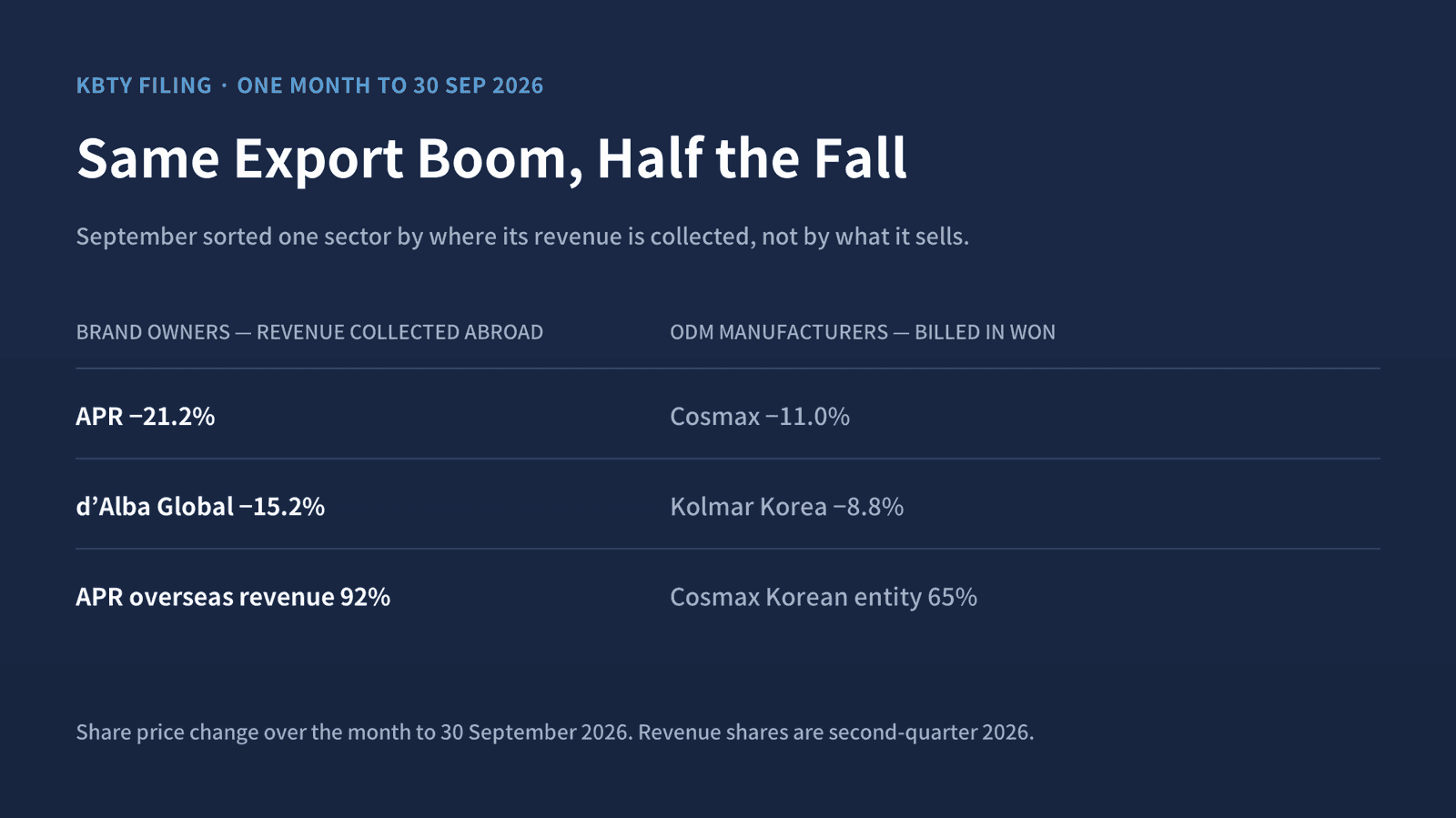
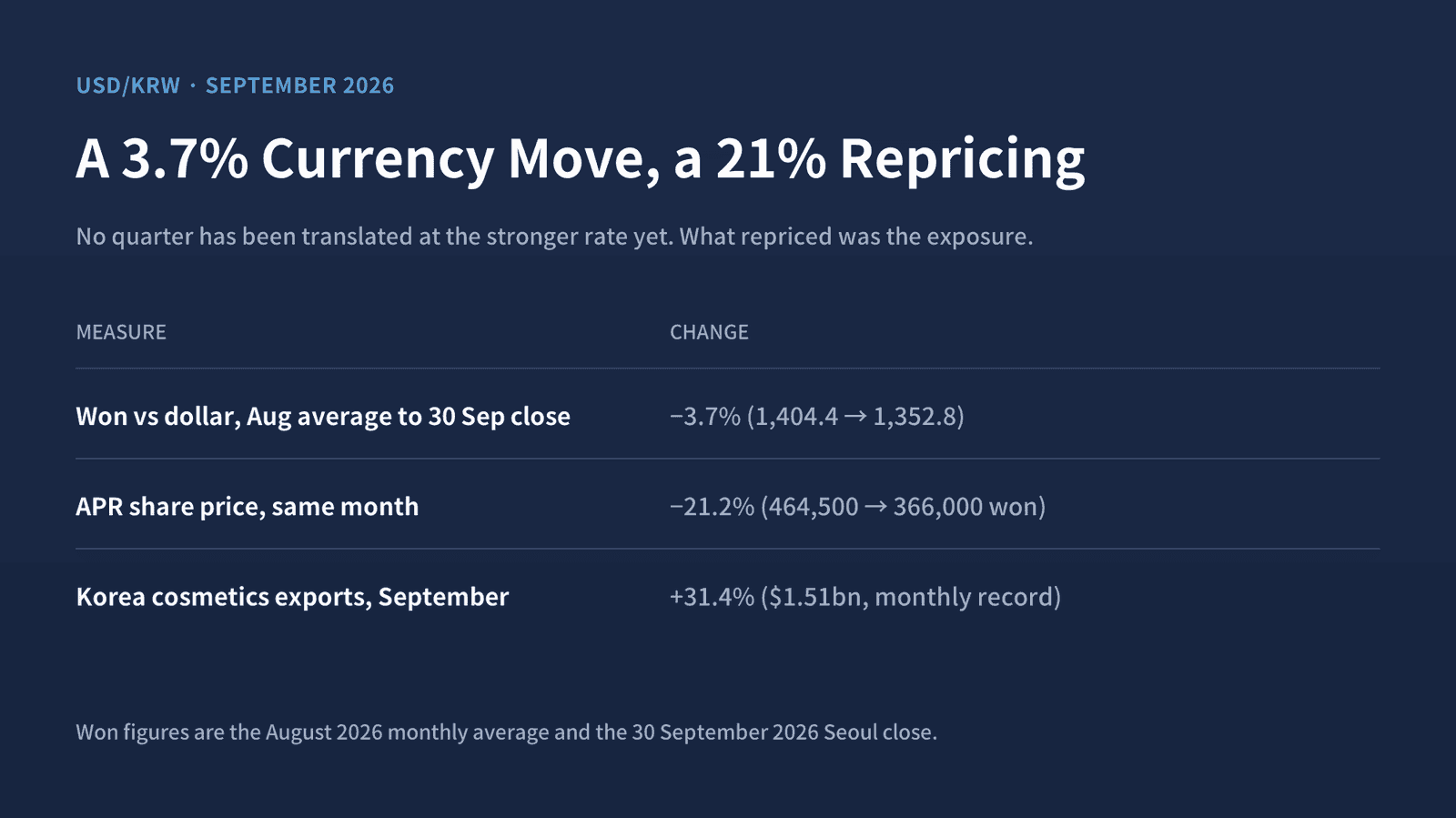
Measured over the month to 30 September 2026, APR fell 21.21%, from 464,500 won to 366,000 won — about $343 to $271 at 1,352.8 won to the dollar, the Seoul close on 30 September 2026 and the rate used throughout this piece. d'Alba Global fell 15.18%. LG H&H fell 14.06%. Cosmax fell 11.00%, from 300,000 won to 267,000 won, roughly $222 to $197. Kolmar Korea fell 8.81%. Amorepacific fell 5.98%. The three Korean-listed cosmetics ETFs fell between 17.81% and 18.39%.
The ordering is the interesting part. The companies that collect most of their revenue abroad sit at the top of the loss table. The contract manufacturers sit in the middle at roughly half the decline. Amorepacific, the oldest and most domestically weighted of the brand houses, sits at the bottom. The market sorted a single sector into a gradient, and the gradient tracks where revenue is collected rather than what the companies sell.
Did the currency move far enough to explain a 21% fall?
No. The won averaged 1,404.4 to the dollar in August 2026 and closed September at 1,352.8, an appreciation of roughly 3.7%. Samsung Securities put the third-quarter move at 5.6% quarter on quarter and 12.7% measured to the quarter's end. Against the June monthly average of 1,528, the won gained 11.5% across the quarter, and Korea Investment & Securities cut its second-half average forecast from 1,420 to 1,380 won, with 1,350 projected for the fourth quarter.
A 3.7% currency move does not arithmetically produce a 21% equity move. No reported quarter has yet been translated at the stronger rate. What repriced in September was not a loss already booked but the market's estimate of how much of each company's earnings is a currency bet, and brand-owners were repriced hardest because the answer for them is most of it. That makes this a re-rating of translation risk rather than a translation loss, which also means the gradient is a statement about structure and should persist after the currency stops moving.
Why is a brand-owner's revenue a currency position?
APR reported second-quarter 2026 revenue of 767.5 billion won, about $567 million, up 134.2%, with operating profit of 190.6 billion won, roughly $141 million, at a 24.8% margin. First-half revenue reached 1.3609 trillion won, close to $1.01 billion. Overseas revenue exceeded 700 billion won and accounted for 92% of the total. North America contributed 376.3 billion won, about $278 million, up 264.6%. Europe contributed 145.1 billion won, roughly $107 million, up 380.3%. North America and Europe together moved from 40% of second-quarter revenue a year earlier to 68%.
d'Alba Global reported second-quarter revenue of 186.9 billion won, about $138 million, up 46%, and operating profit of 47.2 billion won, roughly $35 million, up 62%. Overseas revenue reached 76% of the total, its highest recorded share, with Europe up 242% and North America up 174%. The company attributes the growth to retail store expansion and reorders across channels including Amazon US, TikTok Shop and Costco.
When 92% of revenue arrives in dollars, euros and yen while costs and the reporting currency are won, the income statement is a long dollar position with a skincare business attached to it. The faster the overseas share climbs, the larger that position gets. Both companies spent 2026 reporting their best quarters ever and, in doing so, concentrating their exposure.
Why is an ODM's revenue not one?
Cosmax reported second-quarter revenue of 794.9 billion won, about $588 million, up 27%, and operating profit of 73.7 billion won, roughly $54 million, up 21%. The Korean entity alone recorded 518.4 billion won, about $383 million, up 23%, passing 500 billion won in a quarter for the first time and accounting for 65% of consolidated revenue. China contributed 197.4 billion won, roughly $146 million, up 33%. The US entity contributed 53.8 billion won, about $40 million, up 79%, and turned its first quarterly operating profit since founding. Kolmar Korea reported second-quarter revenue of 861.3 billion won, about $637 million, up 17.9%, and operating profit of 110.3 billion won, roughly $82 million, up 50.2%.
Two features of that structure matter. The Korean plants invoice Korean customers, and that customer base is domestic and growing more so: indie brands made up 65% of Cosmax's top 20 customers by revenue in 2025, against 40% in 2021. The overseas revenue, meanwhile, is produced in the country where it is sold, so a Shanghai plant selling to Chinese clients books costs and revenue in the same currency. What reaches the consolidated statement from those entities is a translation effect on a matched book, not an unhedged receivable.
Lee Hae-ni of Eugene Investment & Securities stated the resulting preference directly, favouring ODM firms over brands on the grounds that manufacturers capture the full benefit of industry growth while their earnings volatility from currency swings stays limited.
Who is absorbing the currency risk, then?
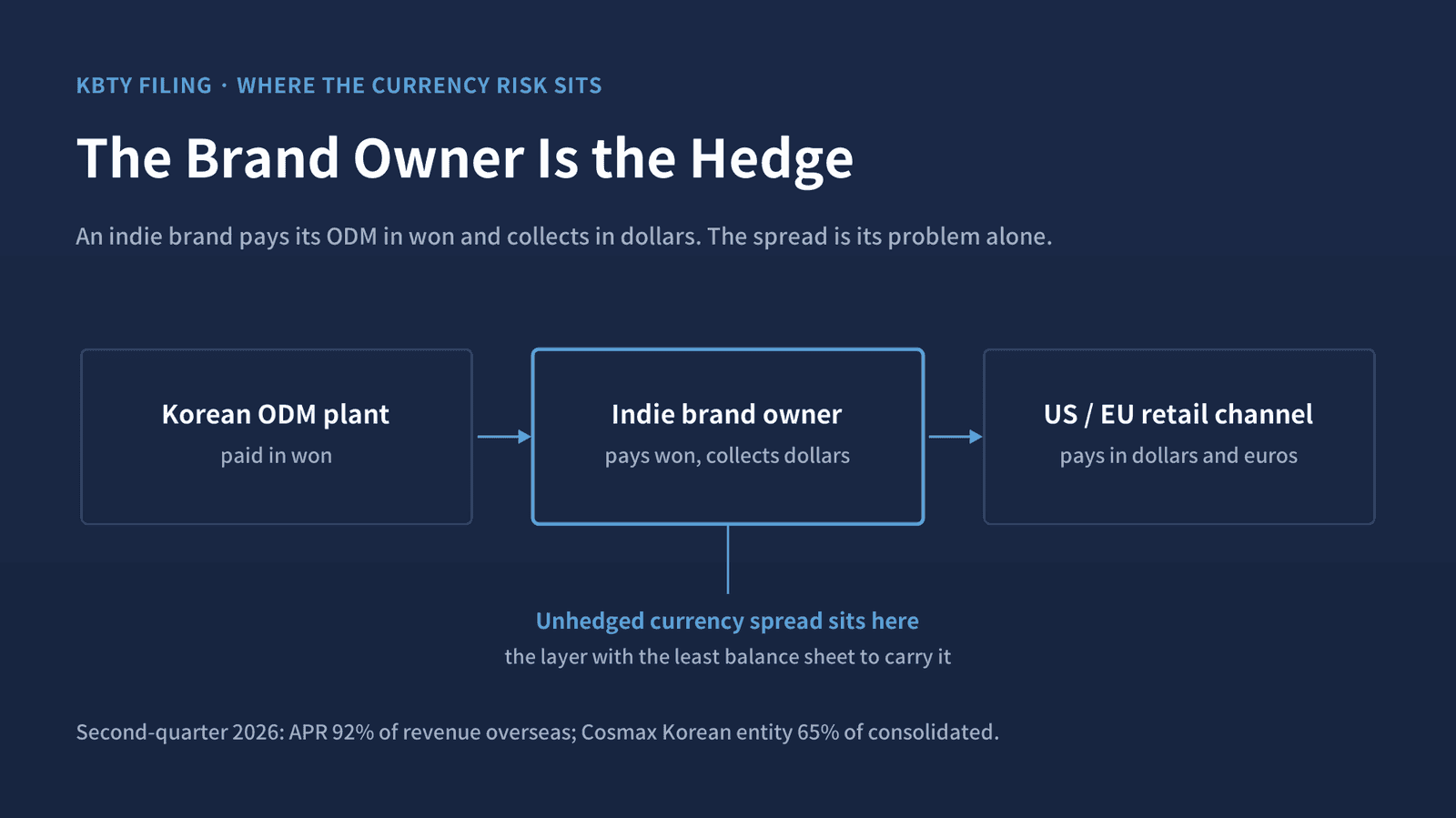
The brand owner, on the manufacturer's behalf. An indie brand pays its Korean ODM in won on domestic terms and collects from Amazon, Costco or a European distributor in foreign currency. The spread between those two legs is the brand's problem alone. The manufacturer has already been paid in the currency it reports in.
That places the currency risk of the entire export boom in its thinnest-capitalised layer. The firms holding the exposure are the ones with the least balance sheet to hedge it, while the firms with the capital to run a treasury desk have arranged their revenue so that they do not need one. The September loss table is that arrangement made visible.
What do the September export numbers do to this?
Korean cosmetics exports reached $1.51 billion in September 2026, up 31.4%, the first month above $1.5 billion and ahead of April's $1.35 billion record. Cumulative January-to-September exports reached $11.14 billion, up 30.8%, equal to 98% of the full-year 2025 figure of $11.42 billion, in an eleventh consecutive month of growth. The EU rose 110.4% to $170 million, the US reached $260 million on 21.9% growth, and China reached $210 million on 13.6%.
So shipments set a record in the month the export-levered shares fell hardest. Kim Myung-joo of Korea Investment & Securities noted that exports are holding up well despite an unfavourable export environment, with US shipments hitting record highs in September's first twenty days. Nothing in that contradicts the share price. Export statistics count units leaving the country. A share price counts units multiplied by a currency, and only one of those two numbers moved against the industry in September.
What does one ticker do to four different businesses?
It averages them, and the average describes none of them. A basket holding both a brand owner and its contract manufacturer holds both sides of the same won-dollar trade and nets part of the exposure out — which is a reasonable thing for a diversified fund to do, and the opposite of what an investor reaching for K-beauty exposure usually wants. Volume growth and currency-translated brand earnings are two different trades inside the same sector, and September priced them 10 percentage points apart.
The regulatory spread inside the basket is wider still. Cosmetics clear notification regimes; botulinum toxin and skin boosters clear drug and device approval, sell through licensed clinicians, and carry liability on a different footing. A rules-based index can hold all of it under one definition. The businesses do not converge because the definition does.
Where does this leave the three sides?
For manufacturers and their ODM partners, won-denominated domestic billing has turned from an accounting detail into a selling point, and the September gradient is evidence a sales team can put in front of an investor. For brands and the buyers who source them, the currency term in a supply agreement now carries as much weight as the unit price, because an exporter collecting in dollars and paying in won is running a position it was never capitalised to run. For regulators and investors, the lesson is that a national industry label is not an asset class: a single definition can be legally clean and economically incoherent at the same time, and the September tape is the test that found the seam.
K-beauty is one export story. It is at least two investments.