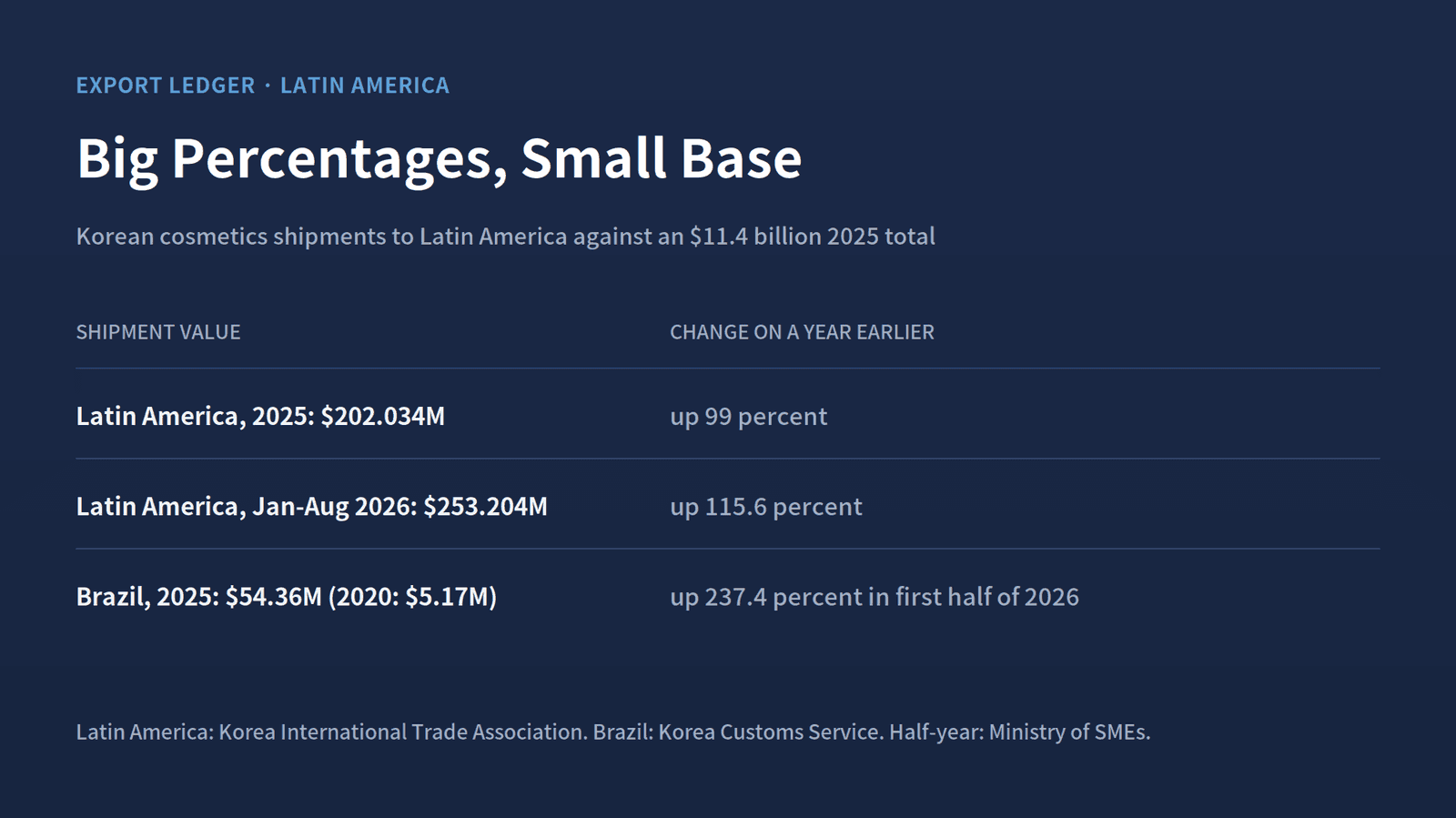
Latin America took $202.034 million of Korean cosmetics in 2025, under two percent of the $11.4 billion Korea shipped that year, and no country in the region sits in Korea's top ten destinations. Over the Chuseok holiday, the chief executives of Amorepacific and LG H&H flew to Mexico City anyway. The region they went to has no Korean trade agreement, no consolidated beauty retailer and no Olive Young. That absence is the reason they went.
Who actually boarded the plane, and when?
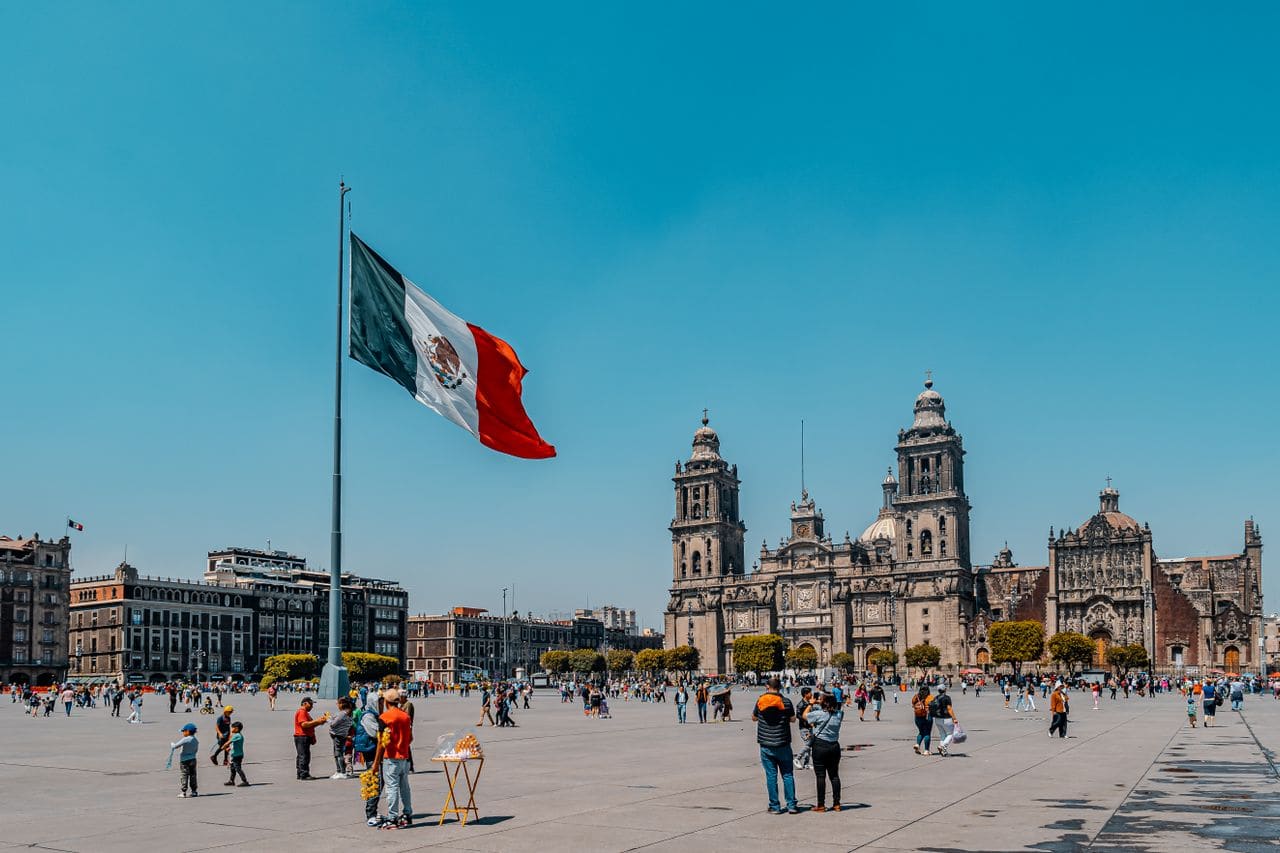
K-EXPO Mexico ran from 24 to 27 September 2026 at the World Trade Center in Mexico City, with the consumer exhibition open from the 25th. Six ministries organised it, led by Culture, Sports and Tourism and joined by Agriculture, Trade and Industry, Health and Welfare, Oceans and Fisheries, and SMEs and Startups, with delivery handled by the trade promotion agency KOTRA and the Korea Cosmetic Industry Institute among others.
Amorepacific and LG H&H held floor space alongside Nongshim, CJ CheilJedang, Binggrae, Korea Ginseng Corporation, Samsung Electronics, Kia and LG Electronics. What separated this from an ordinary pavilion was who showed up in person: Amorepacific's chief executive Kim Seung-hwan and LG H&H's chief executive Lee Sun-joo attended, as did Nongshim's Cho Yong-chul and Binggrae's Kim Kwang-soo, on reporting published 24 September 2026.
They did it over Chuseok — the autumn harvest holiday that is the longest scheduled closure in the Korean corporate calendar, the week Korean executives are expected to be with family rather than on a fourteen-hour flight. The timing was not incidental. President Lee Jae-myung's state visit to Mexico, the first by a Korean head of state in sixteen years, fell inside a 21–27 September trip that also took in the United Nations General Assembly. He walked the expo floor, used an artificial-intelligence skin analysis device at the Amorepacific booth and took a scalp care briefing at LG H&H's. KOTRA's president Kang Kyung-sung said 34 contracts worth $12.5 million were signed in a single day.
How small is Latin America in Korea's export ledger?
Small enough that the trip looks irrational on the numbers alone. Korea's drug and food regulator put 2025 cosmetics exports at $11.4 billion, up 12.3 percent and the highest annual total on record. The United States took $2.2 billion of that, China $2 billion and Japan $1.1 billion, and the top ten destinations together accounted for 70.7 percent.
Against that, the trade association's figure of $202.034 million for all of Latin America in 2025 is roughly 1.8 percent of Korea's cosmetics exports. Neither Mexico nor Brazil appears in the top ten destination table the cosmetics industry institute maintains; that list runs United States, China, Japan, Hong Kong, Vietnam, Russia, Taiwan, United Arab Emirates, Poland and Thailand.
Brazil, the region's largest beauty market, took $5.17 million of Korean cosmetics in 2020 and $54.36 million in 2025 on customs service figures — a tenfold rise that still leaves it an order of magnitude below Poland.
Why does a market under two percent pull chief executives off the Chuseok calendar?
Because the decision being made in Mexico City is not an order. The trade association's cumulative January-to-August 2026 figure for Latin America is $253.204 million, up 115.6 percent — already more than the region took in all of 2025, with four months still to run. The SME ministry's half-year review put Latin American shipments up 131.9 percent in the first six months of 2026 and Brazilian shipments up 237.4 percent.
Growth rates like those are what a small denominator produces, and no chief executive clears a holiday week for a denominator. What pulls that level of seniority is the structure question underneath. In a market with an incumbent channel, entry is a meeting: a brand pitches a buyer, wins doors, and the head of international sales signs. In a market with no incumbent channel, entry is a company-building exercise — a legal entity, an importer of record carrying regulatory liability, warehousing, a pricing ladder, and exclusivity terms that will be hard to unwind. None of those sit below the executive floor.
That is also what separates this from the discount-format expansion story that has dominated K-beauty channel coverage. The question in Mexico is not what price architecture a Korean brand should bring. It is whether there is anything to bring it to.
What does the buyer-to-seller ratio at the expo reveal?
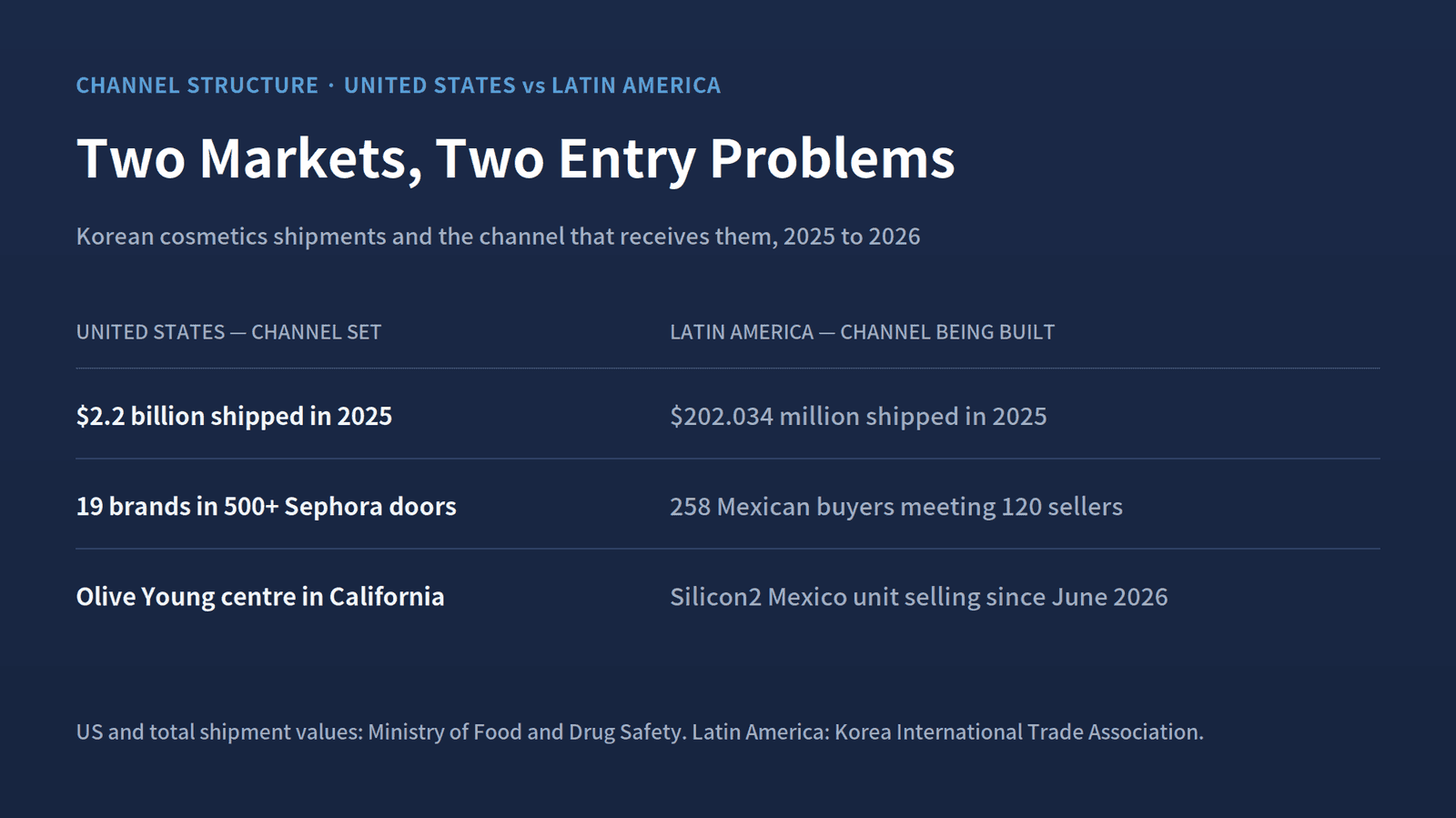
The expo's business-to-business programme — matchmaking sessions in which exporters are scheduled into back-to-back meetings with pre-screened importers and retailers — ran on 24 and 25 September with 120 Korean companies facing 258 Mexican buyers. A separate showcase paired 62 Korean companies with more than 120 buyers from seven countries.
More than two buyers for every seller is the inverse of the ratio a Korean brand meets in the United States or Europe, where a single retailer's buying team is the bottleneck and hundreds of brands queue behind it. It reads as opportunity, and it is also a warning: a buyer surplus of that size means the buyers themselves are unconsolidated, which is another way of saying no one in the room commands enough shelf to set a category standard.
The retail names that surfaced around the event bear that out. El Palacio de Hierro is a department store and Amazon Mexico is a marketplace. Neither is a beauty specialist in the mould of Olive Young or Sephora, and the region has no equivalent operating at that scale. A Korean brand signing a Mexican distributor in this window is not buying entry into a category structure. It is helping build one, and it is doing so at a moment when distribution rights are cheap and reversibility is low.
Why is there no trade agreement to lean on?
Korea and Mexico have no free trade agreement, so Korean cosmetics enter at the general rate applied to goods without preferential origin — a tariff line being the individual product code at which a duty rate is set. The state visit did not change that. The two governments agreed to institutionalise trade, investment and industrial cooperation and to stand up a director-general-level joint committee to analyse the potential benefits, which is a step short of opening negotiations. A presidential office official said Korea's preference is a full agreement but that Mexico is not in a position to respond now. Three shapes remain on the table: a full agreement, a comprehensive economic partnership agreement, or a lower-level complementary framework.
The obstacle is the USMCA review. The United States is pressing Mexico for stricter rules of origin — the tests that determine how much of a product must be made within the bloc to qualify for duty-free treatment — and Korean manufacturers in Mexico rely heavily on Korean-supplied materials and components. President Lee raised tariff burdens and delays in exemption and refund procedures directly, and Mexico responded positively on some points, but the sequencing is fixed: the North American review comes first.
Meanwhile Mexico has been raising its own walls. From 1 January 2026 the general import duty rose on 1,463 tariff lines covering goods from countries without an agreement, at rates between 5 and 50 percent, with South Korea named among the major affected sources alongside China, India, Vietnam and others. The published categories run to vehicles and parts, plastics, steel, appliances, aluminium, toys, furniture, leather goods, paper and board, motorcycles, trailers and glass, following earlier increases on textiles, footwear and apparel. Cosmetics are not among the listed categories. K-beauty walked through a gap in a wall that went up around the rest of Korean industry, and nothing but the absence of a decision holds that gap open.
What does Mexico's regulatory regime reward that Brazil's does not?
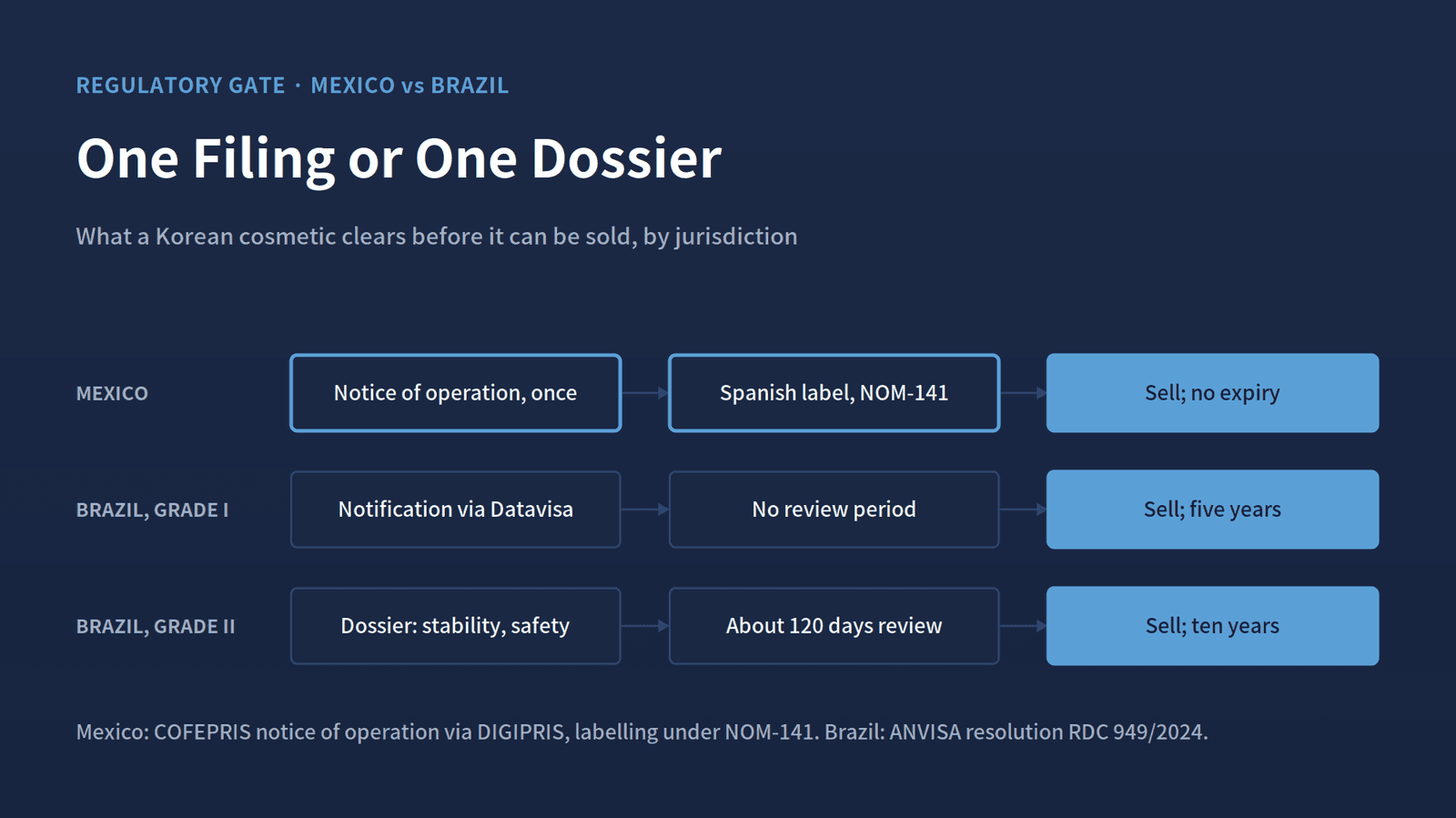
Mexico requires no pre-market registration for most cosmetics — no product-by-product approval clearing a regulator before a first unit is sold. What it requires is a notice of operation, the aviso de funcionamiento, filed once through the health regulator's DIGIPRIS platform under procedure code COFEPRIS-05-018. It does not expire, and the obligation falls on manufacturers, importers, distributors and storage operators. The compliance weight sits in the label: NOM-141-SSA1/SCFI-2012 requires Spanish text carrying product name and function, the full ingredient list in INCI form — the standardised international nomenclature that makes ingredient names readable across jurisdictions — net content, manufacturer and local importer details, country of origin and directions for use.
Brazil runs the opposite model. Under ANVISA's resolution RDC 949/2024, Grade I products clear through prior notification filed on the Solicita/Datavisa platform with five-year validity, while Grade II products require a full registration dossier including stability and safety data, averaging around 120 days of review and carrying ten-year validity. Colombia's route, the mandatory sanitary notification issued by INVIMA, runs seven years under Andean Decision 833 and is recognised in Bolivia, Ecuador and Peru.
So Mexico is cheap to enter and expensive to hold, with the recurring cost in labelling discipline and in an importer of record who carries the liability. Brazil is expensive to enter and cheap to hold. That asymmetry, rather than market size, is what explains the sequencing on display at the expo. Brazil is the larger prize; Mexico is where a Korean brand can be on shelf inside a quarter, which is why the beachhead is in Mexico City and not São Paulo.
Who is building the channel while the brands negotiate?
Distributors, mostly, and they moved first. Amorepacific put Laneige into Mexico in September 2023 through Sephora — online from the 8th, then 36 doors from the 22nd, with more than twenty products. The company's chief strategy officer described Latin America at the time as a beauty and personal care market approaching $45 billion; that sizing is Amorepacific's own.
Silicon2, the distributor that carries Korean indie brands into markets where they hold no local presence, finished setting up its Mexican operation in May 2026 and began trading in June on a direct-purchase model, holding local inventory rather than brokering shipments. It is running administrative procedures to establish a Brazilian entity within the same year, with Medicube and Round Lab among the brands it moves. CVC Capital Partners committed 300 billion won to Silicon2 — about $221 million at the rate of 1,356.18 won to the dollar on 25 September 2026, the reference date for won conversions here.
In Brazil the working channel currently is Shopee rather than physical retail, with Laneige and Mise-en-scène, SKIN1004 and Beauty of Joseon, and APR among the Korean names present. The pattern is the same in both countries: the capital entering Latin America is going into distribution rather than brands, because distribution is the scarce asset. In the United States a Korean brand buys attention. In Mexico it buys, or fails to buy, the ability to be delivered at all.
How different is this from the American and European playbook?
Different enough that the two are no longer the same business. The American structure closed this year. From 20 August 2026, nineteen Korean brands selected by Olive Young sit in more than 500 Sephora doors and on the retailer's site, with a dedicated Olive Young space at the Times Square flagship, and Olive Young has opened its first North American distribution centre in California. The announced expansion of that partnership runs to Hong Kong, Singapore, Malaysia and Thailand, then the Middle East, the United Kingdom and Australia in 2027. Latin America is not on that list.
The consequence is a different job description. A brand entering the United States negotiates with a curator who already holds the shelf and knows which Korean categories sell. A brand entering Mexico has to assemble the curator's function itself — assortment logic, price ladder, education, returns, regulatory filings — or find a distributor willing to do it and pay for that willingness in margin and exclusivity. The first job belongs to a category director. The second belongs to whoever can commit the company. That is why the delegation was chief executives and why the government sent six ministries rather than one trade agency.
What does the pattern mean for the next entry decision?
It cuts three ways, and the three do not agree.
For manufacturers and original design manufacturers — the contract developers that design and produce finished cosmetics for brands owning only the label — an unconsolidated market orders in small lots across many stock-keeping units, in Spanish and Portuguese label variants, against two regulatory regimes. The economics reward short production runs and regulatory documentation capacity, not the longest single line. A supplier organised around large orders from a handful of retail-backed brands is built for the American channel, not this one.
For brands and buyers, 258 buyers chasing 120 sellers is a seller's market for attention and a buyer's market for terms. Exclusivity granted in this window sets the channel structure for a decade, and Latin American distributors understand that better than the brands do. The cost of a bad partner here is not a slow year; it is a market locked behind someone else's contract.
For regulators and investors, the sequence is the finding. Private capital reached Latin America before the treaty did. Mexico's file-once regime made that possible and Brazil's dossier regime did not, which means regulatory design is currently doing the work that trade policy has not. What is being bought in Mexico City is distribution equity at pre-channel prices.
The trade agreement will come later. The shelf space is being allocated now.