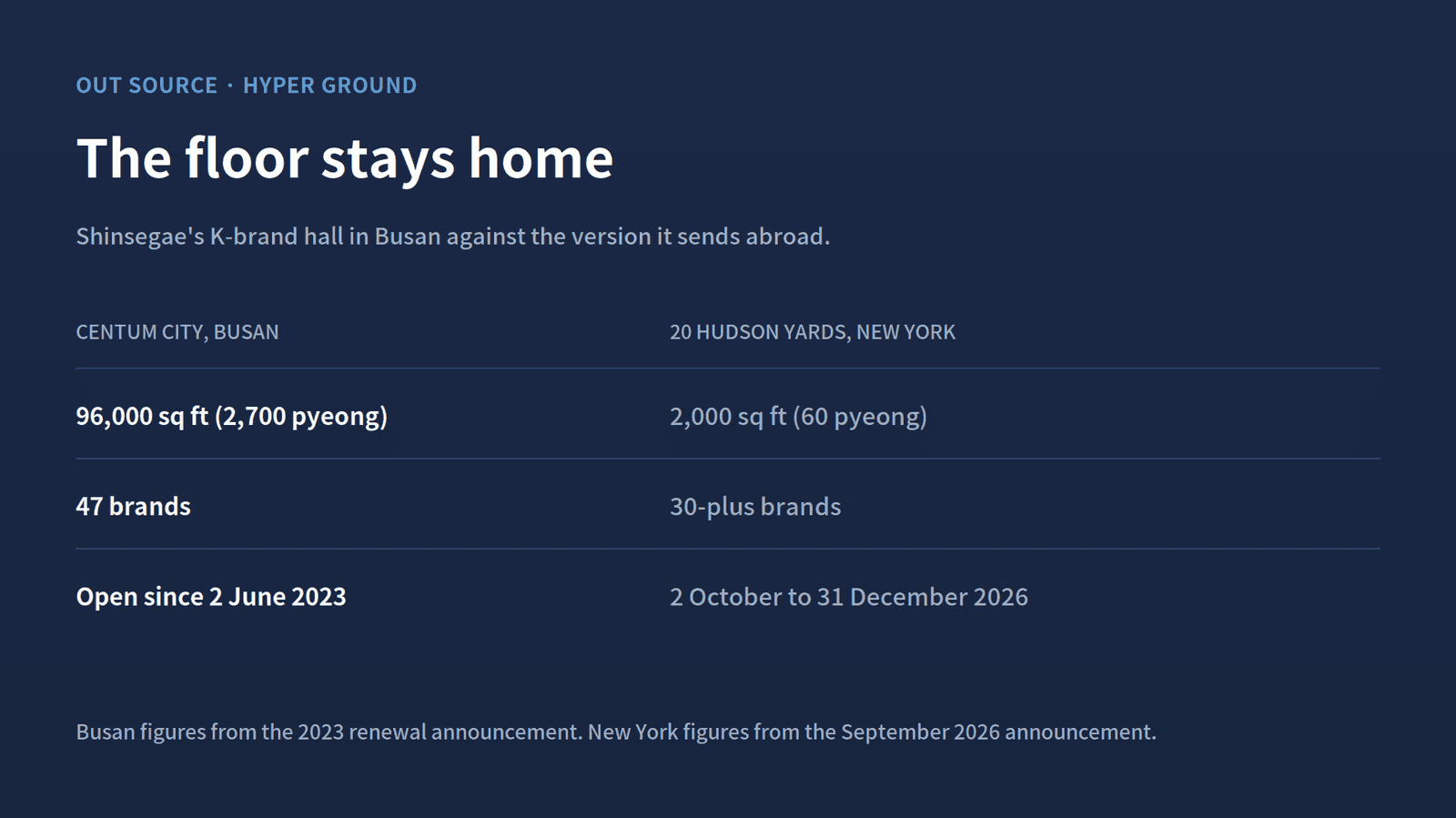
Shinsegae Department Store's K-brand pop-up at Hudson Yards takes 2,000 square feet on Level 1 of 20 Hudson Yards and closes on 31 December 2026. The Hyper Ground floor it is named after occupies about 2,700 pyeong — roughly 96,000 square feet — inside the company's Centum City store in Busan. The travelling version is one forty-fifth the size of the original, and across eleven overseas outings since November 2023 the company has not once owned the floor it stood on.
What opens at Hudson Yards in October?
The installation runs on Level 1 of 20 Hudson Yards in Manhattan and carries more than 30 Korean beauty brands across six themed zones covering skincare, makeup, fragrance and hair, beauty devices, ingestible beauty and lifestyle gifts. Entry is free. The first 200 visitors receive a gift bag the operator values at over $100, and the first 100 shoppers spending $100 or more receive a second gift valued above $300. A rotating brand takeover runs weekly in a dedicated event area.
The Korean announcement puts the floor area at about 60 pyeong — the Korean unit of floor area, 3.3 square metres — and dates the run from 1 October. New York listings put the public opening on 2 October. Both agree the closing date is 31 December, which makes the term 91 days. The named brands include Skit, MiHak, Bbia, Ongredients, Mujagi, Kundal and Yunjac, and most are making their first appearance in US physical retail.
The operator is the Hyper Ground division of Shinsegae Department Store. Shinsegae describes the site's annual footfall as more than 14 million. That figure is the company's own.
What is Hyper Ground at home?
Hyper Ground is a department store floor before it is anything else. Shinsegae reopened the young fashion hall at its Centum City store in Busan on 2 June 2023 across roughly 2,700 pyeong, describing it at the time as the largest young-fashion hall in the country, with 47 brands of which 20 were new to the Busan market. The company reported young fashion sales up more than 75 percent year on year afterwards, sales to shoppers in their twenties and thirties up 127 percent, and that cohort at 48 percent of visitors. Those performance figures are the company's own.
The platform was rebranded on 18 September 2026, first at the Cheonan Asan store, with 20 additional brands including Pottery, Musinsa Standard, Setter, Nomanual, Mark Gonzales and MMLG. Shinsegae's stated purpose for the new identity was to consolidate two things that had been running separately: a domestic floor showcasing Korean brands, and an overseas-entry platform for them. Shoppers in their twenties and thirties account for 42 percent of the Cheonan Asan customer base against a 28 percent chain average.
That consolidation is the substance of the story. The company has decided the curation itself is the asset, and given it one name to travel under. What it has not done is put a store behind it.
Who owns the floor in each of the eleven pop-ups?
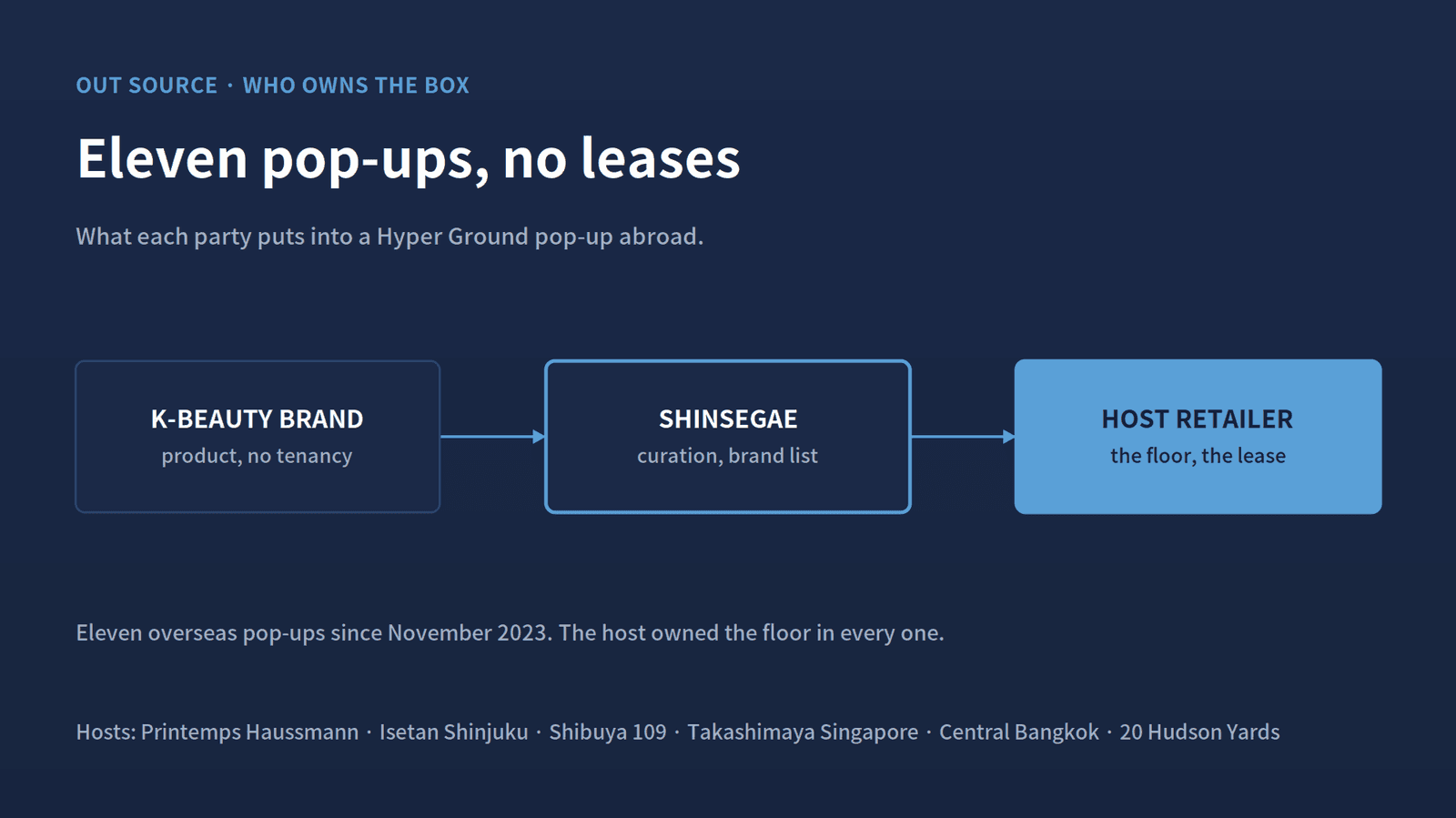
The first K-beauty edition ran in the atrium of Printemps Haussmann in Paris to 31 August 2025 with 14 Korean brands and more than 30 exclusive products. Tokyo came twice: Isetan Shinjuku in May 2025, then Shibuya 109 from 17 October to 10 November 2025. Singapore ran at Takashimaya. Bangkok ran at Central, most recently at CentralWorld from November 2025 to 30 January 2026 with 15 brands. New York runs inside The Shops at Hudson Yards, developed by Related Companies.
The Shibuya 109 edition is the clearest illustration of the arrangement. The press release announcing it was issued by Shibuya 109 Entertainment, the operator of the building, and it described Shinsegae's contribution as curating Korean brands aimed at Gen Z shoppers for the host's eighth floor and ground-floor pop-up bridge. A memorandum of understanding signed with Tokyu Retail Management around the same period covers content exchange and collaborative business models. It does not cover property.
In each case the host retailer holds the building, sets the term and carries the leasing risk. Shinsegae supplies the brand list, the merchandising and the marketing. The word export fits what Shinsegae sends. It does not fit the store, because no store is sent.
Why is a Hudson Yards ground-floor unit available at all?
The Shops at Hudson Yards opened on 15 March 2019 with 750,000 square feet of retail. Neiman Marcus took 188,000 square feet of that as the anchor and closed permanently in the summer of 2020. Wells Fargo began converting 445,000 square feet — the top three floors of the former Neiman Marcus space at 20 Hudson Yards — into offices in March 2024, with completion scheduled for the end of 2026. Sephora and Banana Republic are among the other departures since opening.
Roughly 59 percent of the centre's original retail area is therefore being turned into a bank's offices, in the same building where the pop-up sits on Level 1. A landlord in that position has term space to fill and a reason to fill it with something that reads as new.
This does not make the letting less real. It does mean the arrival of K-beauty at Hudson Yards is a story about supply as much as demand, and that a 91-day licence is the cheapest possible way for both sides to test the proposition. Neither party has committed anything that survives the new year.
What does the permanent version look like?
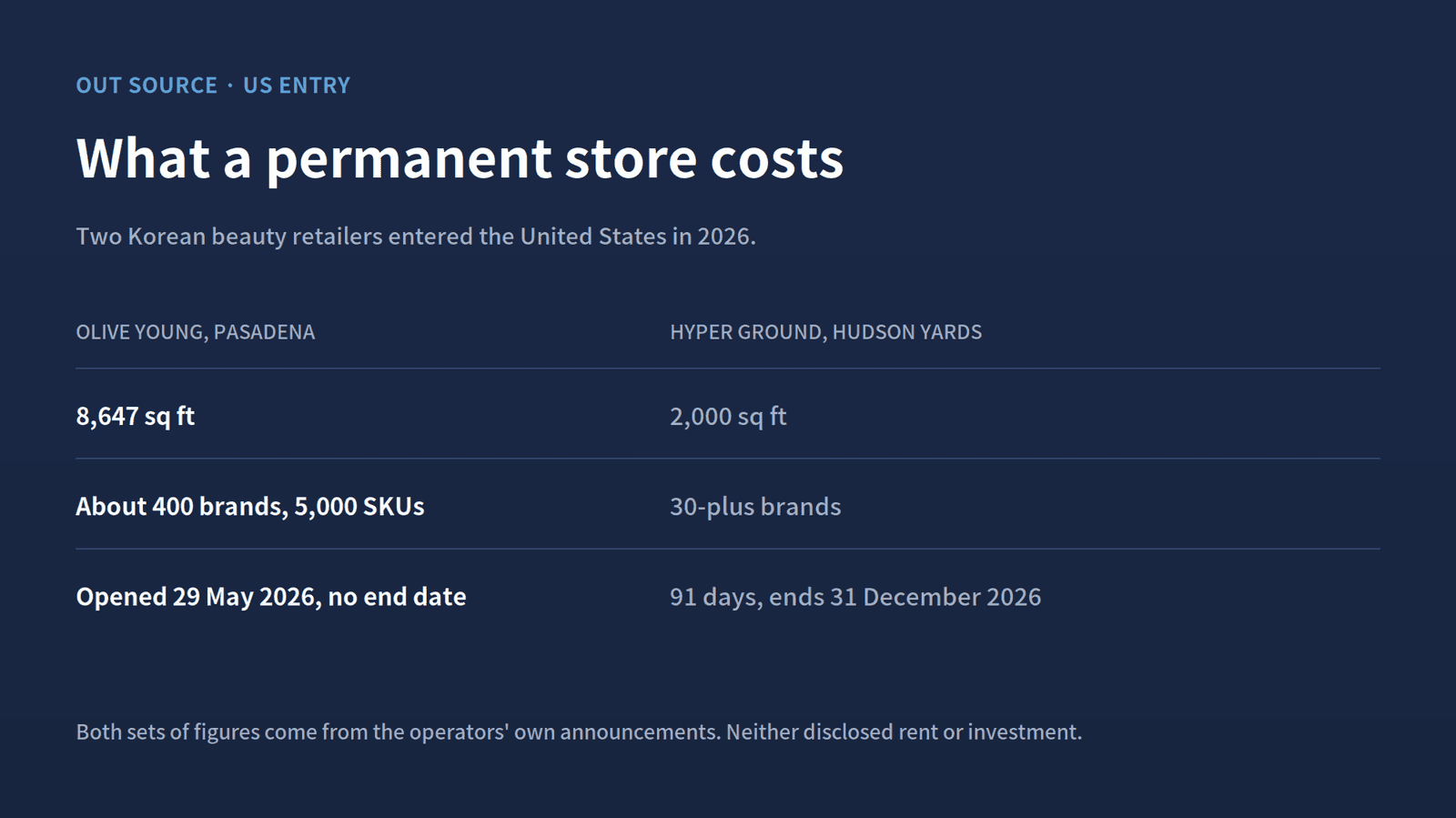
Olive Young opened its first US store at 58 West Colorado Boulevard in Pasadena, California on 29 May 2026, across 8,647 square feet, carrying roughly 400 brands and 5,000 stock-keeping units at launch and modelled on the chain's Korean format. The company named Anua, Biodance, fwee, Mediheal, Mise-en-scene, rom&nd, Torriden, Unove, Foodology and InnerB among the assortment. CJ Group's chairman framed the opening as a first step into the world's largest market rather than the launch of a single outlet, and said the ambition extends past beauty into a broader lifestyle offer. No store count, timeline or investment figure was disclosed.
Set the two side by side. Olive Young took 4.3 times the floor area, 13 times the brand count, and a lease with no end date. Shinsegae took 2,000 square feet for a quarter. Both are Korean retailers entering the United States in 2026, and only one of them exported a store.
What is Shinsegae actually selling here?
The company has been explicit about the function. A Shinsegae Department Store official described overseas pop-ups as a way to introduce leading Korean brands directly to local consumers and raise awareness quickly, and said they create contact with buyers from local retailers that can be converted into partnerships and new business areas. An executive at the Bangkok opening described the intention as developing Hyper Ground into a K-lifestyle platform for global customers.
That is business development, not retail. The product being sold is a shortlist and the access that comes with it: a pre-screened roster of Korean brands, assembled by a buyer with a domestic sourcing desk, delivered into a host's footfall for a fixed period. The economics of that are a service fee and a sourcing relationship, not rent and margin.
The roster behaves like a roster rather than a market test. Yunjac appeared in the Paris edition in 2025 and appears again in New York in 2026. Across 30-plus brands, 2,000 square feet works out at about 67 square feet each — a shelf, for 91 days. That generates awareness and buyer meetings. It does not generate repeat-purchase data at a volume anyone would forecast from.
How far ahead of the accounts is the announcement?
Shinsegae reported first-half 2026 consolidated revenue of 6.3558 trillion won, about $4.68 billion, up 10.1 percent, and operating profit of 365 billion won, about $269 million, up 75.7 percent. The department store division alone turned over 2.017 trillion won, about $1.49 billion, in the second quarter, up 15.5 percent, on operating profit of 108.8 billion won. Won figures are converted at 1,356.85 won to the dollar, the rate on 29 September 2026.
A 2,000 square foot unit operating for 91 days does not register against a division turning over two trillion won a quarter. None of the company's announcements of the eleven overseas pop-ups carries a sales figure, a floor cost or a target, and the pop-up programme does not appear as a reporting segment.
Shinsegae has said it intends to run around six more pop-ups in the United States, Europe and Southeast Asia before the end of 2026. That is a stated plan rather than a set of confirmed sites, and no cities, venues or dates beyond New York have been published. A recruitment notice for a local manager with three to seven years of retail experience is the only durable commitment visible in New York so far.
Does the export data support a retail-format play?
Korean cosmetics exports reached $7 billion in the first half of 2026, up 27.3 percent year on year and the highest first-half total on record. The United States was the largest single destination at $1.45 billion, or 20.7 percent, ahead of China at $1.01 billion and 14.4 percent. Those figures come from the drug safety ministry's compilation of customs data.
Demand for the product is proven and growing at a rate that makes a three-month shelf look beside the point. The open question is a different one: whether Korean retail judgement travels. An American shopper buying a Korean serum is buying the serum. Asking that shopper to also buy a Korean department store's opinion about which 30 brands matter is a separate proposition with separate economics — wholesale in the first case, rent and curation fees in the second.
Nothing in a 91-day pop-up tests the second proposition. It tests whether a gift bag draws a queue.
What does this look like from three sides?
For the brands on the shelf, a pop-up is distribution without capital and without tenure. Sixty-seven square feet for a quarter buys visibility in a high-traffic site and a chance of a buyer meeting, and it ends on a fixed date whatever the sell-through. The brands that convert are the ones an American buyer picks up afterwards, on that buyer's terms. Exposure is not a channel.
For buyers and host retailers, the pre-screened Korean roster is a genuine service and cheaper than building a Seoul sourcing desk. Its value is highest while Korean supply is fragmented and Western buyers lack the relationships to sort it. That value falls as those buyers build their own capability, which is what Olive Young's Pasadena assortment of 400 brands demonstrates is already possible.
For landlords and investors, a category with no lease history is filling term space in a centre converting more than half its retail area to offices. The owner carries no covenant risk across 91 days, and learns almost nothing about what the category pays at market rent. Cheap options are cheap because they settle little.
The curation is the export. The floor stays in Busan.