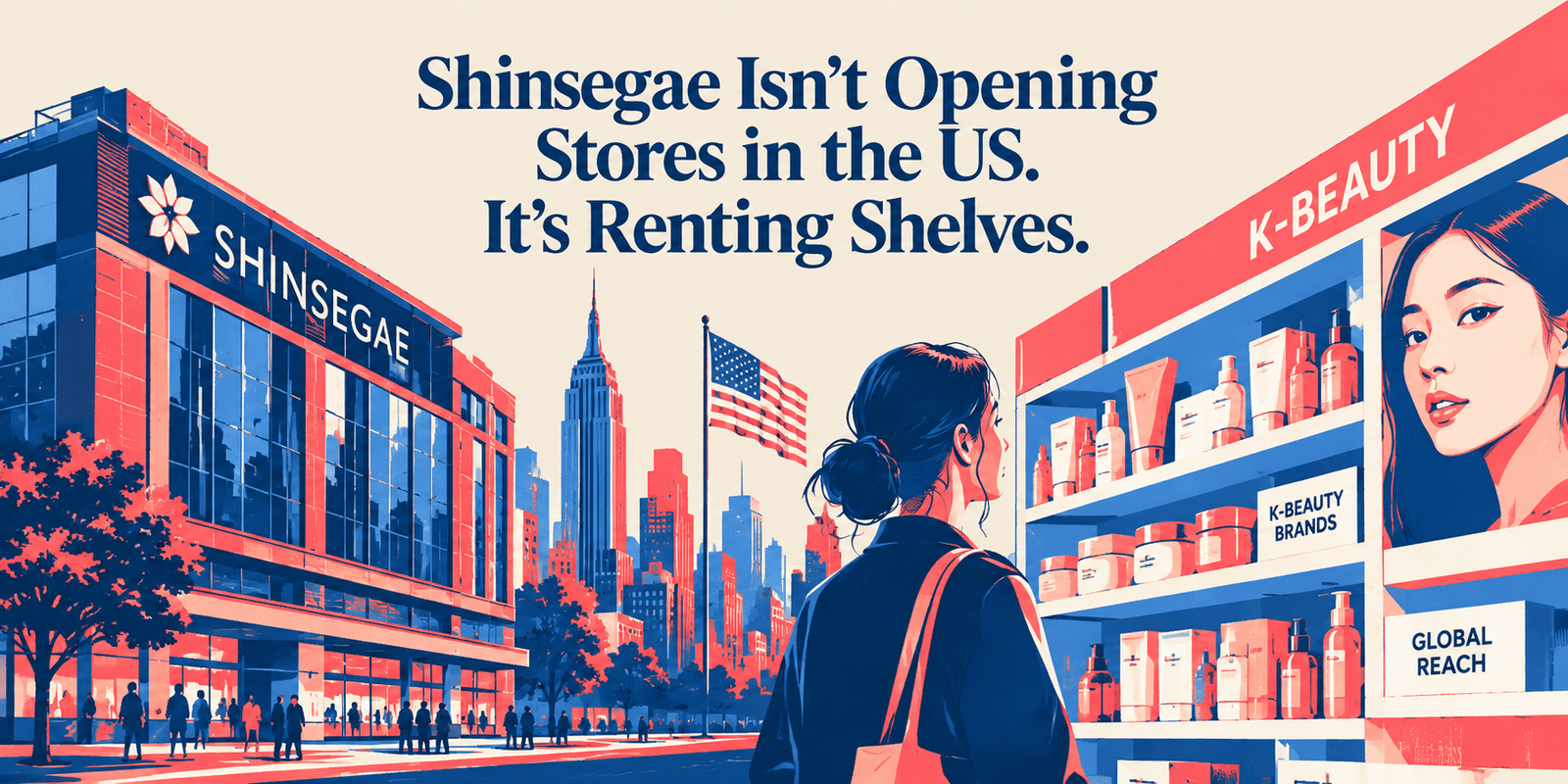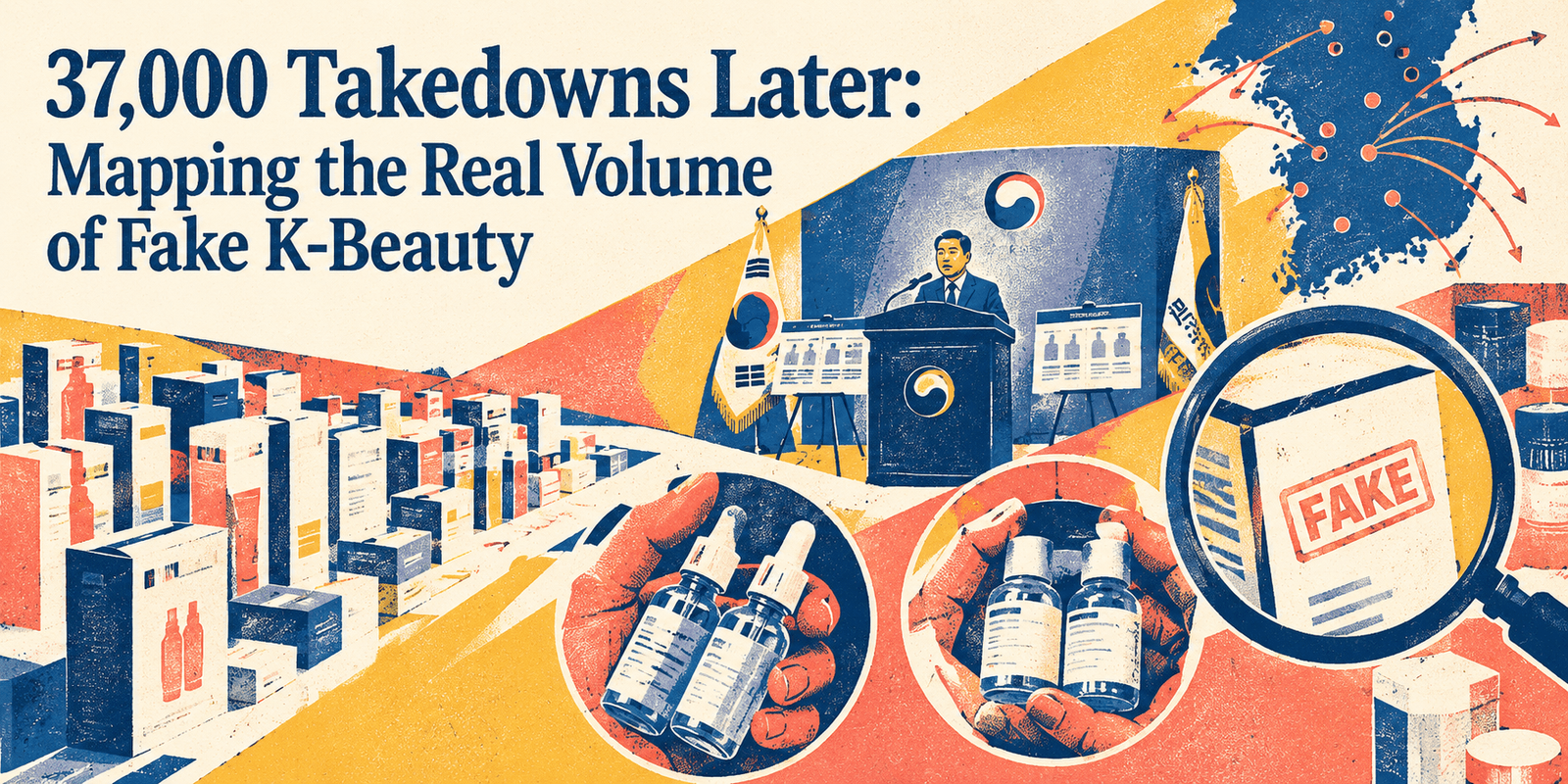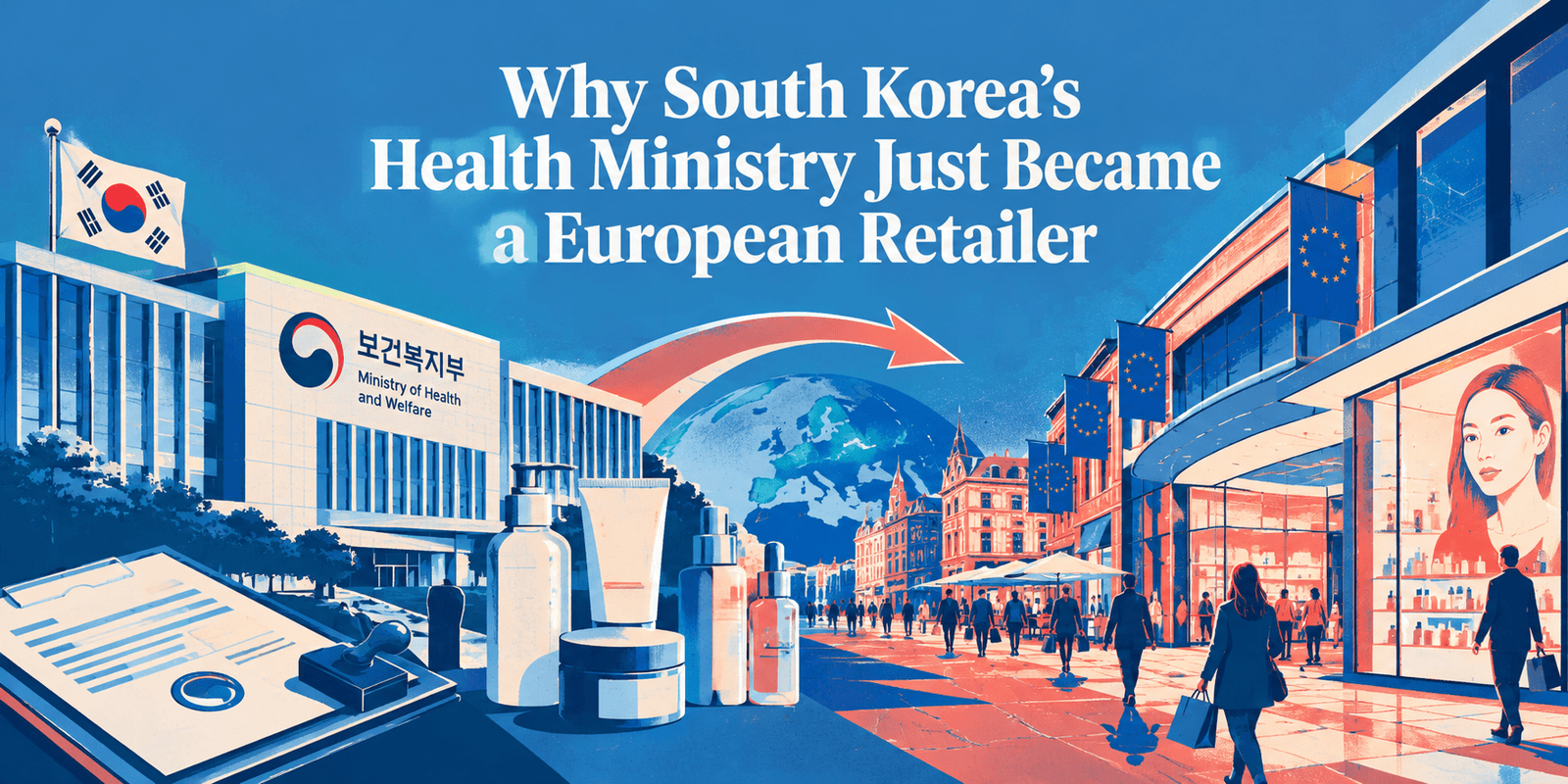
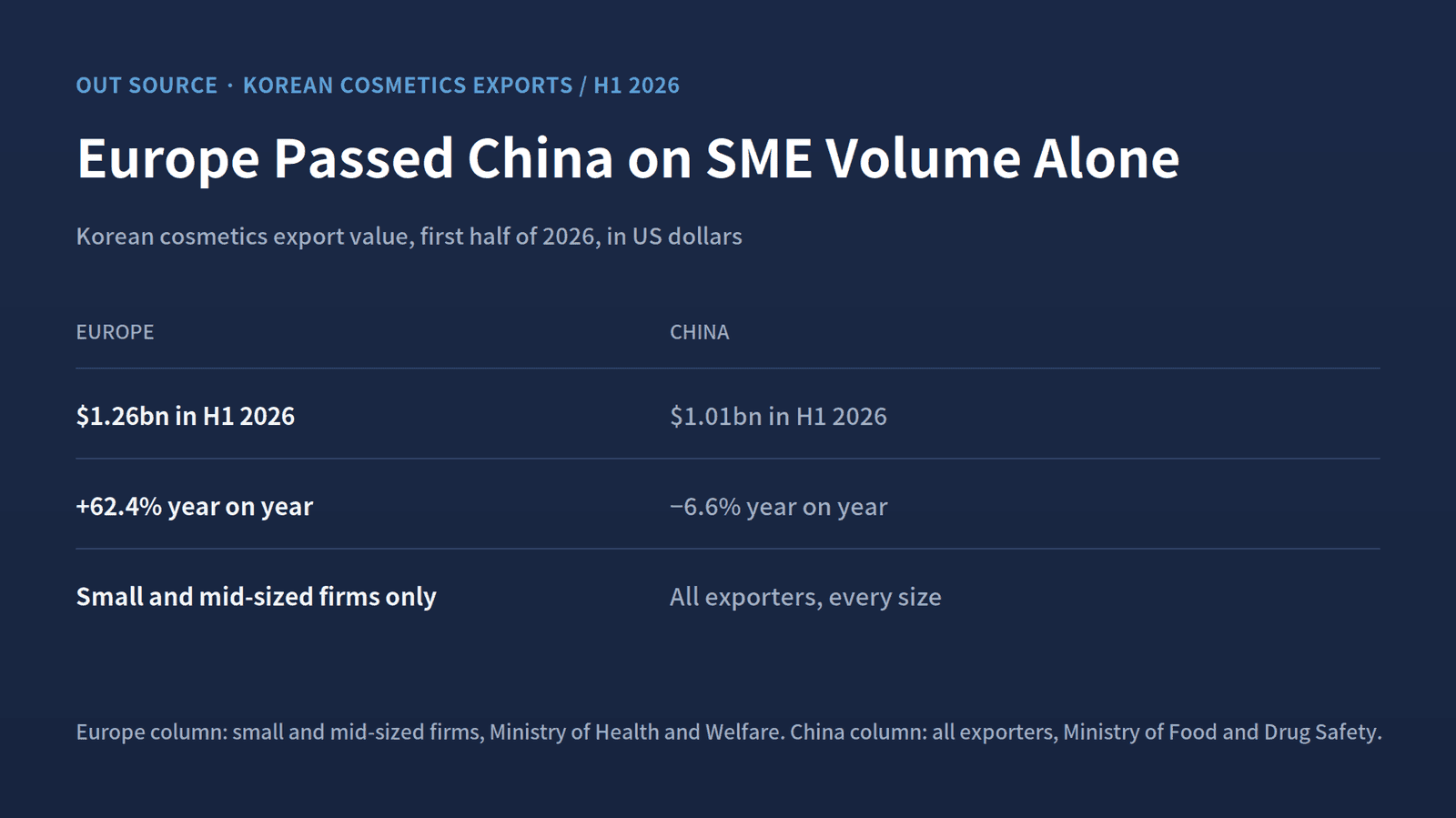
Korean small and mid-sized cosmetics firms shipped $1.26 billion into Europe in the first half of 2026, against $770 million a year earlier. Over the same six months, every Korean cosmetics exporter combined sent $1.01 billion to China. Europe has passed the market K-beauty was built around, and the government's answer was not another subsidy line. It was three retail addresses, a notification desk and a promotion ladder.
What did Seoul actually open in Europe?
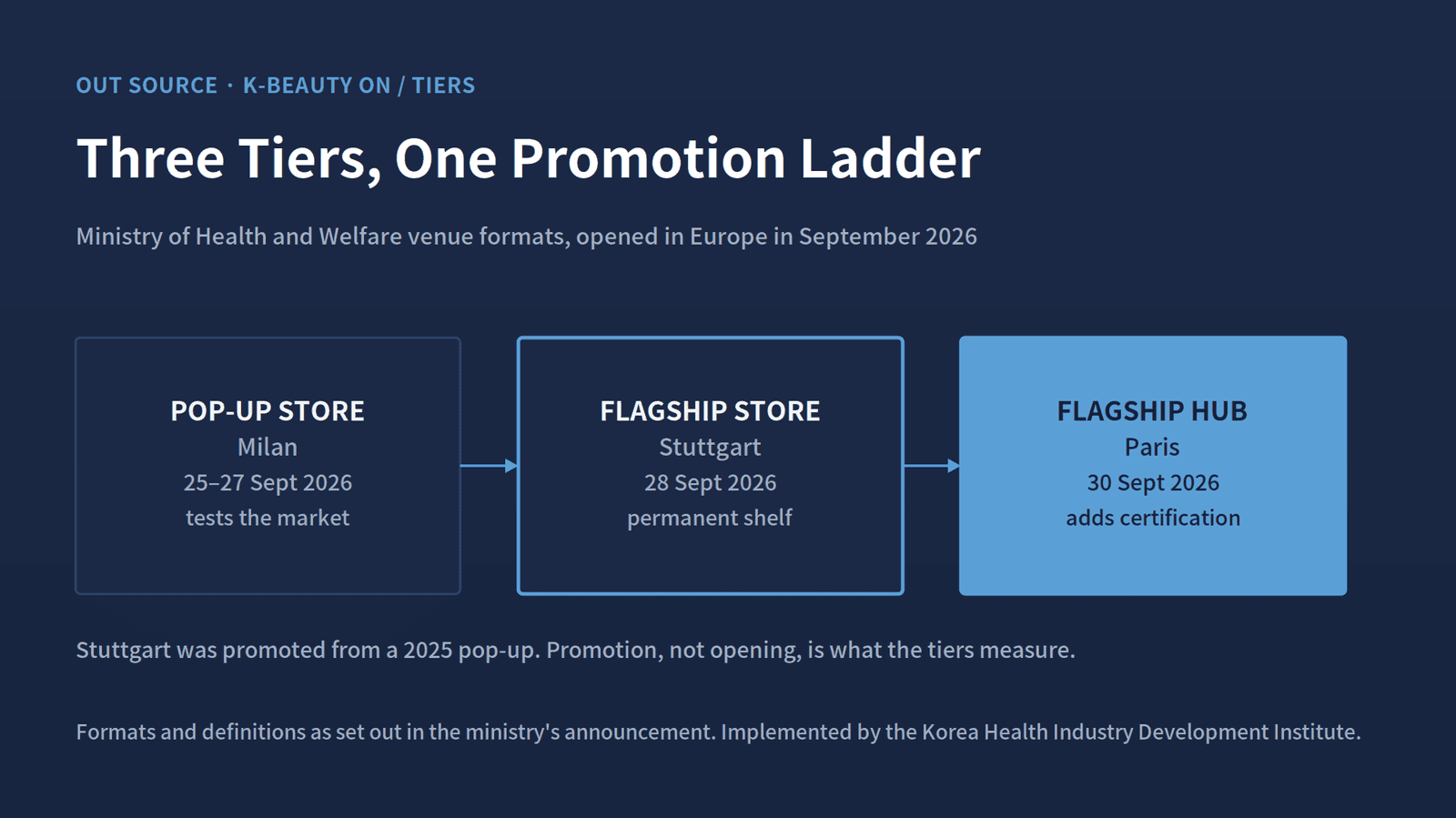
The Ministry of Health and Welfare ran a three-day pop-up called Gop-da in Milan from 25 to 27 September 2026, timed to Milan Fashion Week. It opened a permanent store, NEMO Store x K-BEAUTY ON, inside the MILANEO shopping centre in Stuttgart on 28 September. It opened a flagship hub, mmm (Maison des Mille Muses), in Paris on 30 September.
The ministry's announcement treats the three formats as distinct tiers rather than three sizes of the same thing. A pop-up tests whether a market exists. A flagship store holds permanent shelf space and builds a local distribution network. A flagship hub adds promotion, certification support and buyer introductions on top of selling. Implementation sits with the Korea Health Industry Development Institute, the ministry's industry agency.
Why is a health ministry running shops?
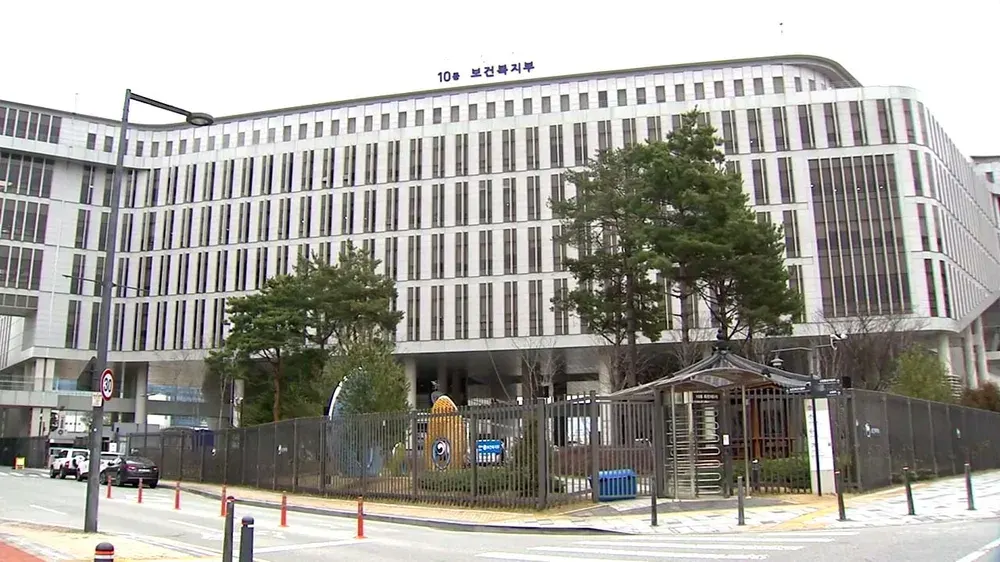
Korea regulates cosmetics as a health product, and the portfolio is split. The Ministry of Food and Drug Safety licenses manufacture and sale and publishes the country-by-country export statistics. The Ministry of Health and Welfare owns industrial policy for the same category and funds the institute that executes it. Export promotion for most Korean goods runs through the trade portfolio; cosmetics carry a second, parallel channel through health.
That split explains the shape of the intervention. A trade agency builds trade fairs and matchmaking events. A health ministry that already sits on registration data, safety assessment capacity and a standing relationship with every licensed brand owner in the country builds something closer to a distributor: it selects inventory, rents floor space and puts a certification desk behind the till.
Is the ministry the landlord or the tenant?
The store names answer that. NEMO Store x K-BEAUTY ON is a co-branding, a local retail operator's name joined to a government programme label, sited inside a privately owned shopping centre. The same K-BEAUTY ON label appeared at Burjuman Mall in Dubai in 2023, in a store the ministry and its institute backed while a private chief executive ran it.
So the state is not the property owner. What Seoul supplies is the programme, the brand selection, the compliance advice and the buyer pipeline. What it takes is floor space in somebody else's building, beside somebody else's tenants. Calling this state-owned retail overstates the asset. Calling it a trade fair understates the permanence.
What gets a city promoted from pop-up to permanent?
Stuttgart is the test case. The permanent store there followed a pop-up the ministry ran in the same city in 2025, and the announcement describes the permanent store as an expansion built on that pop-up's results. The ladder is not decoration. A city earns permanent shelf space by performing in a temporary one.
That makes the programme a market-screening instrument as much as a sales channel. Each pop-up is a paid experiment with an outcome that gets acted on. Milan ran three days against a fashion-week audience. Stuttgart, a manufacturing city with no standing in beauty retail, holds the permanent store. The selection is being made on performance rather than on prestige, and the tier a city sits in is public information.
Why does a beauty venue need a compliance desk?
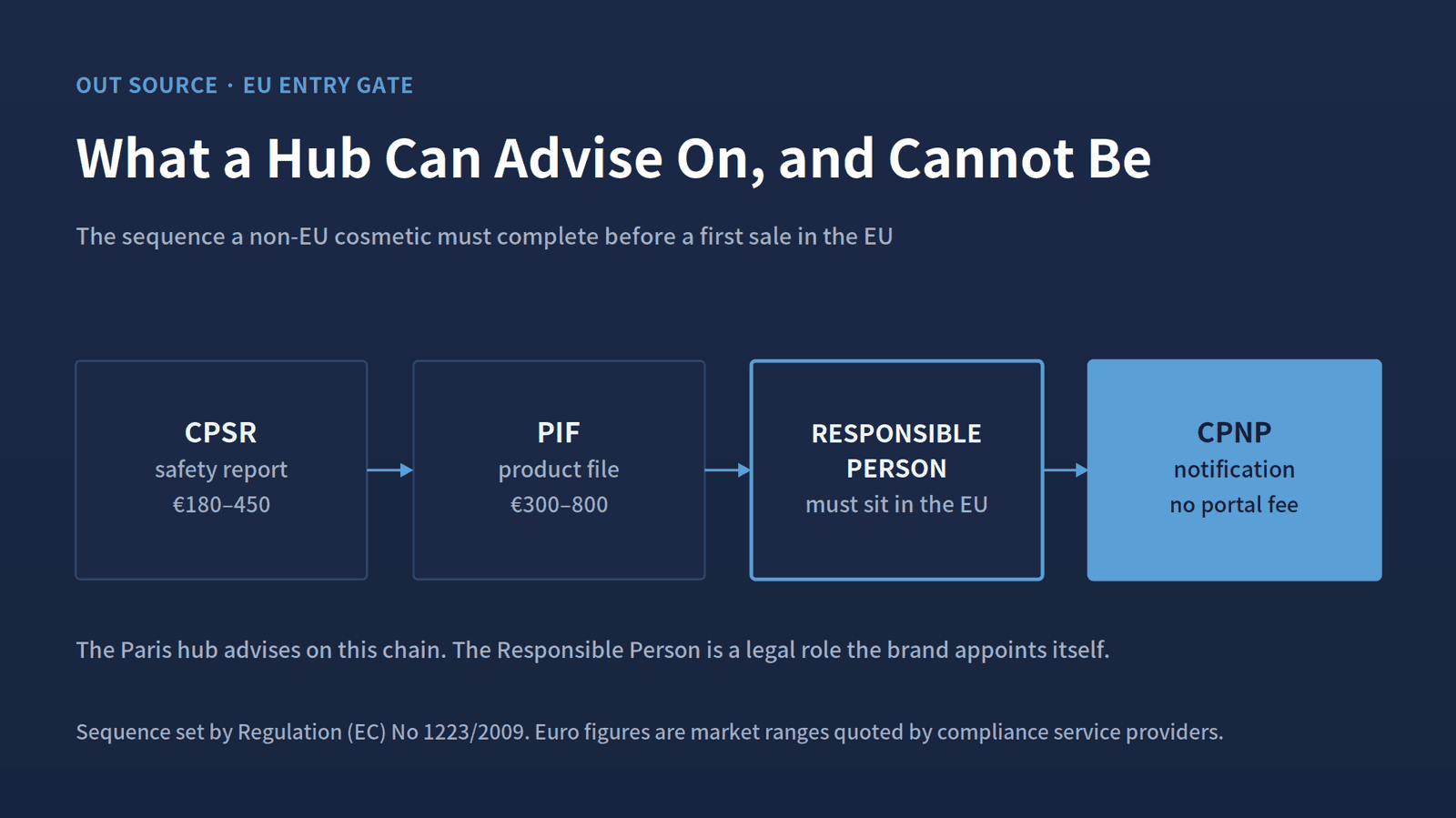
Because the European gate is paperwork, not shelf space. The Cosmetic Products Notification Portal, or CPNP, is the European Commission's single register where a cosmetic product must be notified before it is placed on the EU market. Notification through the portal carries no fee. What it carries is a precondition.
The notification has to be made by a Responsible Person established inside the EU, a legal role that holds the Product Information File, the dossier covering formulation, labelling and safety data. That file has to contain a Cosmetic Product Safety Report, a safety assessment signed by a qualified assessor. A Korean brand cannot notify from Seoul. It appoints someone in Europe to do it, and that appointment is per company and the underlying dossiers are per product.
Compliance service providers quote market ranges of €180 to €450 for a safety report, €300 to €800 to compile a product file, and €200 to €900 a year for Responsible Person service, with a first product landing between €1,500 and €4,500 using outside providers. A brand with twelve items pays that arithmetic twelve times, every year, before it sells a single unit.
What can the hub do about that, and what can it not?
The Paris hub offers CPNP consulting and buyer matching. Consulting is advice on the chain; it is not the chain. The Responsible Person carries liability, and a brand appoints that role itself. A government programme explaining the process does not absorb the obligation or the annual cost.
What the hub removes is search cost and the learning curve, which for a first-time exporter is the part that kills the attempt. What it leaves in place is the recurring bill and the legal exposure. For a European buyer reading a K-BEAUTY ON shelf as a signal, that distinction decides what the signal means: the shelf shows a brand cleared the gate, not that a government stands behind its file.
What do the export numbers say about the timing?
Total Korean cosmetics exports reached $7 billion in the first half of 2026, up 27.3% year on year. The United States took $1.45 billion, 20.7% of the total, up 41.5%. China took $1.01 billion, 14.4% of the total, down 6.6%. Japan took $580 million. Inside Europe the growth is steep and scattered rather than concentrated in the obvious markets: Poland up 72.8%, the United Kingdom up 150.6%, the Netherlands up 220.4% over the same period.
The ministry's own figure for small and mid-sized firms in Europe, $1.26 billion against $770 million a year earlier, is compiled on a different basis from the drug regulator's country tables, and it still lands above the China total for exporters of every size. Two agencies counting two different populations reach the same verdict about which market is moving, which is the condition under which a ministry stops writing subsidy programmes and signs a lease.
Why can 31,000 Korean brand owners not build this themselves?
Because almost none of them are large enough to. Korea counted 31,524 registered cosmetics responsible distributors against 4,567 manufacturers as of 2023, roughly seven brand owners for every factory, a direct product of the outsourced manufacturing model that lets anyone with a formula brief become a brand. Of the distributors that reported production data, 93.5% recorded under 10 billion won in annual production value, about $7.4 million at 1,357 won to the dollar on 1 October 2026.
A firm of that size cannot fund Responsible Person cover across a catalogue, a Paris lease and a buyer-development team at once. The fragmentation that makes K-beauty fast at product creation is the same fragmentation that makes it slow at channel building. A state venue is a shared fixed cost, and the fragmentation is what makes sharing it rational rather than merely generous.
What does a government shelf do to a private distributor's position?
It runs a filter upstream of the distributor. The programme performs first contact, screens brands, stages them physically and attaches translated compliance answers. That is work importers and distributors have historically been paid to do, and it arrives now as free lead generation nobody billed them for.
Whether that reads as disintermediation or as a gift depends on where a distributor's margin actually sits. A business earning on discovery and qualification is watching a state agency do its job at no charge. A business earning on logistics, regulatory ownership, retail relationships and working capital is watching its funnel fill for free. The hub competes with the first. It cannot touch the second, because the Responsible Person obligation and the retail buyer's shelf decision both sit outside what a foreign government can hold.
Where does this leave the three sides?
For Korean manufacturers and their ODM partners — the contract developers that design and produce most Korean cosmetics under other companies' brand names — the venues convert export interest into order visibility earlier: a brand that reaches a Stuttgart shelf commits production volume it would otherwise have needed a year of private negotiation to justify. For brands and the buyers who source them, the sequence of a deal changes rather than its terms, because introduction now precedes negotiation instead of following it. For regulators and investors, the tiers are a disclosure system nobody labelled as one: a city with a permanent store is a city the Korean government holds sales data on, and a city still running pop-ups is not.
Six more countries sit in the ministry's stated plan. The number worth watching is not how many venues open. It is which pop-ups get promoted.