How many counterfeit K-beauty listings are actually being blocked?
The Korean Intellectual Property Office supplied the National Assembly with a count of online listings for counterfeit Korean cosmetics taken down on overseas platforms. For January through August 2026 the figure is 37,544, against 16,270 in the same eight months of 2025, a rise of 130.8 percent. Eight months of 2026 came to 95.5 percent of the entire 2025 total.
The trend line behind it runs 16,780 listings in 2023, 23,521 in 2024 and 39,295 in 2025, annual increases of 40.2 and 67.1 percent. A blocked listing is a takedown of an online post, obtained by the rights holder or by Korean agencies working with the platform. It is not a seizure of goods, not a prosecution and not a unit of product. One blocked listing can stand behind a single bottle or behind forty thousand.
That distinction matters because the number is doing two jobs in public discussion. It is read as a measure of how many fakes exist. It measures how many were found and removed.

Why does the C-commerce number get the attention?
Because the growth rates are spectacular and the base is small. Alibaba.com, a business-to-business marketplace where buyers purchase in wholesale lots rather than single units, carried 1,291 blocked listings in the first eight months of 2026 against 575 in the same period of 2025, a rise of 124.5 percent. AliExpress, its consumer-facing sibling, carried 368 against 140, a rise of 162.9 percent. Cumulatively since 2021 the two have accounted for 10,522 and 1,278 blocked listings.
Together they are 4.4 percent of this year's blockings. A count that more than doubles off a base of 575 reads as an emergency. A count that is 56.6 percent of everything and grew more slowly reads as background. The reporting has followed the percentage rather than the mass.
Where is the volume really coming from?
Southeast Asia accounts for 21,266 of the January to August 2026 blockings, or 56.6 percent. China counted as a region accounts for 5,344, up 162.2 percent. Japan accounts for 2,231 and Europe for 2,224, a 17.2-fold rise. The regional split and the platform split are drawn on different bases and do not sum to the same total.
The same map shows up in trademark squatting, where a third party registers a Korean brand name in a foreign market before the brand owner does. Figures compiled for National Assembly member Oh Se-hee from the Intellectual Property Office and the Korea Intellectual Property Protection Agency record 30,841 suspected bad-faith filings against Korean brands over five years to August 2025: 4,977 in 2021, 4,654 in 2022, 5,015 in 2023, 9,520 in 2024 and 6,675 in the first eight months of 2025. China accounts for 8,474, Indonesia for 5,234, Vietnam for 3,001 and Thailand for 2,683. That series covers all sectors, not cosmetics alone.
Read together, the two datasets say the same thing. The counterfeit problem tracks the export map. Southeast Asia is where Korean cosmetics grew fastest and where the legal apparatus for defending a brand is thinnest.
Can the official count be trusted?
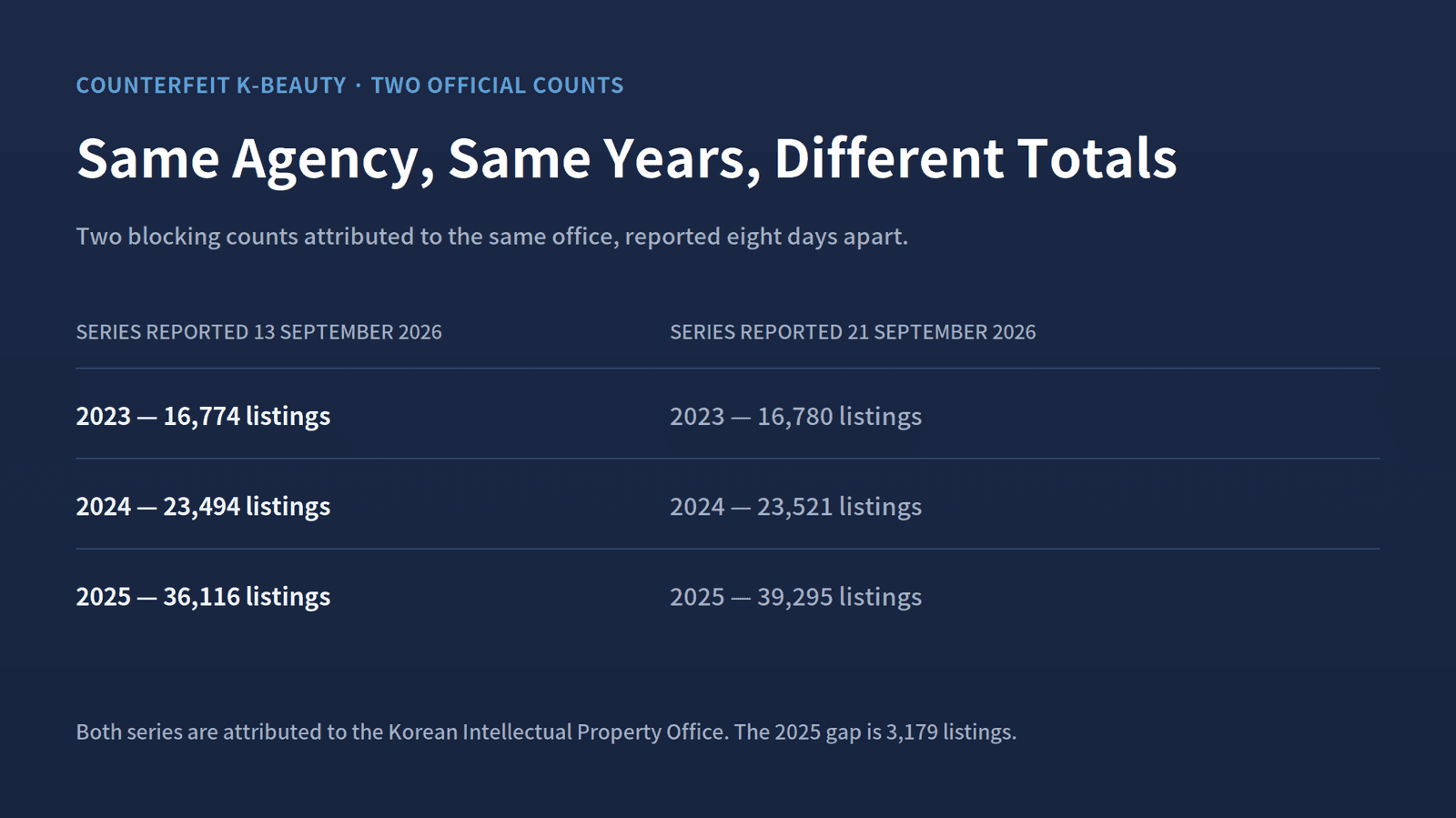
Two counts of the same years, both attributed to the Intellectual Property Office, circulated within eight days of each other in September 2026. One gives 16,774 listings for 2023, 23,494 for 2024 and 36,116 for 2025. The other gives 16,780, 23,521 and 39,295. The 2023 and 2024 pairs sit within thirty listings of each other. The 2025 pair is 3,179 apart. The first series also reports 20,370 blockings for the first half of 2026 where the second reports 37,544 for the first eight months.
These are not competing claims. They are one enforcement programme counted at two moments, with takedowns still being logged against prior years when the earlier figure was published. The practical rule is to carry one series end to end and name it, rather than taking the highest number from each year.
Is the problem only counterfeit goods?
The Intellectual Property Office and the Korea Consumer Agency surveyed roughly 10,000 cosmetics listings across seven Korean shopping platforms, among them Naver Smart Store, Coupang, 11st, G-Market, Auction, SSG and Lotte On, between May and 12 June 2026. They identified 634 misrepresentations of intellectual property rights. Of those, 626 concerned patents, 98.7 percent of the total. 514 presented an expired right as live, 81.1 percent. 73 cited patent numbers that do not exist. 30 claimed a pending application that was not pending, and 11 cited patents that had been rejected.
By category, hair care accounted for 242 cases, 38.2 percent, followed by skincare at 97, body care at 91 and cleansing products at 67. The office ordered corrections and said repeat offenders would face administrative investigation.
These are genuine products, sold by identifiable sellers, on Korean platforms, carrying claims about patents their sellers do not hold. The counterfeit is the claim rather than the jar. It is also the category the counterfeit debate consistently leaves out, because it implicates domestic distribution rather than a factory in Guangdong.
What does a counterfeit operation actually look like?
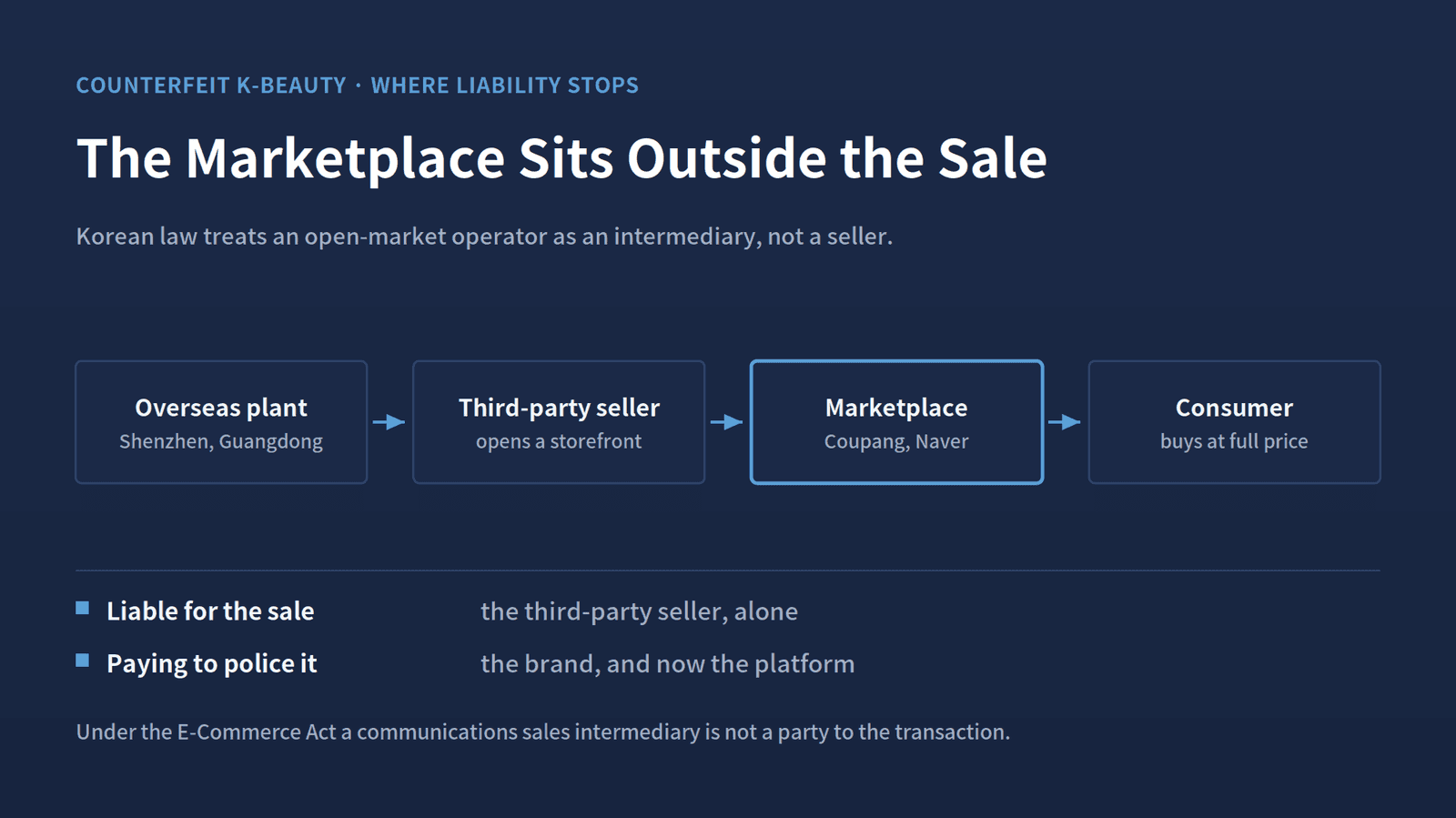
The Ministry of Food and Drug Safety and the Intellectual Property Office ran an operation the two agencies described as the first conducted jointly by their special judicial police units. Between October 2024 and November 2025, goods manufactured in Shenzhen moved through a logistics warehouse in Cheongju, North Chungcheong Province, and onto Coupang and Naver. 82,860 items reached consumers across 61 product lines, generating 4.5 billion won in sales, about 3.3 million US dollars at 1,358.4 won to the dollar, the closing rate on 23 September 2026. A further 87 product types worth 1.3 billion won, about 957,000 dollars, were seized unsold. The combined haul runs past 97,000 items and 5.4 billion won, roughly 4.0 million dollars.
The copied lines included Celladix, Gahi and Beauty of Joseon alongside Estée Lauder and SK-II, and extended to multivitamins, probiotics and water filters. Twelve seized products were laboratory-tested. None contained the functional ingredients or marker substances printed on the packaging.
Overseas seizures show the same shape at brand level. Roughly 1,400 counterfeit Medicube units were taken at Zhaoqing in Guangdong in May 2025, and roughly 40,200 at Shantou in the first half of that year. The pattern is consistent: an offshore plant, a domestic warehouse, a third-party storefront on a mainstream platform, and about a year of uninterrupted trading before anything stops it.
Who is liable when a fake sells on Coupang or Naver?
Under the Act on Consumer Protection in Electronic Commerce, an open-market operator is a communications sales intermediary: it hosts the transaction without being a party to it. The seller is the seller. The platform is the venue. Liability for an inauthentic product stops at the storefront.
Naver revised its SmartStore terms with effect from 22 January 2025, extending the list of prohibited false information beyond manufacturer, origin and brand to include price and discount rate, and allowing a completed transaction to be cancelled where counterfeits are involved. The Naver Pay terms separately state that Naver does not guarantee or take responsibility for seller members' product information and trading conditions, and does not participate in transactions between sellers and users. A Chung-Ang University specialist has argued that these exemption clauses resemble the ones the Fair Trade Commission ordered Alibaba and Temu to correct, and that tightening seller penalties changes little while the platform stands outside the transaction.
Market-share estimates published for 2026 put Coupang at 23 percent of Korean online retail and Naver Shopping at 20.7 percent. Two companies carry more than two-fifths of the country's e-commerce and hold no statutory duty of authenticity on it. An amendment requiring platforms to monitor trademark infringement has been proposed. It has not been enacted.
Why is Coupang building enforcement it is not required to build?
On 10 September 2026 Coupang held a brand protection seminar with the Korea Cosmetic Association and began piloting a dedicated counterfeit reporting hotline for major cosmetics brands, staffed at weekends, on holidays and late at night. Those are the hours in which a fraudulent listing trades unchallenged. Coupang describes its approach in three stages: screening bad actors before they list, AI detection and monitoring while they trade, and immediate suspension with a one-strike-out policy once a counterfeit is confirmed. That description is the company's own.
None of it is required by statute. The reason to build it is that the platform's own credibility is the asset at risk. When a shopper cannot distinguish a real Aestura cream from a fake one on a marketplace, the doubt attaches to the marketplace as firmly as to the brand, and unlike the brand, the marketplace cannot withdraw from the category.
This is the structural change worth marking. Enforcement is migrating from a rights-holder cost to a channel cost, ahead of the law and without being compelled by it.
What is the state doing that platforms cannot?
On 29 July 2026 the Intellectual Property Office opened a public reporting centre for counterfeit Korean brands, operated by the Korea Intellectual Property Protection Agency inside the K-Brand Protection Portal. It accepts image-tagged and location-tagged reports from consumers abroad through a web page or a QR code, sorts them by infringement type and routes them to the rights holder. A companion service issues early warnings when an unrelated party files a Korean trademark overseas.
The government certification mark is the more consequential instrument. The office has registered a national certification mark in 73 countries and is enrolling companies to carry it, with authentication technology embedded in the mark that a smartphone camera can read. The first intake closed on 11 September 2026. Applicants must already hold filed or registered trademarks in the destination market and meet domestic quality certification such as KC or HACCP, and selected firms receive up to 200 million won, about 147,000 dollars, toward implementing the technology. The office's platform partnerships for takedowns went from six in 2025 to nine in 2026.
What the state supplies here is legal standing in foreign jurisdictions: the registered mark that makes a customs hold or a local injunction available at all. No platform can supply that, and no brand protection team can substitute for it.
What does this change about the economics of the export boom?
For contract manufacturers and ODMs, the original design manufacturers that develop and produce formulas under a client's brand, authentication is turning into a production specification. A mark a phone can read has to be applied on the line, which moves anti-counterfeit technology into tooling and packaging decisions taken at the contract stage rather than into legal spending booked after the fact.
For brands and the buyers who source from them, the enforcement bill is already being paid. APR has monitored open markets with AI image analysis since 2024 and had more than a hundred counterfeit units of one Medicube cream intercepted at Timișoara airport in Romania in July 2024. Amorepacific runs an authorised-retailer mark alongside real-time monitoring. Goodai Global, whose brands include Beauty of Joseon, built an in-house intellectual property team in 2024 and runs test purchases to map seller networks. Beauty of Joseon appears on both lists, as an enforcer and as a target, which is the pattern: the brands spending most on protection are the ones being copied most. A buyer evaluating a Korean supplier is evaluating a cost line that rarely appears in the margin conversation.
For regulators and investors, the gap between who is liable and who is paying will not hold. Platforms taking on enforcement voluntarily are setting the standard of care that a future amendment codifies, and every hotline and one-strike policy narrows the argument that monitoring is impractical. An OECD estimate put trade in counterfeit Korean goods at around 11 trillion won a year as of 2024, with roughly 7 trillion won in foregone sales and about 14,000 jobs.
The fakes follow the exports. The enforcement follows the trust. The law follows last.