What Did Cosmax and L’Oréal Sign in Paris?
The agreement was signed by Choi Kyung (Vice Chairman and CEO, Cosmax) and Nicolas Hieronimus (CEO, L’Oréal Group) during the 140th anniversary of Franco-Korean diplomatic relations. It was witnessed by South Korea’s Minister of Trade, Industry and Energy, Kim Jung-kwan, alongside a French trade envoy.
As a standard MOU, it is a statement of intent carrying no binding purchase commitments. Korean trade press outlined three core areas of cooperation:
- Global R&D: Joint development drawing on L’Oréal’s beauty science and consumer insights.
- Ingredient Innovation: Discovery of active ingredients and functional substances.
- Formulation & Format Planning: Co-creation of new product formats and textures inspired by K-beauty trends.
What the announcement does not contain is as informative as what it does. There is no disclosed value, no volume commitment, no term, no exclusivity clause, and no statement on who owns jointly developed intellectual property. L’Oréal’s own press-release page carries no corresponding announcement; the news moved entirely from the Korean side.
Why the Third Area Signals a Structural Shift
The first two clauses are ordinary supplier-development language. Every large beauty group runs joint ingredient work with its manufacturing partners, and has for decades. Ingredients and actives sit upstream of the product: they are molecules with a demonstrated effect, and sourcing them from a partner changes nothing about who decides what gets made.
The third clause moves the boundary:
- Formulation is the decision about what a product physically is — the texture, the delivery format, the sensory behavior on skin, and the sequence in which a consumer uses it.
- Product format is the decision about what the object is at all: a stick, a cushion, an ampoule, a sheet.
Those decisions have historically belonged to the brand owner, because they encode a reading of the consumer. Writing that responsibility into a document with a supplier names the supplier as a source of consumer interpretation.
The asymmetry is visible in the numbers. L’Oréal reported 2025 sales of €44.05 billion (up 4.0% on a like-for-like basis) with research and innovation spending of €1,380.6 million (3.1% of sales). A group with that research base has signed a document stating that a Korean manufacturer is where new formulation concepts come from.
How Did a 2004 Supply Account Become a 2026 Formulation Brief?
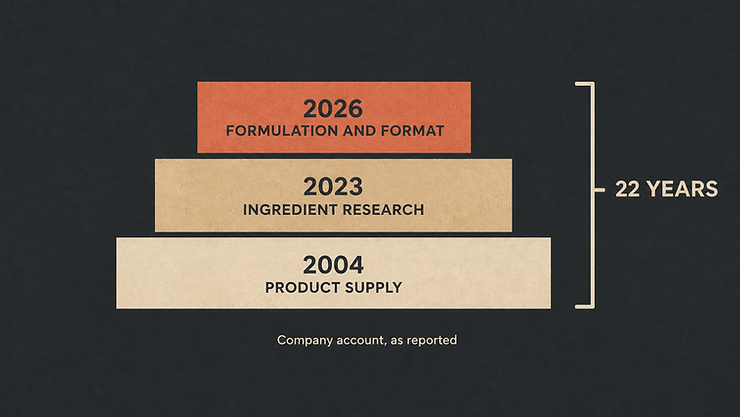
On Cosmax’s own account, as carried by Korean trade press, the relationship evolved across three key milestones over twenty-two years:
- 2004: Initial supply relationship (Capacity relationship).
- 2023: Signed a memorandum covering joint research into skin microbiome ingredients and sustainable formulations (Science & ingredient relationship).
- 2026: Expanded into joint formulation and product format planning (Product-definition relationship).
Three rungs in twenty-two years, each one further from the factory floor than the one below it. Supply is a capacity relationship. Ingredient research is a science relationship. Formulation and format planning is a product-definition relationship. The direction of travel is single and it does not reverse.
The quoted language from both executives tracks that reading:
- Choi Kyung framed the agreement as building on more than twenty years of accumulated trust to create the next generation of innovation led by K-beauty.
- Nicolas Hieronimus framed it as combining respective strengths to deliver a new level of beauty experience to consumers worldwide.
Neither statement mentions manufacturing volume.
What Does Cosmax Hold That a European Contract Manufacturer Does Not?
The scale figures explain the direction. Korean business press reported in August 2026 that Cosmax:
- Produces around 3.5 billion units a year
- Serves roughly 5,000 client companies
- Operates 19 plants globally
- Employs more than 1,100 research staff across the group
- Develops more than 8,000 new formulations annually
- Has manufactured 900 million cushion compacts cumulatively since 2013
The plant capacity is replicable. The 8,000 formulations a year across 5,000 clients is not. That volume produces a continuously refreshed record of which textures sold, which formats died on shelf, and which consumer claims held up in a market that reprices novelty every quarter. A company cannot buy that record. It accumulates only by shipping failures at scale, and Korea’s fragmented indie brand sector generates failures at a rate no single European brand house can match.
The financial position underneath is solid rather than spectacular. Cosmax reported 2025 consolidated revenue of 2.399 trillion won (~$1.79 billion USD at 1,337 KRW/USD), up 10.7%, with operating profit of 195.8 billion won (~$146 million USD), up 11.6%. Korea’s Ministry of Food and Drug Safety ranked Cosmax the largest ODM by domestic production for 2025 at 1.61 trillion won (~$1.20 billion USD).
(Note: ODM stands for original development manufacturing, where the supplier designs the product as well as making it, in contrast to OEM, where the supplier builds strictly to the customer’s design.)
Why Is L’Oréal Acquiring Korean Judgment Through Several Channels at Once?
The Paris MOU is one of three procurement routes running in parallel:
- Brand Equity (Outright Purchase): Acquired 100% of Nanda Co. (owner of Stylenanda and 3CE) in May 2018, and Gowoonsesang Cosmetics (owner of Dr.G) in December 2024.
- Consumer Signal (Programmatic Engagement): Operates a generative-AI content laboratory in Seoul and runs open-innovation programs with Korea’s Ministry of SMEs and Startups. As L'Oréal Korea’s digital marketing leadership noted, Korean consumers function as the world’s most trend-sensitive early adopters.
- Formulation by Contract: Outsourcing product definition directly through the 2026 Cosmax memorandum.
Equity, program, and supply agreement are three different instruments pointed at the same input. That is what a group does when it has concluded the input is structural rather than seasonal.
The national context sharpens it: Korea exported $11.4 billion of cosmetics in 2025 (up 12.2%), ranking second worldwide behind France ($24.3 billion) and ahead of the United States ($10.8 billion), reaching 202 countries. The world’s largest beauty group is headquartered in the country that ranks first, and it has signed a document sourcing product ideas from the country that ranks second.

If the Manufacturer Writes the Formula, Where Does Brand Differentiation Sit?
This is the question the announcement does not answer, and Korea’s own market shows the end state. Domestic cosmetics production reached 17.94 trillion won in 2025 (up 2.3%). The brand tier and the manufacturing tier are formally separate: brand owners register as responsible distributors, and thousands of them commission from a small number of ODMs drawing on shared formulation libraries.
When two competing products originate from adjacent shelves in the same sample library, they compete on story, distribution, and price. The formula is not the moat.
The counter-position is that the brief is the moat. A brand that writes a sharper brief extracts a better formula from the same supplier, and the first clause of this memorandum states that L’Oréal’s beauty science and consumer insight feed the joint work. On that reading, L’Oréal has not outsourced product definition; it has bought a faster instrument for executing definitions it still owns.
Which reading holds depends entirely on a term the memorandum does not disclose:
- Non-exclusive: If Cosmax retains the right to sell an adjacent version of a co-developed formulation to other clients, the arrangement is a speed advantage with a short half-life.
- Exclusive: If L’Oréal holds exclusivity on the output, it has converted a supplier’s accumulated judgment into a proprietary asset at a fraction of the cost of acquiring the supplier.
What Does a Memorandum With No Numbers Commit Anyone To?
Nothing enforceable in commercial terms. Documents of this shape create options: a defined scope of conversation, a public signal to both companies' markets, and a framework for contracts that follow. The disclosed content is intent and subject matter. The undisclosed content is money, volume, duration, exclusivity, and ownership.
The diplomatic staging supplies weight the commercial terms do not yet carry. Two governments witnessed the signature at a bilateral anniversary summit, which raises the cost of quiet abandonment for both parties. That is a real constraint, and it is not the same thing as a purchase order.

What Does This Settle About Where Value Sits in Beauty Manufacturing?
Three readings sit side by side, and the industry has not chosen between them:
- The Supplier Reading: Interpretation is the scarce input and assembly is not, so the ODM tier is climbing into work the brand tier used to guard, and pricing will follow the climb.
- The Brand Reading: Outsourcing formulation converts a durable internal capability into a rented one, and any brand that rents it competes with every other tenant of the same landlord.
- The Structural Reading: Neither position is stable on its own, because the margin follows whoever writes the brief and whoever owns the resulting intellectual property, and those two roles are separable.
What the Paris document establishes is narrower and harder to argue with. A group with €1.4 billion of annual research spending has put in writing that a manufacturer in Seoul is a source of what products should be, not merely of the products themselves. The areas are named. The owner of the output is not. The contract that follows this memorandum will name one, and that is the document worth reading.