What did the export data actually show?
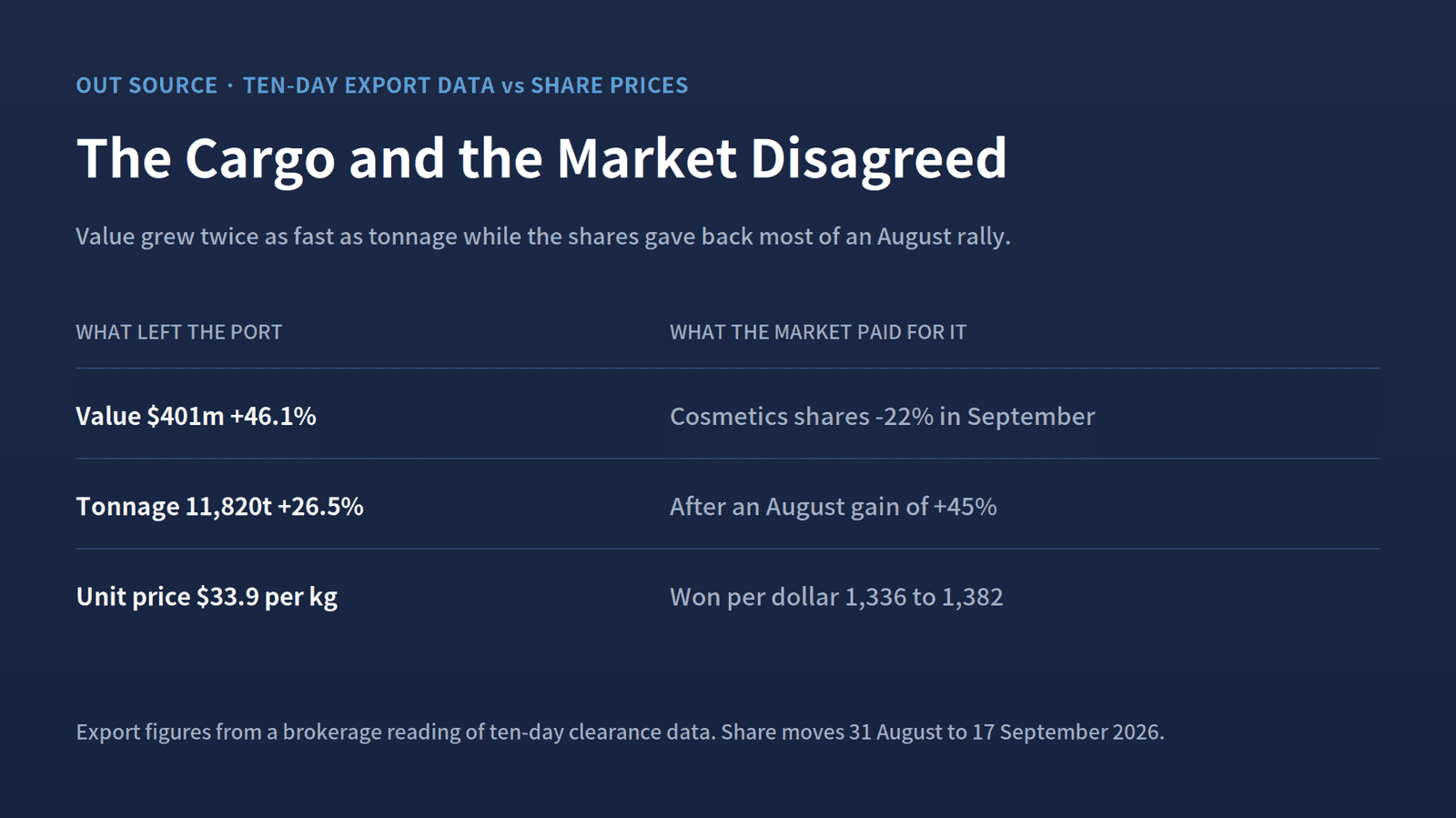
The ten-day clearance figures for 1 to 10 September 2026, as read by a brokerage note on the customs data, put cosmetics exports at just over 400 million dollars, up 46.1% on the same period a year earlier. Tonnage came to 11,820 tonnes, up 26.5%.
The regional split is where the growth sits. Europe took 92 million dollars, up 88.6%, on 2,270 tonnes, up 51.4%. North America took 82 million dollars, up 33.6%, on 2,860 tonnes, up 28.6%. China took 58 million dollars, up 20.8%, and Japan grew 28.7%. Shipments to the United States alone rose 32.8%, a record for the period.
Ten-day figures are preliminary and one ten-day window is not a quarter. The direction has held across enough of 2026 that the composition, rather than the headline, is the part worth reading.
What does the gap between value and volume mean?
Unit price, which is simply export value divided by export weight. Value grew 46.1% and tonnage grew 26.5%, a gap of roughly twenty percentage points, and the only way that arithmetic resolves is that a kilogram of exported Korean cosmetics is worth more than it was.
The division is straightforward. Just over 400 million dollars across 11,820 tonnes works out at about 33.9 dollars per kilogram. Running the same growth rates backwards, the comparable figure a year earlier was about 29.4 dollars. That is a rise of roughly 15% in what a kilogram fetches at the border.
This cuts against the story the industry has been telling about itself. The dominant narrative of the past two years has been descent: cheaper formats, lower price points, volume built on accessibility. The border data for early September says the opposite about the aggregate. Whatever is filling the containers is worth more per unit of weight than what filled them a year ago.
Then why did the shares fall?
The currency, mostly. The won strengthened hard through the third quarter. On 2 July 2026 the rate stood at 1,555.8 won to the dollar. By 9 September it closed at 1,336.1, the lowest since October 2024 and a move of roughly 220 won in ten weeks. It recovered to 1,382.2 on 17 September 2026, which is the rate used for every dollar conversion in this article.
A strengthening won shrinks the won value of dollar revenue. For a company whose sales are increasingly earned abroad and whose reporting currency is the won, an exchange-rate move of that size does more to the reported number than a strong quarter of shipments does. Sell-side commentary at the time put the fall down to three things at once: valuation after August, a high base in September exports, and the currency.
The pattern inside the decline is the informative part. Measured from 31 August to 17 September 2026, Pharma Research fell 28.6%, Dalba Global 24.6% and APR 23.5%. The manufacturers fell less: Cosmecca 15.0%, Cosmax 10.2%, Kolmar 8.8%. The further a company sits from the brand and the closer to the production line, the less the market took off it.
What did the manufacturers commit, and when?
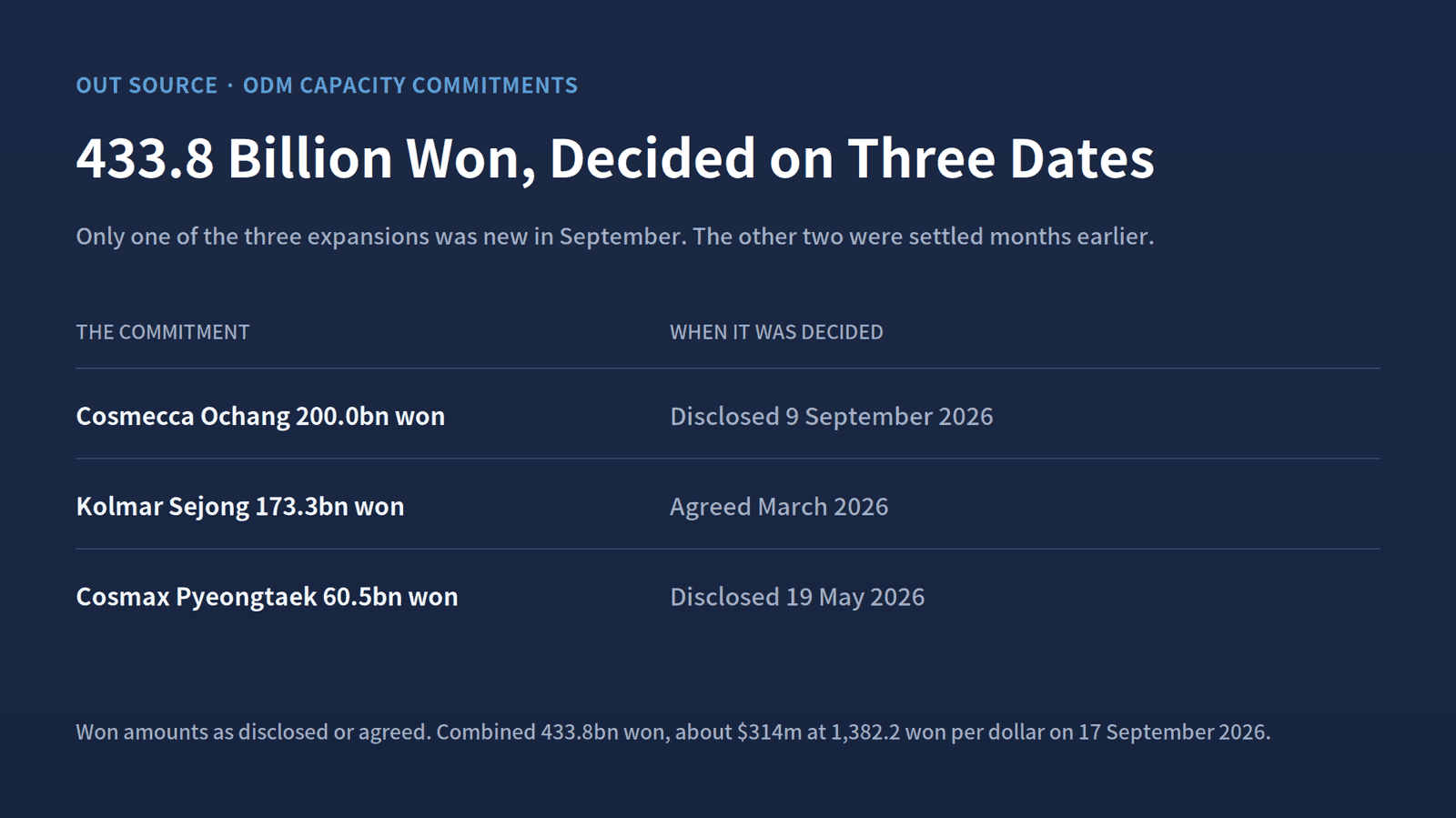
Three expansions totalling 433.8 billion won, about 314 million dollars. All three companies are ODMs, or original design manufacturers, meaning they develop the formula as well as produce it rather than simply making to a brand's specification. The three commitments were not decided together.
Cosmecca's 9 September disclosure covers 136 billion won running to 31 December 2030. On the same day the company signed an investment agreement with North Chungcheong Province and Cheongju City covering 200 billion won in total, a figure that includes the 64 billion won it paid in June 2026 for an existing Ochang plant. The site runs to 50,174 square metres with 58,863 square metres of floor area. Groundbreaking is this month, first-phase operation is set for 2027 and completion for 2030, with around 500 jobs added in stages.
Kolmar Korea's 173.3 billion won Sejong project was agreed in March 2026, not in September. It covers a basic-skincare plant on a 9,851 square metre site in the Jeonui industrial complex, targeted for completion in 2028 with 431 jobs, and it brings production back from a Beijing facility the company is withdrawing from.
Cosmax disclosed its 60.5 billion won Pyeongtaek expansion on 19 May 2026 at 9.9% of equity, with work running from June to October 2026. It adds skincare lines in unused space at the existing Pyeongtaek plant and takes group global annual capacity from about 3.5 billion units towards 4 billion.
So the combined figure describes a posture held across six months rather than a decision taken in one week. Only one of the three is new.
Which of the three is the real bet?
Cosmecca, by a distance, and the ratio is what shows it. Cosmax committed 9.9% of its equity. Cosmecca committed 40.45%, in a single disclosure, for a plant whose full capacity arrives in 2030.
Its balance sheet moved with it. Borrowings rose from 165.5 billion won to 225.8 billion won by the end of June 2026, taking the debt-to-equity ratio from 87.9% to 119.6% against 77.5 billion won of cash. First-half 2026 revenue was 178.8 billion won, up 62.6%.
The reason for the spend is not capacity in the abstract. Combined outsourcing and subcontract processing costs went from about 46.6 billion won in 2024 to about 69 billion won in 2025, a 48% rise against 22% revenue growth over the same stretch. Growth was arriving faster than owned capacity absorbed it, and the difference was being paid to other people's factories. Four hydrogel lines running at the start of 2026 were fully booked by July.
That reframes the investment. It is not a bet on more demand arriving. It is a bet that demand already on the books is worth owning the margin on. The company describes the facility as an intelligent manufacturing system built on artificial intelligence transformation; that is its own characterisation of it, and the verifiable parts are the money and the dates.
What does capacity measured in units not tell you?
What the units are worth. Cosmax states its global capacity in pieces: about 3.5 billion a year now, roughly 4 billion after the current round. A unit is a count. It describes how many tubes, jars and sachets come off the lines and says nothing about whether each one leaves at three dollars or thirty.
This is the blind spot in the capacity story. Korea is adding a large number of units of skincare capacity for delivery between now and 2030, while the export data used to justify the spend is an argument about value per kilogram. Those two measures move independently, and neither is wrong when they diverge.
The question to ask about Korean capacity in 2027 and 2028 is not whether it exists. It is which price band the new lines are configured for.
What fills the new lines?
Two answers are already visible, and both are scaling.
The first is the format the aggregate data points to. Europe took 92 million dollars on 51.4% more tonnage, which means it is paying more per kilogram and taking more kilograms. That is the mix the unit-price arithmetic describes, and it is concentrated outside the markets Korean manufacturers built their volume on.
The second is a price floor being exported as a format. E-Mart's 4,950 won line, about 3.60 dollars a unit at the 17 September rate, has grown to 28 brands and roughly 120 products, and its Glow Up by Beyond range, developed with LG Household and Health Care, has passed 200,000 cumulative units. E-Mart skincare sales rose 26.6% from January to August 2026. Abroad, Primark sells own-label K-beauty from 0.75 to 5 pounds and Five Below lists around 80 items in a dedicated category. The companies producing those lines are the same ones pouring the concrete.
The domestic version of that format is maturing rather than accelerating. Daiso's beauty category grew 85% in 2023, 144% in 2024, 70% in 2025 and 30% from January to August 2026. The growth rate has fallen by roughly four-fifths in two years on a much larger base, which is what a category looks like as it fills out.
Do the two clocks ever meet?
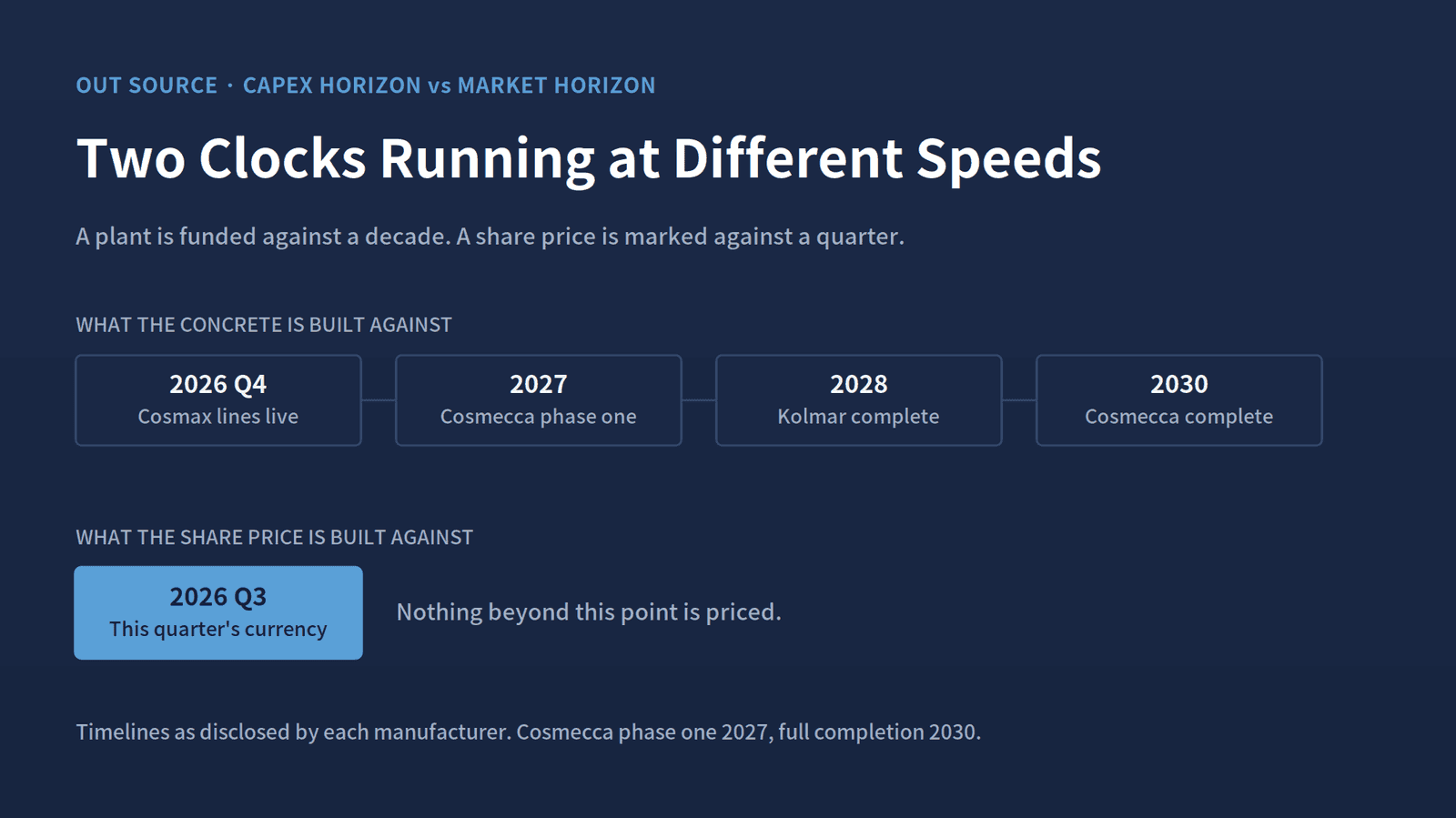
Not on the same schedule. Cosmax's Pyeongtaek lines are live in October 2026. Kolmar's Sejong plant lands in 2028. Cosmecca's Ochang site is not complete until 2030. Against that, a share price is marked to a currency that moved 220 won in ten weeks and 46 won back in eight days.
The three-to-five year framing usually applied to capital expenditure only fits part of this. One of these expansions is a this-year decision, one is mid-decade and one is a decade-long build with staged hiring attached to it.
Neither clock is measuring something false. A won at 1,336 does reduce this year's reported earnings, and a plant finishing in 2030 is untouched by it. What the September divergence shows is that the two are answering different questions, and only one of them is a question about whether Korean manufacturing capacity gets used.
Where does this leave the three sides?
For manufacturers, the binding constraint has shifted from winning orders to owning the margin on orders already won. Cosmecca's outsourcing bill rising at twice the rate of its revenue is the specific form that takes, and it is a problem that gets worse with success rather than better. Capacity bought at 40% of equity is a different order of commitment from capacity bought at 10%, and the balance sheets will separate accordingly.
For brands and buyers, the useful question about Korean capacity through 2028 is which price band the new lines serve. A country adding billions of units of annual capacity while its average export value per kilogram rises 15% is running two businesses at once, and which one a supplier sits in determines what it can quote and what it can refuse.
For investors and regulators, the September gap is a reminder that a currency move and a capital cycle are not comparable evidence. One of them gave back a fifth of its move in eight days. The other has a groundbreaking date.
The concrete is poured against 2030. The share price was marked against ten weeks of currency.