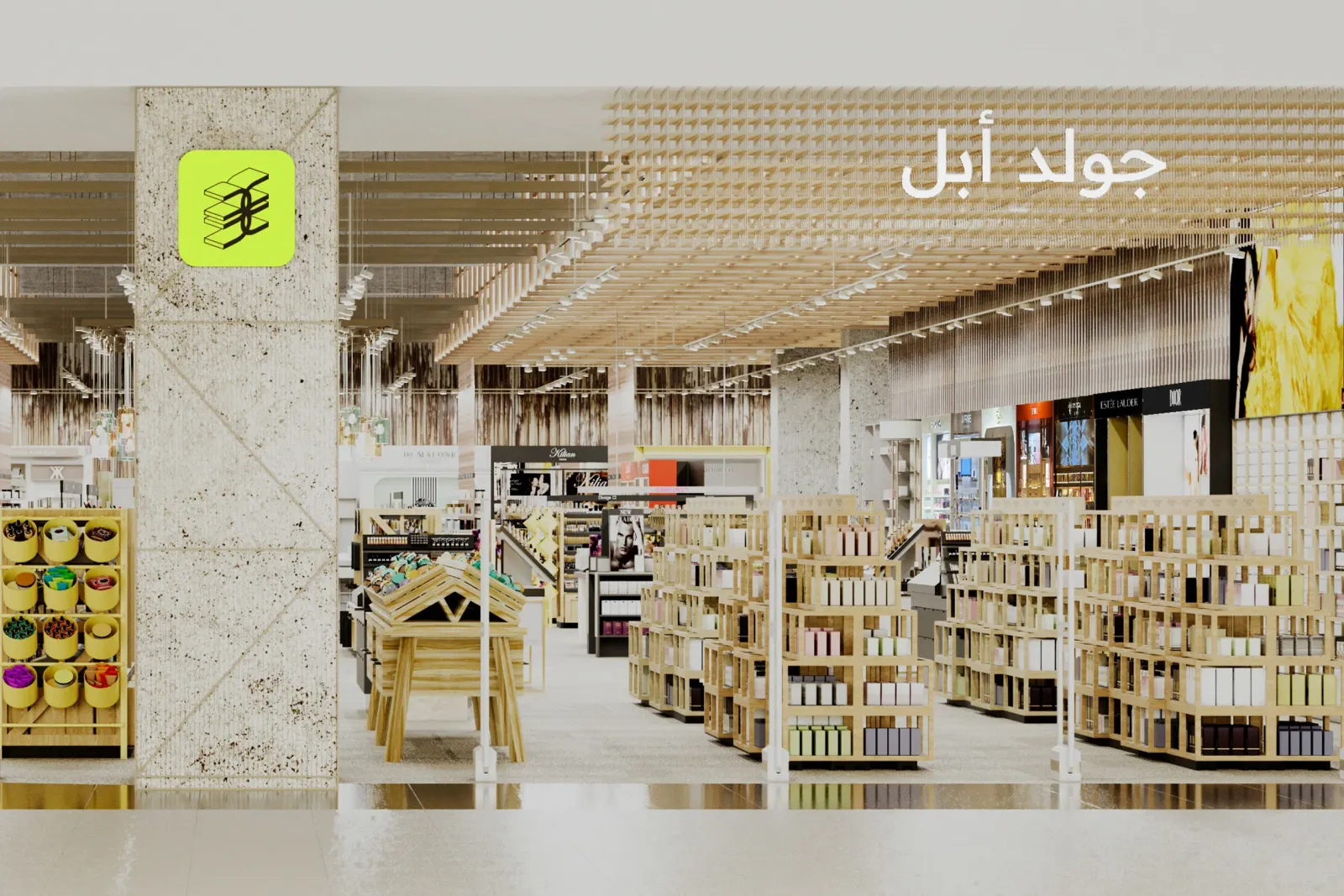
About 50 stores, six countries, $1.7 billion of Russian revenue in 2024, and more than half of it sold online rather than in the shops. That is Gold Apple, and Korea has been the largest cosmetics origin on its shelves for years. Then the chain published a study of its own sales. Korean-origin products grew 34 percent between January and October 2025 — last of the five origins it reported. Russian brands grew 50.
What is Gold Apple, in numbers?
Two classmates, Ivan Kuzovlev and Maxim Panyak, founded the company in 1996 and opened the first store in what they called the beauty supermarket format in 2004 — a wide open-sell floor where the breadth of the range, not the branded counter, is the whole pitch. Closer to a category killer than to a department store concession.
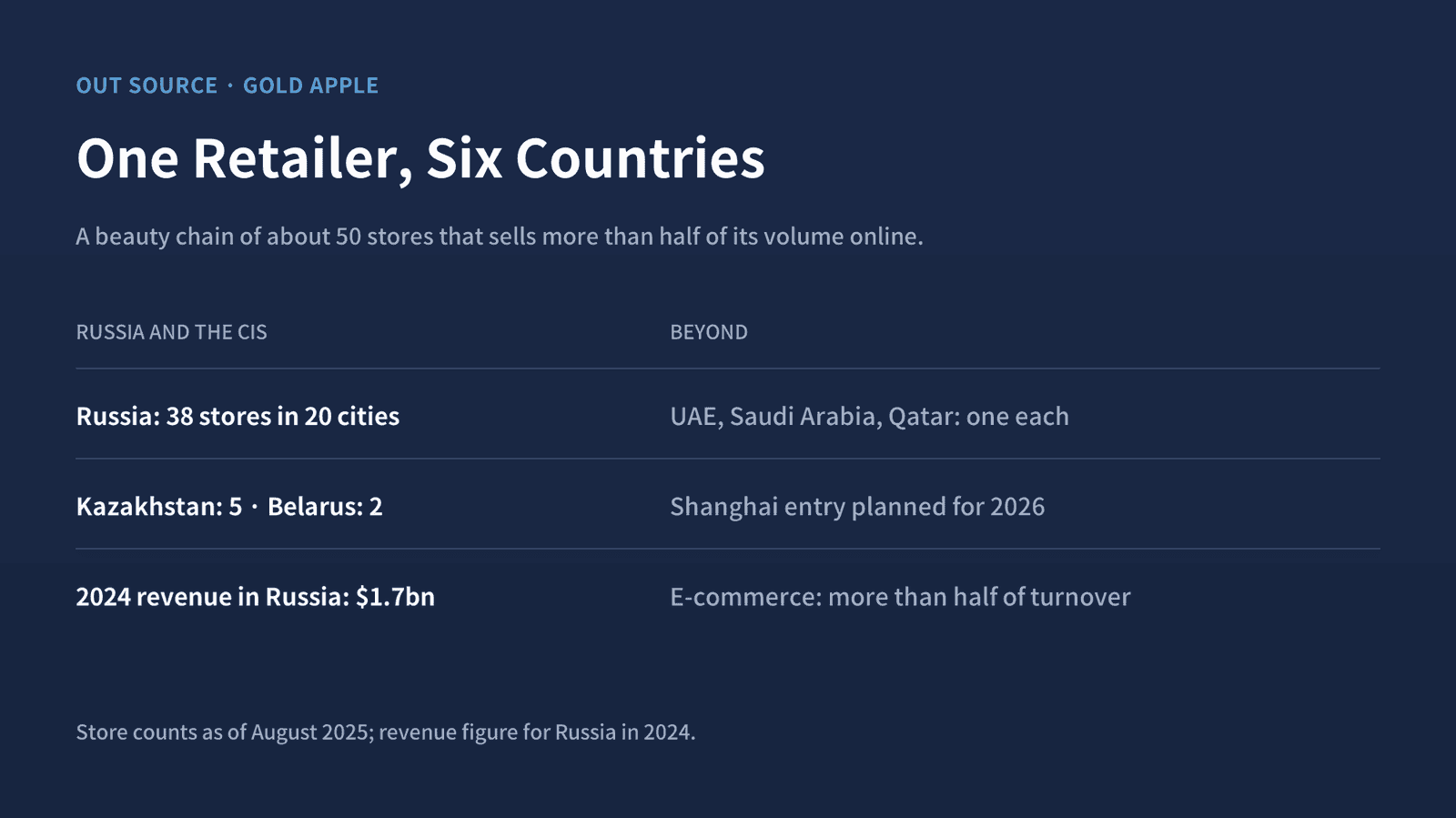
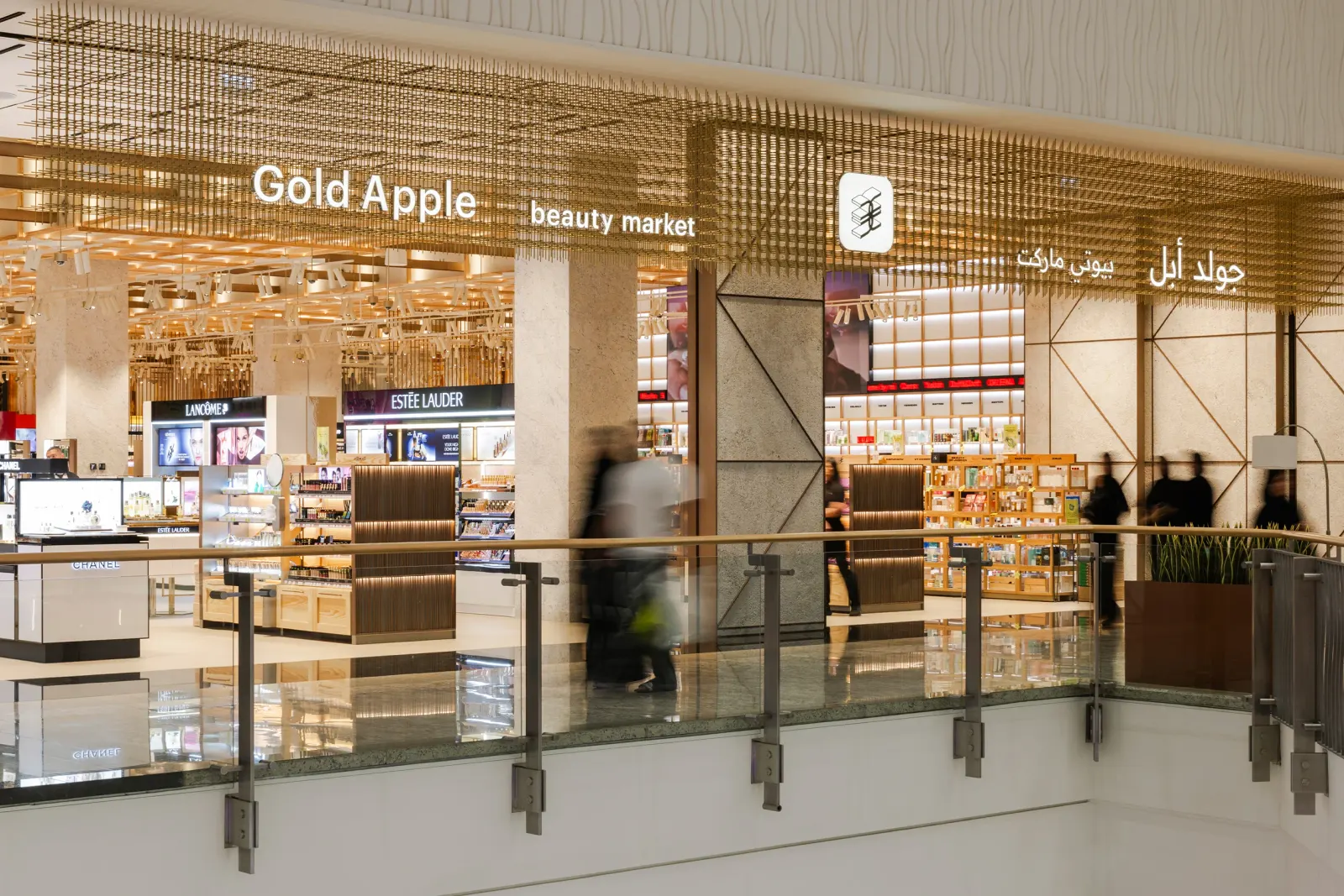
By August 2025 it ran roughly 50 stores across six countries: 38 in Russia spread over 20 cities, five in Kazakhstan, two in Belarus, and one each in the United Arab Emirates, Saudi Arabia and Qatar. Stores average about 1,500 square metres. Headcount is near 14,000, around 700 of them in the technology arm. The range runs to 5,000 brands, 200 of which are exclusive to the chain, plus a house label called FOR ME. Russian revenue came to $1.7 billion in 2024, e-commerce accounts for more than half of turnover, and a Shanghai entry is planned.
Put that together and the appeal to a Korean brand is obvious enough. It is the one retailer still serving the Russian market at the depth the departed Western chains used to, it runs cross-border e-commerce that actually works, and one commercial relationship reaches Russia, the CIS and three Gulf states at the same time.
Why did a sanctioned market become one of Korea's fastest-growing?
The export line reads $221.34 million in 2022, $316.16 million in 2023, $361.23 million in 2025. The first half of 2026 brought $212.63 million on its own, up 25.1 percent year on year and a record half, which puts the full year on course to clear $400 million for the first time. Among Korean cosmetics destinations only the United States grew faster — 36.5 percent against Russia's 23.9.
The mechanism isn't complicated. Western luxury and mass brands left after February 2022, the shelves didn't stay empty, and Korean products got read locally as a European-quality substitute at a lower price. No Korean marketing budget bought that positioning. Nobody engineered it.
The part worth holding onto is buried in the trade data. Korea's total exports to Russia have fallen by roughly 60 percent since 2022. Exports by Korean small and mid-sized companies have held at about the same level. The state-to-state relationship contracted hard; the small-brand consumer-goods piece didn't move. Cosmetics is the clearest case of that split, which is why the category's Russian numbers look nothing like the country aggregate.
Which Korean brands are already inside?
Goodai Global's Beauty of Joseon went into more than 40 Gold Apple stores in Russia and onto the platform in early 2024, then all four Kazakhstan locations, led by sunscreens, serums and cleansing oils. VT Cosmetics listed across all 37 of the chain's stores in Russia and the CIS in June 2025 with its Coloreal Shot, Stick Pouch and Cica lines, and framed that listing as the next step after Ulta Beauty in the United States and Boots in the United Kingdom. The chain's own bestseller selection carries Innisfree and Laneige from Amorepacific, Medicube from APR, plus Clio and Anua.
None of this is symbolic volume. Dalba Global reported Russian revenue of about 50 billion won in 2025 — roughly 16 percent of the company's total, at operating margins above 30 percent — and its Gold Apple orders roughly doubled, from about 5 billion won to about 10 billion. At 1,350.60 won to the dollar, the rate on 2 October 2026, that is around $37 million, $3.7 million and $7.4 million respectively.
So the door opens. It has opened repeatedly, for brands of very different sizes, and the chain's merchandising already treats Korean products as part of the core offer. The interesting question is what happens after.
What does the retailer's own data say?
Gold Apple put out a study of its sales in November 2025, comparing January through October against the same months of 2024. Growth by country of origin: the United Arab Emirates up 139 percent, Russia up 50, Turkey up 47, China up 46, South Korea up 34. A consumer survey in the same study, more than 2,000 respondents, put Russia first on country preference at 52 percent and South Korea second at 45, with 74 percent naming product quality as the reason they pick by origin at all.
Korea is the biggest origin on that shelf and the slowest-growing of the group reported. Both can be true — a large base grows more slowly than a small one, and 34 percent is a rate most retailers would sign for tomorrow. But the gap to Russian domestic brands is sixteen points, and the chain's own private label sits on the Russian side of it, with its placement, pricing and promotion decided by the same company that decides a Korean brand's.
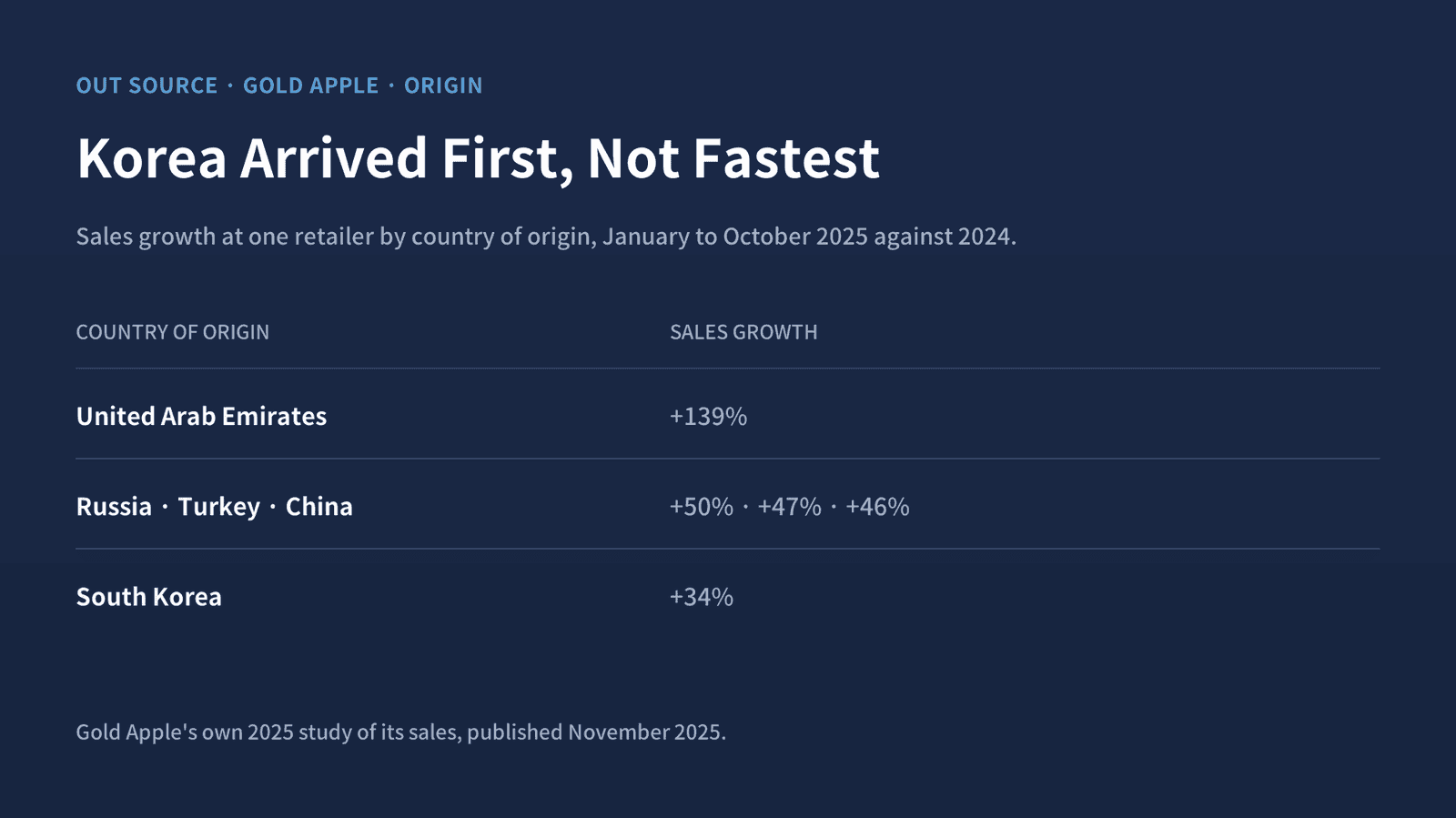
The vacancy Western withdrawal created was never reserved for Korea. It went to open auction, and four other origins turned up to bid.
What does it take to put a product on that shelf legally?
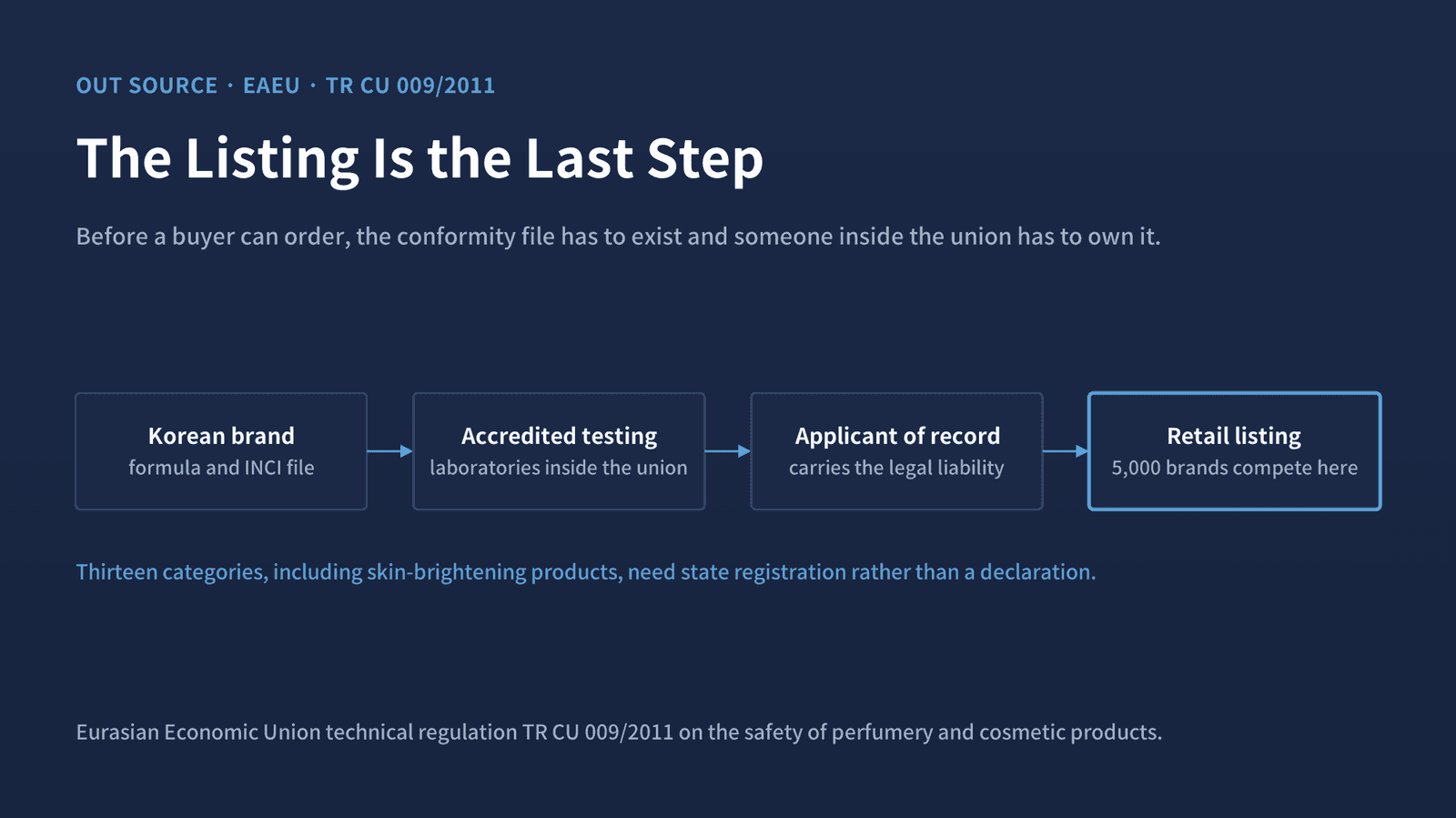
The governing text is TR CU 009/2011, the Eurasian Economic Union technical regulation on the safety of perfumery and cosmetic products. It applies across the union, not in Russia alone, and compliance shows up on pack as the EAC mark.
Two routes through it. Most cosmetics clear by an EAC declaration of conformity. Thirteen categories need a Certificate of State Registration instead — perfumes, skin-brightening products, hair dyes, children's cosmetics, depilatories, chemical peels and fluoride oral care among them. Several of those map straight onto Korean hero categories, so a brand can find its lead product on the slower, more document-heavy track while the rest of the range sails through.
Testing has to happen in laboratories accredited inside the union. And the applicant named on the file carries responsible-person liability, which is where this stops being a technical question and becomes a commercial one. Whoever holds the registration holds the right to put the product on the market. If that's the distributor, the registration isn't the brand's, and switching distributors means rebuilding the file from the testing stage up.
Where does the money actually get stuck?
Rarely at customs. It gets stuck at the correspondent bank. Trade compliance practitioners describe shipments delivered in full while payment sat frozen, the correspondent bank asking for documentation of the final country of sale, the end user and the distribution chain before releasing anything, with recovery running into months. The case cited most often involved a buyer in the United Arab Emirates, not Russia — which is the point. Screening attaches to the route and the counterparty, not just the destination printed on the invoice.
Banks run denied-party screening and will mark a transaction suspicious with no underlying breach anywhere in sight. Payment made by a third party on the buyer's behalf draws extra scrutiny all by itself. The contractual result is that sanctions compliance clauses, re-export restrictions and termination conditions have moved from optional drafting into standard provisions.
Cosmetics aren't controlled goods, which is exactly why this surprises people. The exposure is procedural, not legal. It lands hardest on exporters who decided sanctions were somebody else's problem on the grounds that they don't sell anything strategic. An exporter whose Russian distributor also covers Central Asia and the Gulf reads, to a compliance officer, as a re-export question until proven otherwise.
What risk does not appear in a distribution agreement?
Physical risk to stock, for a start. One Korean exporter reported inventory losses after a Wildberries warehouse took bomb damage, while noting that local demand itself held up. No standard distribution contract allocates that.
Channel concentration, for another. E-commerce is around 22 percent of Russian retail overall but more than half of Gold Apple's turnover, so a brand's Russian business is really a platform business sitting inside a store chain, with the platform's ranking and promotional calendar setting the terms.
Then substitution, which is the slow one. Russian private label is expanding and local contract manufacturing is growing. A retailer holding 200 exclusive brands and a house label has the sell-through data to spot what works and the supply route to copy it. Korean ODM capability, in this one respect, is the competitor's enabling asset as much as the Korean brand's. And finally reversal — Western brands coming back would close the gap that opened the door in the first place.
What does Korea's own trade agency say about the position?
KOTRA's CIS regional head wrote on 28 September 2026 that Korea holds the largest share of Russia's cosmetics import market and is setting a record. Then he spent the rest of the piece arguing for diversification: into fashion, pet care, health and self-care; geographically out past the big cities into Siberia and the Far East via e-commerce; across channels into specialist retailers, pharmacies and food service.
Diversification advice from the official closest to the market is a statement about concentration. The same piece noted that Russian and Chinese companies moved fast into the gaps the global brands left, and that what settles the outcome is repeat purchase rather than the initial curiosity about anything Korean. It is the retailer's growth table restated as policy advice.
Where does this leave the three parties?
Manufacturing and ODM suppliers. The conformity file is a production document before it is a regulatory one — formula, INCI detail and stability data have to exist in a shape an accredited union laboratory will accept. A supplier who can assemble that quickly is worth more than one who can't, and the same work covers five countries at once, which is the argument for building it properly rather than shipment by shipment.
Brands and the buyers who stock them. The durable asset is the registration and the name on it. A listing can be won in a season and lost in one. A conformity file in the brand's own name outlives a change of distributor, a change of retailer and a change of terms.
Investors. The headline and the ledger disagree. The headline says Korea leads Russian cosmetics imports. The retailer's own sales table says four other origins are growing faster inside its stores. Those are the same business described at two points in its life, and the growth rate is the one that arrives first.
Gold Apple isn't a market. It's a shelf, and the shelf is being re-cut.