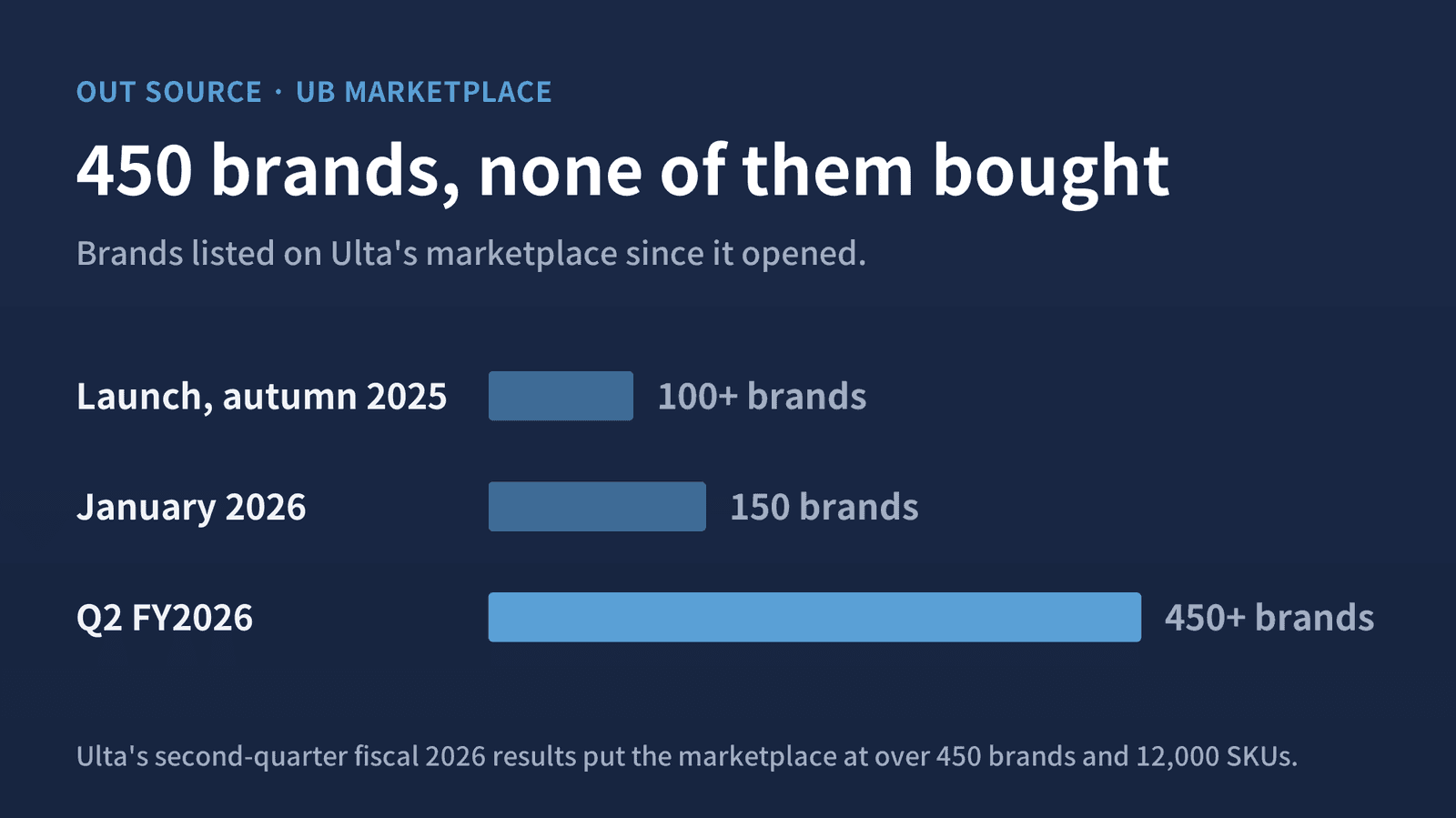
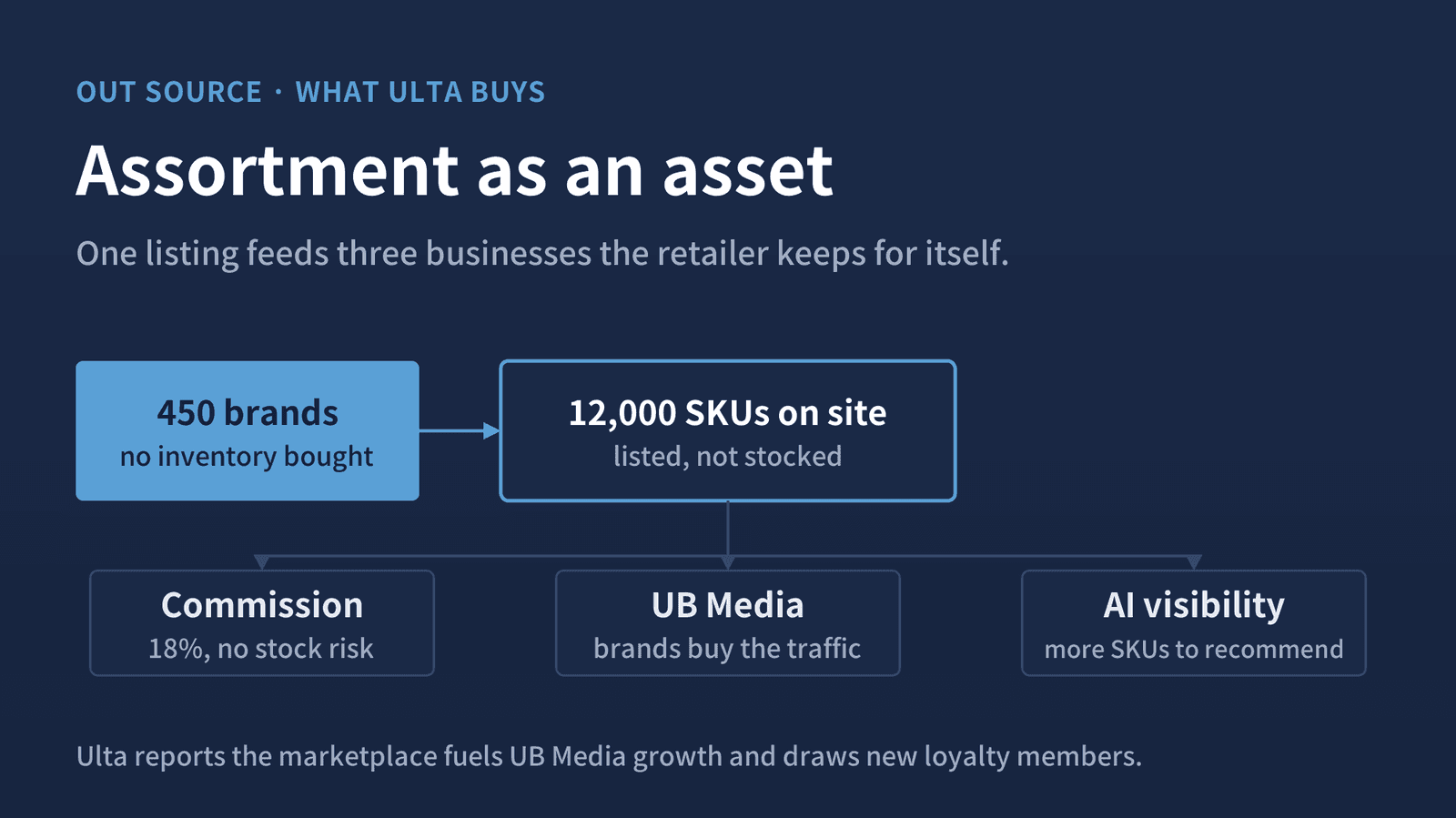
UB Marketplace opened in the autumn of 2025 with just over 100 brands. Ulta’s results for the second quarter of fiscal 2026 put it at more than 450 brands and 12,000 SKUs. Ulta bought none of that inventory, ships none of it and will mark none of it down. Every new name on the site is reported as a brand the retailer has decided to back. The fastest-growing part of its assortment is the part it never bought.
How big has the marketplace actually got?
A marketplace, in retail terms, is a platform where the retailer supplies the storefront, the traffic and the transaction while a third party owns the goods and ships them. Ulta built its own on the Mirakl platform and opened it to brands by invitation, excluding resellers and distributors.
The growth is the part worth holding onto. Just over 100 brands at launch. Around 150 by January 2026. More than 450 brands and 12,000 SKUs by the close of the second quarter of fiscal 2026, according to Ulta’s own results for that period. That is roughly a fourfold increase in ten months, against a physical estate of 1,534 Ulta stores.
Ulta does not disclose marketplace sales, so its share of the business is unknown. What the company does report is that the marketplace draws new and reactivated loyalty members and fuels incremental growth at UB Media, its retail advertising arm. Those are the two results it chose to name.
What does a marketplace listing look like from the outside?
It looks exactly like a wholesale listing, which is the difficulty. Take the British haircare brand Umberto Giannini, which appeared on Ulta.com this month. Nine products, each at US$14.99, each flagged New and badged Online only. The trade coverage described it as a US retail launch with Ulta Beauty.
The retailer’s own pages say something more specific. Beneath the delivery options on every one of those product pages sits the line Fulfilled by Umberto Giannini. The same pages note that the brand is excluded from most Ulta Beauty coupons. The product URLs carry an mkt prefix ahead of the item number. Ulta’s marketplace documentation states that a product page shows an indicator when an item is sold and shipped directly by a brand.
Three markers on the retailer’s own site, pointing the same way. Neither the retailer nor the brand said the word marketplace in the announcement, and the one detail that decides what the arrangement is was the detail left out.
Who holds the stock, and who pays to move it?
Ulta’s published seller terms answer this without ambiguity. A seller must be a US business with a US bank account and an Employer Identification Number. Fulfilment comes from US-based warehouses. Shipping is limited to the lower 48 states. Orders are picked, packed and shipped within two business days through DHL, FedEx, UPS or USPS, with tracking supplied.
Shoppers still earn Ulta Beauty Rewards points and can return marketplace items in store. What the terms decline to promise is promotion: by Ulta’s own wording, inclusion in marketing is not guaranteed.
That list has a consequence the coverage of these launches keeps missing. A brand cannot list until it is already a US operating entity with a US warehouse behind it. A marketplace listing is not the moment a foreign brand enters the United States. It is something a brand does once it has already built the American operation.
Does a listing pay a brand better or worse than wholesale?
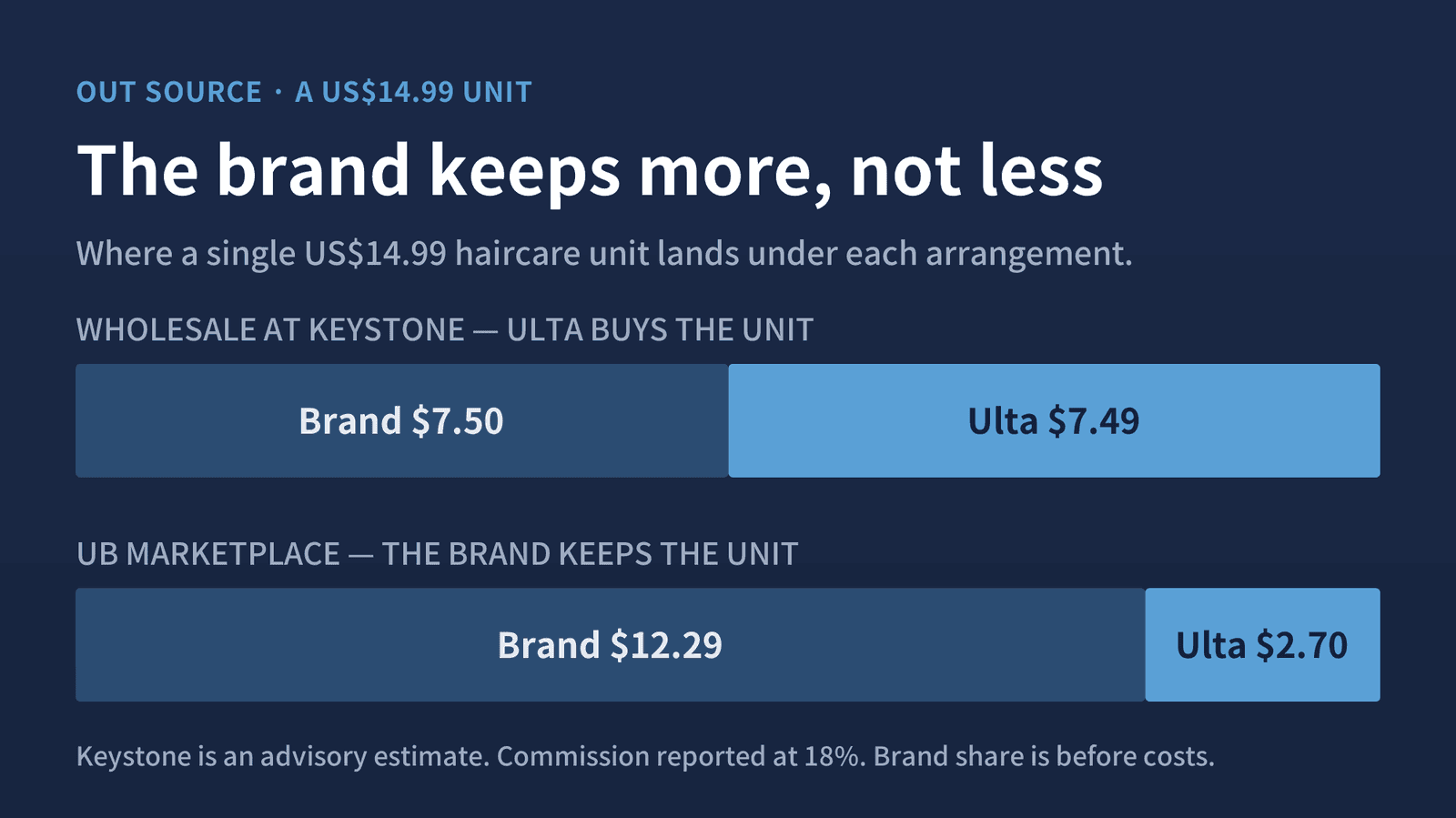
Better per unit, and that is the finding that reframes the whole arrangement. Standard practice in beauty wholesale is keystone: the retailer buys at roughly half the recommended retail price. On a US$14.99 product that leaves the brand around US$7.50, before trade spend, co-op marketing and freight, which advisory estimates put at a further 10% to 20% of wholesale revenue. Those percentages are advisory analysis rather than any published retailer term, and no retailer confirms them.
Marketplace commission has been reported at 18% plus shipping. On the same US$14.99 product the brand keeps US$12.29. Even after the brand pays for goods, warehousing, fulfilment and the retail media it buys to generate the traffic, the gross take per unit is higher than wholesale leaves it. Brand-side operators who work in these channels put all-in costs at 30% to 35% once advertising is included, which still lands above the keystone split.
So the exchange runs the opposite way to how it reads. The brand is not giving up margin for access. It is buying margin back by taking on the inventory, the logistics and the demand generation that a wholesale buyer would otherwise have absorbed.
What does the brand give up for that margin?
The customer, mostly. Operators who advise brands on marketplace channels describe these shoppers as loyal to the channel rather than to the brand, and put repeat purchase rates well below what the same brand sees on its own site — by their estimate 40% to 60% lower. A brand can win the sale and not acquire the buyer.
It also gives up the floor that a purchase order provides. Wholesale transfers risk at the moment the retailer takes title: the units are sold whether or not shoppers want them. A marketplace listing transfers nothing. Every unit the brand forecast wrongly stays the brand’s problem, and the brand carries the working capital that a buyer used to fund.
Against that, the timeline compresses. Where a wholesale listing has conventionally taken twelve to twenty-six weeks to onboard, and a full retail negotiation considerably longer, marketplace onboarding is described as four to six weeks.
What does the arrangement do for the retailer?
Ulta reported a gross margin of 39.1% of net sales in the second quarter of fiscal 2026, down ten basis points, on net sales of US$3.0 billion. A commission line carries no cost of goods, no inventory, no shrink and no markdown. Revenue of that shape does not sit inside that 39.1% the way a bought unit does.
The second return is the advertising business. Ulta states that the marketplace fuels incremental UB Media growth. A brand that lists is also a brand that buys sponsored placement to be found among 12,000 SKUs it is now competing with. The retailer earns on the sale and again on the traffic that produced it, having financed neither.
The third is the loyalty file. Ulta counts more than 45 million rewards members and reports that marketplace shoppers include new and reactivated ones. Assortment the retailer never paid for is pulling in customers the retailer keeps.
Why would a retailer want 12,000 SKUs it does not stock?
Because of where product discovery is heading. Agentic commerce — shopping carried out by an AI assistant acting for the shopper rather than by a person browsing — depends on what an agent knows a retailer sells. Research published by Mirakl found one large US retailer appeared in AI recommendations about half the time on its own assortment, and three-quarters of the time once its marketplace catalogue was included. The retailer is not named and the finding is the platform vendor’s own.
Ulta is a partner in Google’s Universal Commerce Protocol, announced at the start of 2026, under which agents weigh real-time pricing, availability and delivery performance in deciding which retailers to put in front of a shopper. Breadth of catalogue becomes an input to that decision in a way it never was on a shelf.
Read against that, 350 added brands in ten months stops looking like merchandising. A shelf is constrained by square footage and by the cost of everything on it. A catalogue is constrained by neither, and a catalogue is what an agent reads.
Does a marketplace listing lead to a shelf?
It can. Ulta has described the marketplace as a way to test brands and categories for onboarding into its omnichannel pipeline, which is the company saying plainly that a listing can precede a store rollout. Practitioners who place brands make the same point, and note it is a proof point a brand cannot generate on Amazon, because that demand record sits outside the retailer that would buy.
What the arrangement does not do is commit the retailer to anything. There is no conversion clause, no volume trigger, no date. Until a purchase order exists, the shelf is an option the retailer holds and the brand pays to keep alive.
Umberto Giannini shows what that option looks like from the brand’s side. In 2021 it placed one range in 486 Target doors and its boxed hair colour in 266 locations. Its 2026 American listing has no doors at all. The brand has been in US physical retail before; what it has now is a page and a test.
What has actually changed about getting into American beauty retail?
The gate has moved rather than opened. Target, Macy’s, Nordstrom and Walmart have all opened marketplaces of their own, so this is a sector position rather than one retailer’s experiment. Getting listed is now fast, cheap for the retailer and available to any brand that can incorporate, warehouse and ship in the United States. Getting bought is as hard as it ever was, and rarer, because the retailer no longer has to buy in order to carry.
That splits a word the industry has long used as one thing. Distribution used to mean a buyer had committed capital to a brand. It can now mean a brand has committed capital to a buyer’s website. Both get announced in the same sentence.
The distinction is recoverable from the evidence, and it is usually one line on a product page. Who fulfils the order is who took the risk.