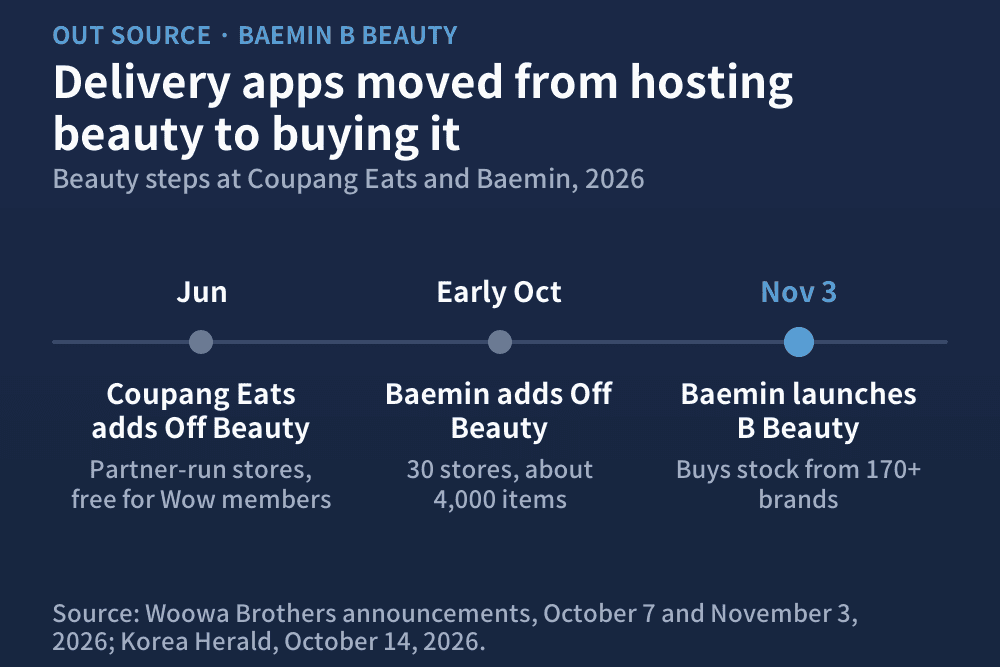
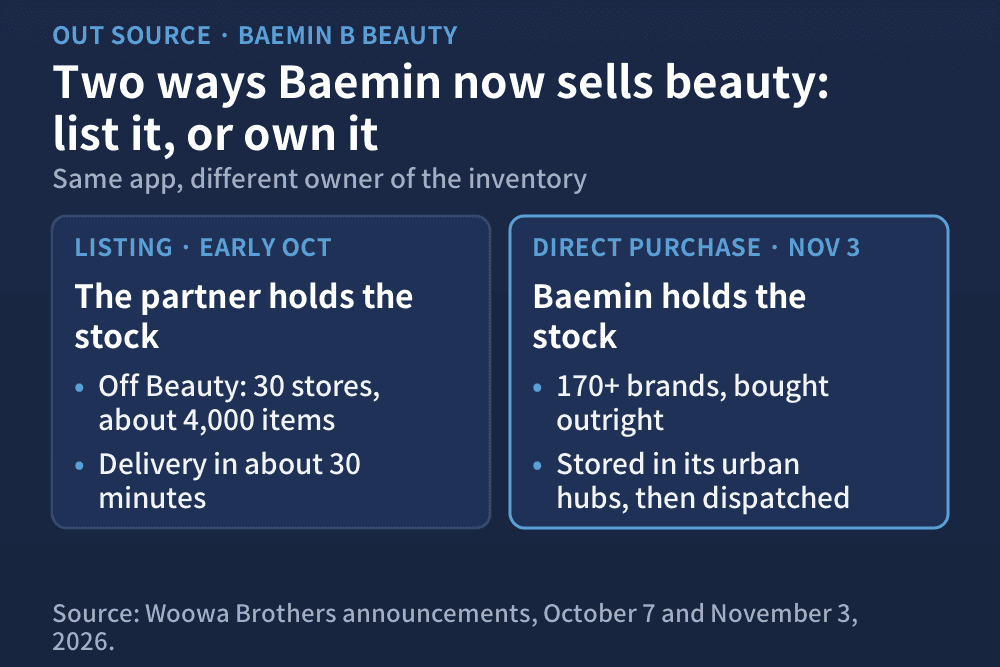
Baemin started buying beauty stock itself on November 3, 2026. A month earlier it had listed Off Beauty, a discount retailer that keeps its own inventory in 30 stores. B Beauty works the other way: Baemin buys from more than 170 brands, holds the units in urban fulfillment centers it already runs, and sends a rider after the order. Olive Young's Oneul Dream already carries 48.7% of its deliveries. The question is no longer who delivers fastest. It is who owns the unsold box.
What did Baemin launch on November 3, 2026?
B Beauty is a beauty-only shopping space on the Baemin app that shares a cart with B Mart, Baemin's grocery quick-commerce service. Quick commerce means delivery within about an hour from a nearby stock point rather than from a store shelf. Baemin runs roughly 80 urban fulfillment centers for B Mart, and B Beauty draws on them: the stock sits there, and riders deliver after the order comes in.
Delivery takes 30 minutes to one hour. The service starts in five Seoul areas, including Sinchon, Sillim, and Apgujeong, and expands gradually from there. The range covers more than 170 brands, with IOPE and Round Lab among the named ones. A Woowa Brothers official, speaking for Baemin, said the launch followed the growth of the online beauty market and a rising number of cosmetics buyers on the app.
How is this different from the Off Beauty listing a month earlier?
In early October, Baemin added Off Beauty to its shopping category. Off Beauty is a discount chain that sources surplus stock, pre-redesign packaging, and near-expiry products directly from manufacturers. The rollout began with 30 Off Beauty stores in Seoul, Busan, and other cities, about 4,000 items, and delivery in around 30 minutes. Off Beauty had joined Coupang Eats in June, where it runs about 50 stores and aims for 100. Lush and Aritaum came to Baemin the same way, as partners with their own stock.

In a listing, the partner owns the stock. The app supplies the customer and the rider. Under B Beauty, Baemin owns the stock and the app supplies everything else. That single change moves three things: who sets the shelf price, who carries the units that do not sell, and who sees the order data.
What does direct purchase change for a brand?
Direct purchase means the platform buys the product and sells it to the customer itself. For a brand, a listing and a purchase order are different relationships. A listing keeps the brand's name on the stock until a customer buys it. A purchase order ends the brand's ownership when Baemin takes delivery, and from that point price, display, and markdown belong to Baemin. The brand's volume is the size of the order Baemin places.
Korean coverage of the launch frames direct purchase as more profitable than hosting outside shops, and cheaper to start because the fulfillment centers already exist. Both points describe Baemin's side of the table. The brand's side is a buyer that arrives with about 80 stocking points and a cart that already holds groceries.
An industry analyst quoted in Korean coverage said profitability depends on holding logistics efficiency and lowering waste rates as the service area widens. A waste rate is the share of stock that expires, breaks, or goes unsold. Under a listing that share belongs to the partner. Under direct purchase it belongs to Baemin, and it is the number Baemin has to hold down as the service reaches new neighborhoods.
Why does beauty fit a network built for meals?
Food orders bunch around lunch and dinner. Cosmetics orders arrive steadily through the day, which fills the gaps between meal peaks for riders and hubs that would otherwise sit idle. Industry watchers cited in Korean coverage add that cosmetics keep longer than groceries and take less room per order, and that a beauty basket carries a higher average order value than a food basket.
Delivery Hero, Baemin's parent, reported that South Korean quick-commerce gross merchandise value rose 39% year over year in the second quarter of 2026, which it attributed to larger baskets and more frequent orders. Gross merchandise value is the total value of goods sold through a platform. A lipstick added to a grocery cart raises basket size by definition, and a shopper who now finds beauty in the same app has another reason to open it.
How large is the incumbent Baemin is entering?
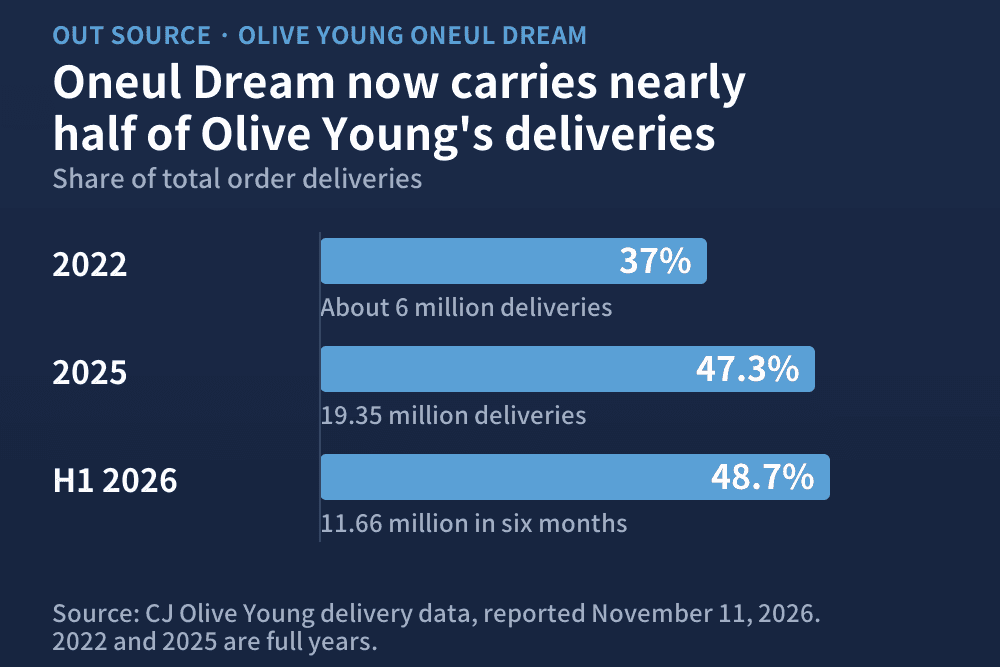
Oneul Dream launched in 2018. It handled about 6 million deliveries in 2022 and 19.35 million in 2025, more than triple in three years. Its share of Olive Young's total order deliveries rose from 37% in 2022 to 47.3% in 2025 and 48.7% in the first half of 2026. The 11.66 million deliveries of those six months already equal 60% of the 2025 total.
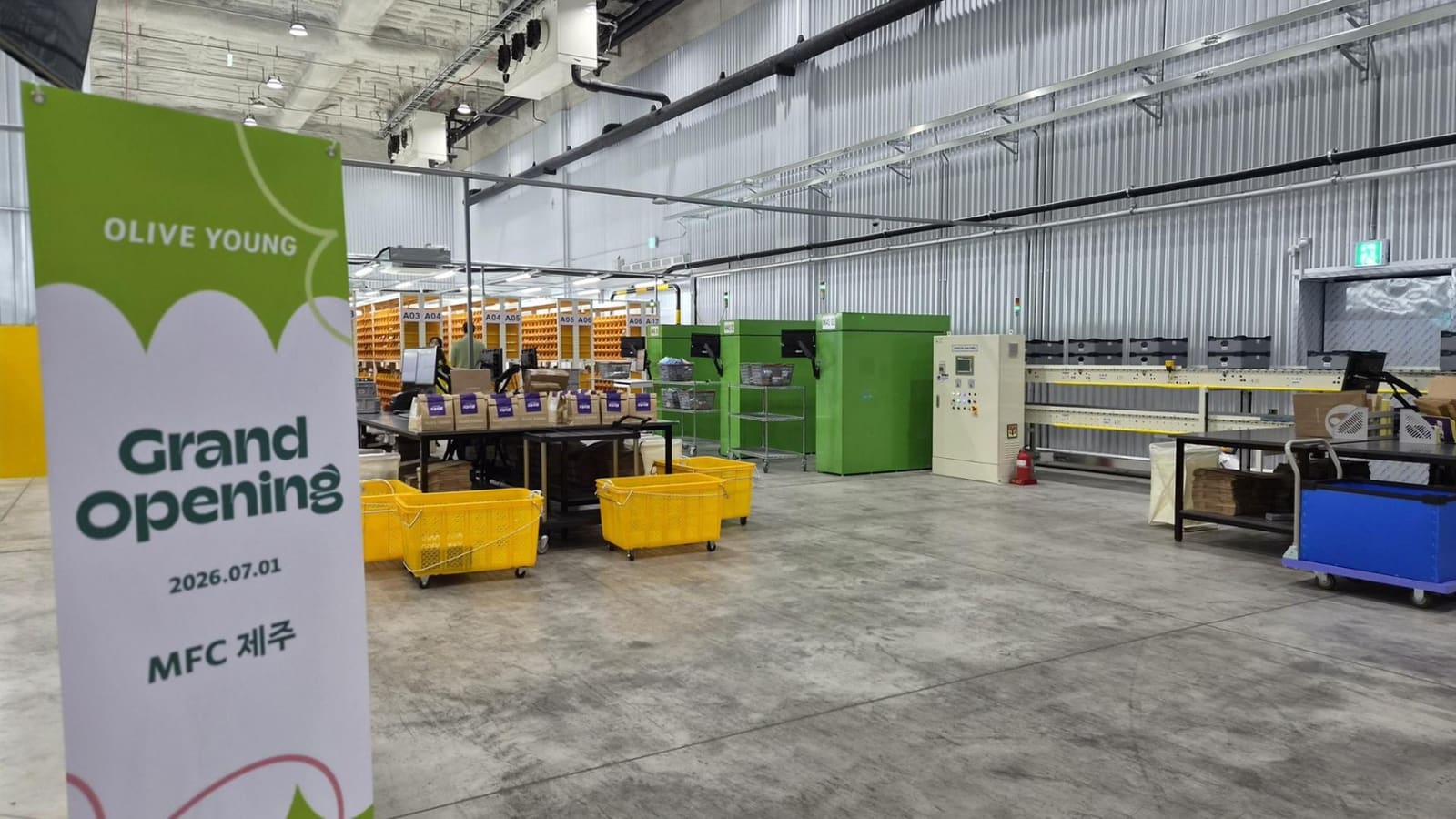
Olive Young opened micro-fulfillment centers, small urban stock points, in Jeju in July 2026 and in Suncheon, South Jeolla Province, in August 2026. In Jeju, Oneul Dream now handles 90% of online orders. Its fastest tier averages 55 minutes in 2026.
If speed is equal, what decides the contest?
Baemin promises 30 minutes to one hour. Olive Young's fastest tier averages 55 minutes. Speed has settled into the same band. Analysts quoted in Korean coverage say assortment and inventory management decide the contest from here, because shoppers hold strong preferences for particular brands and products.
That moves the fight to the shelf. Olive Young competes with indie brands and exclusive sets. Baemin answers with breadth, more than 170 brands at launch, and an order cart that already holds dinner. Kurly extended its one-hour Kurly Now service to Dongtan in Gyeonggi Province in early November, after Beauty Kurly transaction volume rose 25% year over year in the third quarter. Daiso is widening cosmetics on its same-day delivery. All of them are competing to be the app a shopper opens when the lipstick runs out.
Where does a small brand sit among four same-hour sellers?
The channel menu now splits by who owns the units. On a marketplace, the brand keeps its stock and its price. Under a purchase order, Baemin takes the stock and sets the price. Off Beauty, with prices up to 97% below list, takes surplus and near-expiry stock straight from manufacturers, which gives the units a brand cannot move at full price a third home.
A brand with an Olive Young exclusive and a Baemin purchase order holds two different relationships with two different owners of the same lipstick. The shelf is shared. The risk is not.
Who carries the inventory risk now?
Three positions read the same launch differently. Brands see a purchase order that turns a listing into a sale: their risk ends at Baemin's receiving dock, and so does their control over price and display. Retailers see a rival that matches Oneul Dream's speed on day one; Olive Young's lead rests on assortment, exclusives, and a delivery share near half. Platforms and investors see a low-cost entry, because the hubs exist, and a higher basket on orders that were going out anyway.
All three are looking at one fact. The stock now sits on Baemin's books. The app that used to carry only the delivery carries the risk.