BaroPharm's ordering app is registered at 24,787 pharmacies, about 90% of Korea's total, and 7.2 trillion won (US$5.4 billion) of orders have passed through it. Yet 72% of 2025 revenue came from reselling other companies' drugs at a 6.7% gross margin. The company lists on KOSDAQ on November 11 at the bottom of its price range, with 89.6% of institutions bidding at or below that floor. The channel is proven. The earnings behind the price are 2027 and 2028 forecasts.
What does a pharmacy order app actually own?
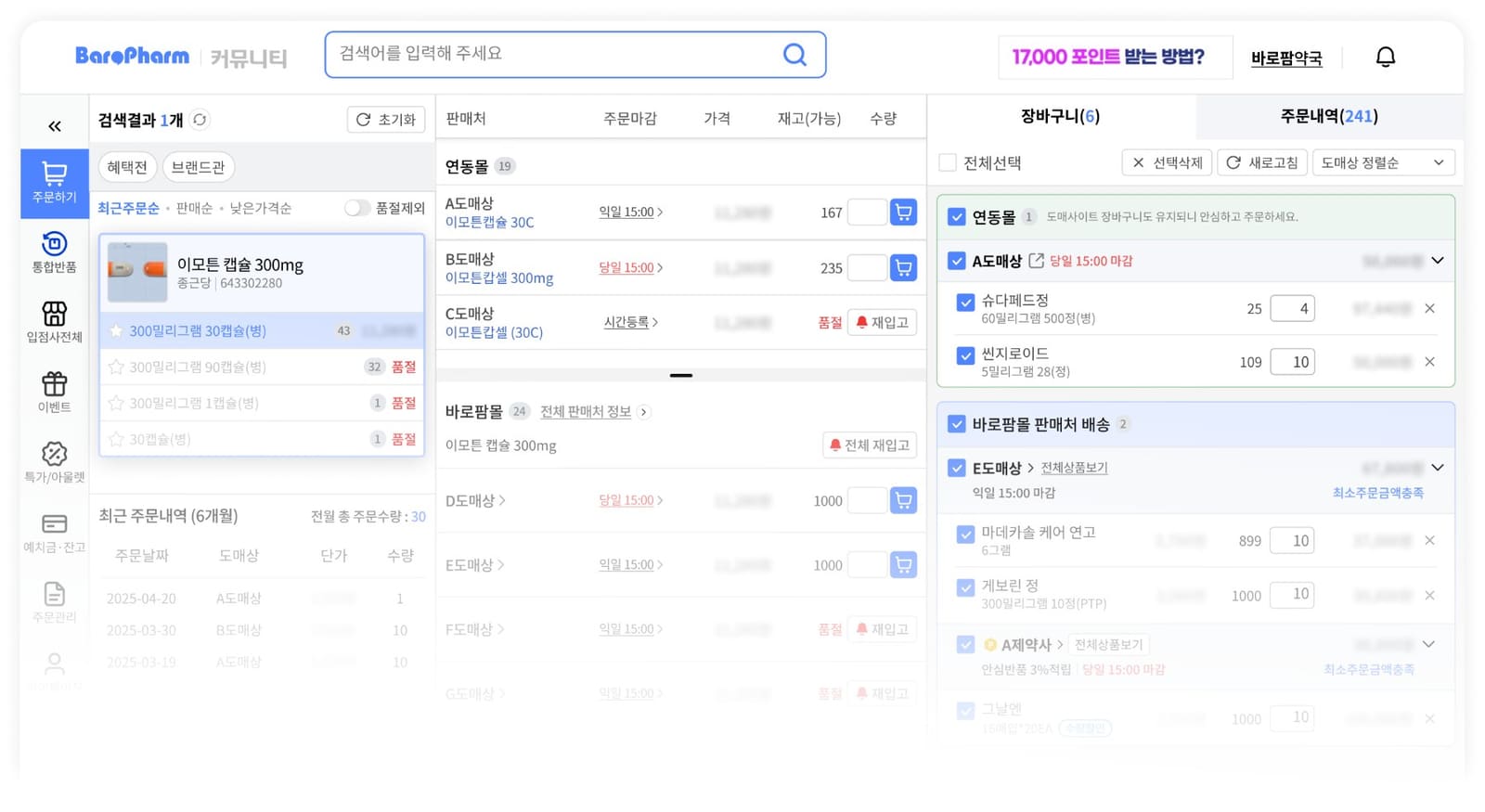
BaroPharm runs a platform where pharmacies place drug orders. A pharmacy picks a product, BaroPharm brokers the order to the supplier, and the same app sells advertising, cloud tools, and data services. At the end of the first half of 2026, 24,787 pharmacies were registered, about 90% of pharmacies nationwide, and 16,357 were active in June. Users spend 18 minutes and 35 seconds a day on it.
The 7.2 trillion won (US$5.4 billion) figure is the value of orders connected through the app, not revenue. Revenue was 11.6 billion won (US$8.7 million) in 2023, 45.5 billion won (US$34 million) in 2024, and 96.7 billion won (US$72.9 million) in 2025, and 69.0 billion won (US$52.0 million) in the first half of 2026, up 56.2% from a year earlier. Dollar conversions in this article use 1,325.9 won per dollar, the October 26, 2026 close.
An order app is a distribution position. It sits between nine in ten pharmacies and the companies that supply them, and everything else BaroPharm does starts from that position.
How does an order app end up selling cosmetics?
By buying and by building. Under what BaroPharm calls its marketing service, the company purchases products directly from drug and brand makers, then sells them to pharmacies and handles marketing and logistics. Quarterly revenue from that business rose from 2 billion won (US$1.5 million) in the first quarter of 2024 to 26.9 billion won (US$20 million) in the second quarter of 2026, and the number of listed suppliers grew from 4 to 31. Tylenol, Ketotop, Festal, and Nizoral are among the products.
Building came second. CHD Pharmaceutical, a BaroPharm subsidiary, launched Revikl, a cosmeceutical brand sold only through pharmacies, in January 2026 with a cream containing PDRN (a DNA-derived ingredient) and epidermal growth factor (EGF). Sunscreen, sheet mask, and niacinamide products followed in July and August. Revikl reached more than 2,000 pharmacies within six months. The Pharmacy Beauty Zone, an in-store cosmetics display program that began in July, passed 200 locations within two months. A second own-brand line, Our Pharm, sells 55 dietary supplements to more than 10,000 pharmacies.
The sequence is the model. A distribution position produces suppliers, suppliers produce shelf relationships, and those relationships are what an own brand launches into. Revikl did not buy a channel. It inherited one.
Why does the biggest business earn the least?
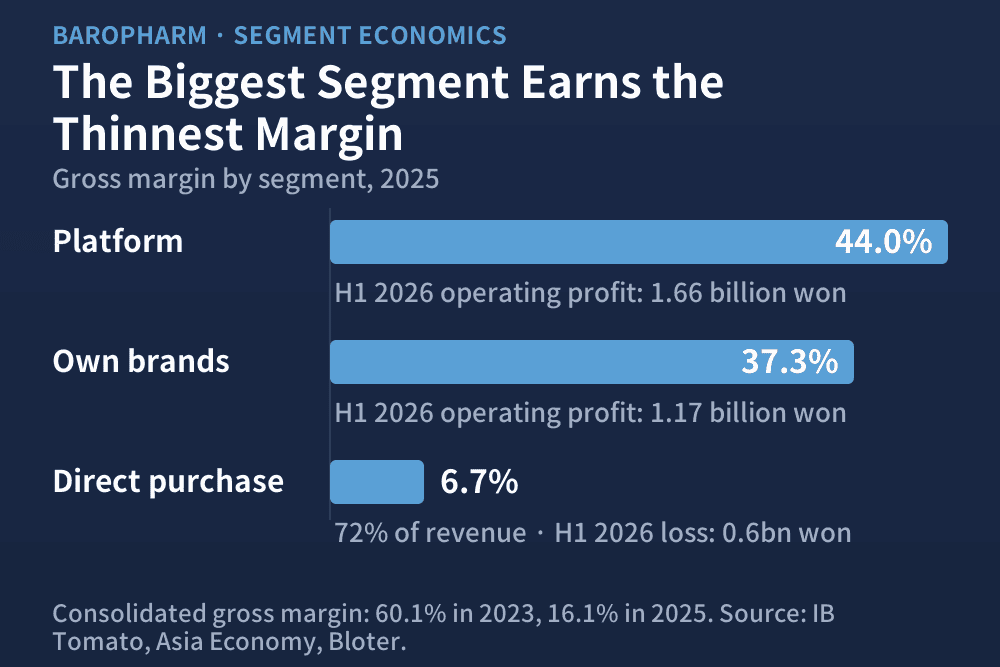
Direct purchase carried 69.7 billion won (US$53 million) of 2025 revenue, 72% of the total, at a 6.7% gross margin. The platform earned 44.0% and own brands 37.3%. As direct purchase grew, consolidated gross margin fell from 60.1% in 2023 to 16.1% in 2025. Direct-purchase gross margin reached 9.9% in the first half of 2026, up from 5.1% a year earlier.
The segment results show where profit sits. First-half 2026 operating profit was 2.2 billion won (US$1.7 million): 1.66 billion won (US$1.3 million) from the platform and 1.17 billion won (US$0.88 million) from own brands, offset by a loss of about 0.6 billion won (US$0.45 million) in direct purchase. In 2025, direct purchase lost 2.7 billion won (US$2.0 million).
Direct purchase supplies volume, and the platform and brands supply margin. The company's size and the company's profit sit in different segments.
Cash tells the same story. Operating cash flow was negative in each year from 2023 through 2025, including minus 6.5 billion won (US$4.9 million) in 2025, with inventory and receivables growth at a subsidiary behind the outflows. It turned positive at 0.39 billion won (US$0.29 million) in the first half of 2026.
Why does a company that lost money for three years qualify to list?
Through a special route. KOSDAQ, Korea's growth-company exchange, lets companies without profits list under a rule nicknamed the Tesla rule. BaroPharm qualifies because it recorded pre-tax losses from 2023 through 2025. Operating losses were 2.5 billion won (US$1.9 million) in 2023, 5.5 billion won (US$4.1 million) in 2024, and 3.9 billion won (US$2.9 million) in 2025, and the accumulated deficit stands at about 41 billion won (US$31 million).
The route carries a safeguard for retail buyers, a put-back option. For three months after listing, subscribers can sell their shares back at 14,760 won (US$11.13), which is 90% of the offering price.
Because trailing earnings cannot carry the valuation, forecasts do. The valuation rests on estimates for 2027 and 2028.
What did institutions say about the price?
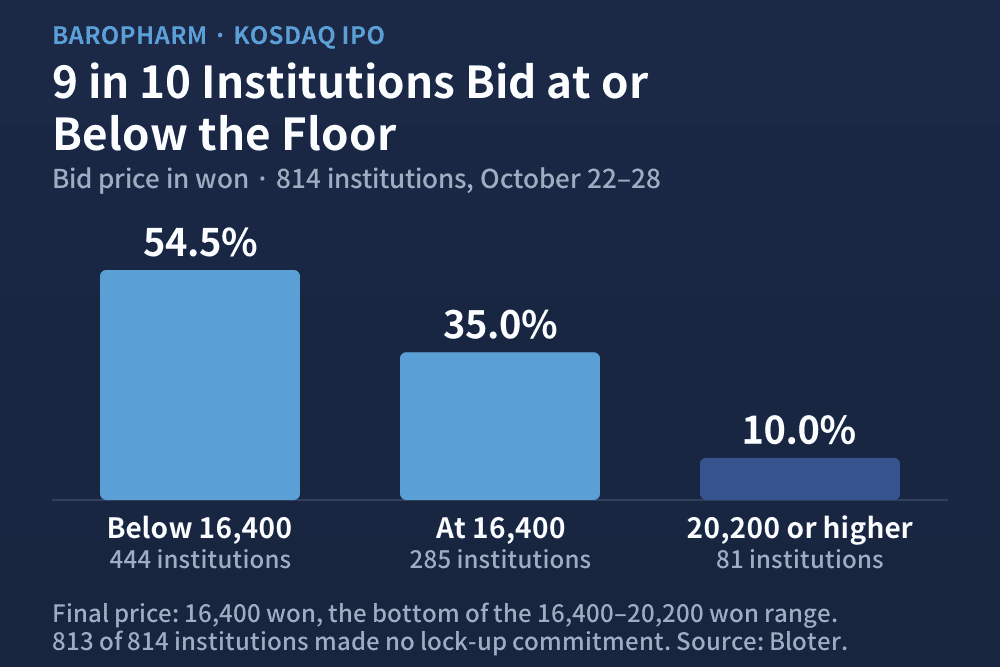
At the demand forecast, the round in which institutions state what they would pay, 814 institutions bid between October 22 and 28. The competition ratio was 152.36 to 1. The headline hides the distribution. In all, 444 institutions (54.5%) bid below 16,400 won, 285 (35.0%) bid exactly 16,400 won, and 81 (10.0%) bid 20,200 won or higher. That puts 89.6% at or below the floor of the 16,400–20,200 won range. BaroPharm priced at 16,400 won.
The offering is 1.78 million new shares and raises 29.2 billion won (US$22.0 million), 6.8 billion won (US$5.1 million) less than the 36 billion won (US$27 million) at the top of the range. Of the proceeds, 14 billion won (US$11 million) goes to production facilities at a subsidiary, 7.61 billion won (US$5.7 million) to overseas brand expansion, and 7.28 billion won (US$5.5 million) to AI technology.
Supply on the first day matters as much as price. Of 814 institutions, 813 made no lock-up commitment, a pledge not to sell for a set period. One pledged 5,000 shares for 15 days. At listing, 30.38% of shares are free to trade, and when financial investors' lock-ups end after one month the tradable share reaches 57.54%. The largest shareholders, led by CEO Kim Seul-gi, hold 40.64%, locked up for up to two and a half years.
Which companies set the valuation yardstick?
The first registration statement, filed September 8, benchmarked BaroPharm against two companies: M3, a Japanese medical-information platform, and Doximity, a US network for physicians. A revised statement, reported on October 6, widened the group to four by adding Galenica, a Swiss pharmacy and wholesale group, and Hanmi Science, a Korean pharmaceutical holding company. Value per share moved from 26,210 won to 26,547 won, and the indicative offering range stayed at 16,400–20,200 won.
The two lists describe two different companies. The first pair prices a data platform. The second pair adds a distributor and a drugmaker. The 44.0% margin belongs with the first list, and the 72% of revenue earning 6.7% belongs with the second. Where a bid sits depends on which list an investor believes. The bids sat at and below the floor.
What does the second half have to deliver?
The registration statement's neutral scenario projects 174.6 billion won (US$131.7 million) of revenue and 7.2 billion won (US$5.4 million) of operating profit for 2026, then 226.2 billion won (US$171 million) and 18.5 billion won (US$14 million) for 2027, and 281.2 billion won (US$212 million) and 30.2 billion won (US$23 million) for 2028. Net income is projected at 14.4 billion won (US$11 million) in 2027 and 23.3 billion won (US$18 million) in 2028.
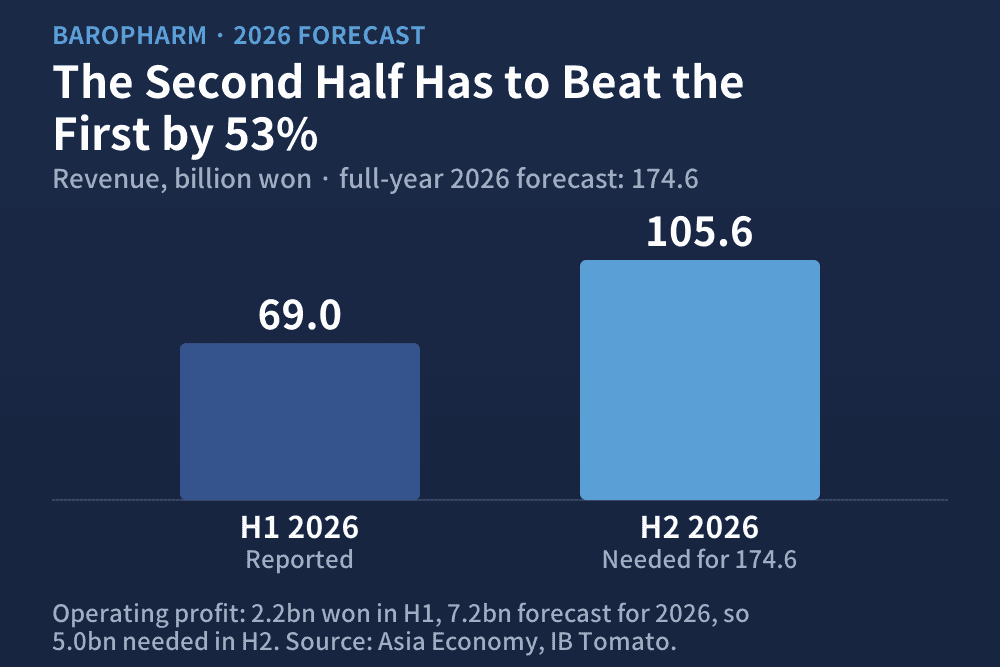
First-half 2026 revenue was 69.0 billion won (US$52 million). Reaching 174.6 billion won (US$132 million) requires 105.6 billion won (US$80 million) in the second half, 53% above the first. Operating profit follows the same arithmetic: 2.2 billion won (US$1.7 million) in the first half against 7.2 billion won (US$5.4 million) for the year leaves 5.0 billion won (US$3.8 million) for the second.
Direct purchase is 72% of revenue, so a revenue forecast is in large part a forecast for the thinnest-margin line.
Does a pharmacy channel travel?
BaroPharm is testing the question in Japan and the US. Revikl went on sale on October 8 at AINZ & TULPE, a Japanese beauty and drugstore select shop, starting with the Shinjuku store and other major Tokyo locations. The plan adds Matsumoto Kiyoshi, Japan's largest drugstore chain, at the end of November. In the US, onboarding to Amazon's K-beauty store and logistics integration are complete, and the official opening is set for December.
In Korea, the asset is the order network. In Japan and the US, the entry points are a select shop, a drugstore chain, and an online store. The overseas line in the use of proceeds is 7.61 billion won (US$5.7 million), about a quarter of the raise.
What does the structure settle for the industry?
It splits three ways, depending on where a reader sits.
For manufacturers, the largest single use of proceeds is production capacity at a subsidiary, 14 billion won (US$11 million) of the 29.2 billion. A channel owner that wants its own product is adding a factory to the shelf.
For brands and buyers, the pharmacy shelf has an owner that also competes on it. BaroPharm buys from 31 listed suppliers, sells to pharmacies, and sells Revikl beside them.
For regulators and investors, the structure puts a distributor's margin and a platform's multiple in one ticker. The Tesla rule and the put-back option exist for that gap, and the first trading day starts to answer which one the market pays for.
The channel is built. The margin is still being priced.