What did Brenntag's Woojin Trading Deal actually buy?
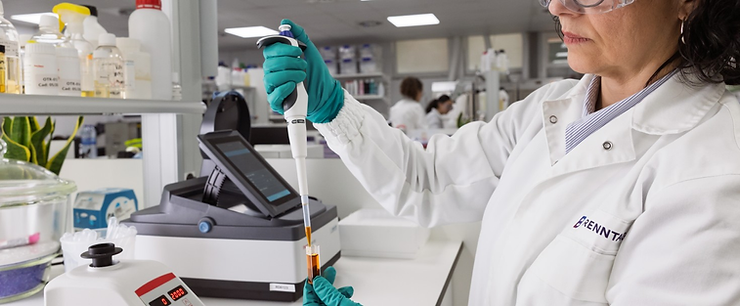
Brenntag SE distributes chemical and cosmetic ingredients rather than manufacturing them. On 3 August, it signed an agreement to acquire Woojin Trading Co., a beauty and personal care ingredients distributor based in Anyang and founded in 1999 by Young-bae Song. Woojin runs an in-house laboratory and a technical team, and has built a network of global suppliers with a customer base expanding across Asia.
The companies did not disclose terms. KED Global reported an enterprise value of about $35 million. Closing is expected by the end of the year, subject to customary conditions including third-party approvals.

Why is a $35 million distributor more interesting than a billion-dollar brand?
Thirty-five million dollars is a rounding error next to what global buyers have paid for Korean brands. Unilever paid €2.27 billion — $2.7 billion at the time — for Carver Korea, the company behind AHC, in 2017. That is roughly seventy-seven Woojins.
The record on the brand side is now long enough to read. KED Global reported in June 2026 that earnings at AHC, Dr. Jart+, Dr.G and 3CE — all acquired by global beauty groups — have tumbled, squeezed between weak Chinese demand and the operating rigidity of multinational parents. Estée Lauder has put Dr. Jart+ up for sale, and The Founders, the Korean company behind Anua, has been exploring a bid for it. A brand a global strategic paid a premium for in one cycle is being shopped back to a Korean buyer in the next.
How did the KKR–Samhwa packaging deal perform?
Now the same period on the infrastructure side. In July 2025, TPG agreed to sell Samhwa Co., a cosmetics packaging specialist founded in 1977 as a mold manufacturer, to KKR. KED Global reported the deal at around 800 billion won; Reuters later valued the completed transaction at 733 billion won, or $528 million. TPG had bought Samhwa and four affiliated entities in November 2023 for around 300 billion won. KED put the return at close to three times the original investment, an internal rate of return of roughly 75 percent in under two years. KKR outbid Blackstone and Carlyle.
Samhwa holds around 17 percent of the Korean cosmetics packaging market and supplies more than 300 brands, including L'Oréal, Estée Lauder, Chanel and LVMH.
Read those two records next to each other and the logic is not subtle. Estée Lauder is struggling to sell a Korean brand it owns, and it is one of the 300-plus brands on Samhwa's client list. The packaging company was paid either way.
What do the 2026 export figures say about where the risk sits?
Korea's cosmetics exports reached $7 billion in the first half of 2026, up 27.3 percent year on year and the largest first-half figure on record, according to the Ministry of Food and Drug Safety. The composition matters more than the total.
Exports to the United States rose 41.5 percent to $1.45 billion, a 20.7 percent share. Exports to China fell 6.6 percent to $1.01 billion, and China's share dropped from 19.6 percent to 14.4 percent. Exports to Poland grew 72.8 percent, to the United Kingdom 150.6 percent, and to the Netherlands 220.4 percent. Basic skincare carried roughly three-quarters of the total at $5.48 billion, up 25.0 percent, while color cosmetics fell 4.2 percent and body cleansing fell 20.6 percent.
That is a market rotating hard underneath its own headline. A brand built for the Chinese daigou channel in 2019 is a different company from one built for Amazon and Target in 2026, and the transition is not free — ask Estée Lauder. But the ingredient houses, the ODMs and the packagers sold to the 2019 winners and are selling to the 2026 winners, and they will sell to whoever wins in Warsaw and Rotterdam next. They are indifferent to which brand takes the shelf. They are not indifferent to how much of the category ships, and that number is up 27.3 percent in dollar terms.
What did Brenntag mean by "bridgehead"?
Francois Bleger, global president of Brenntag Beauty & Care, called the Korean market "a global trendsetter for beauty and personal care formulations" and said the strengthened footprint "will serve as a bridgehead for accelerating Brenntag's other businesses across South Korea."
Bridgehead is a precise word, and note what it is a bridgehead into: not Korean consumers, but Korean formulation. Bleger's sentence is about accelerating Brenntag's other businesses across South Korea, with a beauty ingredients distributor as the entry point. The customer he wants is the person specifying the ingredient, well before anything reaches a shelf.

Is this a problem for Korean industry?
There is a version of this argument that ends in alarm about foreign ownership. That is not the argument. Woojin's chief executive, Seon-yeon Kim, framed the deal as combining "regional expertise with global scale," and for a mid-sized distributor gaining a European parent's balance sheet, that is a reasonable trade. Brenntag closing in the fourth quarter is not a loss for Korean industry.
The argument is about attention. Korea's public conversation about K-beauty is almost entirely a conversation about brands — which one went viral, which one got acquired, what the export record was. Meanwhile the compounding, defensible, unglamorous layer beneath those brands is being repriced and, increasingly, bought. Private equity noticed first. Strategics are noticing now. Most of the founders and executives I work with are still benchmarking themselves against other brands.
If you run a Korean supplier — ingredients, packaging, contract manufacturing, logistics — someone has already built a model of your business. The question worth asking is whether you have.