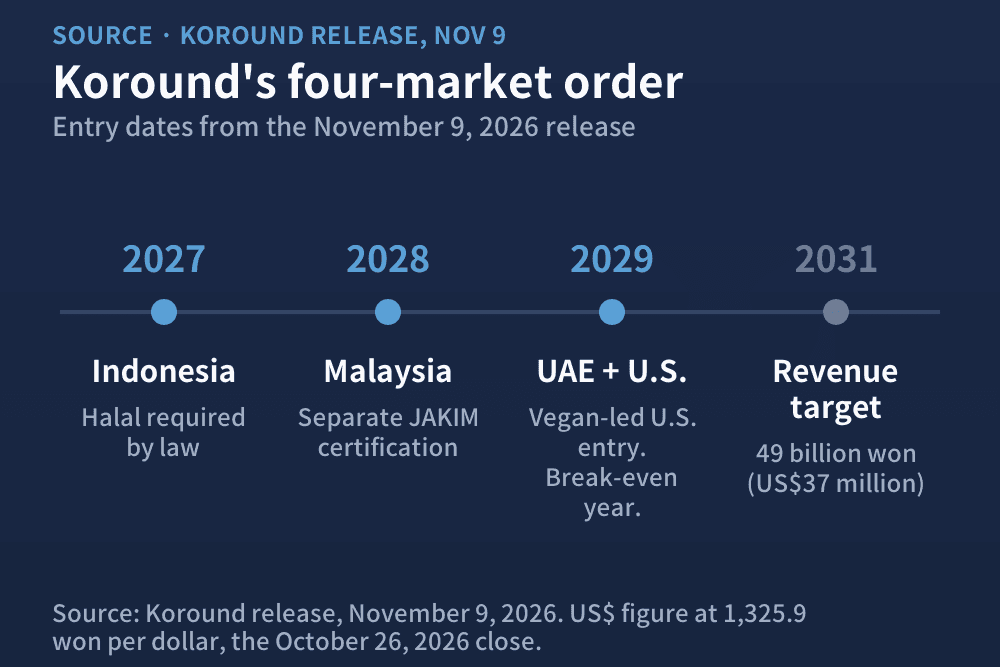
Koround's release dated November 9, 2026 lays out a four-market plan for its DECORE skincare brand: Indonesia in 2027, Malaysia in 2028, the UAE and the U.S. in 2029. Every step is sequenced by a certificate. Indonesia now requires halal certification by law. Malaysia leaves it optional. In the U.S., FDA keeps no list of approved cosmetic claims. The plan runs from the heaviest gate to the lightest.
What does Koround's release commit to?
Koround is a Korean company founded in February 2024. It launched DECORE in July 2025. The release, distributed through PR Newswire on November 9, 2026, says the DECORE core line holds halal and vegan certifications and a registration with BPOM, Indonesia's food and drug authority. Cumulative sales have passed 20,000 units, the release reports.
The market plan is dated. Indonesia comes in 2027, Malaysia in 2028, and the UAE and the United States in 2029. Break-even is set for 2029. The revenue target for 2031 is 49 billion won (US$37 million at 1,325.9 won per dollar, the October 26, 2026 close).
Two details shape everything after that. Koround is pursuing a separate certification from JAKIM, Malaysia's halal authority. And in the U.S., the brand leads with vegan credentials and clinically validated ingredients instead of halal.
Why does the order run Indonesia, Malaysia, then the U.S.?
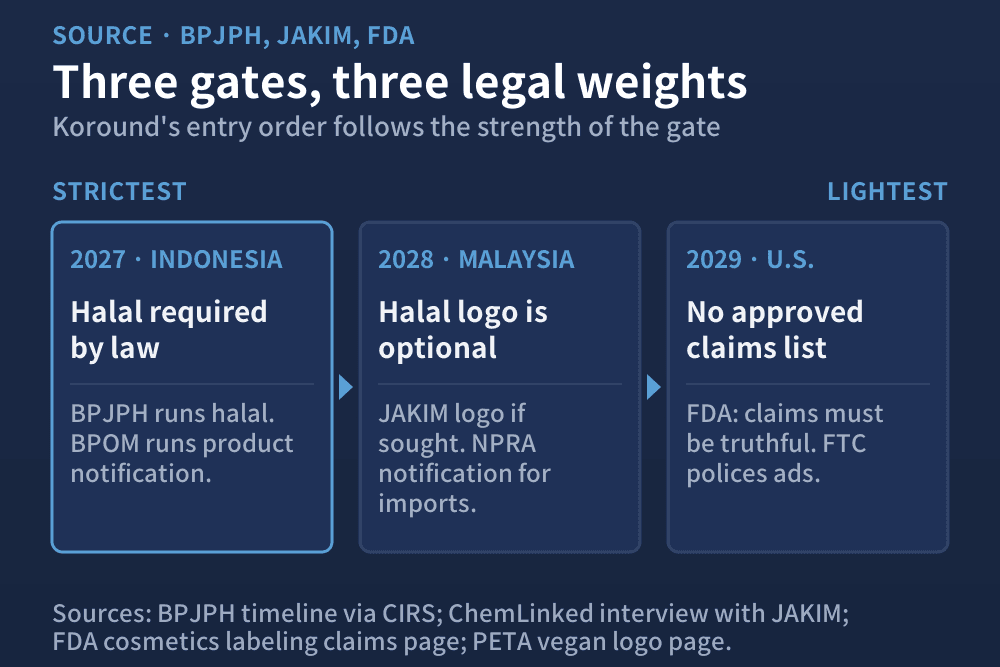
Because each market's gate has a different legal weight. Indonesia's is a statute. Malaysia's is a logo a brand chooses to earn. The U.S. asks for proof that a claim is truthful, and nothing more. The release lists the markets by date. The regulatory record lists them by strictness. The two orders match.
That match is the sequencing logic. The ingredient-level file built for the heaviest gate overlaps with what the lighter gates ask for, so a certificate-first plan front-loads the hardest work. The last sections return to that overlap.
What does Indonesia require, and who checks it?
Two agencies split the job. BPJPH, the Halal Product Assurance Organizing Agency, runs halal certification. BPOM runs product notification, which every imported and locally made cosmetic needs before it is marketed. Halal sits with BPJPH, not BPOM.
Mandatory halal certification for cosmetics took effect in October 2026. On September 16, BPJPH said it would proceed as scheduled, without delay. For imports, BPJPH told exporters to start halal conformity work in the country of origin. It listed four overseas inspection bodies on September 10 and runs a pre-shipment verification mechanism for imported products. Halal information has to match across packaging labels, certificates, and accompanying documents. A mismatch is a customs clearance risk.
Koround's 2027 entry lands after the transition ended. The transition rules in BPJPH's July 2025 notice let uncertified cosmetics keep selling until October 2026, with ingredient documents filed in place of certificates. That route is closed. A brand arriving in 2027 enters a market where the certificate is a license to sell.
What did Korea win from Jakarta before the mandate?
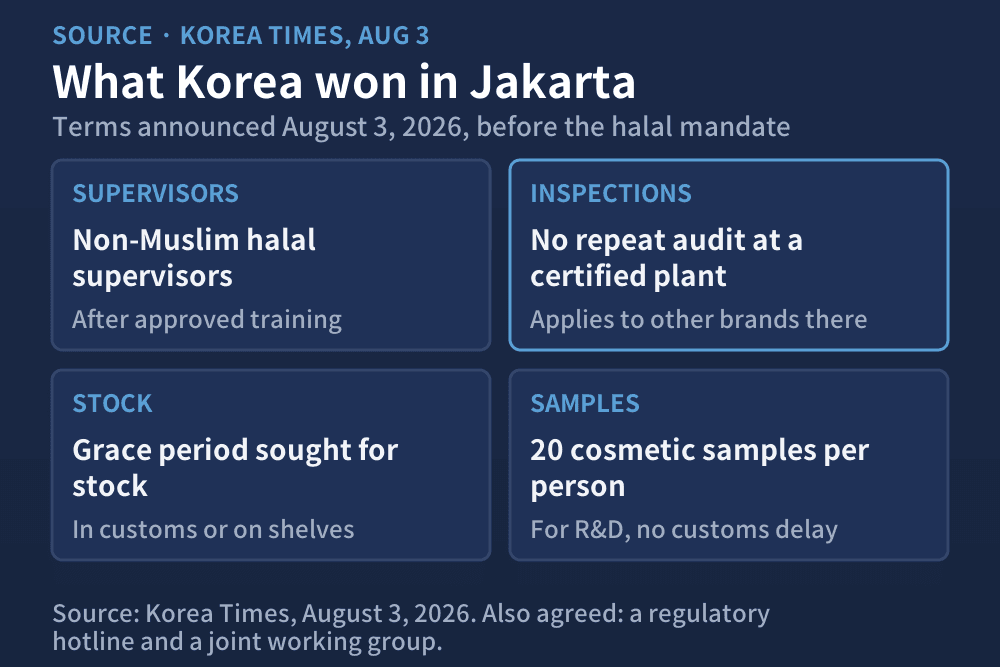
A joint public-private delegation led by Korea's Ministry of Food and Drug Safety met Indonesian officials in Jakarta from July 20 to 22, 2026. The terms were announced on August 3.
Four concessions came out of it. Non-Muslim staff can serve as certified halal supervisors after approved training. BPJPH will not repeat on-site inspections at a facility already certified for one brand, so other brands contracted to work there skip the duplicate audit. BPOM committed to push for an extended grace period for cosmetics already in customs or on store shelves. Companies can bring up to 20 cosmetic samples per person for market research and R&D without customs delay. Both countries also set up a regulatory hotline and a joint working group.
The inspection concession moves the structure. It attaches to the facility, not the brand. The saving goes to whichever brand manufactures at a certified plant, and the plant's certification history becomes a shared asset among its clients.
Why is Malaysia a different kind of gate?
JAKIM certification for cosmetics is voluntary. JAKIM describes it as encouraged, not compulsory. The mandatory step for an imported cosmetic is notification to the NPRA, Malaysia's cosmetics regulator. The halal cosmetics standard is MS 2634:2019.
What the voluntary certificate buys is the logo. Certified cosmetics must carry the halal logo, and the logo is widely recognized across Muslim-majority markets. International applicants appoint a Malaysian representative company and apply through the MyeHALAL system. Applicants can also certify in their country of origin instead of applying in Malaysia.
So Koround's plan to pursue a separate JAKIM certification is a choice, not a requirement. In Indonesia, the certificate is a license to sell. In Malaysia, it is a sales credential.
Why lead with vegan in the United States?
Because in the U.S. the question is not permission but proof. FDA's cosmetics labeling page says the agency has no list of approved or accepted claims for cosmetics. Claims must be truthful, and the Federal Trade Commission regulates advertising claims. Nothing on that page defines vegan.
Private certifiers fill the space. PETA's vegan logo program, for example, asks an applicant to complete a statement of assurance and a questionnaire, and asks its manufacturers or suppliers to complete statements of assurance. The annual fee scales with estimated revenue, from $250 to $3,000.
For a brand entering in 2029, the vegan badge is a documentary exercise built on supplier statements. That makes it the natural lead credential in a market where no gate checks the claim before the shelf does.
What gap is the CEO pointing at?
In the release, Koround CEO Kim Jung-hoon names the opening: "Locally, there's a gap: halal brands are seen as weak on efficacy, and K-beauty brands lack certification." The plan fills the second half of that sentence first.
Kim also says "Visual curiosity drives the first purchase, but it's real efficacy that drives repeat purchases," and that for K-beauty to keep growing, "its center of gravity has to shift from trends to trust." In this plan, trust is a sequence of third-party documents.
A June 19, 2026 analysis of the Indonesian mandate made the same point from the other direction. Halal is turning into a baseline, and brands now have to explain ingredients and sourcing, because consumers check claims themselves through ingredient databases and apps.
What do the three gates ask for in common?
Documents about ingredients. BPJPH's July 2025 notice for ingredient applications during the transition asked for the production process flow, the product composition, and a certificate of analysis. Malaysia asks for composition, sources, and production processes for ingredients that lack halal certification. PETA asks suppliers for statements of assurance.
The paperwork differs in form and matches in substance: who made each ingredient, how, and from what. A brand that builds that file once for Indonesia holds the raw input the other two markets ask for.
That is the case for certificate-first sequencing. The work sits at the start, and each later market draws on it.
Where do the positions split?
The plan reads differently depending on the seat.
Manufacturing. The Jakarta terms make the certified plant the unit of value. Inspection history belongs to the facility, and every brand that contracts there benefits.
Brands and buyers. A certificate opens the door in Indonesia and decorates it in Malaysia and the U.S. Kim's own sentence says the rest: efficacy decides the second purchase.
Regulation and capital. The 2031 target of 49 billion won (US$37 million) rests on four regimes. Only one of them, Indonesia's, is enforced at the border. The others are earned in the market.
The sequence is the strategy. The certificates come first. The sales have to follow.