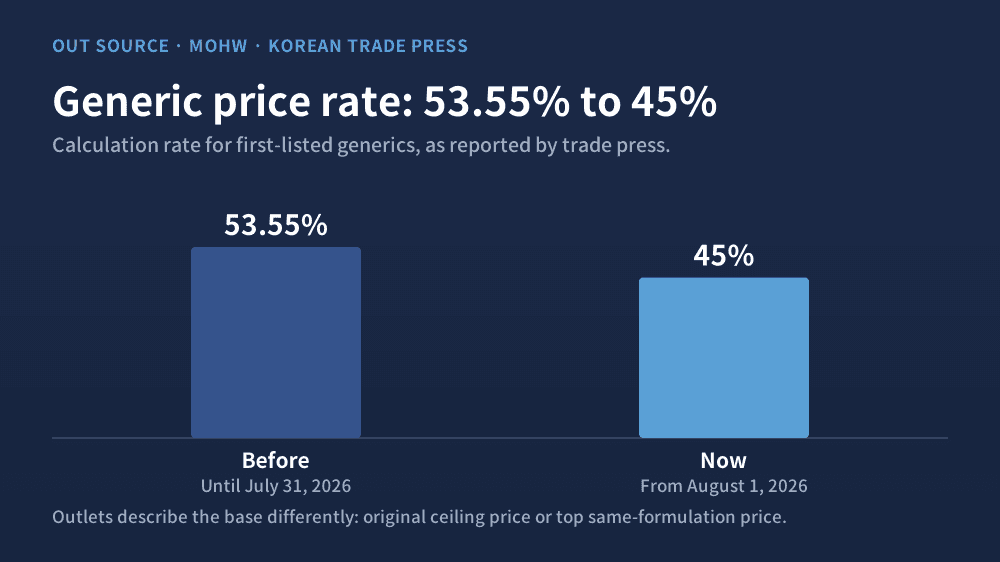
On July 30, 2026, Korea's Ministry of Health and Welfare lowered the calculation rate for first-listed generics from 53.55% to 45% (effective August 1). Shortly after, on October 12, Dongkook Pharmaceutical's board approved renaming the company to DK Centellian.
While much of the media connects these two events, Dongkook's official announcement never mentions drug prices. Furthermore, the name change is still just a proposal heading to a shareholder vote on November 27, 2026.
What did Korea change on August 1?
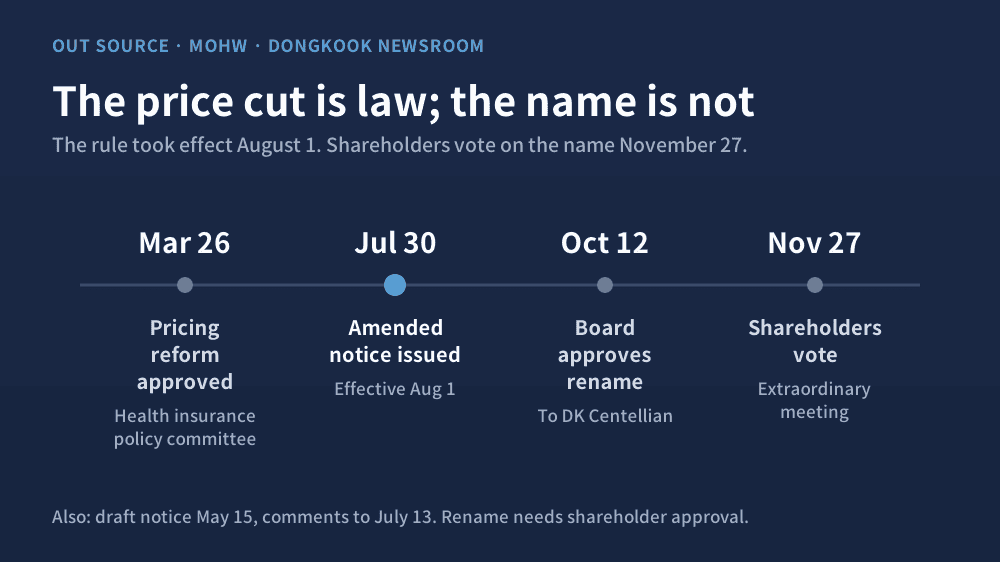
On August 1, 2026, South Korea's Ministry of Health and Welfare enacted a partial amendment to its drug-pricing notice, officially known as the Standards for Determining and Adjusting Drugs. The journey to this change began when the health insurance policy committee approved the underlying reform on March 26, followed by the ministry's draft publication on May 15 and a public comment period that closed on July 13 before the final promulgation on July 30.
At the core of the reform is a new calculation rate for generic drug reimbursement ceiling prices—the maximum amount the national insurer will cover. According to Korean trade reports, the rate for a first-listed generic has dropped from 53.55% to 45%. However, media outlets have been split on how the baseline is defined, with some pointing to the original drug's ceiling price and others citing the highest ceiling price among identical formulations, leaving the exact technical baseline up to the official notice text.
Assuming an unchanged baseline, this adjustment effectively lowers the maximum initial listing price for new generics by roughly 16%. It is important to note that this reduction figure is calculated mathematically from the reported rates rather than being an official statistic provided directly by the ministry.
Who pays less, and who gets a softer rate?
The reform is not a flat cut, meaning that drugs already on the reimbursement list will phase down gradually over roughly ten years until 2036, split around a 2012 listing cutoff. To ease the transition, companies certified as innovative pharmaceutical firms receive a special rate of 49% for four years, while quasi-innovative firms are granted a 47% rate for three years.
Other regulatory adjustments tighten the rules further across the board. Stepped cuts—which lower a drug's price as more identical products enter the market—now trigger at the 13th identical product instead of the previous threshold of the 20th. Additionally, drugs that miss two bioequivalence and registered-ingredient requirements face an adjustment rate drop from 85% to 80%. On the other hand, new drugs benefit from a shortened listing window of within 100 days instead of up to 240, along with price premiums of 60% for innovative firms or 50% for quasi-innovative firms for up to four years.
Finally, two key provisions have been deferred: volume-linked pricing begins in January 2027, and restrictions on transfer prices are postponed to August 1, 2027. Ultimately, a generic drug maker's revenue line must reprice according to this complex schedule, whereas a consumer cosmetics line remains completely untouched by these pharmaceutical rules.
What exactly is Dongkook proposing?
On October 12, Dongkook Pharmaceutical's board resolved to propose changing the company's name to DK Centellian. An extraordinary shareholders' meeting is scheduled for 9:00 a.m. on November 27, 2026, at the company's Cheongdam building in Gangnam, Seoul, with a single agenda item to amend the articles of incorporation. The record date for voting rights was October 27, and until the vote passes, the legal name remains unchanged. Meanwhile, the company's subsidiary, Dongkook Life Science, is separately pursuing a rename to DK Luonix.
Does the company say the rename is about drug prices?
Crucially, the company's official announcement does not mention drug prices, instead framing the rebrand as a push into global markets. The DK prefix is said to represent 58 years of history, scientific trust, and unchanging corporate roots, with a stated vision centered on science-based health and beauty. While media coverage on October 13 tied the corporate rename directly to the government's pricing overhaul—often incorrectly describing the reform as still being pursued even though it had been in force for over ten weeks—the official record points strictly to a strategic pharma-to-cosmetics pivot rather than an explicit reaction to price regulations.
Where does the name Centellian come from?
The origin of the proposed name stems from Centellian24, Dongkook’s dermocosmetic brand launched in 2015 and best known for its Madeca Cream. The name's roots trace back to Centella asiatica—a herb commonly known in Korea as byeongpul—which serves as the active ingredient in Madecassol, Dongkook's flagship wound-care product. While one trade outlet traces the new name back to the plant and another attributes it to the brand, Dongkook's official announcement mentions neither.
This distinction carries strategic weight: a company renaming itself after a brand signals an identity rooted in consumer retail, whereas a name tied to an ingredient evokes a supplier positioning. Having been founded in 1968 and adopting the Dongkook Pharmaceutical name in 1982 to replace UEC, the company is retiring a 44-year-old corporate banner. This transition follows a well-established pattern in Korean pharmaceuticals, echoing previous rebrandings such as JW Pharmaceutical in 2011, Green Cross adopting the GC Biopharma identity, CJ HealthCare becoming HK inno.N in 2020, and Boryung Pharmaceutical shortening its name to Boryung in 2022.
How much of Dongkook is cosmetics?
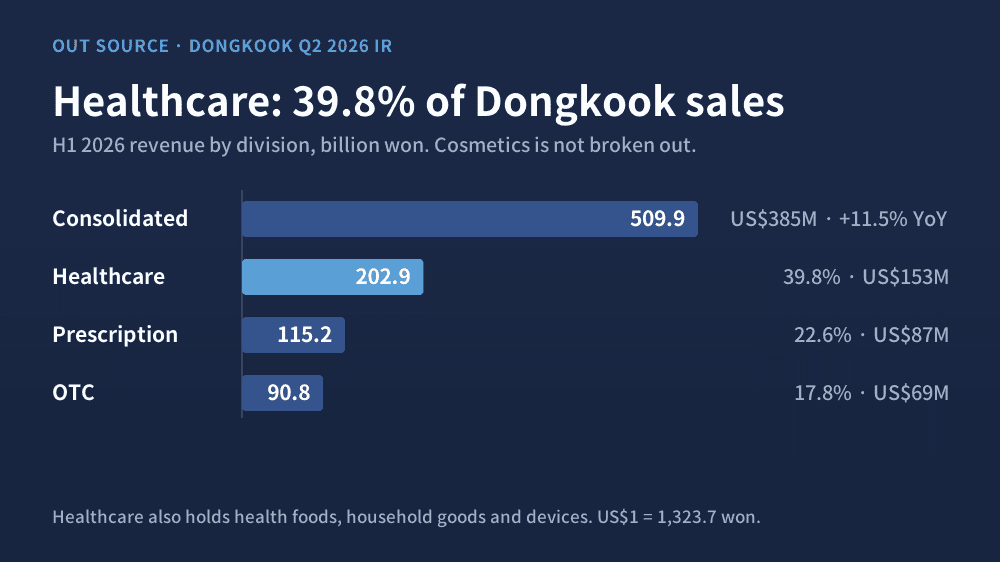
Dongkook does not disclose cosmetics as a standalone line item in its financial reports. Instead, the company reports a Healthcare division that generated 202.9 billion won (US$153 million) in the first half of 2026—accounting for 39.8% of its 509.9 billion won (US$385 million) consolidated revenue and up from 157.7 billion won (US$119 million) a year earlier, using an exchange rate of 1,323.7 won per dollar (the Seoul close on October 27, 2026).
However, because the Healthcare division also includes health functional foods, household goods, and beauty devices, treating this entire division as cosmetics overstates the skincare business. During the same half-year period, prescription drugs earned 115.2 billion won (US$87 million) and over-the-counter drugs brought in 90.8 billion won (US$69 million), while total operating profit rose 12.6% to 53.4 billion won (US$40 million).
To bridge the gap, brand-level estimates from brokerages and trade press offer an outside view, placing cosmetics revenue at 154.9 billion won (US$117 million) in 2023, 181.5 billion won (US$137 million) in 2024, and 222.7 billion won (US$168 million) in 2025 (representing about 24% of that year's 926.9 billion won total revenue). Looking ahead, LS Securities forecasts cosmetics revenue will reach 315.0 billion won (US$238 million) for 2026, though these figures remain external projections rather than official segment disclosures.
What do the export figures prove?
A widely repeated narrative claims that exports surged from 3 billion won (US$2.3 million) in 2025 to over 50 billion won (US$38 million) in the first half of 2026, though the initial figure is off by a factor of ten. According to the underlying brokerage series, cosmetics exports actually reached 16.3 billion won (US$12 million) in 2024 and 30.0 billion won (US$23 million) in 2025, with estimated figures of roughly 53 billion to 54 billion won (US$40 million to US$41 million) for the first half of 2026.
By contrast, the company's half-year report—as analyzed by the Korean trade press—presents a narrower and firmer picture. Total company exports hit 69.0 billion won (US$52 million) in the first half of 2026, already reaching 91% of the 76.0 billion won (US$57 million) exported across all of 2025. Specifically, the cosmetics-and-other-drugs segment exported 21.6 billion won (US$16 million) in the second quarter compared to just 4.4 billion won (US$3 million) a year earlier, nearly quintupling its performance and driving its export share up from 6.4% to 21.8%.
However, interpreting these metrics requires caution because the report's export table also includes an "other-products" line totaling 40.0 billion won (US$30 million). This category encompasses pharmaceutical items like Madecassol powder and cannot be used as a direct proxy for cosmetics, especially since the sub-lines overlap and do not neatly add up to the consolidated total.
Which overseas listings are verified?
Verification of Dongkook's overseas retail footprint reveals a mixed picture. Ulta is fully verified at both ends: Centellian24 announced on May 6 that its Madeca Cream Time Reverse launched on May 2 in about 1,400 Ulta stores, Ulta's official website lists 24 Centellian24 products, and an August expansion into checkout-area displays reached about 760 stores, with both counts standing with their respective dates.
In contrast, Costco is only partly verified; Korean press reports based on company statements cited about 200 US warehouses starting July 7, but since Costco.com lists a two-pack of the cream as online-only, physical warehouse placement relies solely on corporate claims. Similarly, Don Quijote remains company-sourced only, following Dongkook's April 6 announcement that 500 Don Quijote stores would carry the line from April 20 alongside 85 Matsumoto Kiyoshi and 100 Loft stores—a total of 685 stores that falls short of the roughly 1,000 stores cited in headlines, with no independent Japanese retailer confirmation. Meanwhile, Nordstrom is reported at about 89 US stores plus online availability from early June.
How do the other pharma entrants compare?
Channel choice varies significantly by company as pharmaceutical firms navigate their shifts into consumer skincare. For instance, Dongwha Pharm launched its Fucidem line at Daiso on May 18 featuring eight products priced between 2,000 and 5,000 won (US$1.51 to US$3.78)—initially stated to sell nationwide in stores and online, though later media coverage described it as Daiso-exclusive. Following this trend, Yuhan also announced an eight-product lineup called Dermafuramin Rx at Daiso on October 22.
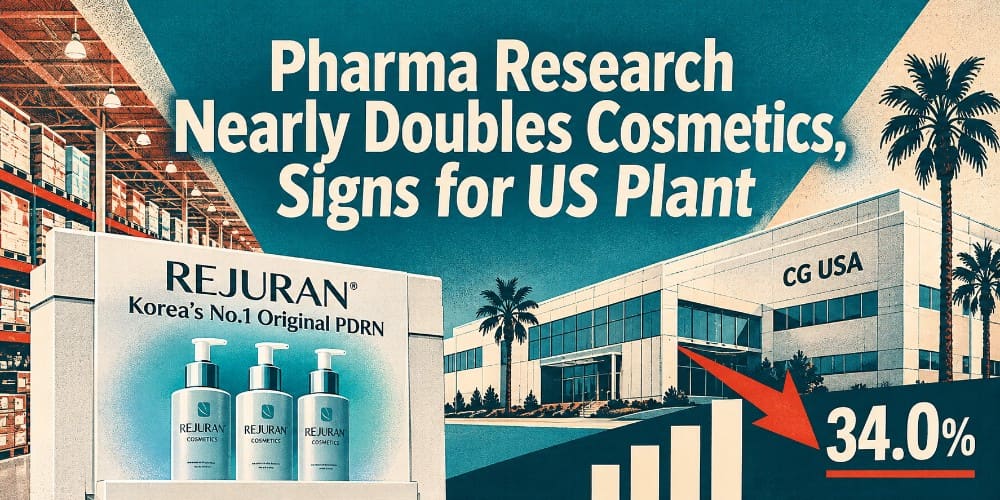
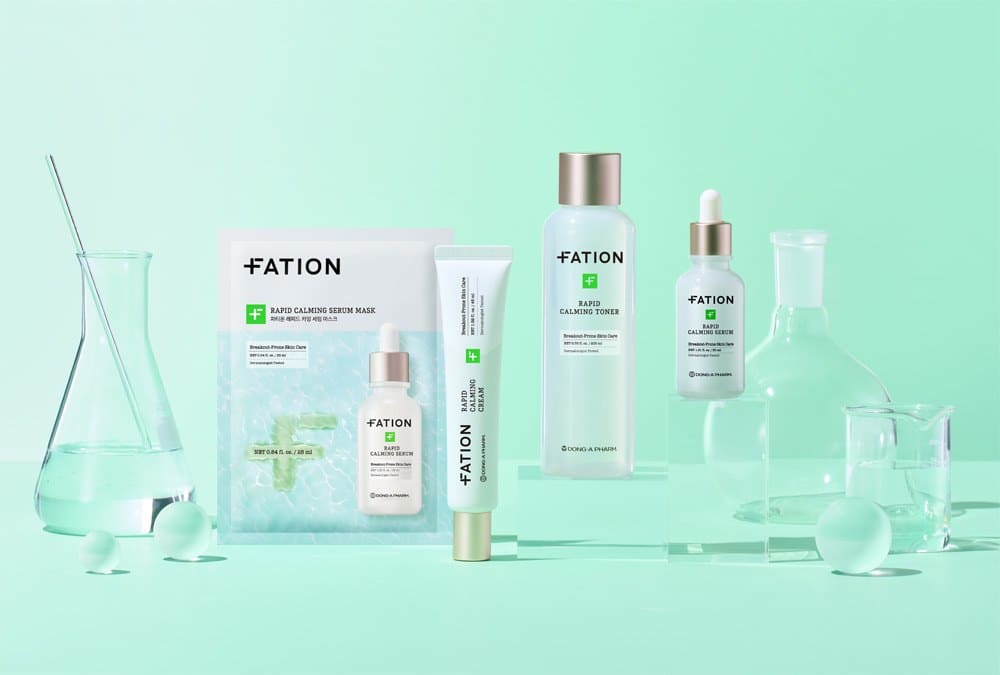
Meanwhile, other firms have targeted high-profile international retail channels. Dong-A Pharmaceutical announced on August 31 that its Fation line (known in Korean as Pation) would enter 55 US Sephora stores, though it is featured within the Olive Young K-Beauty Edit display rather than as a standalone brand listing. Similarly, Pharma Research's Rejuran Cosmetic secured a listing at US Sephora starting March 16, subsequently reporting robust second-quarter 2026 cosmetics sales of 60.2 billion won (US$45 million), with 72.4% driven by exports.
What does the pattern mean for the industry?
Prescription pricing now reprices strictly on a government schedule, whereas cosmetics reprice directly at the retail shelf. To adapt, pharmaceutical groups are answering by growing the consumer product lines that government notices do not touch, making a corporate rename the cheapest and most visible signal of that strategic choice.
Different stakeholders read this shift through distinct lenses. Manufacturers see a core generics business with a defined price path alongside a variable consumer line, funding the latter using profits from the former. Meanwhile, brands and buyers observe a trusted pharmaceutical name entering Ulta, Costco, and Daiso all at once, leading them to question which of those announcements represent actual store counts versus promotional press releases. At the same time, regulators and investors recognize that a corporate name change moves zero revenue, leaving the upcoming November 27 vote and future financial filings as the true indicators to watch.
Ultimately, a new name is not a line item. Until Dongkook officially discloses cosmetics as a separate reporting segment, the proposed rename remains purely a market signal rather than a quantifiable financial number.