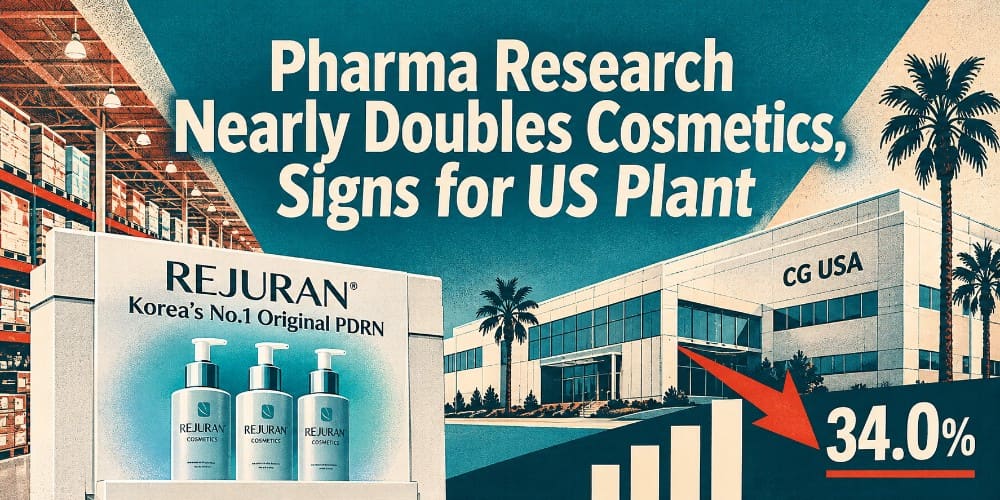
Pharma Research signed on June 30, 2026 to buy CG USA, a California cosmetics contract manufacturer, and has not disclosed the price, stake or closing date. Kyobo Securities currently estimates third-quarter cosmetics revenue at 68.2 billion won (US$51.3 million), up 93.8% and about 39% of the 174.8 billion won (US$132 million) total. Operating profit is estimated down about 4%, and the margin falls to 34.0% from 45.7%. A skin-booster company is now a cosmetics business with a plant it has not priced.
What is Pharma Research actually selling?
Pharma Research is best known for Rejuran, a skin-booster treatment used in clinics, which the company's filings group under medical devices. Rejuran Cosmetics is a separate consumer line that sells through Sephora, Amazon and, since October, a Costco program.
In the second quarter of 2026 the company reported revenue of 178.7 billion won (US$134.5 million), operating profit of 66.5 billion won (US$50 million) and an operating margin of 37.2%. Medical devices contributed 96.7 billion won (US$73 million) and cosmetics 60.2 billion won (US$45 million), about a third of revenue. First-half revenue was 324.8 billion won (US$244 million) and operating profit 123.8 billion won (US$93 million), a 38.1% margin, with exports rising to 44% of revenue from 38%. Dollar figures in this article use 1,328.9 won per dollar, the rate on October 16, 2026.
How fast is the cosmetics line growing?
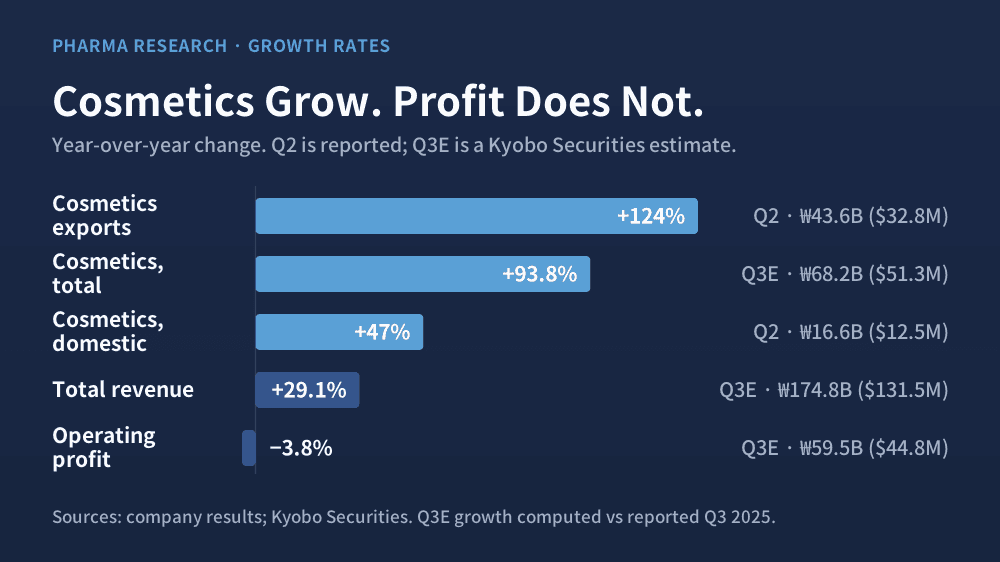
Faster than the device business that built the company. Second-quarter cosmetics exports reached 43.6 billion won (US$32.8 million), up 124% from a year earlier, and domestic cosmetics sales reached 16.6 billion won (US$12 million), up 47%. In the first half, cosmetics exports rose 92%. A year earlier the domestic cosmetics line was small: third-quarter 2025 domestic cosmetics sales were 13.2 billion won (US$9.9 million), up 126.4%, according to the company's results for that quarter.
Kyobo Securities' third-quarter estimates, reported on October 29, carry that further. Cosmetics revenue is estimated at 68.2 billion won (US$51 million), up 93.8% from a year earlier and 13% above the second quarter. The device side moves the other way. Estimated domestic device sales are 57.7 billion won (US$43 million) against 64.5 billion won (US$49 million) in the second quarter, and estimated device exports are 25.7 billion won (US$19 million), down 20.3% from the second quarter. Kyobo credits the cosmetics growth to North America and Southeast Asia, including TikTok Shop, and points to weaker spending by Japanese tourists on the device side.
The 39% share of third-quarter revenue is a calculation from those estimates (68.2 divided by 174.8). The company does not report it.
Why buy a factory in California?
Until now the company supplied the US market from Korean manufacturing, according to its July 1 press release. The release names the Sephora launch and the expanding Amazon channel as demand drivers and gives the rationale as supply stability, logistics and distribution efficiency across North America. It adds a Canadian entry in the second half of 2026 and localization across the Americas. The CEO described the acquisition as a base for a future US contract manufacturing business.
The October 23 press release adds a retail driver. Rejuran Cosmetics runs Beauty Tables, a beauty-only display program, in 25 Costco stores in the US and plans more than 150. Its Costco-only set pairs the 50 mL Rejuran Turnover Ampoule with an extra 10 mL. A planned 150 stores is a replenishment problem more than a launch problem, and replenishment is decided by where the product is made.
What is CG USA?
A contract manufacturer is a factory that makes products for other brands. An OEM (original equipment manufacturer) produces to the brand's formula. An ODM (original design manufacturer) also develops the formula. According to the company's release, CG USA was founded in 1986 and covers product planning, formula development, manufacturing, filling, packaging and quality control.
The release says CG USA holds a cosmetics manufacturing license, operates an FDA-registered facility and carries ISO 22716 certification, the international good-manufacturing-practice standard for cosmetics. It adds that the site can produce over-the-counter (OTC) drug products. Those descriptions are the company's own. The release gives no production volume or capacity.
What has the company not said?
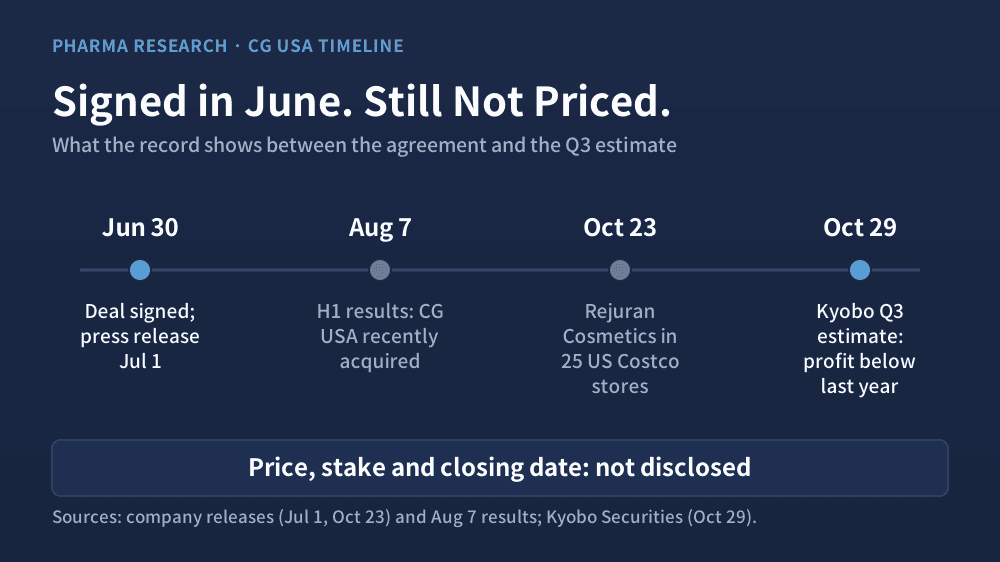
The price. The stake. The closing date. The July release describes a planned acquisition. The company's August 7 first-half results describe CG USA as recently acquired and say the company will use its production base in the US. No document reviewed for this article states a closing date.
CG USA's revenue, losses and headcount are also undisclosed. Kyobo says CG USA's losses will be partly reflected in quarterly earnings, so the company is consolidating a plant of unknown size and unknown loss.
Where does the profit go?
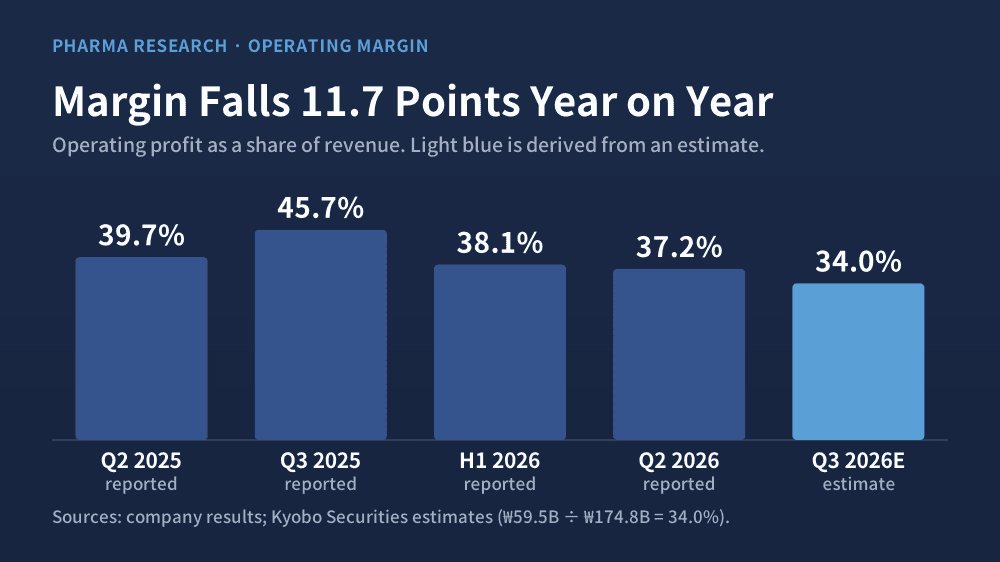
The company reported third-quarter 2025 revenue of 135.4 billion won (US$102 million) and operating profit of 61.9 billion won (US$47 million), a margin of 45.7%. Kyobo's third-quarter 2026 estimates are revenue of 174.8 billion won (US$131.5 million), about 29% higher, and operating profit of 59.5 billion won (US$44.8 million), about 4% lower. That is a 34.0% margin, 11.7 points below the same quarter a year earlier. Kyobo says the expansion weighs on profitability and that the operating profit estimate falls short of market expectations.
The second quarter shows where the pressure started. Gross margin improved to 76.97% from 76.24%, so product economics held. Operating margin fell to 37.20% from 39.74% because selling and administrative costs reached 39.77% of revenue, up from 36.50%, with advertising and promotion up 26.5% to 22.77 billion won (US$17 million). Through the second quarter the squeeze came from selling costs. The third-quarter estimate adds two new variables: a larger share of lower-margin cosmetics, which Kyobo flags as pressure on gross margin, and the CG USA loss.
Does owning the plant change what the company is?
A brand that buys its manufacturer takes on fixed costs and the problem of keeping lines full. The CG USA plant has two jobs: supplying Rejuran Cosmetics, and, in the CEO's description, growing a US contract manufacturing business for other brands. The two jobs draw on the same lines. A line hour used for Rejuran Cosmetics is a line hour not sold to an outside brand, and an outside order needs the same FDA-registered, ISO 22716 site.
For a company whose estimated margin has dropped 11.7 points in a year, utilization of that plant decides whether cosmetics growth adds to profit or dilutes it.
What remains unconfirmed?
The third-quarter figures are estimates until the company reports. The English-language report of the Kyobo estimates cites revenue growth of 30.1%, while the estimate measured against the company's reported third-quarter 2025 revenue is 29.1%. This article uses the second figure. The 39% cosmetics share and the 34.0% margin are calculations. The deal's price, stake, closing date and the plant's economics remain with the company.
What does a device maker's US plant mean for the industry?
Contract manufacturers read it first as a customer taking supply in-house. A company with a US plant and an ODM ambition is a buyer that can also compete for the next brand's order.
Brands and buyers read it as the option of shorter lead times once production moves to the US. The plant's cost then sits in the brand owner's results, not in a supplier's invoice.
Investors and regulators read the disclosure. A signed acquisition with no price, an estimated margin 11.7 points lower and a plant described as acquired without a stated closing: the next report has to answer all three.
Cosmetics growth is no longer the question. The cost of making it is.