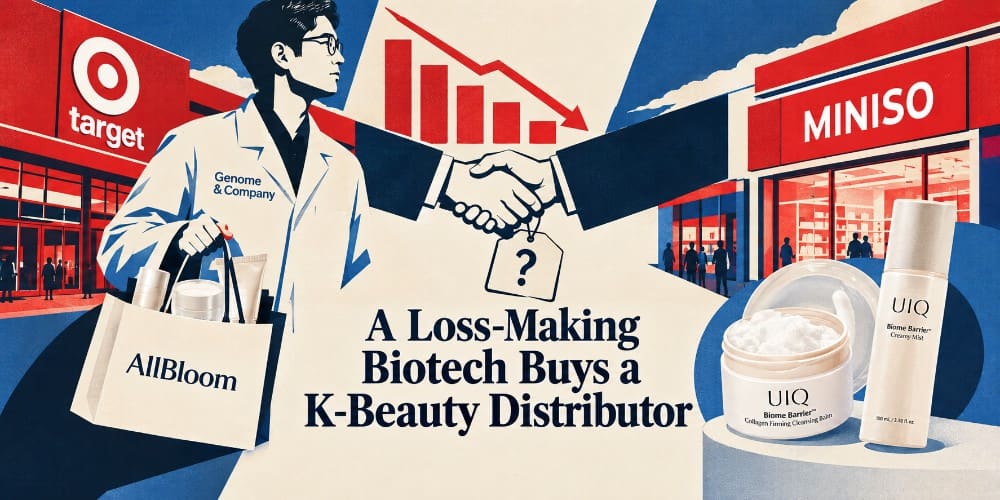
On October 26, 2026, Genome & Company said its new wholly owned subsidiary Bloom Partners acquired 64.46% of AllBloom, a company that exports Korean beauty brands to the United States and distributes them there. No price was disclosed. DART, Korea's electronic disclosure system, lists no Genome filing for October 23 or October 26. The buyer reported first-half 2026 revenue of 12.0 billion won (US$9.1 million) against an operating loss of 14.1 billion won (US$10.7 million). The target reports 23.0 billion won (US$17.4 million) for 2025.
What did Genome announce on October 26?
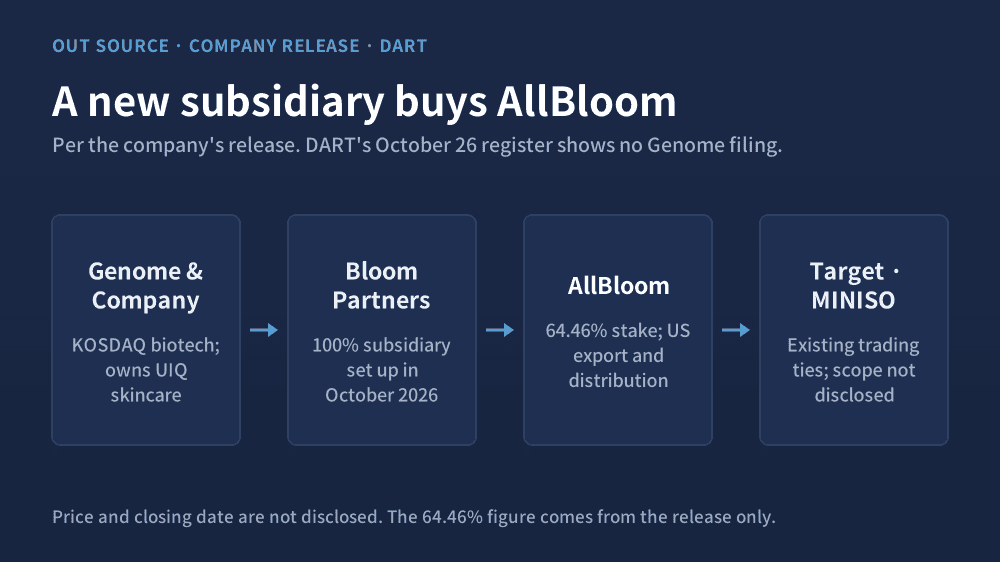
Genome & Company, a microbiome biotech listed on the KOSDAQ, said that Bloom Partners acquired 64.46% of AllBloom and secured management control. One print edition rounds the stake to 64.5%. Bloom Partners is a 100% subsidiary that the company set up in October 2026 for this deal. Genome did not buy the stake directly.
The company did not disclose the price or the contract terms. It describes AllBloom as an exporter and local distributor for Korean beauty brands in the United States, covering local sales, import and export logistics, inventory management and customer service. It named Target and MINISO as existing trading relationships.
Where is the filing?
DART, run by the Financial Supervisory Service, is where a listed Korean company records a material acquisition. The registers for October 23 and October 26, 2026 list no entry for Genome & Company. No acquisition decision, no major-matters report, no other filing appears.
That makes the 64.46% figure, the undisclosed price, the identity of the buyer and the completed status the company's own statements. No signing date, closing date or payment date has been given. Coverage of October 26 is near-identical across outlets because it traces to one release. Independent reporting on the company comes from earlier and later pieces about its finances, not from the deal announcement.
What does AllBloom do, and what is unknown about it?
All AllBloom figures are the company's own. Revenue was about 17.8 billion won (US$13 million) in 2024 and about 23.0 billion won (US$17 million) in 2025, up 29.6%. Roughly 63% of 2025 revenue came from exports. Dollar figures here use 1,323.7 won per dollar, the Seoul close on October 27, 2026.
The identity of the company is thinner than its revenue. No source names a single brand it distributes. None states where it is incorporated, so calling it US-based is unsupported. No company website, registry record or chief executive had surfaced in public sources before the announcement. The Target and MINISO ties are described only as existing trading relationships, with no door count, product count, launch date or contract type.
Who owns UIQ, and where does it sell?
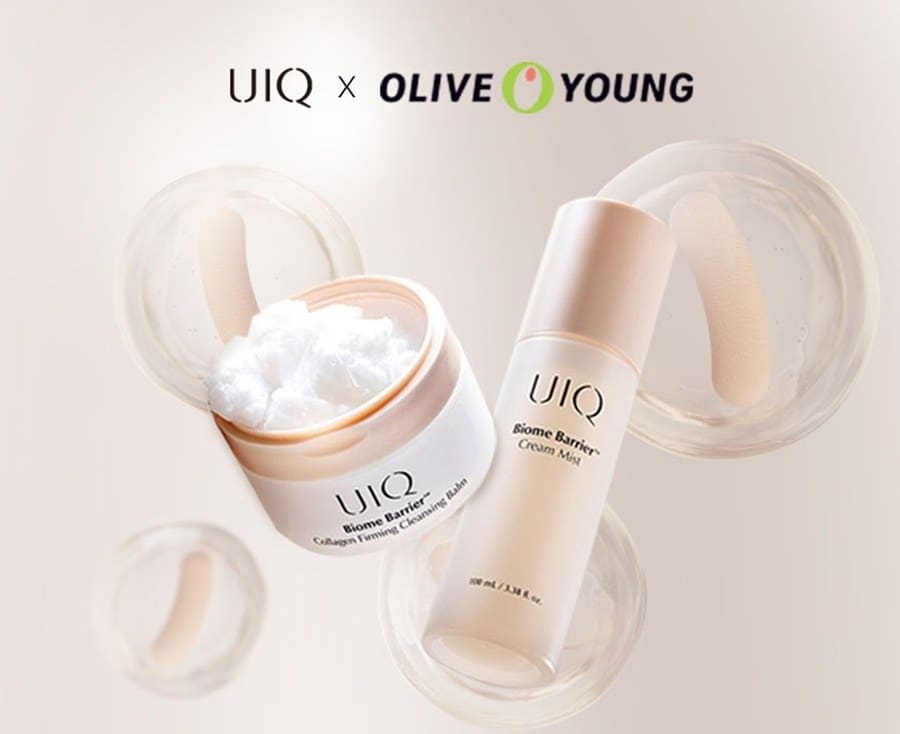
UIQ is Genome's own skincare brand, launched in 2021 and held inside its consumer segment. Bloom Partners does not hold it. The company reports UIQ revenue of about 8.0 billion won (US$6 million) in 2024 and about 12.0 billion won (US$9 million) in 2025, up 50%. Trade outlets report Genome's whole consumer segment, cosmetics plus health functional foods, at about 12.0 billion won (US$9.1 million) for 2025 as well, so UIQ and the segment are nearly one number. The half-year report would show whether health foods are material.
UIQ is already on US shelves. It entered Olive Young's Pasadena, California store, announced on June 15, 2026, and opened an Amazon US brand store in 2025. The AllBloom deal therefore does not give UIQ its start in American offline retail. It adds a controlled route to retailers outside the Korean-owned channel. As of September 2025, UIQ also sold through its own brand mall, Olive Young online and offline, and Shinsegae Duty Free, with pop-ups in Tokyo at Mitsukoshi Ginza and Tsutaya Daikanyama. The company counted 61 products across four lines in April 2026.
How strong is the buyer's balance sheet?
Genome's operating loss was 55.1 billion won (US$42 million) in 2023, 24.2 billion won (US$18 million) in 2024 and 29.2 billion won (US$22 million) in 2025. Cash and equivalents fell from 65.6 billion won (US$50 million) to 15.6 billion won (US$12 million) during 2025.
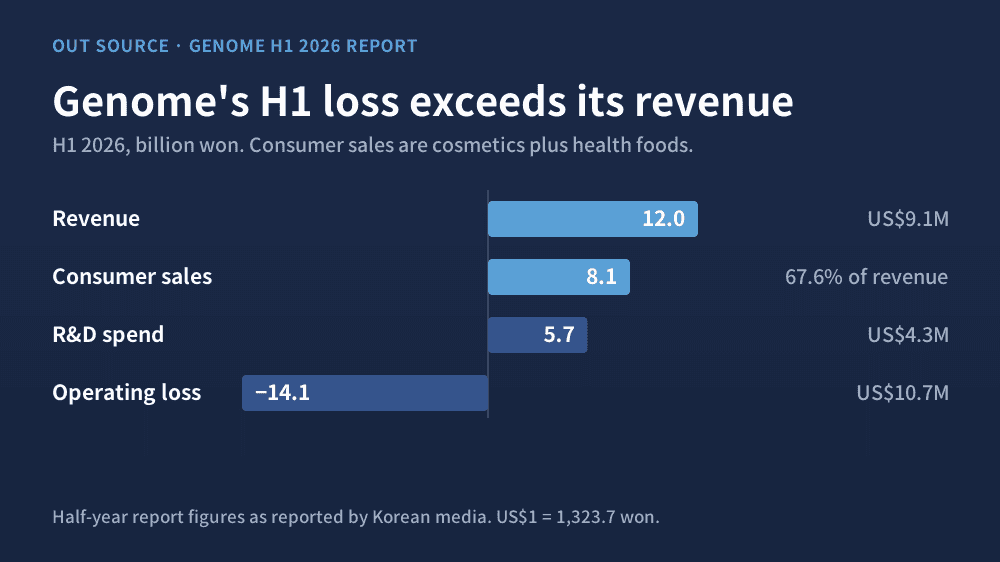
The first half of 2026 repeated the pattern. Consolidated revenue was 12.04 billion won (US$9.1 million). Consumer sales, cosmetics plus health functional foods, were 8.14 billion won (US$6.1 million), up 36.4% and 67.6% of revenue. R&D spending was 5.7 billion won (US$4.3 million) and the operating loss was 14.1 billion won (US$10.7 million). These figures come from the half-year report as read by Korean media.
The company raised money in 2026 through a 27.0 billion won (US$20 million) convertible bond, a 3.0 billion won (US$2 million) rights offering and a 7.0 billion won (US$5 million) third-party placement. Convertible and similar instruments cover 14,778,363 shares, 33.5% of the 44,169,621 shares in issue, per a trade outlet's reading. The price of the AllBloom stake is not disclosed, so how it was paid for is not known.
What happened to the biotech side?
The drug business has contracted. Genome withdrew its domestic Phase 2 trial of GEN-001, a microbiome cancer immunotherapy, in biliary tract cancer in March 2025. It halted construction of a US contract manufacturing plant in Fishers, Indiana in February 2025 and agreed with the city to terminate the project and return the land in March 2025. Drug-development revenue was 7.1 billion won (US$5 million) in 2024 and zero in 2025 and the first half of 2026.
The pipeline is now preclinical antibody-drug conjugates, drugs that attach a toxin to an antibody, led by GENA-120. The chief executive has set a goal of one out-licensing deal in each of 2026 and 2027 and has said an upfront payment of several hundred billion won (in the hundreds of millions of US dollars) is unrealistic at this stage. Consumer products now carry the revenue line.
How does AllBloom compare in size?
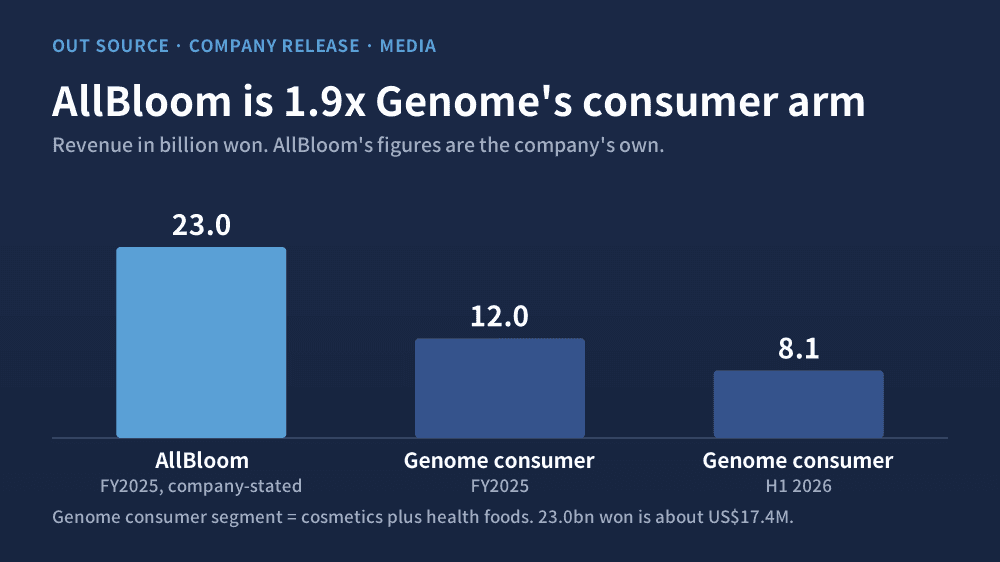
AllBloom's reported 2025 revenue of 23.0 billion won (US$17.4 million) is 1.9 times Genome's consumer segment for the year, which was about 12.0 billion won (US$9.1 million). The segment earned 8.1 billion won (US$6.1 million) in the first half of 2026.
The comparison is not like for like. A distributor books the sales of the products it moves, and a brand books its own. AllBloom's revenue also includes brands that are not UIQ. The gap still shows the scale: the target is larger than the consumer business it is meant to serve.
Does owning the distributor create a conflict of interest?
AllBloom distributes Korean beauty brands, plural, and no source names one. Genome now controls the distributor, and UIQ competes for the same buyers and shelf space as every brand AllBloom carries. A third-party brand must decide whether its US route runs through a competitor.
The company says it plans to keep the Target and MINISO relationships while adding new brands and channels. No source says outside brands will stay, and none says they will leave. The deal records no commitment on how shelf priority is set. The answer shows up in AllBloom's brand roster, which has not been published.
What does the deal mean for the industry?
A distribution layer owned by a brand owner is not new. A distributor owned by a loss-making drug developer is. Three groups read it differently.
Manufacturers and exporters see a route to the American shelf that now has an owner with a competing product. Brands and buyers see a distributor whose neutrality is unproven and whose financials are the company's own. Regulators and investors see a deal with no filing, no price and no closing date, made by a buyer whose cash fell by about three-quarters in 2025.
The announcement is a claim. The filing is the fact. Until one appears, the 64.46% is a press-release number.