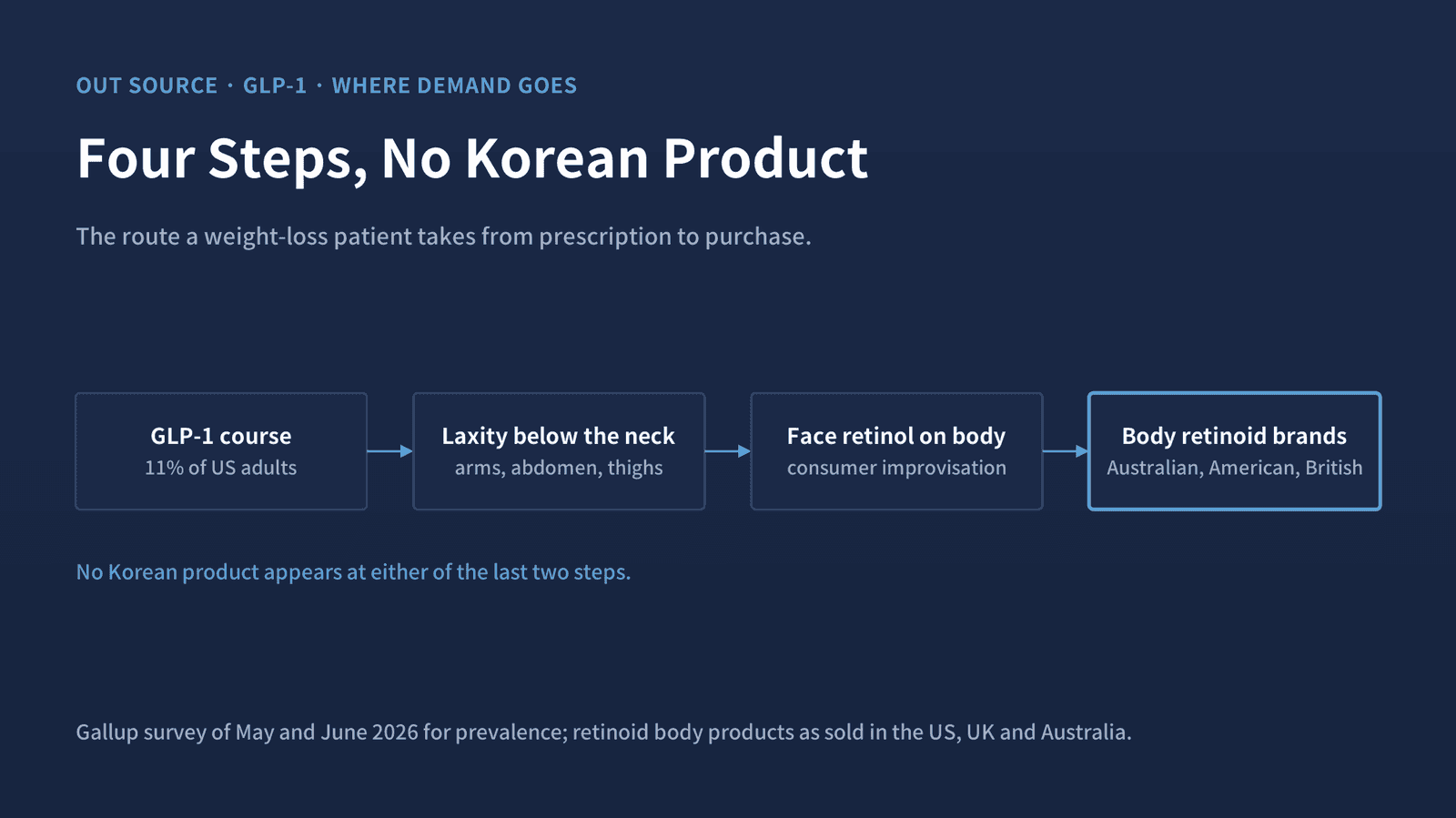
Gallup put 11 percent of American adults on a GLP-1 drug for weight loss in June 2026. Two years earlier the figure was 3 percent. The skin complaint that follows the weight is mostly below the neck — arms, abdomen, thighs — and Korea's visible answer to it is an injectable for the face that its maker expects to sell at the end of 2027. The Korean body aisle, in the meantime, is wash, barrier cream and a body oil.
How many people are we actually talking about?
Gallup surveyed 5,065 American adults between 28 May and 5 June 2026. Eleven percent said they were currently taking a GLP-1 medication for weight loss; 15 percent had taken one at some point. The same question returned 3 percent and 6 percent in 2024, and 8 percent and 12 percent in 2025. Margin of error is plus or minus 1.5 points.
One adult in nine, in a single market, on a drug class that barely existed as a consumer product five years ago.
Trend forecasters stopped treating this as a pharmaceutical story some time ago. In March 2026 a WGSN beauty strategist named the categories the drugs are feeding, and the list is short: body care and skin firming, where the brief is firming technologies, collagen-supporting actives and barrier repair; and haircare, where it is shedding, scalp health and density. Face care did not make the list.

What does losing weight that fast do below the neck?
Fat volume goes faster than the skin envelope contracts. What shows up is laxity, crepey texture and stretch marks, and it shows up where the fat was — upper arms, abdomen, thighs, sometimes the chest. The facial version earned a nickname early, because faces are what people photograph.
The body version got the surface area.
What has Korea actually built for this?
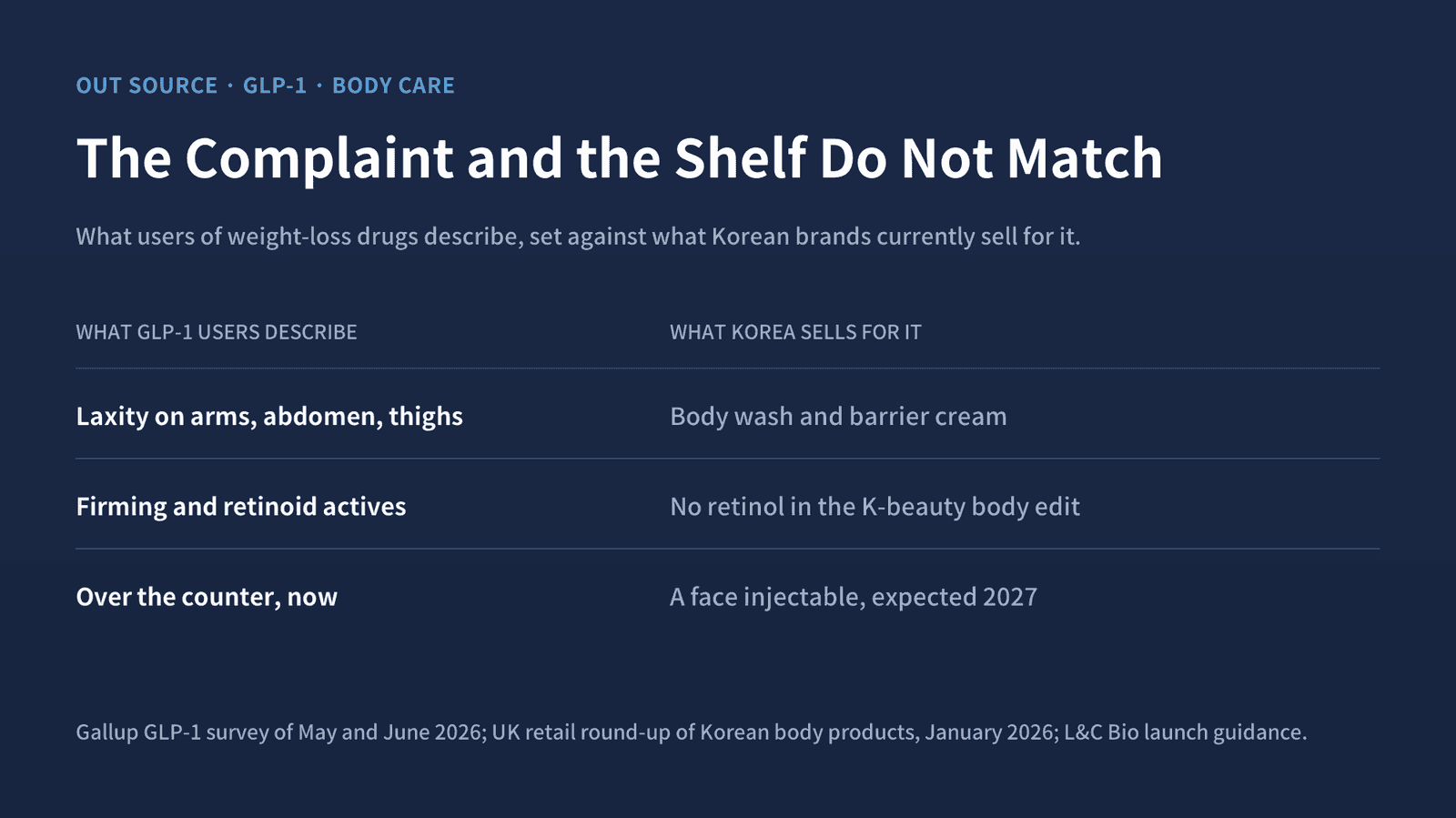
One serious thing, and it is worth describing properly rather than dismissing. L&C Bio is developing a product provisionally called MegaAdipoECM, built on the extracellular matrix of donated fat — a bioscaffold, meaning a structural lattice the body colonises rather than a filler the body absorbs. The scaffold gradually fills with the patient's own fat cells. The technology is patented in South Korea, the United States and China, and a 2026 change in Korean law reclassified donor fat from medical waste into usable material, which is what made the product possible at all.
The company has talked about a 1 trillion won revenue (~$744 million USD) target from its human tissue platform by 2030, and about exploring Singapore and United States manufacturing. Its own guidance puts launch at around the end of 2027, after a one-year grace period, in South Korea first.
So Korea's answer to GLP-1 skin is a clinic product, for the face, that nobody can buy for another year and a bit. That is a real answer to a real problem. It is just not the problem most of the eleven percent are describing, and it is not available on the timeline they are describing it on.
What is in the K-beauty body aisle right now?
A British retail round-up in January 2026 picked out the Korean body products worth buying. Eight made the cut: a barrier lotion, a hand and foot cream, a body wash built on PDRN, an acid body wash, an exfoliating cleanser aimed at body acne, a ceramide cream, a smoothing body oil and a repair lotion. Prices ran from £10.80 to £49.94. The piece framed Korean body care as a new category rather than an established one.
Not one retinoid. Not one firming claim. Two of the eight are things you rinse off.
None of which is a knock on the products. Barrier repair and gentle cleansing are what Korean formulation does better than anyone, and the ceramide and PDRN work behind those launches is genuine. It is simply a different job from the one a weight-loss patient is shopping for.
Who is already selling what GLP-1 users are improvising?
Consumers have been solving it themselves, which is the usual early signal: face retinol applied to arms. The products built for that job exist, and they are Australian, American and British. Alpha-H sells an encapsulated retinol body treatment. Paula's Choice sells a 0.1 percent retinol body treatment. DRMTLGY and RoC sit in the same aisle.
The drug class itself has already been claimed as a product name. Image Skincare sells VOL.U.LIFT GLP-1 4D Skin Rebound Complex at $134, with a 12-week study on people who lost weight on GLP-1 agonists, GIP drugs or after gastric bypass, claiming a 20.1 percent increase in facial volume and a 22.5 percent increase in firmness.
That one is for the face as well. Which leaves the board looking like this: Korea has a face injectable that is not for sale, the United States has a face serum that is, and the body shelf is generic Western retinoid with nobody's name on the drug class. The largest surface area has the thinnest offer.
What does the export data say about the shape of this?
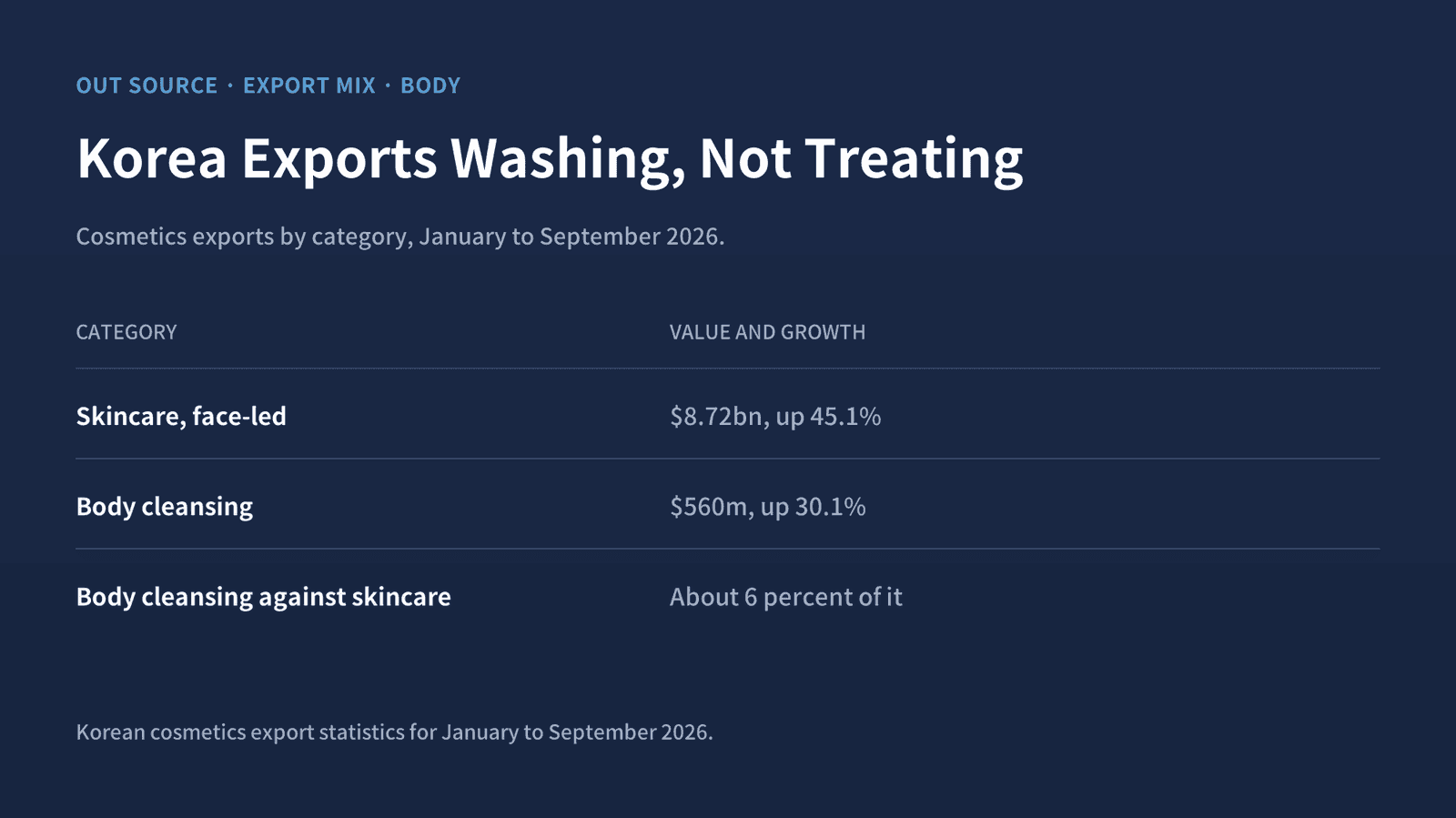
Korean cosmetics exports for January to September 2026: skincare, which is overwhelmingly face, came to $8.72 billion and grew 45.1 percent. Body cleansing came to $560 million and grew 30.1 percent.
Thirty percent growth is a perfectly good number. The base is the thing to look at — body cleansing runs at roughly 6 percent of skincare, a ratio of about one to sixteen. That is where a decade of formulation spend, claims work and shelf negotiation has gone, and it has not gone to the body.
Is hair the same gap a second time?
A meta-analysis published in Skin Appendage Disorders on 30 June 2026 pooled 17 studies covering 1,091,743 patient-exposures. It found a 40 percent increase in non-scarring alopecia with GLP-1 receptor agonists, odds ratio 1.40 with a confidence interval of 1.33 to 1.48. Telogen effluvium came in at an adjusted odds ratio of 1.76, androgenetic alopecia at 1.64. Pharmacovigilance signals were strongest for semaglutide at 2.46 and tirzepatide at 1.73. The authors attribute the effect primarily to micronutrient deficiency driven by the weight loss itself rather than to the drugs directly.
Korean scalp care has been one of the genuinely strong builds of the past three years — exosomes, peptides, the whole scalp-as-skin argument. It is positioned nowhere near this.
Shedding driven by a nutritional deficit is not the same condition as pattern thinning, and a scalp serum is not a treatment for it. But adjacency is what positioning is made of, and the adjacency here is close enough that somebody will claim it.
Why did Korea go to the clinic instead of the shelf?
Because that is where Korea wins. The aesthetics clinic — injectables, energy devices, the whole procedural stack — is the part of Korean beauty with the deepest technical lead and the best economics per patient. A bioscaffold built from donated tissue is a hard thing to make and a harder thing to get approved, and Korea has the regulatory muscle memory for exactly that kind of file.
A body firming treatment is the opposite kind of problem. It is a mass SKU in a 400ml bottle with a claim that has to survive a regulator, sold in a category Korean brands barely occupy overseas, against incumbents who have been there for years.
So Korea did not miss this. It went where it already had an advantage. The cost of that choice is that the volume sits in the other direction.

Where does this leave the three parties?
For manufacturers and ODM suppliers, active body treatments represent a fundamentally different product brief than standard body washes or barrier lotions. Formulating a high-performance firming treatment requires significantly higher active loading, specialized delivery vehicles to penetrate thicker skin, new stability testing, and rigorous clinical trials to substantiate firming claims under regulatory scrutiny. Because Western brands are actively placing these complex formulation briefs, suppliers are prioritizing Western orders first, leaving Korean ODMs focused on traditional client demands.
For brands and retail buyers, the barrier to entry is strategic rather than technical. Korean beauty manufacturers already possess the technical capability to produce high-potency, encapsulated retinoid body treatments in standard 400ml packaging. The delay is driven purely by positioning: brands are hesitant to pivot from the established, highly profitable facial care aisle into a competitive, active-led body treatment segment.
For investors, current market valuations around the GLP-1 trend remain heavily concentrated in clinical solutions—such as aesthetic clinics, energy-based skin tightening devices, and bio-injectables. However, the mass-market consumer demand for daily, over-the-counter firming and scalp-density products remains completely unpriced, simply because no major brand has built the pipeline to capture it yet.
While "Ozempic Face" captured early public attention, the body accounts for the vast majority of affected skin surface area. Until Korean brands choose to claim that space, Western competitors will continue to capture the market's commercial volume.