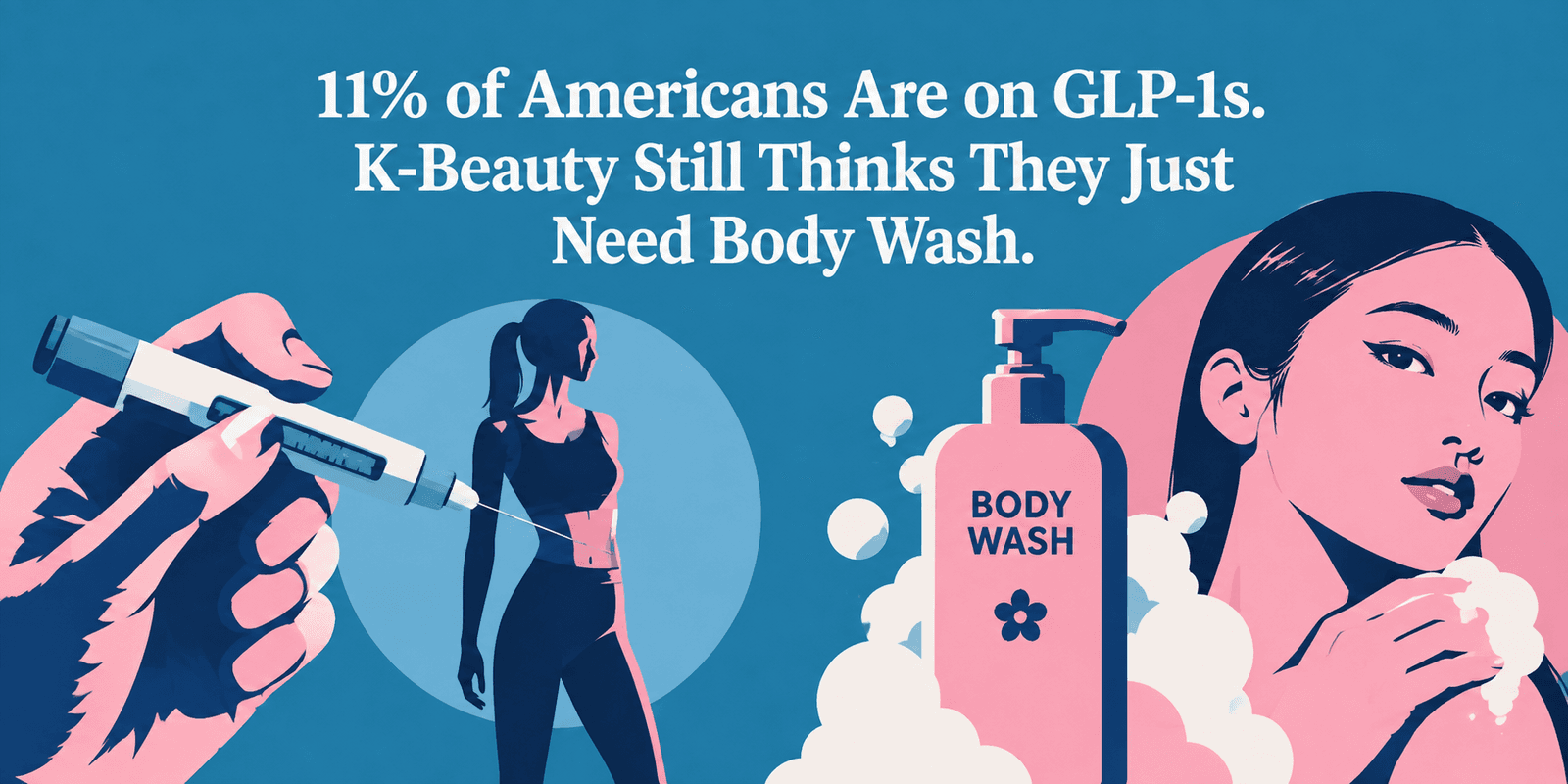
Great Britain's GLP-1 household use rose from 2.3% in 2024 to 6.3% in 2026, and hair loss product sales there grew 32% in the year to the end of August. A BMJ study found the risk of recorded hair loss up to 1.68 times higher for GLP-1 users than for patients on other diabetes drugs. Korea's shampoo exports rose 46.6% in the third quarter of 2026. No figure connects the two, because Korean customs data cannot tell a hair loss product from a cleansing shampoo.
What do the GLP-1 demand numbers actually show?
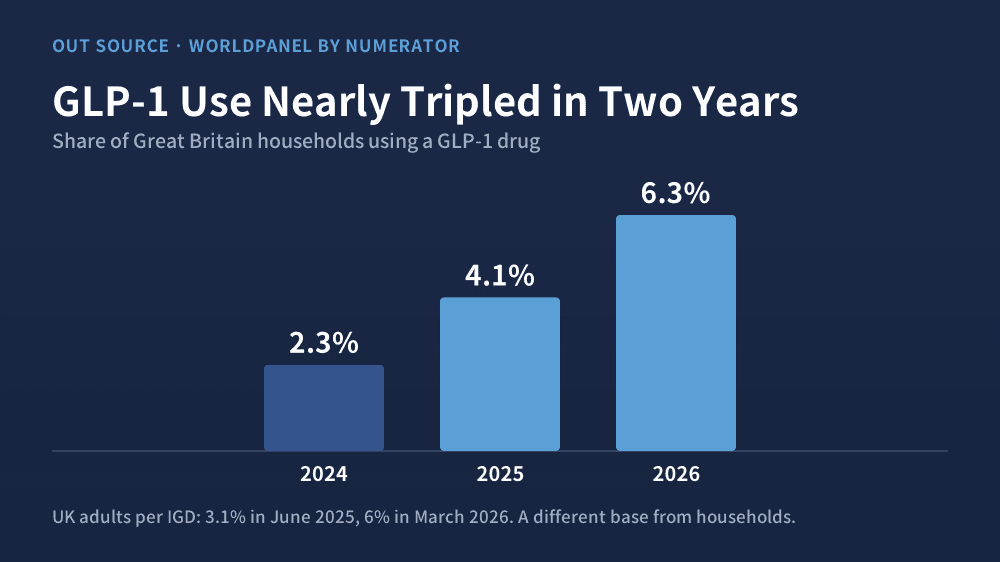
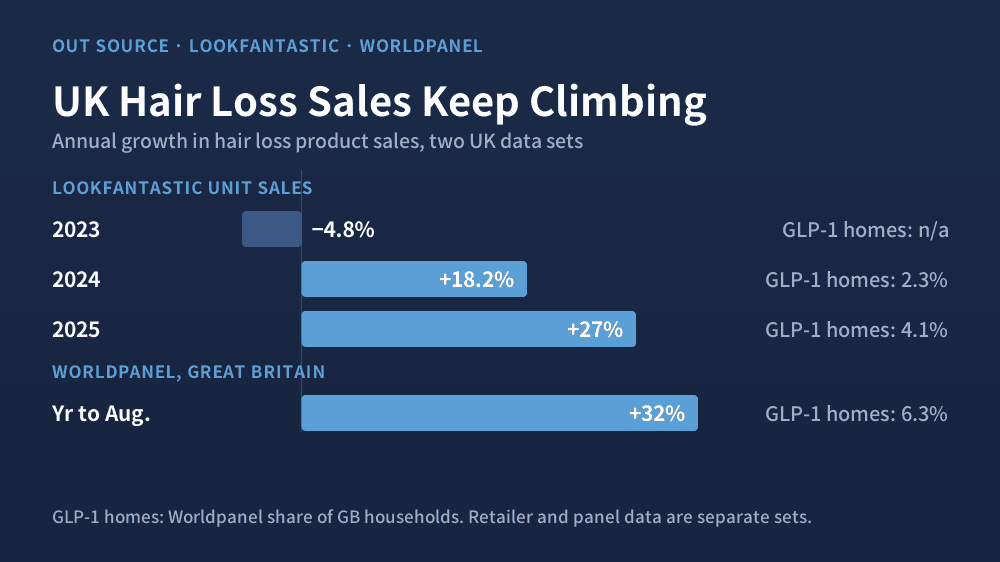
Worldpanel by Numerator, a consumer panel, puts GLP-1 use in 2.3% of Great Britain's households in 2024, 4.1% in 2025 and 6.3% in 2026, according to an October 26, 2026 Cosmetics Business report. The same report says hair loss product sales grew 32% in the year to the end of August and links that acceleration to rising GLP-1 use. The data shows the two moving together. It does not measure whether one caused the other.
A second UK source points the same direction. LOOKFANTASTIC, the online retailer owned by THG Beauty Retail, reports that hair loss product unit sales fell 4.8% in 2023, rose 18.2% in 2024 and rose 27% in 2025, in a Retail Times report dated July 31, 2026. That report states the data does not show GLP-1 use caused the increase. The Institute of Grocery Distribution puts GLP-1 use among UK adults at 3.1% in June 2025 and 6% in March 2026.
In the United States, Ulta Beauty CEO Kecia Steelman said in an April 2026 interview that hair loss with GLP-1 drugs is real and that GLP-1 users are buying hair and skin care products to address it. She gave no sales figures. Every figure in this section comes from the United Kingdom or the United States. None is Korean.
What does the BMJ study measure, and what does it not?
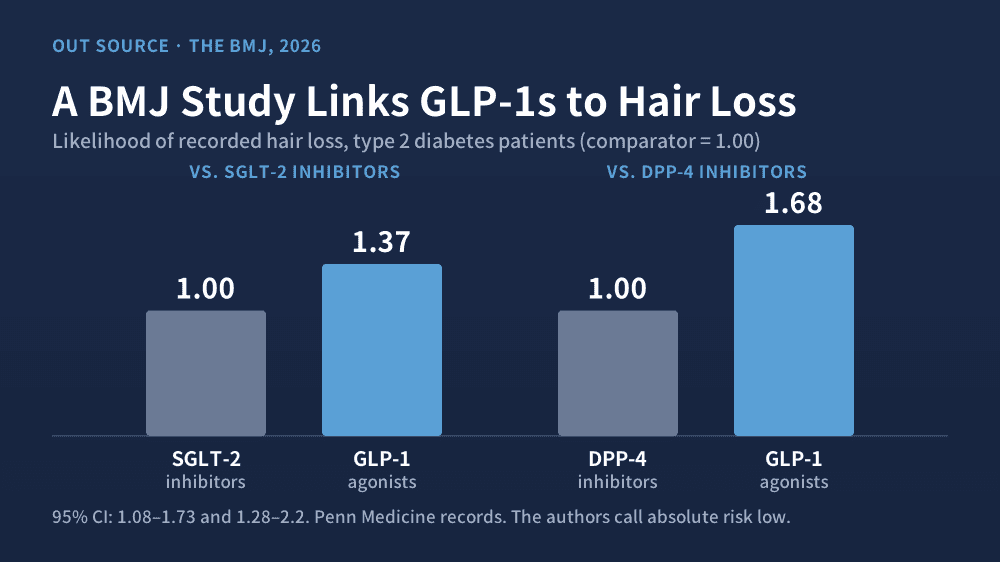
Tang and colleagues published the study in the BMJ in 2026. They used Penn Medicine electronic health records and an emulated target trial, an observational design that imitates the structure of a randomized trial. Adults with type 2 diabetes who newly started a GLP-1 drug (12,004 patients) were compared with new users of an SGLT-2 inhibitor (15,221), and a second GLP-1 group (11,964) with new users of a DPP-4 inhibitor (11,238). SGLT-2 and DPP-4 inhibitors are other classes of diabetes drug.
GLP-1 users had 1.37 times the risk of recorded hair loss of SGLT-2 users (95% confidence interval 1.08 to 1.73) and 1.68 times the risk of DPP-4 users (1.28 to 2.2). The authors describe the absolute risk as low, say most cases were reversible with follicles intact, and name rapid weight loss and reduced calorie intake as established triggers of shedding.
Three limits apply. The patients have diabetes, which is not the same population as people taking the drugs for weight loss alone. The GLP-1 groups were mostly women averaging about 58 years old, while the comparison groups were mostly men averaging 64 to 67. And the outcome is clinically recorded hair loss, not product purchases.
Why would a shedding problem change what hair care sells?
Rapid weight loss is a recognized trigger of hair shedding, in the authors' own words. A shedding problem is a density and scalp problem, and the products sold against it are treatments, serums and scalp care. Cleansers are not that product.
Daol Investment & Securities analyst Park Jong-hyun made a version of this argument at Kosdaq Connect 2026 on July 2, 2026. He called hair care the most underpriced category tied to the GLP-1 trend and said Korean hair products remain concentrated in cleansing rather than treatment. He added that L'Oréal's Redken and the supplement maker Nutrafol already sell hair products directly to GLP-1 users in the United States.
Those are an analyst's claims, not measurements. They set the test for the Korean data: if the GLP-1 thesis holds for Korea, growth has to show up in treatment products, not only in cleansing.
What does Korea's own export data say?
Shampoo exports under harmonized system code 330510, the customs code for shampoos, reached US$70.1 million in the third quarter of 2026, up 46.6% from US$47.8 million, in Korea Customs Service data compiled by Beauty Economy on October 27, 2026. The United States ranked first among September destinations at US$5.74 million, 23% of the month's total. Wider hair care exports were US$232.6 million from January through May 2026, up 30.6%, in customs data reported on June 19, 2026.
None of this separates treatment from cleansing. The code tags a product as a shampoo whether it cleanses or is sold for hair loss. The reports reviewed give no export figure for hair loss or scalp care products, and none ties a destination's GLP-1 use to Korean shipments.
The United States is both the largest September market and a large GLP-1 market. The Daol analyst cited a KFF survey in which 12.4% of American men have taken a GLP-1 drug. Two facts sit side by side. Neither the customs data nor the survey connects them.
Is Korean hair care already moving from cleansing to treatment?
The June 19 report describes a market shifting from shampoo and conditioner centered on cleansing toward functional scalp and hair loss products. It gives no export breakdown by country or product line.
Dr.Forhair, a Korean scalp care brand, has entered Sephora in the United States with Folligen Thickening Shampoo as its lead product, according to an August 26, 2026 report. The brand's director says Sephora has increased its investment in scalp care. That is a company statement. Its first US store launch, per its own release, was 50 Costco branches in October 2023, and the Sephora entry came almost three years later.
Both items describe direction. Neither measures how much of Korea's hair care export value is treatment.
Which numbers would settle the claim?
Three numbers would settle it. First, Korean export value for hair loss and scalp care products, separated from cleansing shampoo. Second, brand-level sales in the markets where GLP-1 use is highest. Third, a purchase-level survey tying hair care buying to GLP-1 use. None of the sources reviewed supplies any of the three for Korea.
The British panels and the BMJ study measure demand abroad. The customs lines measure Korean supply. The claim sits in the gap between them.
What does this change for each side of the industry?
For manufacturers, orders currently follow cleansing volume, because that is what the export line shows. A shift toward treatment changes formulation and testing work, and no export line shows that shift yet.
For brands and buyers, the shelf is moving. Ulta's CEO says GLP-1 users are buying, and Dr.Forhair's director says Sephora has raised its scalp care investment. The Korean share of that shelf is unmeasured.
For regulators and investors, the evidence base is British panels and one US health system's records. Korean claims about GLP-1 demand need Korean numbers, and the customs code cannot supply them.
Demand is measured. Korean exposure is not.