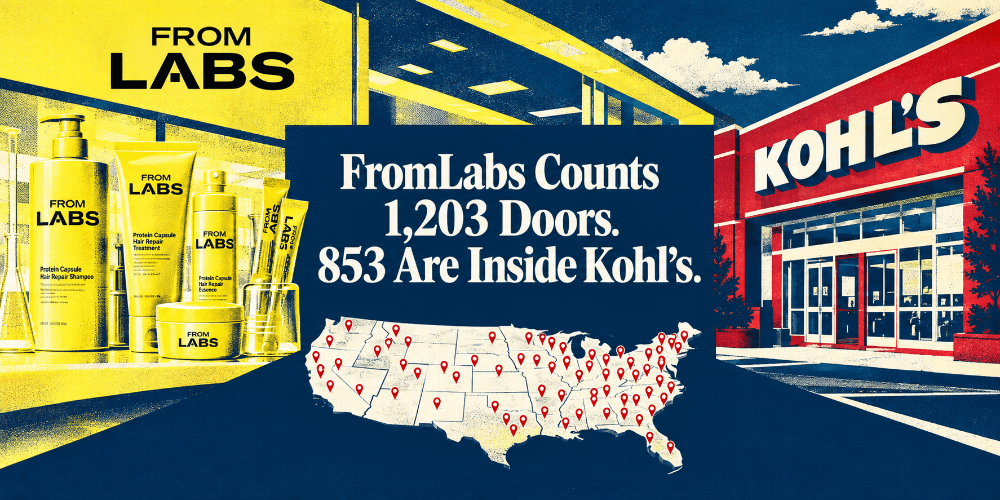
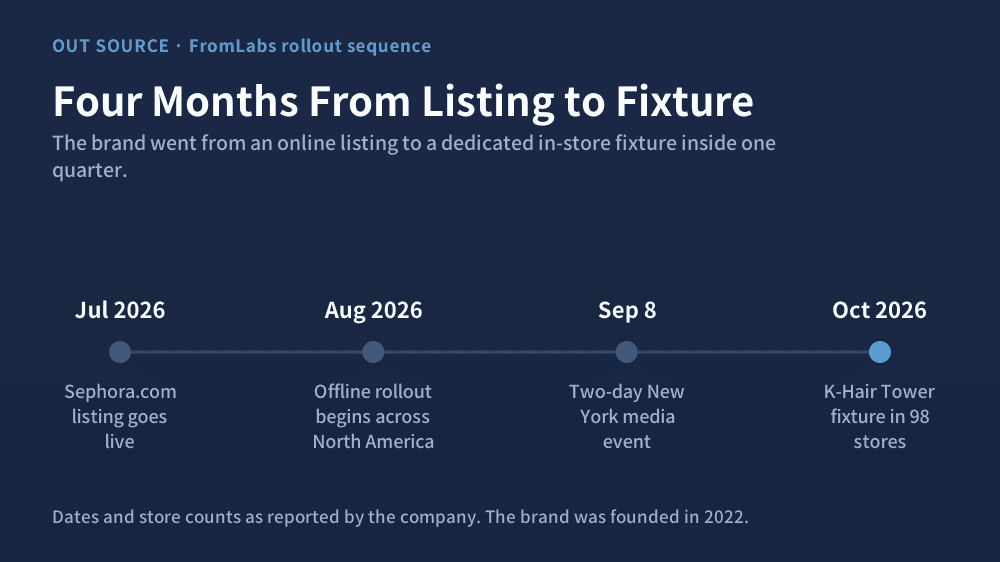
FromLabs lists about 1,200 North American doors for a brand that went live on Sephora.com in July 2026. The company's own breakdown is 853 Kohl's stores, 205 Sephora stores in the United States and 145 in Canada. Seven in ten of those doors sit inside a mid-tier department store rather than a prestige specialty retailer. Across the same year its parent, The Founders, watched operating margin fall from 34.0 percent to 18.0 percent and borrowed 80 billion won after three years carrying no debt.
What does a count of 1,203 doors actually contain?
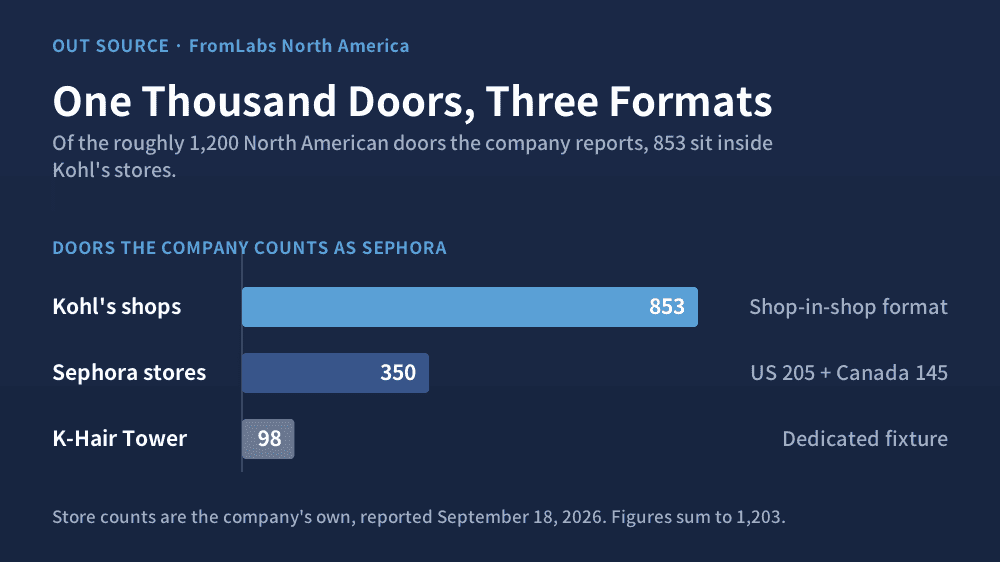
FromLabs is a hair care brand The Founders started in 2022, alongside the skincare brand Anua and a pet lifestyle line. It appeared on Sephora.com in mid-July 2026 and began entering physical stores in August. The company puts the North American footprint at 205 Sephora stores in the United States, 853 Kohl's stores and 145 Sephora stores in Canada. Those three figures sum to 1,203, and the company rounds them to about 1,200 Sephora doors.
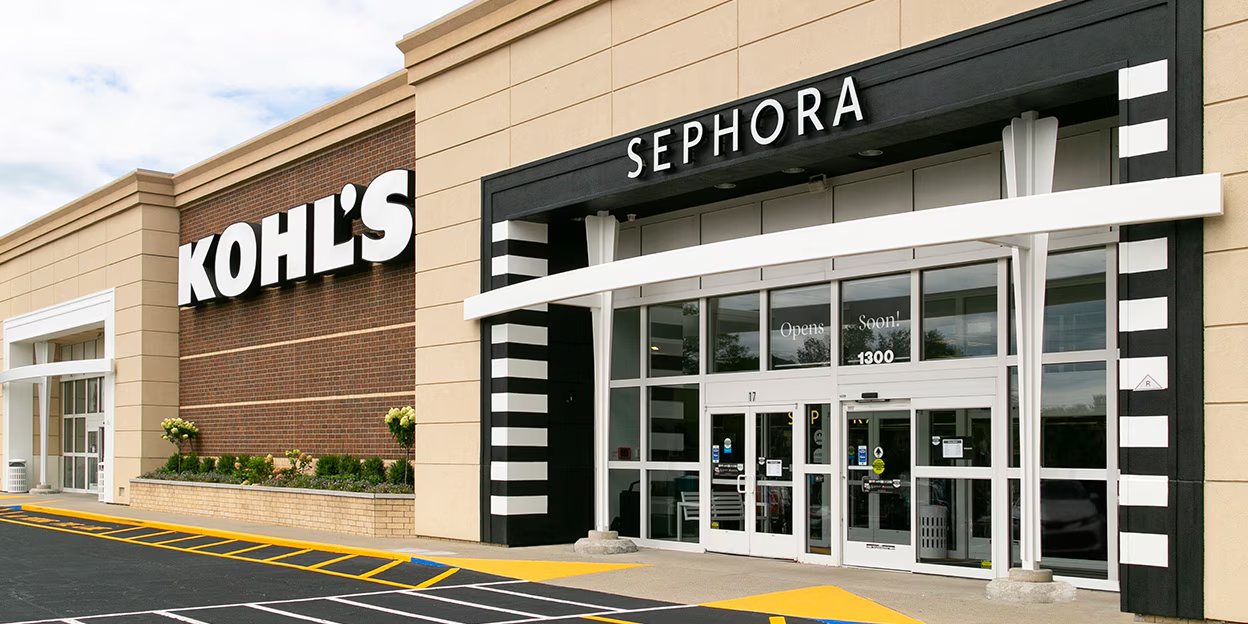
Seven in ten of those doors are Kohl's locations. Kohl's is an American department store chain, and the Sephora presence inside it runs under a partnership the two companies announced in December 2020. A Sephora at Kohl's shop is a licensed shop-in-shop, not a Sephora store. Adding the three categories together produces one large number that describes three different selling environments.
How does a Sephora at Kohl's shop differ from a Sephora store?
By floor area, by assortment, and by the shopper who walks past it. Kohl's and Sephora said in August 2022 that Sephora would expand to all of Kohl's 1,100-plus locations, with about 600 shops open at that point and 850 full-size shops of roughly 2,500 square feet planned. Kohl's said in March 2024 that it was adding about 140 small-format shops of about 750 square feet across 40 states, taking the fleet past 1,000.
A 750 square foot shop inside a department store carries a fraction of a freestanding Sephora's range, and it is reached by a customer who came in for something else. Sephora describes its own business as more than 2,700 stores in 35 countries and more than 500 stores across the Americas. Set against that, 205 United States Sephora stores is a partial listing of Sephora's own fleet, and neither company has published what share it represents.
None of this makes the Kohl's doors small. Kohl's reported that Sephora at Kohl's passed US$1.4 billion in sales in 2023 and projected US$2 billion by 2025, and it said the 2021 and 2022 shop cohorts delivered high-single-digit and mid-single-digit percentage sales lifts against the rest of the chain. The issue is precision. A brand that reports 1,203 doors as Sephora distribution is reporting a prestige placement and a department store placement under one word.
What is actually sitting on those shelves?

Three products and two sets. Sephora lists the Protein Capsule Keratin Hair Repair Mask at US$11 to US$25, the Protein Capsule Hair Mask Booster Powder at US$20, and the Protein Capsule Hair Repair Leave-In Conditioner at US$11 to US$20, with a mini set at US$22 and a mask and booster value set at US$39. Sephora's own brand page describes FROMLABS as a Korean hair care brand built on protein capsule technology, clinically tested and sulfate-free.
Kohl's carries the same three items under the Sephora partnership, each flagged as new. On that page the only other Korean hair care brand is UNOVE. The assortment that reached 1,203 doors is three products, and the company says 98 stores carried a dedicated fixture called the K-Hair Tower through October 2026.
What did the expansion year cost the parent?
The Founders reported 2025 revenue of 717.6 billion won (US$541.0 million), up 67.8 percent, with operating profit of 129.4 billion won (US$97.5 million), down 11.1 percent, and net profit of 86.6 billion won, down 25.7 percent. Operating margin went from 34.0 percent to 18.0 percent. Won amounts here are converted at 1,326.50 won per US dollar, the rate on October 21, 2026.
One caution on the comparison. The 2025 revenue figure is consolidated, and the prior-year figure of 427.7 billion won is on a separate basis, because the United States entity entered the consolidated accounts for the first time in 2025. The growth rate and the margin decline are therefore measured across a change in reporting perimeter, not only a change in trading. The company's own April 30, 2026 announcement gave 717.7 billion won and 129.5 billion won, rounding differences against the accounts.
The cost lines, on a separate basis, moved further than revenue. Selling and administrative expenses went from 162.0 billion won to 379.9 billion won. Advertising reached 116.6 billion won (US$87.9 million), 2.6 times the prior year and 16.3 percent of revenue. Salaries reached 86.5 billion won, 5.8 times the prior year, against more than 200 domestic hires during the year. Sales commissions were 41.1 billion won, up 52.8 percent, and export costs were 85.0 billion won, up 76.2 percent.
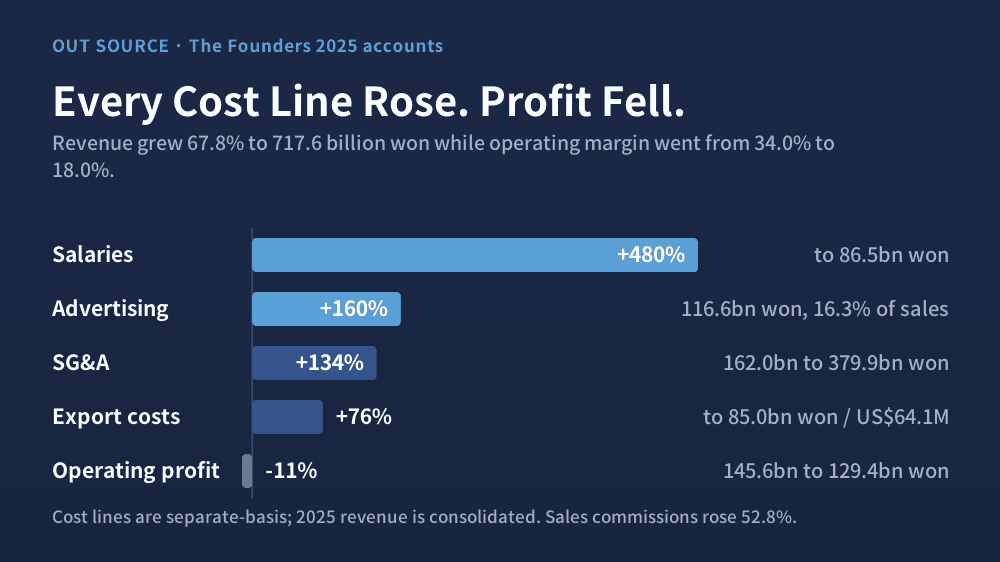
Advertising at 16.3 percent of revenue and a salary line approaching six times its prior level are not the signature of a company harvesting an established brand. They are the signature of a company buying position in two new markets at once. The margin fell because the spending arrived ahead of the revenue it was meant to create.
Why did a company with no debt borrow 80 billion won?
The Founders took 80 billion won (US$60.3 million) in short-term borrowing from the Korea Development Bank during 2025. It had borrowed 4.8 billion won in 2022, repaid it in 2023, and carried no debt after that. The company characterizes the borrowing as preemptive investment, and it has taken no outside equity: the two co-chief executives hold the whole company.
Short-term debt at a business whose cost base is compounding faster than its revenue is a different instrument from short-term debt at a business funding working capital against a stable margin. It is also the cheapest way for a founder-owned company to fund expansion without selling equity. Both readings are available from the same disclosure, and neither is settled by it.
How much of the growth is actually North America?
Anua, Inc., the United States entity, entered the consolidated accounts in 2025 with revenue of 42.2 billion won (US$31.8 million), close to 6 percent of the group total. Supply from headquarters to that entity was 39.3 billion won, 9.4 times the prior year. The Japanese entity's revenue was not disclosed, with related other expenses of 2.9 billion won. Two further entities were created during the year, one in Russia with 300 million won of paid-in capital and one in Hong Kong with about 9 million won.
FromLabs's own North American revenue has not been published in any form. The brand's contribution sits inside a group that does not break out brands, and the entity that would carry most of it recorded most of its revenue as goods supplied from Korea. A door count exists because a door count is the only number available.
Which figures here belong to the company?
Most of the North American ones. The store counts, the 98-store fixture count, and the Amazon figures are all the company's own statements. Those Amazon figures are that the flagship treatment reached the top ten of the United States Deep Hair Conditioners category and that average daily sales in September ran 12 times the prior year's level. Neither carries a category denominator, a ranking date, or a base, and 12 times a small September is a smaller fact than 12 times a large one.
What is checkable without the company: the products and prices on Sephora's and Kohl's own listings, the Kohl's and Sephora statements about the shop-in-shop program, and the parent's filed accounts. A two-day media event ran in New York on September 8, 2026 with the stylist Matt Benns.
What does a door count settle, and what does it leave open?
It settles placement. It says a buyer at a major retailer agreed to carry three products, which is a real threshold and a slow one to reach. It leaves open everything that happens after placement: rate of sale per door, repeat purchase, returns, markdown, and whether the listing survives the next assortment review.
The category conditions are favorable on one side of the price line and tighter on the other. United States prestige hair care grew 11 percent in dollars and 8 percent in units in the first half of 2026, with hair serums up nearly 60 percent, according to Circana. Mass hair care grew 7 percent in dollars over the same period while units dipped, which means price carried that growth rather than volume. A line priced from US$11 to US$39 sits at the entry edge of prestige and the top edge of mass, and it is being sold through doors that span both.
What does the rest of the industry take from this?
Three readings sit on the same disclosures.
Manufacturers and ODMs. A thousand doors reached in one quarter is a replenishment commitment before it is a revenue event. Three SKUs across 1,203 locations with two retailer-exclusive sets means initial fill, fixture stock and reorder cycles land in the same window. Capacity planning follows the door count whether or not the sell-through justifies it.
Brands and buyers. Door counts that merge a specialty retailer with a department store shop-in-shop are now common enough to be read as standard, not as overstatement. The question to put to any such number is which retailer operates the space, how large it is, and how many of the brand's SKUs it holds. Those three answers describe a placement; the headline figure does not.
Investors and lenders. A margin that halves while revenue grows two-thirds is legible only with the reporting basis attached. Here the comparison crosses from separate to consolidated, the heaviest cost increases are advertising and payroll rather than cost of goods, and the company funded the year with short-term bank debt instead of equity. Each of those is a different risk, and the growth rate conceals all three.
A door is permission to be bought. It is not a purchase. The accounts record what the permission cost, and nothing yet records what it returned.