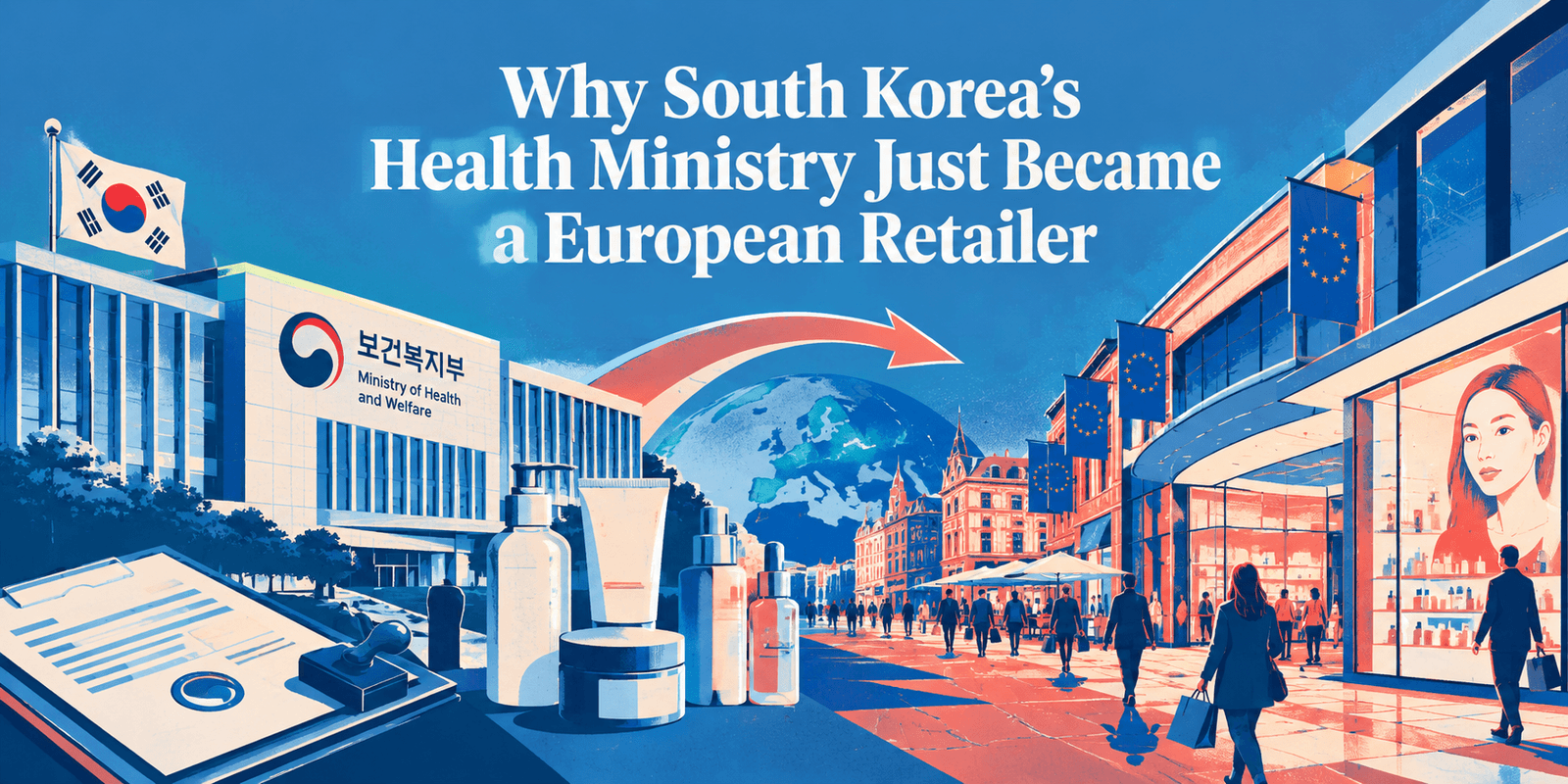
Korea's National Food Cluster in Iksan is built for food and beverage plants. Finished drugs and cosmetics cannot be made inside it, and only some drug categories enter after review. At a November 24, 2026 meeting, the agriculture ministry said it will allow health functional food companies to make drugs and cosmetics inside the complex through deliberation. For a functional-ingredient company that wants to make cosmetics, the constraint is not technology. It is the zoning on its factory lot.
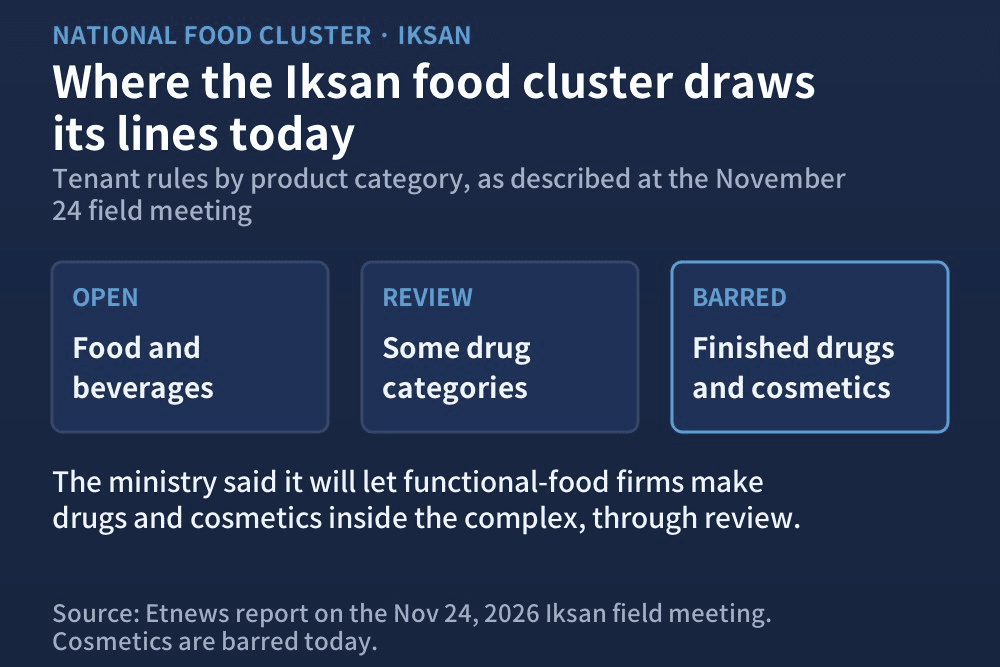
▲ Finished drugs and cosmetics cannot be made in the Iksan food cluster today. Some drug categories enter after review.
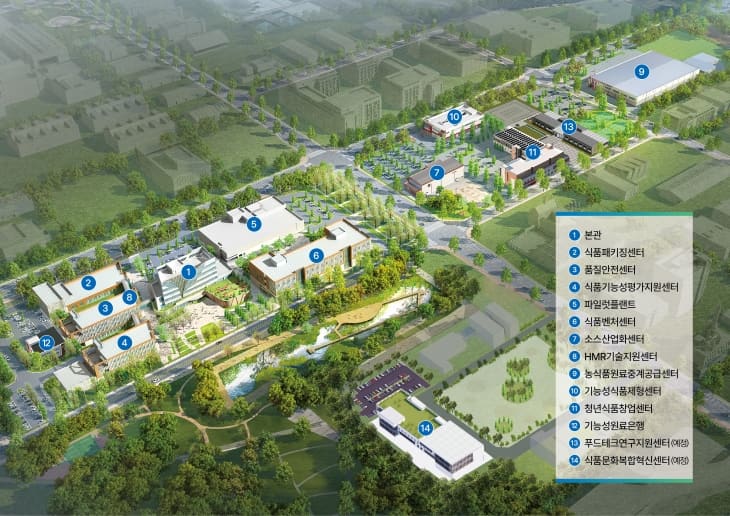
▲ Aerial layout of the National Food Cluster in Iksan. Image: Korea Food Industry Cluster Promotion Agency
What is the National Food Cluster, and what can it make?
The National Food Cluster is a government-built industrial complex in Iksan, North Jeolla Province, designed to gather food companies in one place. It is run by the Korea Food Industry Cluster Promotion Agency, and its main designated tenants make food and beverages.
The land is divided by industry. There is a strategic food zone, a zone for foreign-invested food companies, a logistics zone, a general food zone for bakery, confectionery, noodles, beverages, liquor, meat, dairy and seafood, a zone for packaging and machinery suppliers, an R&D district, and support facilities such as pilot plants and rental factories.
The investor guide sizes the general food zone, the largest, at 500,000 square meters. The foreign-invested zone covers 450,000 and the strategic food zone 350,000. Every zone is defined by what its tenants make, which is why a change in what a tenant makes becomes a question about land.
Pharmaceuticals follow a narrower rule. Only some drug categories can enter, and only after the management agency reviews them. Finished drugs and cosmetics cannot enter at all.
What did the ministry say on November 24?
The setting was a field meeting at the Promotion Agency in Iksan, with 20 attendees and ombudsman Choi Seung-jae present. The ministry said it will allow health functional food companies to use their functional ingredients to make drugs and cosmetics inside the complex, through deliberation.
Widening the list of tenant industries requires changes to two documents: the industrial complex implementation plan and the management master plan. The ombudsman said he will consult the relevant agencies on those changes and check the follow-up.
The answer takes the form of a review gate rather than a new product list. Drugs already pass through that kind of gate. The ministry is extending the existing mechanism to cosmetics.
A review gate decides case by case. It lets the management agency judge each company's plan, and it keeps the zone's food identity intact while a company with a functional ingredient makes the next product from it. A fixed list of permitted products decides nothing about the company in front of it.
Why does a health functional food company want to make cosmetics?
Health functional food is Korea's regulated category of dietary products carrying approved functional claims. Companies in this category start from an ingredient: a strain, an extract, a fermentation process. The ingredient is the technology. The finished product is a choice about end use.
Enterobiome, which entered the cluster in 2022, builds on health functional food ingredient technology and wants to move into drugs. Vice President Jang Jin-hyeong said it is hard to build drug production facilities in the cluster under current standards. Mycogenics asked for the permitted industries to be widened so it can make health functional foods and cosmetics together.
Both requests describe the same pattern. The tenant arrives as a food ingredient company and grows into a company whose next product sits in another regulatory category.
Cosmetics is the nearer of the two destinations. A drug needs clinical evidence and a long road to approval. A cosmetic built on a functional ingredient reaches a shelf sooner, so a tenant that wants revenue while its drug program matures has a reason to ask for both.
Why is land the first bottleneck?
A factory lot in the cluster is assigned to a category of industry. A company whose next product falls in a different category has no lot to build on, and no way to expand in place.
Choi said that if companies that grew up in the cluster must leave just as they scale into drugs and cosmetics, both the company and the region lose. The cluster trains firms to the point where its own rules push them out.
For a manufacturer, land is the slowest input to change. A formulation changes in months. A lot designation changes through administrative documents, and until those documents change, the plan for the next product waits.
The cost compounds on the other side of the fence. A cluster that loses its fastest-growing tenants keeps the ones that stay in their original category, and its average company gets smaller relative to the ambition that attracted it.
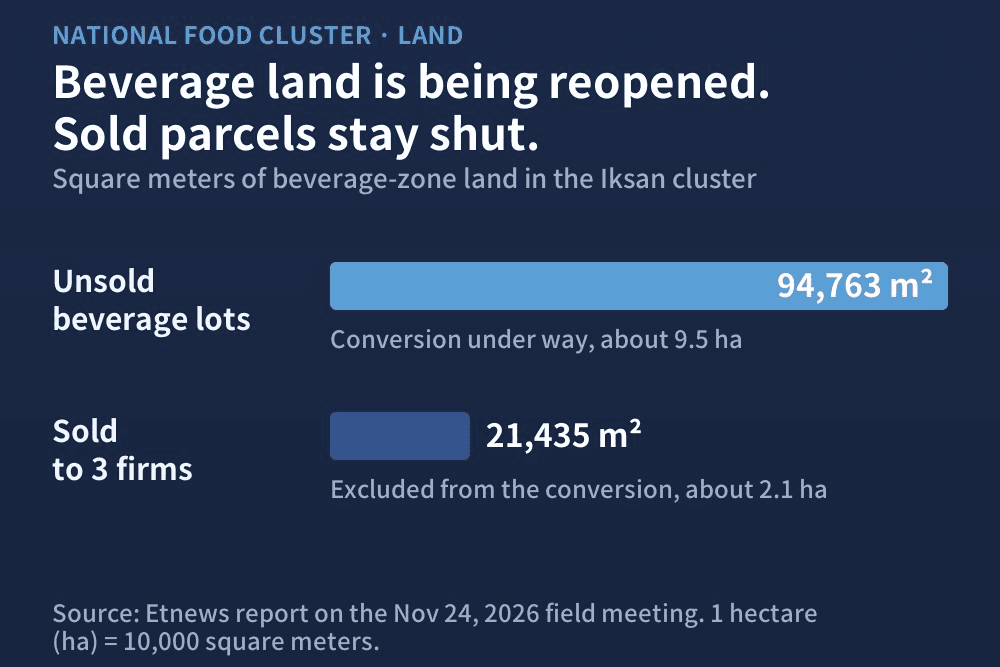
▲ The cluster is converting 94,763 square meters of unsold beverage land. The 21,435 square meters already sold stays out.
What is the beverage-lot problem, and why does it matter here?
The cluster has beverage-zone land that sells poorly. 94,763 square meters of unsold beverage lots, about 9.5 hectares, are in the process of conversion to food-and-beverage use. Lots already sold to three companies, 21,435 square meters, are outside the conversion.
The result is stranded capacity. Existing tenants on those lots find it hard to use their production facilities for anything but beverages. When one of them sells its factory, the buyer pool is limited to beverage makers.
The ministry plans to amend the implementation plan and the management master plan in the fourth quarter of 2026 to address the beverage lots. Those are the same two documents the ombudsman named for widening tenant industries. The beverage fix shows the mechanism: category zoning changes only when two planning documents are rewritten.
What would the cluster offer a cosmetics maker that a standalone plot does not?
The cluster already carries infrastructure built for ingredient-led companies. Its support facilities include centers for food functionality, safety and packaging, pilot plants for trial production, and rental factories. A company that needs to prove a new formulation before committing to a full plant finds those under one roof.
The export services are broader still. The cluster arranges logistics management, quarantine and customs handling, sample shipping, patent and certification support and brand development. It also supports buyer credit checks, translation and buyer invitations. A cosmetics maker that sells abroad needs the same list.
The land is the missing piece. The services exist, the neighbors are ingredient suppliers and packaging firms, and the one thing a cosmetics tenant cannot receive is a lot designated for its product.
What else did the tenants ask for?
Attendees asked for an operating procedure for shared factories for health functional food, so that a small company can rent production capacity instead of building its own. They also asked that startups using shared kitchens be allowed to file for on-the-spot manufacturing and processing business licenses.
These requests point the same way as the cosmetics request. Tenants want the cluster to behave like a platform that rents capacity, not like an estate that allocates plots by product label.
A shared factory is the opposite of a category lot. It lets a company test a new product without a permanent claim on land, and it moves the regulatory question from the site to the product.
What does this case say about how Korea sorts manufacturing land?
Korea regulates food, drugs and cosmetics in separate categories, and its industrial land follows the same boundaries. Companies that start from a functional ingredient do not respect those boundaries. Their technology moves across categories while their lots stay inside one.
The Iksan cluster is where that mismatch is written onto a map. The ministry has stated the direction: entry by review. The documents that carry the direction still have to be rewritten.
Contract manufacturers, brands and regulators read the case differently. Manufacturers see a new source of ingredient-driven demand. Brands see more places to make a product. Regulators see a boundary that needs a procedure, not a prohibition.