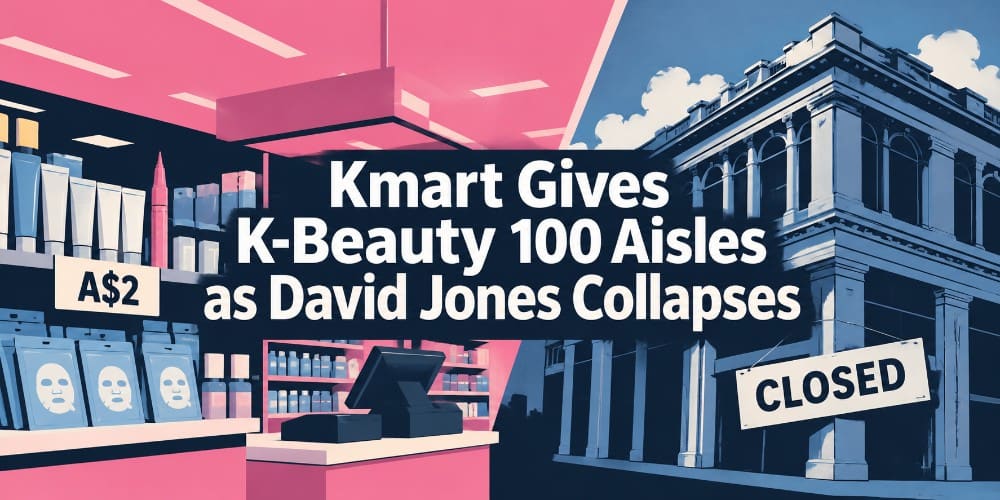
Kmart is opening enclosed beauty counters in about 100 Australian stores before Christmas: its own checkout, more than 2,700 products, over 60% of the range exclusive to Kmart and Target. Medicube and Biodance share the floor with OXX, the house label, whose Korean-made sheet masks start at A$2. The same month, 188-year-old David Jones entered administration. The stories are unrelated, and together they place Korean skincare's Australian growth in the discount aisle, not the department store.
What exactly is Kmart building?
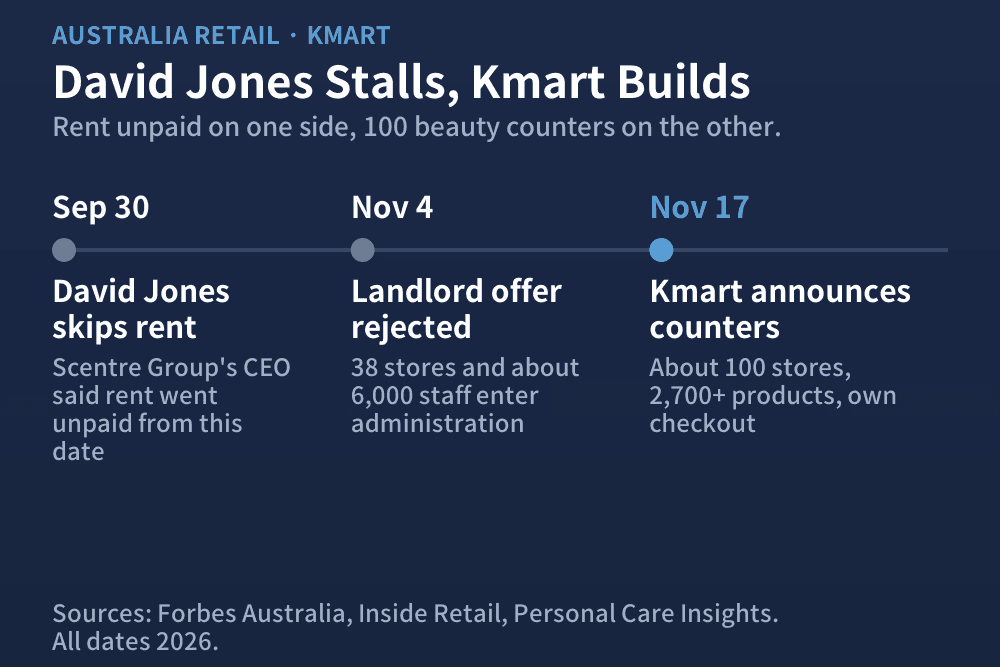
Kmart, the Australian discount department store chain, is rolling out a store-in-store beauty format at about 100 locations before Christmas, according to a November 17, 2026 report. A store-in-store is a defined zone inside a larger shop with its own staffing and its own checkout. Kmart's version is enclosed, staffed by trained beauty team members during peak periods, and finishes at a dedicated register.
The range behind it numbers more than 2,700 products from well over 100 brands. Callum Smith, chief commercial officer of the Kmart Group, said the format exists to make beauty easier to shop at low prices. It sits inside a wider store redesign: 20 stores began trading under the Plan C layout in fiscal 2026, and its modular floor lets the chain change categories faster as shopper demand shifts.
For a discount chain, giving one category its own room, its own staff and its own till is a commitment of floor space, and floor space is the scarcest asset a store has. Beauty has been promoted from a shelf to a counter. That is a statement about where the chain expects shopper traffic to come from.
Which Korean brands are on the shelf?
Reporting on the rollout names Medicube, Biodance, SKIN1004 and Beauty of Joseon among the Korean skincare brands, with Arencia and The Face Shop joining the range. Colorgram, another Korean brand, and Glow Hub, from the United Kingdom, are new to Australia and sold nationwide through Kmart and Target stores.
The same counters carry e.l.f., Essence and Tree Hut. A Korean brand at Kmart does not sit in a separate K-beauty aisle with a flag on it. It sits in a beauty range organized by category and price, next to American and British names that shoppers already know.
That placement treats Korea as a style of product, not a destination. It also changes what a Korean brand competes against. In a department store, the neighbor is another prestige skincare line. At Kmart, the neighbor is a lip stain at A$8, and the shopper compares the two in seconds.
What does an exclusive range cost a brand?
Nicola Farrell, Kmart's beauty business manager, put the exclusive share of the range above 60%. Those products are available in Australia only through Kmart and Target. Exclusive range means a product, a pack size or a whole line that one retailer holds the right to sell in a market, so no competitor can stock it.
The trade is plain. The retailer gets items its competitors cannot match, and the brand gets volume from a chain placing about 100 counters at once. What the brand gives up is the option to put the same item in other Australian stores. The decision is made once, for the whole market, and it is made at the moment the range is set.
An exclusive share above 60% turns a brand's Australian presence into a retailer's range decision. Brands that want the counter supply a version of the line that Kmart owns the right to place. Brands that want breadth compete for the remaining share of the shelf.
Where does the price ladder start?
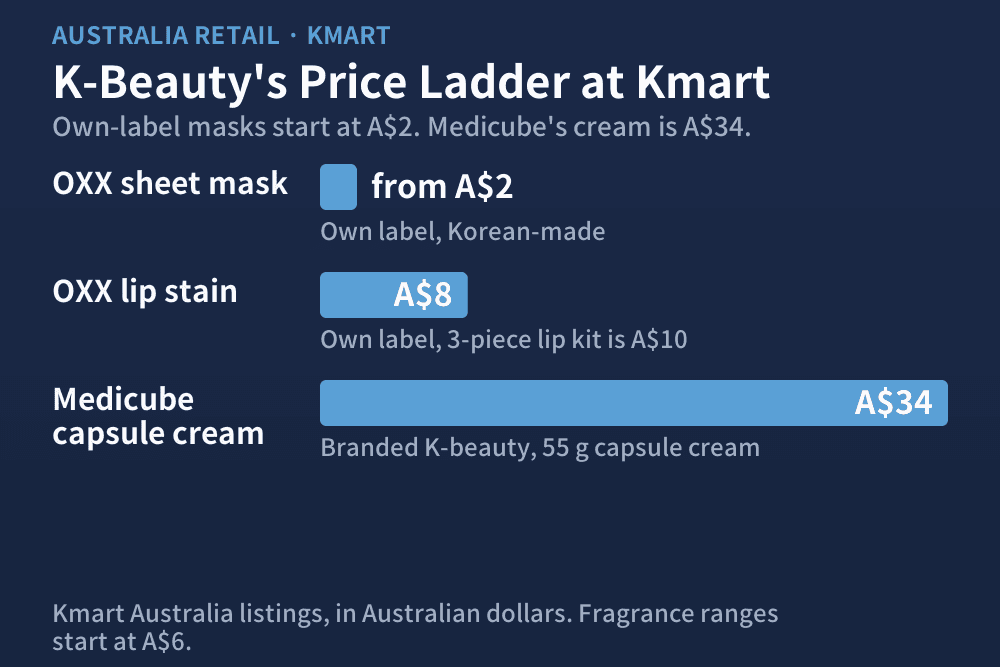
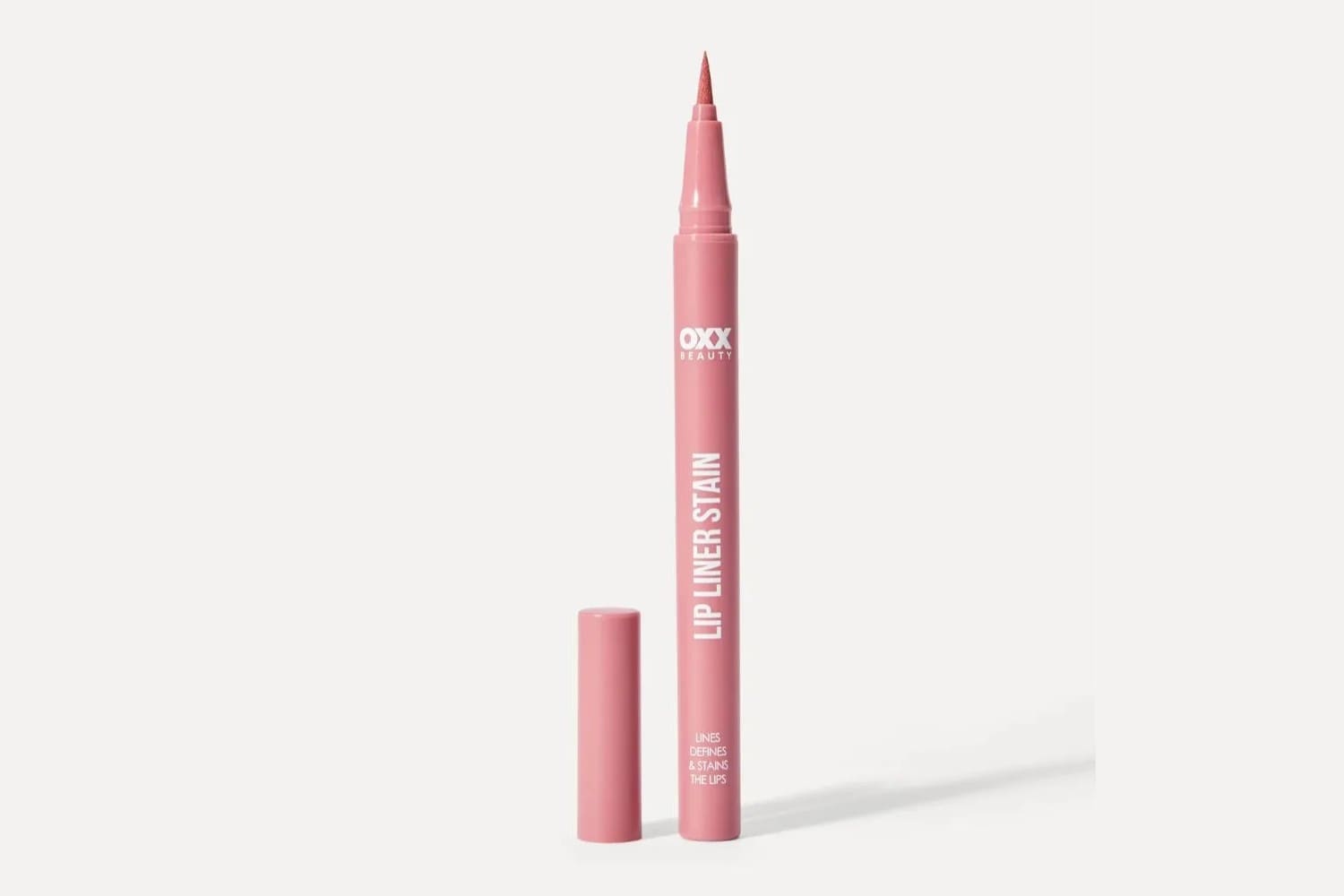
Kmart lists its OXX Cosmetics sheet masks, made in Korea, from A$2. Its lip stains are A$8 and a three-piece lip kit is A$10. Fragrance ranges start at A$6. All prices here are Australian dollars. At the other end of the same counter, Medicube's PDRN Pink Collagen Capsule Cream, a 55 g jar with 5% niacinamide and PDRN (polydeoxyribonucleotide), is A$34.
A$34 is 17 times A$2. A single counter now spans a wide price range. The cheapest item draws the shopper to the counter, and the most expensive item has to justify itself against it.
A branded Korean product at Kmart is judged on value per dollar against a house label made in the same country. The shopper who picks up an A$2 sheet mask has already set the reference price for every other sheet mask on the shelf.
Why does a Korean-made house brand matter?
OXX is Kmart's private label: products made to Kmart's specification and sold under Kmart's name. Its new additions include sheet masks made in Korea. Manufacturing origin is the one supply-chain fact Kmart puts on the page, and it is enough to place a Korean factory at the center of the counter.
Korea now supplies the Kmart counter in two forms. One is a brand that Kmart buys. The other is a factory that Kmart commissions, usually an ODM, short for original design manufacturer, a company that develops and produces formulas for other companies' labels. Only the first form carries a Korean logo.
For branded Korean players, the house label is both ally and rival. It teaches the Australian shopper that a Korean sheet mask costs A$2. For manufacturers, it is a channel that needs no brand at all, only a specification and a price. The same country wins either way, and the exporter that builds a name is not always the one that books the order.
What happened to David Jones?
David Jones, Australia's oldest department store at 188 years, entered voluntary administration, a process in which outside administrators take control of a company to find a buyer or a restructuring. On November 4, 2026, its board rejected a counteroffer from Scentre Group, the landlord of 17 of its 38 stores. Scentre's chief executive, Elliott Rusanow, said David Jones had not paid rent since September 30.
David Jones had proposed closing nine stores in Scentre centers and exchanging A$45 million in bank guarantees held by the landlord for equity. Scentre rejected that proposal. Christopher Hill of FTI Consulting, one of the professionals appointed over the business, cited rising costs, an outdated retail footprint and supply chain challenges.
About 6,000 staff are affected. Stores and the online shop continue to trade while administrators seek offers to recapitalize the business or sell it as a going concern. David Jones's chief executive, Erica Berthold, said the brand has a well-developed plan to reset the business. The dispute that ended the old structure was about rent and store count, not about beauty.
Are the two events connected?
The two stories run on separate clocks. Kmart's counters belong to a store-redesign program that began trading in fiscal 2026. David Jones's failure traces to rent, footprint and cost. One company is adding floor space for a category while the other is negotiating over floor space it can no longer pay for.
What they share is a question every Australian beauty shopper now answers: where to stand when buying skincare. A department store asks the shopper to come to a footprint that the professionals now running it call outdated. Kmart asks the shopper to walk into a box where beauty has its own counter, its own staff and a price that starts at A$2.
Jana Bowden of Macquarie University called the David Jones collapse a death knell for the department store format. That is one academic's reading of one retailer, and it describes a format under pressure, not a category in decline. The category's growth in Australia is happening at a different kind of counter.
What does the Australian counter tell the rest of the industry?
Korea's cosmetics exports reached US$11.43 billion in 2025, up 12.3%, according to the Ministry of Food and Drug Safety. The United States took US$2.2 billion, China US$2 billion and Japan US$1.1 billion. Australia sits outside that top tier, yet it is where a mass retailer is building a counter around Korean skincare.
The top markets are won by brands. Secondary markets are won by retailers. In Australia, one retailer sets the range, the exclusive share, the price ladder and its own Korean-made label. A brand that arrives there arrives on the retailer's terms, and the factory behind the house label arrives without needing a brand at all.
The department store is in administration. The discount counter has opened with its own till. Korean skincare in Australia now answers to the retailer that owns the till, and to the factory behind its house label.