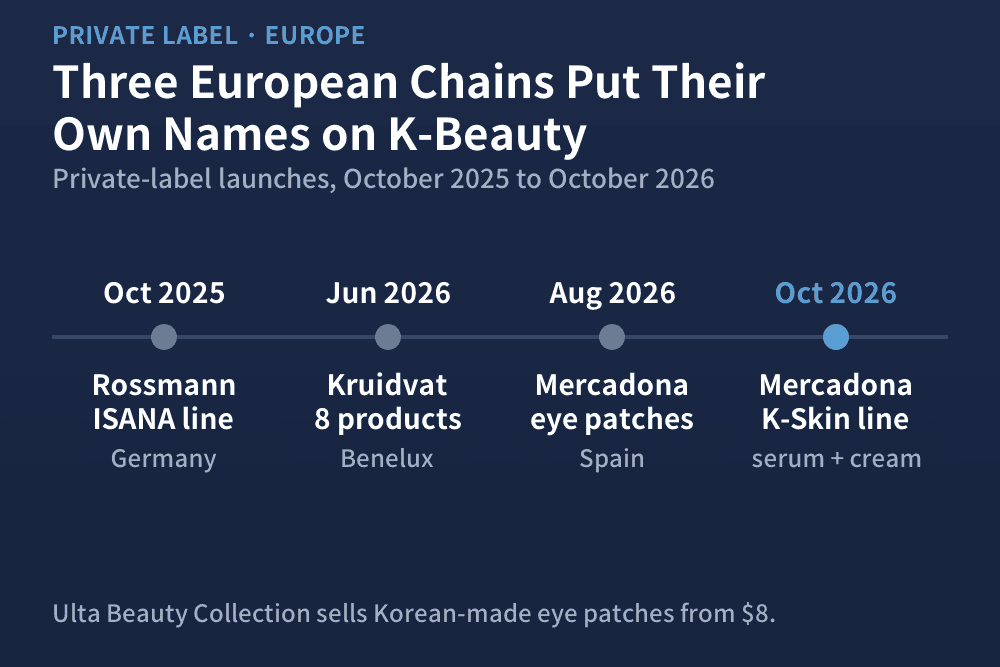
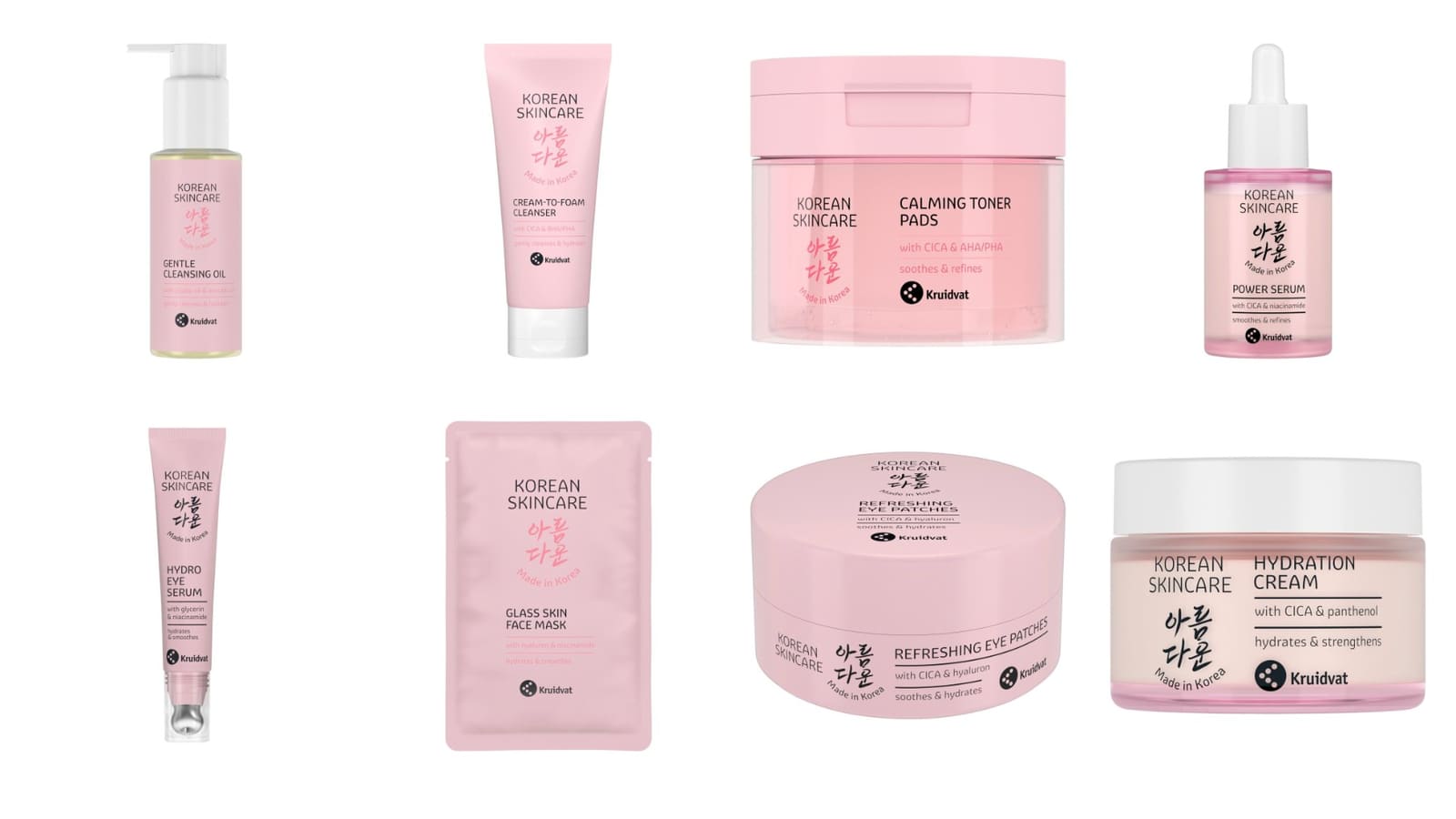
In June 2026 Kruidvat put eight products on its shelves under a label called Kruidvat Korean Skincare. Rossmann did the same in October 2025 with ISANA, and Mercadona followed in Spain with eye patches at €1.75 and a K-Skin line in October 2026. None of the three names belongs to a Korean brand. Korean contract manufacturers grew export revenue 1.7x to 2.5x between 2022 and 2025. Korean skincare is reaching Europe less as a brand than as a process, and the owner of the label is the retailer.
Which European retailers now sell K-beauty under their own names?
Rossmann, the German drugstore chain, launched the ISANA Korean Skincare line in October 2025. The line follows a four-step routine from cleansing to care, with centella asiatica (cica) as the lead ingredient, and a glass-skin sheet mask sells for €2.49. ISANA is Rossmann’s own label, developed and made in Korea, so the Korean element sits in the product and the formula, not in the owner’s name.
Kruidvat followed in June 2026. The Dutch and Belgian drugstore chain released eight Korean-made products, from serums to face masks, as Kruidvat Korean Skincare, in stores and online from June 23. Kruidvat already sold Beauty of Joseon and SKIN1004, so its shelf now carries Korean brands and a Korean-made label of its own side by side.
Mercadona, the Spanish supermarket chain, moved in two steps under its Deliplus label. In August 2026 it released hydrogel eye patches with PDRN (polydeoxyribonucleotide, a DNA-fragment ingredient popular in Korean skincare) and collagen for €1.75 a pack. In October it added K-Skin, a line with a €7.00 lifting serum and a €6.50 gel cream with collagen capsules. A November 15, 2026 report added Ulta Beauty Collection in the United States, which sells Korean-made eye patches from $8.
What do Mercadona’s prices say about the target?
The K-Skin cream costs €6.50 for 50 ml, about €13 per 100 ml. Spanish coverage compared the gel-and-capsule jar with Medicube’s PDRN Pink Collagen Capsule Cream, a branded K-beauty product with the same two-texture format. The comparison describes the mechanism: a format that a Korean brand made popular becomes a store item.
A retailer sees which textures and ingredients its shoppers already buy from Korean brands, then commissions its own version at a fraction of the price. PDRN eye patches at €1.75 and a capsule cream at €6.50 are the output of that loop.
The prices also set the ceiling for what a formula earns at retail. At €1.75 and €7.00, the label contributes the shelf and the trust of a familiar chain. The Korean contribution is a texture and an ingredient list.
Why do retailers go to Korean factories instead of building the formula themselves?
Speed is the stated reason. Kim Myoung-joo, an analyst at Korea Investment & Securities, said Cosmax takes three to four months from development to production, compared with five to eight months at global competitors.
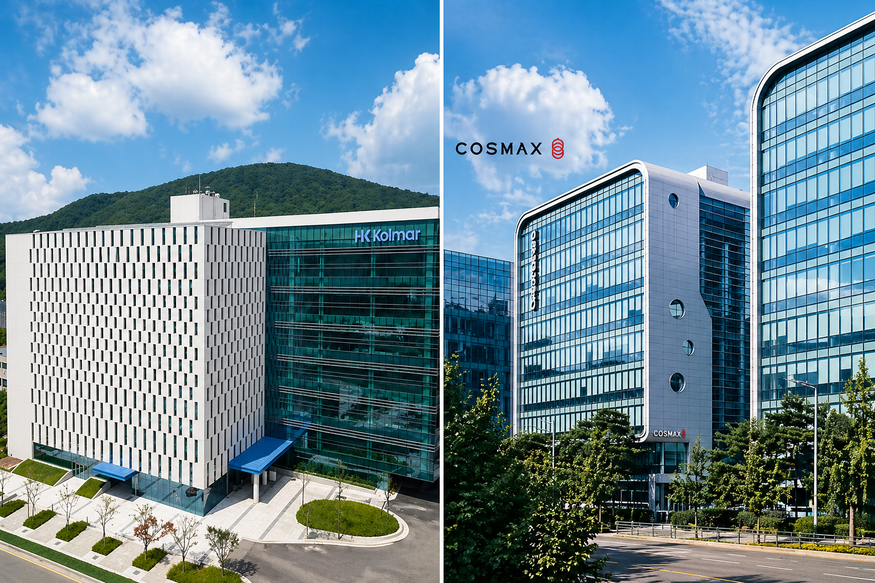
Cosmax, Kolmar Korea and Cosmecca Korea are ODM companies, meaning original design manufacturers: they develop the formula and make the finished product, and the customer’s name goes on the box. A retailer that wants a PDRN serum or an eye patch with a trend ingredient buys that development work and the factory in one order.
The retailer does not need a Korean brand to get there. It needs a formula library, a plant that turns a request into a finished product in months, and a launch calendar that matches the trend. Those three things are what the ODMs sell.
How much have Korea’s big ODMs grown on exports?
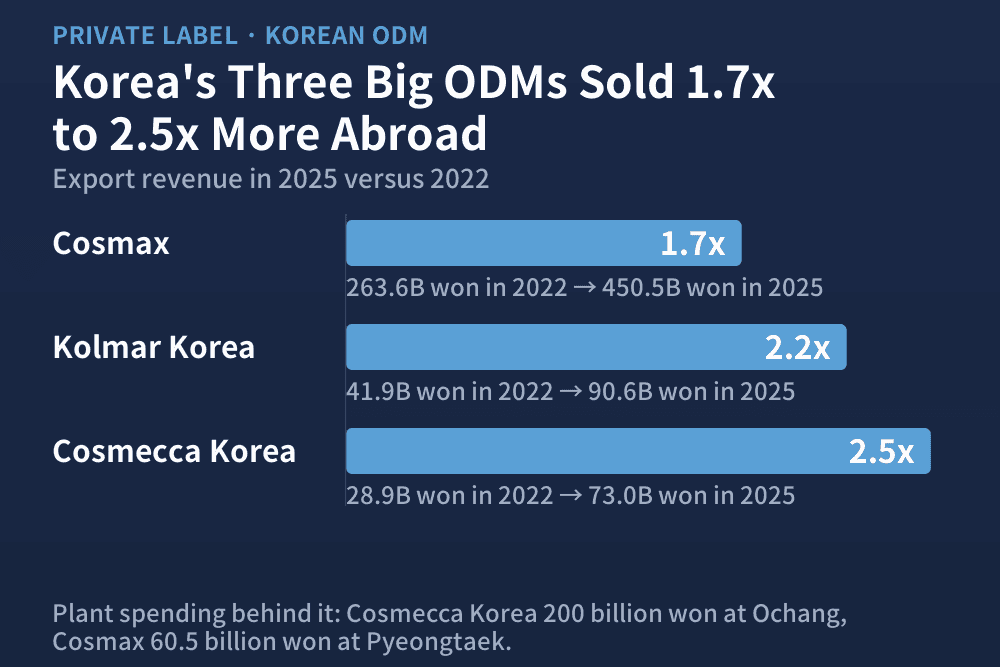
A November 15, 2026 report put Cosmax’s export revenue at 263.6 billion won (US$196 million) in 2022 and 450.5 billion won (US$336 million) in 2025. Kolmar Korea went from 41.9 billion won (US$31 million) to 90.6 billion won (US$68 million). Cosmecca Korea went from 28.9 billion won (US$22 million) to 73.0 billion won (US$54 million). All dollar figures in this article use 1,342.1 won per dollar, the November 5, 2026 close.
The multiples are 1.7x for Cosmax, 2.2x for Kolmar Korea and 2.5x for Cosmecca Korea. The ranking runs opposite to size: the company with the smallest export base in 2022 grew fastest.
Second-quarter 2026 results kept the pace. Cosmax reported revenue of 794.9 billion won (US$592 million), up 27.5% year on year, and Kolmar Korea’s operating profit rose 50.2% to 110.3 billion won (US$82 million), its first quarter above 100 billion won.
Why are the ODMs building plants right now?
Cosmecca Korea signed an investment agreement on September 9, 2026 to put 200 billion won (US$149 million) into a new skincare plant at the Ochang Science Industrial Complex in Cheongju. Construction starts in September 2026, first-phase operations are set for 2027, and equipment upgrades continue through 2030. The plant covers 58,862.83 square meters of floor area and adds about 500 jobs.
Cosmax is spending 60.5 billion won (US$45 million) to expand its Pyeongtaek plant, and Kolmar Korea’s Sejong plant starts operating in 2027. Three of Korea’s largest ODMs are adding floor space in the same stretch of time.
The ODM model sells the same development capacity to anyone with an order, whether the buyer is an indie brand or a drugstore chain. Every new plant raises the number of orders the ODM has to win, and a store label is one more order.
Where does a branded K-beauty product sit when the retailer sells its own?
An industry official quoted in a September 8, 2026 report said overseas retail chains want established K-beauty brands in their stores more than they want private labels, and that private-label launches are still few but rising. Kim Joo-deok, a professor in the beauty industry department at Seoul Cyber University, said European brands are launching K-beauty-concept products quickly because demand is proven, and that Korean brands must tighten quality and safety management to keep their edge.
Both statements hold at once. Kruidvat sells Beauty of Joseon and SKIN1004 and its own Korean line. The branded product builds the demand, and the store label sells into that demand at a lower price.
Rossmann’s €2.49 glass-skin sheet mask and Mercadona’s €1.75 eye patches mark where the price pressure starts. The same September 8 report set Biodance’s collagen mask at €5.99 against that.
What does a store label take from a brand, and what does it leave?
It takes the price tier, the ingredient trend and the format. PDRN, cica, capsule creams and eye patches are public information once a Korean brand makes them popular, and a formula library at an ODM turns each into a store item.
It leaves what a formula cannot copy: a founder’s story, consumer proof tied to a name, a product that outlives one trend cycle, and the relationship with a buyer who wants something the store label cannot supply. Brands that sell on texture or ingredient alone sit closest to the store label’s price. Brands that sell on a point of view sit farthest.
That is why one retailer can stock both. Branded K-beauty fills the top of the shelf, the store label fills the bottom, and the middle is where the squeeze falls.
Who benefits when the factory sells to both sides?
Manufacturers read the numbers as a volume story. Each store label is an additional order on a development system that already serves branded clients, and the Ochang, Pyeongtaek and Sejong plants exist to take those orders.
Brands and buyers read it as a pricing story. The store label sets the floor for a trend ingredient, and a brand that wants to stay above the floor needs something the ODM catalog does not sell.
Investors read the capacity spending as a bet that store-label orders keep arriving: 200 billion won at Ochang is a commitment that runs through 2030. Europe is buying Korea’s factory base. The label belongs to whoever owns the shelf.