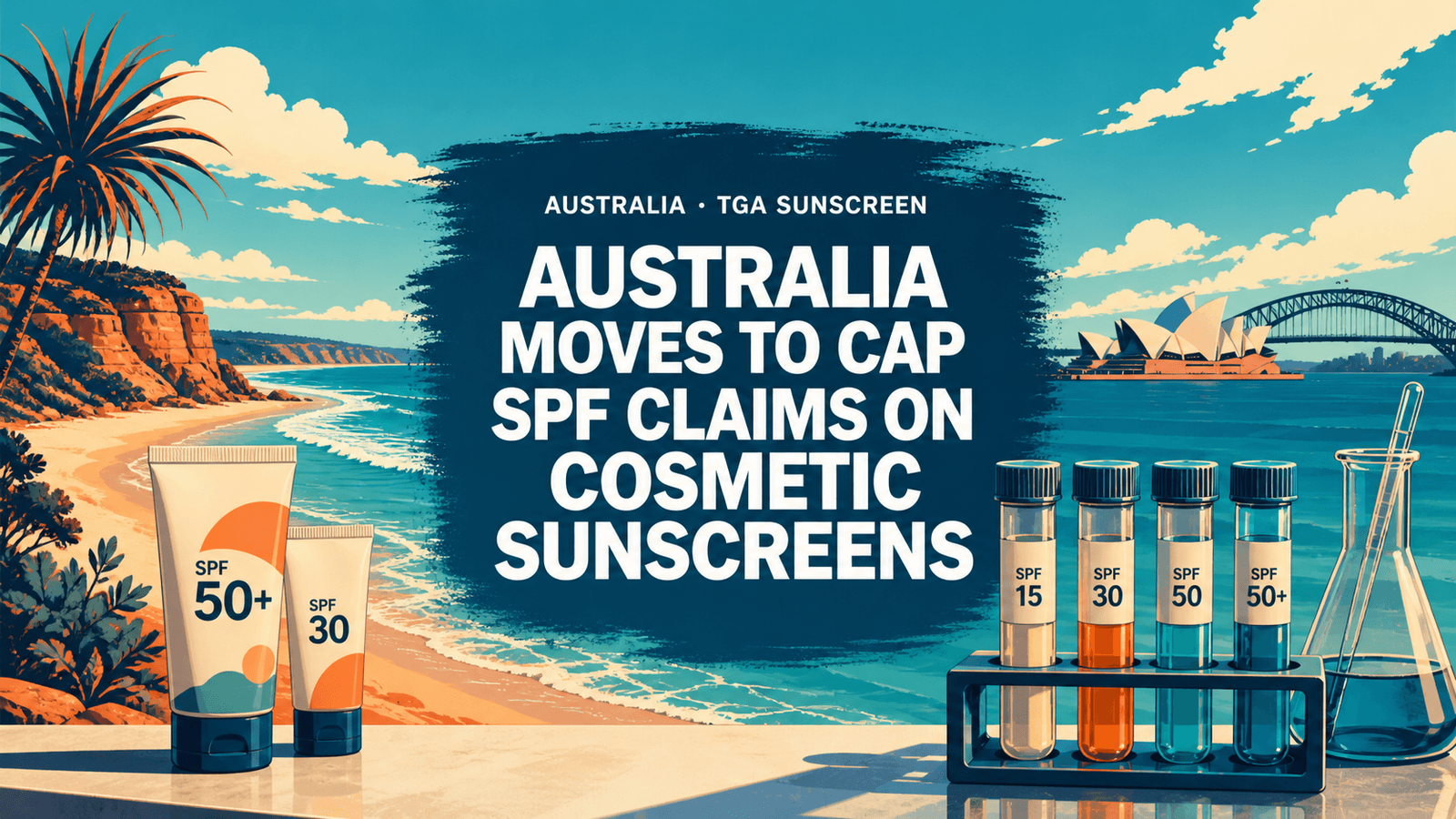
Under Australia's current rules, a tinted foundation can claim SPF 50+ without therapeutic oversight, and a sunscreen can be listed without test data going to the regulator. On October 27, 2026, the Therapeutic Goods Administration (TGA) said it is advancing reforms that change both: finished-product SPF tests at listing and again while listed, data filed with the TGA, and limits on cosmetic sunscreen claims. The target is the number on the tube, not the formula inside.
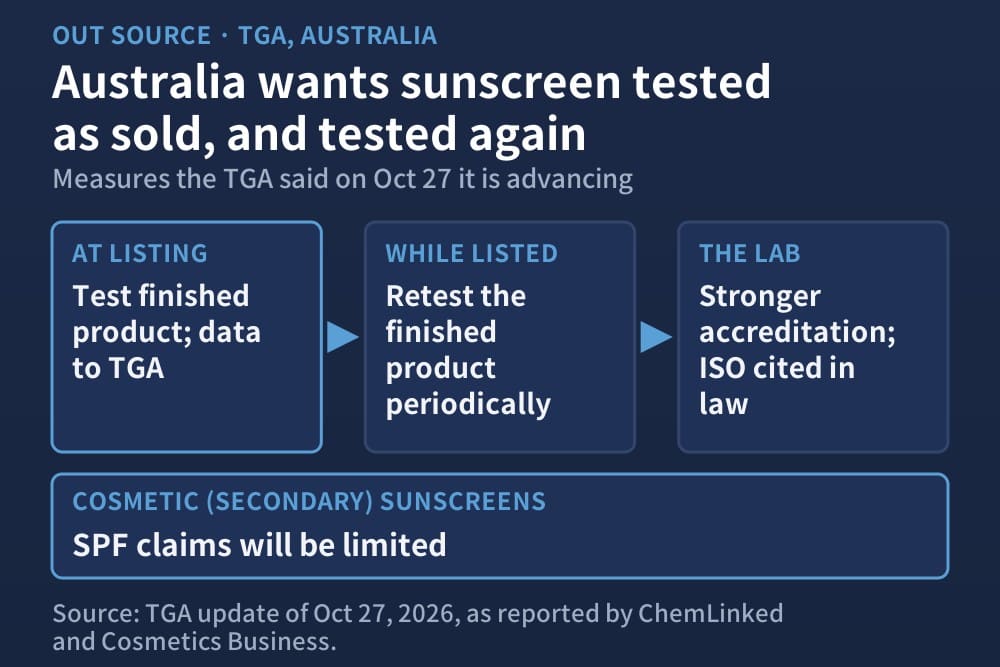
▲ Australia's sunscreen reform runs from the lab to the label: finished-product tests at listing, retests while listed, stronger lab accreditation, and a limit on the SPF that cosmetic sunscreens can claim.
What did the TGA say on October 27, 2026?
On October 27, 2026, the TGA said it is progressing with reforms to strengthen sunscreen regulation. The announcement follows a public consultation that ran from March to May 2026 and drew nearly 120 responses from industry, testing laboratories, healthcare professionals, consumer groups, and academia.
The package has five parts: SPF testing on the finished product at listing and periodically afterward; test data submitted to the TGA at listing; stronger accreditation for testing laboratories, with ISO standards (the international technical standards that define how SPF is measured) cited directly in legislation; quality requirements for specific sunscreen ingredients; and a review of the good manufacturing practice (GMP) guidance for sunscreens. A sixth measure sits beside them: limits on the SPF that cosmetic, or secondary, sunscreens can claim.
The TGA said each reform will take time to develop. SPF labeling gets a further review and consultation before any change proceeds, because the first consultation produced mixed views on how SPF should be displayed.
Why did Australia reopen its sunscreen rules?
The trigger was a consumer test. In June 2025, the consumer group Choice sent 20 popular sunscreens to accredited laboratories, and 16 failed to meet their advertised SPF. Ultra Violette's Lean Screen SPF 50+ was the worst performer, returning an SPF of 4 and 5 in two tests, and the brand withdrew it.
The TGA then found that the same base formula sat behind several other brands, and dozens of products have since been recalled. An ABC investigation found that many failing products had been tested by an overseas laboratory, and that several different products had been supplied under a single listing number on the Australian Register of Therapeutic Goods (ARTG), the national list of approved therapeutic products.
The TGA also found that some product owners and manufacturers did not understand their legal obligations. That finding puts the sponsor at the center of the reform. In Australia, the sponsor is the entity that holds a product's listing and answers for its claims.
How does the proof behind an SPF number change?
SPF is measured two ways. The in vivo method applies the product to human volunteers and exposes them to UV light under ISO 24444, and the TGA's consultation paper flags its results as highly variable. The in vitro method measures UV protection in the laboratory without volunteers, and ISO 23675 describes it. Australia's standard, AS/NZS 2604, does not yet recognize the in vitro method.
Under the reform, sponsors can use in vitro and in vivo testing where appropriate, and the test runs on the finished product, not the base formula. Results go to the TGA at listing, and the regulator keeps them confidential. Retesting repeats while the product sits on the ARTG, which ties the SPF claim to the product across its shelf life instead of to a single test at launch.
Choice, the group behind the original tests, wants more: results made public, routine monitoring by the TGA, and a compliance testing program run by the regulator. The TGA's plan has the regulator receiving the data. The question of who reads it is the next fight.
What is a secondary sunscreen, and why cap its SPF?
Australia splits sunscreens by purpose. A product whose main purpose is UV protection is a therapeutic good and sits on the ARTG. A cosmetic with a secondary sun-protection function, such as a tinted foundation or a lip product, falls under the Excluded Goods Determination 2018, which currently lets it claim up to SPF 50+ without therapeutic oversight.
The TGA sees a safety and compliance gap in that arrangement, because consumers use these products as their main sunscreen. The March consultation paper put two options forward: require the words cosmetic sunscreen on the primary label, or limit excluded secondary products to low SPF claims, with anything higher moving to ARTG registration. The October 27 announcement says the TGA plans to limit the SPF claims of secondary sunscreens to separate them from sunscreens whose main purpose is UV protection.
The level of the cap is the variable that matters. A low ceiling sends every high-SPF multifunction product into the therapeutic pathway, with the testing, data filing, and GMP obligations that come with a listing. A high ceiling leaves the boundary roughly where it sits today.
Where does a product land between cosmetic and therapeutic good?
Currently, sunscreens in Australia are regulated as either cosmetics or therapeutic goods, depending on their ingredients, their therapeutic claims, and their claimed SPF. One proposal in the consultation aims to harmonize the claims each category can make.
That makes classification a product-by-product decision. A sun-protecting cushion, a tone-up cream with SPF, and a stick sunscreen each sit on one side of the line or the other depending on what the label claims first. Under a cap, the lead claim on the label decides the regulatory pathway, the testing bill, and the retailer's compliance file.
Retailers feel the line too. The reform moves proof of SPF from the brand's own file to a filing at the TGA, so a buyer's compliance question changes from whether the brand has a test to whether the product is listed and its data filed.
Who pays for the new testing?
Sponsors carry the testing choices, the retesting schedule, the data submission, and any labeling change. Manufacturers carry the updated GMP guidance. Laboratories carry accreditation: the consultation paper proposed that SPF testing be done by accredited or GMP-certified laboratories, and noted that few such laboratories exist globally.
Clayton Utz's summary of the paper flags bottlenecks and higher costs as the consequence of that scarcity. The TGA's finding that some overseas laboratory results were unreliable explains why accreditation sits at the top of the package. Testing capacity joins the regulation text as a constraint on how fast a brand can list a new SPF product in Australia.
The data-filing step touches formulation as well. The consultation paper itself flagged that public data would let competitors reverse-engineer formulations, while the October 27 plan keeps submitted data confidential.
Why does the timing line up with K-beauty's push into Australian mass retail?
COSRX launched at Coles on September 25, 2026, in more than 850 stores plus online. It already sells through Chemist Warehouse, with about 350 stores, and BIG W. From November, bestsellers including its 6 Peptide Skin Booster Serum began shipping to Kmart and Target, which takes COSRX's Australian offline reach to about 2,000 locations.
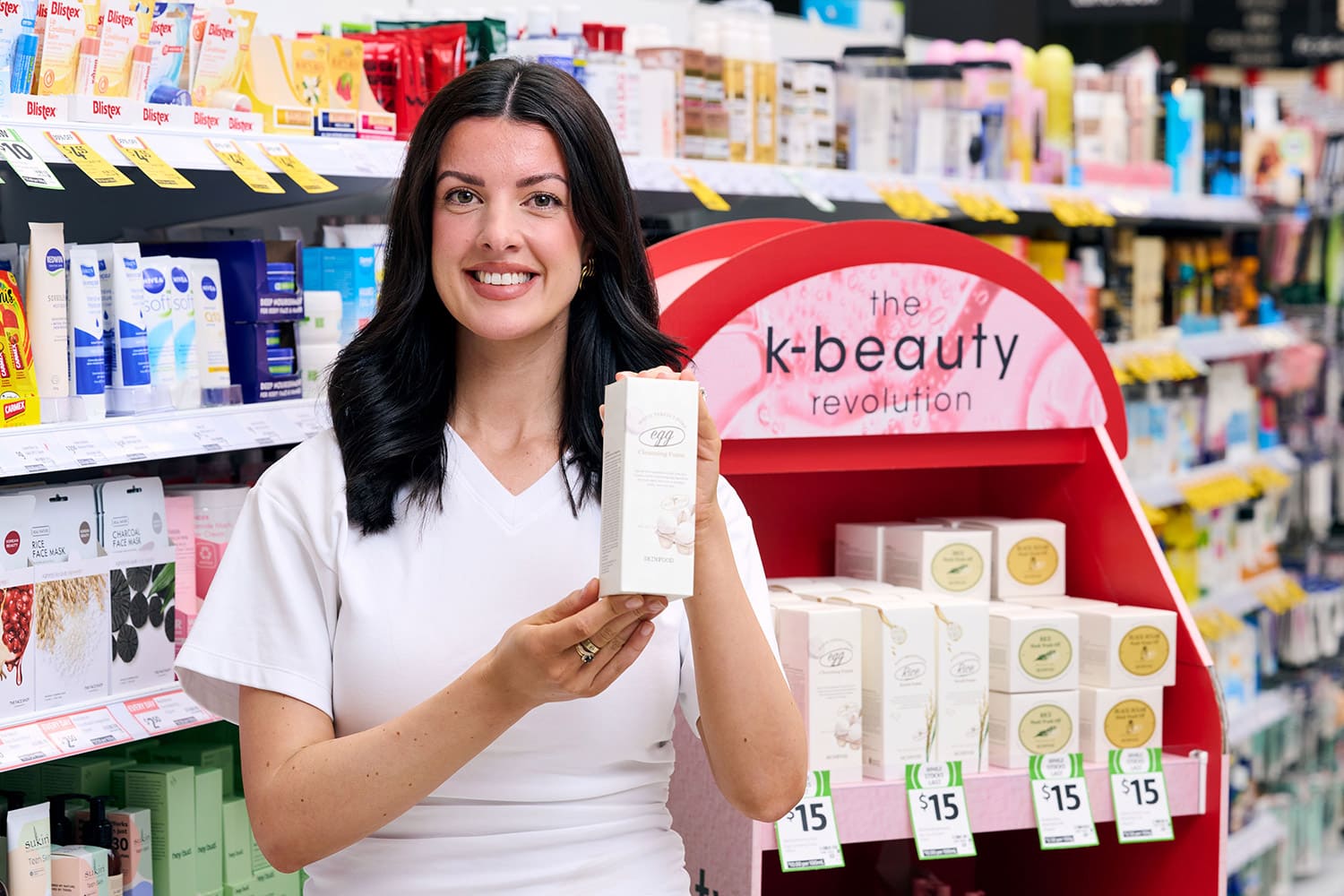
▲ K-beauty products launching at Coles supermarkets across Australia. Photo: Coles Group
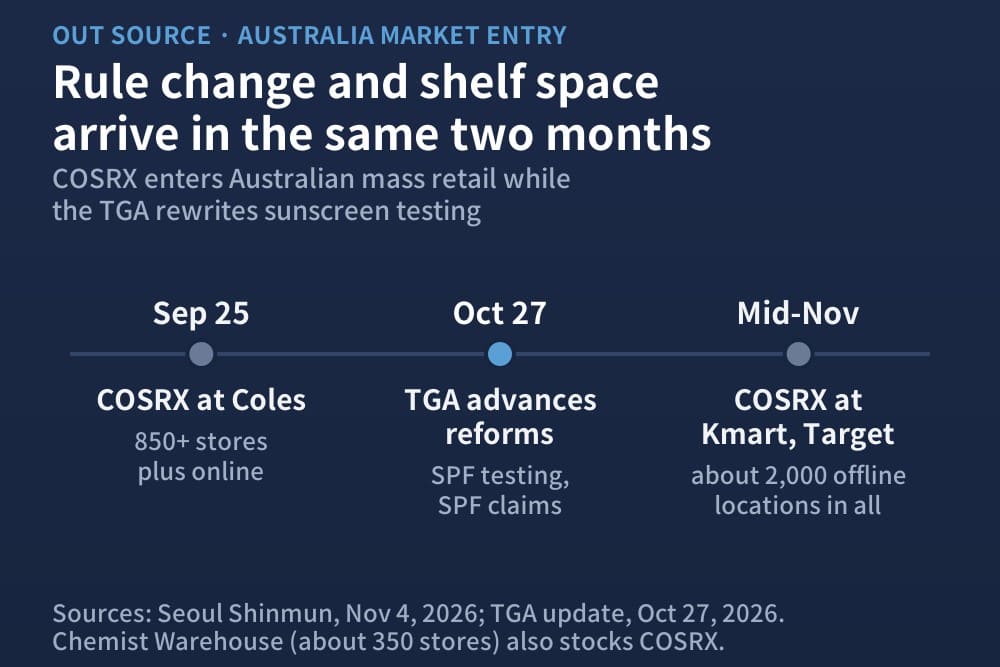
▲ COSRX entered Coles on September 25, 2026, in more than 850 stores. The TGA advanced its sunscreen reforms on October 27. Kmart and Target followed in November, taking COSRX to about 2,000 Australian offline locations.
Kmart added more than 2,700 beauty products from over 117 brands, with Medicube, Biodance, SKIN1004, and Beauty of Joseon among the Korean names, and over 60 percent of its beauty range is exclusive to Kmart and Target. ABC News reporting puts Australia second globally in per-capita K-beauty spending, behind Korea. In November, David Jones, the country's oldest department store, entered voluntary administration.
Shelf volume changes the exposure. A brand present in 2,000 offline locations carries its claims on labels in 2,000 places, and any SPF product among them falls under the new testing and data-filing regime. Mass retail turns sun protection from a niche listing into a volume category with a regulator watching the number.
What does the reform change for the industry?
The reform moves SPF from a brand claim to a filed fact. Finished-product data at the TGA, periodic retesting, accredited laboratories, and ISO standards written into law turn the number on the tube into a record a regulator holds. Cosmetic sunscreens carry a ceiling on the number they can print.
Three positions follow. Laboratories and manufacturers gain demand for accredited testing and carry the GMP review. Brands and retail buyers carry the cost of retesting and classification, and gain a shelf where every competitor's SPF faces the same proof. Regulators and consumer groups split on disclosure: the TGA keeps the data confidential, and Choice wants it public.
The proof behind the number now decides who gets to sell it.