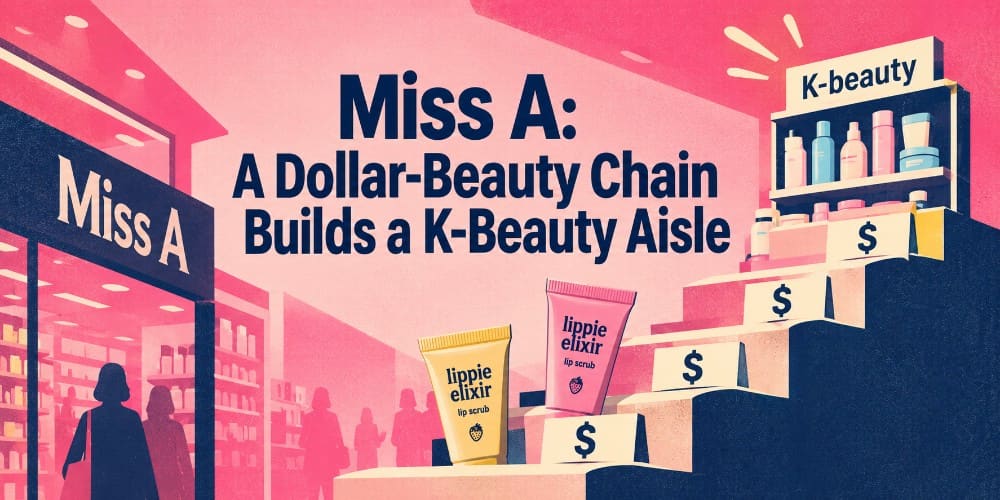
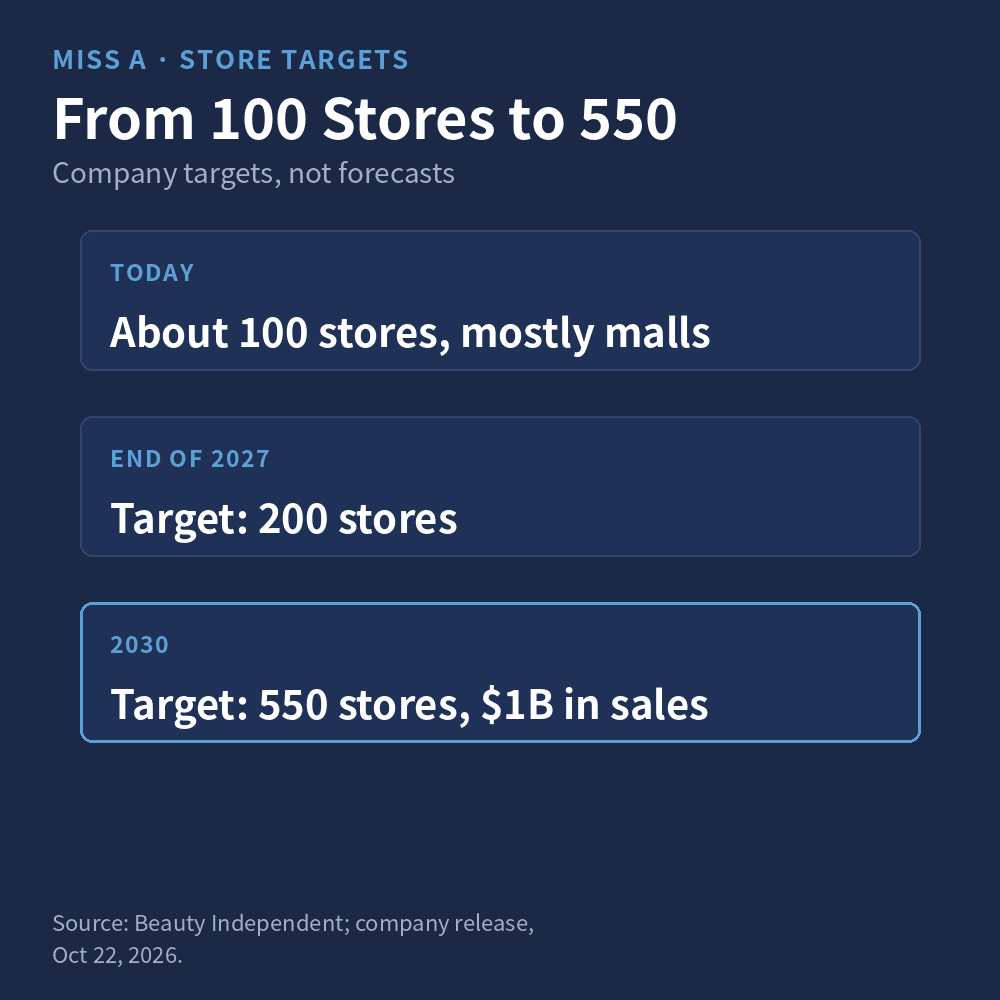
Miss A sells makeup, brushes and sponges, mostly for $1 to $1.88, in about 100 mall stores, and its first outside investor just valued it at nearly 1 trillion won (about US$672 million to US$754 million, depending on the outlet). The Dallas chain says it wants 550 stores and $1 billion in annual sales by 2030. Inside its stores sits a K-beauty shop-in-shop with more than 200 brands. For Korean brands, the useful question is where that shelf sits on a ladder that runs from $1 to $30.
Who is Miss A, and what did VMG buy?
Miss A is a beauty and lifestyle brand headquartered in Dallas. Kenneth and Jean Baik, a married couple, started it online in 2013 and opened the first store in 2016. It now runs about 100 stores in 23 states, most of them malls and most in Texas, according to Beauty Independent. Each store carries more than 15,000 products, per the company's release.
On October 22, 2026, the company announced that VMG Partners, a San Francisco consumer-focused investment firm, is taking a minority stake. It is Miss A's first outside capital, and the amount is undisclosed. The release states the valuation as "nearly KRW 1 trillion." It gives no dollar figure, and outlets converted it differently: Beauty Independent printed about $672 million at deal closing in a correction, while other coverage used about $750 million. The release was issued from Seoul, in won.
How is the shelf built?
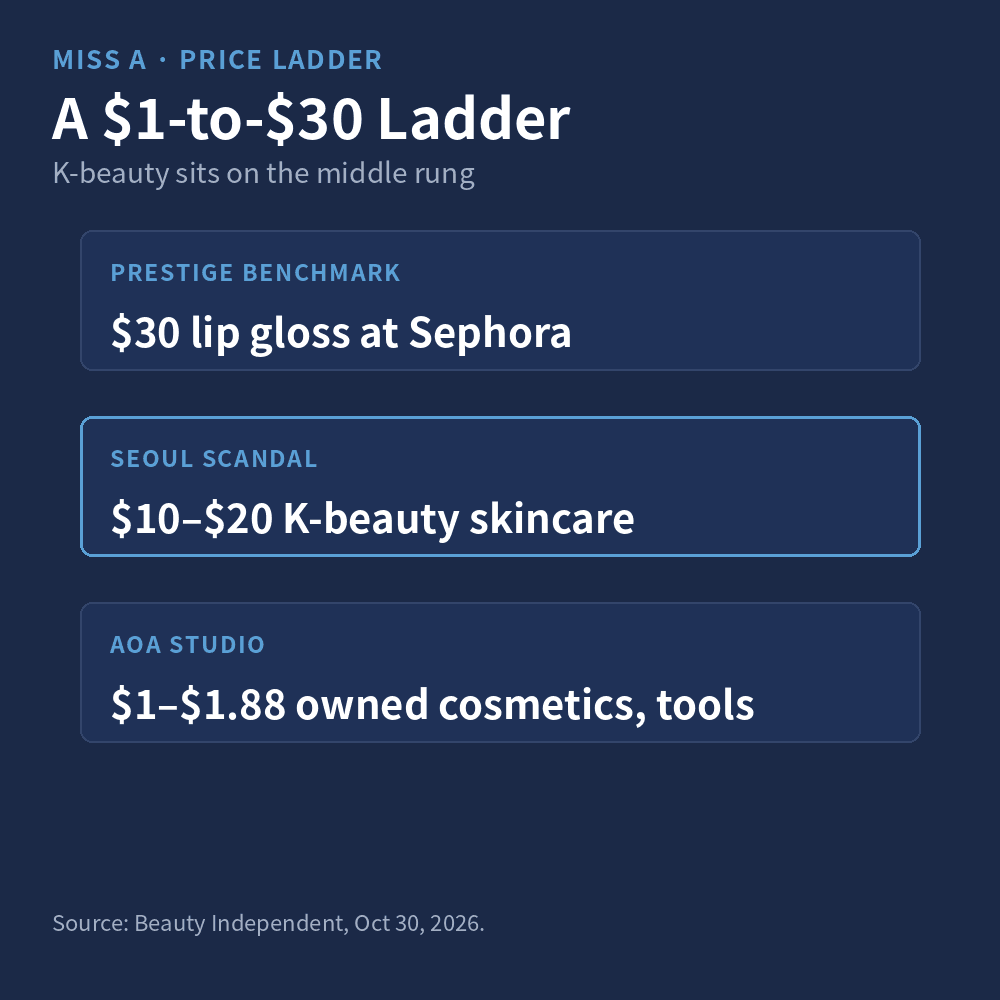
Miss A is mostly its own brand. AOA Studio, the owned line of affordable cosmetics and tools, is about 90% of the assortment and sells largely at $1 to $1.88. AOA Pro, with more elevated makeup and professional-quality tools, is under $10. AOA Skin, the owned skincare line, costs $5 to $10 and includes Korean-made ginseng products and toner pads.
Products come from South Korea, China, Taiwan, Vietnam and India, and the company has diversified suppliers to reduce reliance on any one of them. After the 2025 tariffs, some items priced at $1.33 rose to about $1.55, while most of the range was unaffected. Korean-made sheet masks sell for $1.33.
Where does K-beauty sit?
Seoul Scandal is a K-beauty shop-in-shop, a branded section inside the store, introduced last summer. It now operates in about 70 stores. Each space is 600 to 800 square feet and holds more than 200 K-beauty brands, mostly skincare priced between $10 and $20. Beauty Independent names Anua, Medicube and Dr. Althea. New Miss A stores will include the concept from opening, and existing stores are being remodeled to add it. The company plans a Seoul Scandal skincare line by the end of 2026.
Jean Baik told Beauty Independent that shoppers "got to go to Sephora and get that $30 lip gloss," and that "Korean skincare is here to stay. It's just a part of skincare now." Read against the price chart, Seoul Scandal fills a rung between the $1 dollar-store tool and the $30 prestige product.
How fast is it growing, and who says so?
Go Generational counts about 30 stores in early 2024 and more than 65 by June 2025. Beauty Independent reports that sales rose 34% in 2024 and 58% in 2025, and that Miss A passed its full-year 2025 revenue by July 2026. It does not say who supplied those figures, and no absolute revenue number has been published. Beauty Independent puts the 2027 goal at 200 stores and the 2030 goal at 500 to 550. The company release says 550 and $1 billion in annual sales by 2030. Those are targets.
Jean Baik also said, "We're very profitable and our four-wall economics are very good." Four-wall economics means store-level profit before corporate costs. It is a company statement, and no margin figure accompanies it.
What reaches beyond Miss A's own stores?
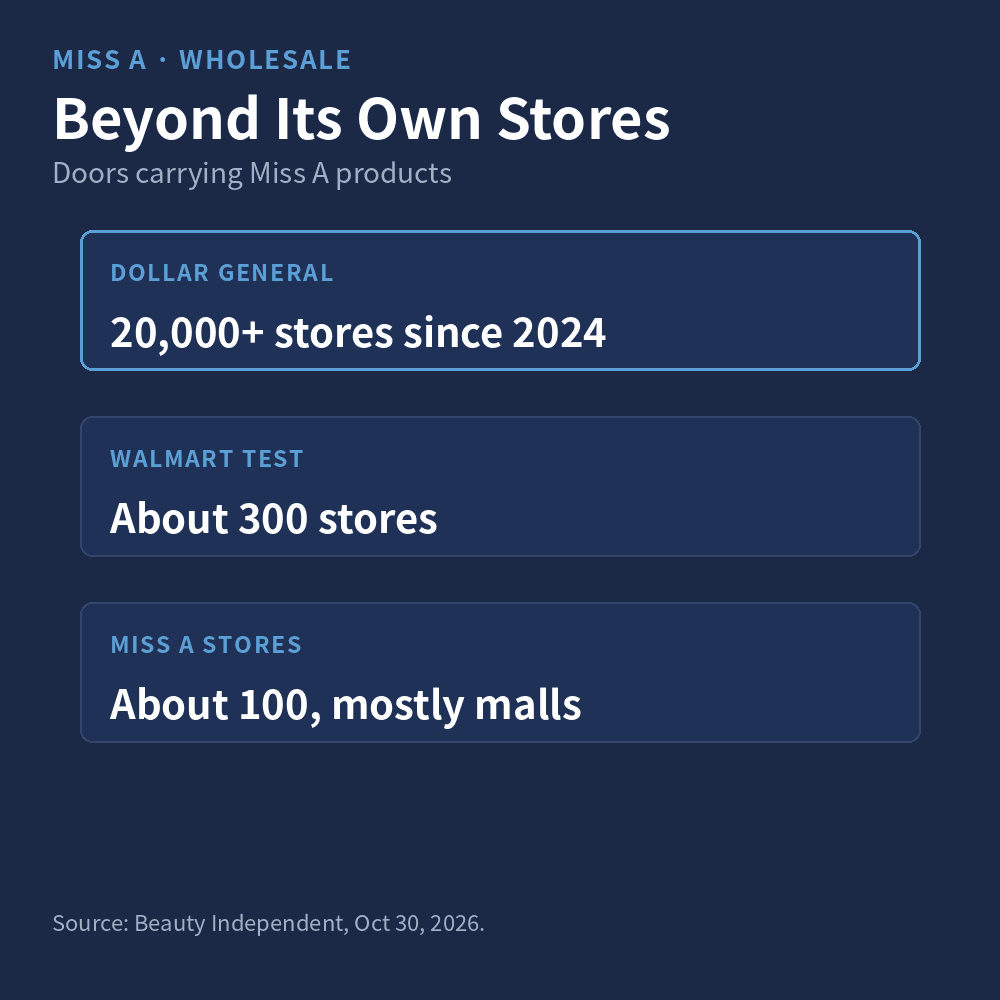
Miss A also sells wholesale. Its skincare products and beauty tools have been in Dollar General's more than 20,000 stores since 2024, and in Popshelf, Dollar General's specialty chain of about 180 units. A Walmart test covers beauty tools and the Paw Paw makeup sponge in about 300 stores, with growth expected in early 2027. The article does not say whether any K-beauty brand from Seoul Scandal travels with those wholesale lines.
What does it mean for Korean brands and factories?
For independent brands, the channel offers mall traffic and a stated price band of $10 to $20. What is not public is the entry route. Beauty Independent does not explain whether brands reach Seoul Scandal through wholesale, consignment or a distributor, and it publishes no sell-through data. Those terms decide whether the shelf is a sales channel or a showcase.
For manufacturers, the owned lines show the price floor in this channel. A Korean-made sheet mask at $1.33 has to cover formula, sheet, pouch and the retailer's margin, and the same company buys from four other countries. A Korean factory in this chain competes on cost and speed with capacity in China, Taiwan, Vietnam and India.
For buyers at larger retailers, the useful number is the spread. The same chain sells a $1.33 mask, a $10 to $20 K-beauty serum and a $30 prestige reference in one mall unit. That is a three-rung map of what shoppers are asked to pay for Korean skincare.
A dollar chain has built the K-beauty rung between $1 and $30. The brands on it still have to find out the terms.