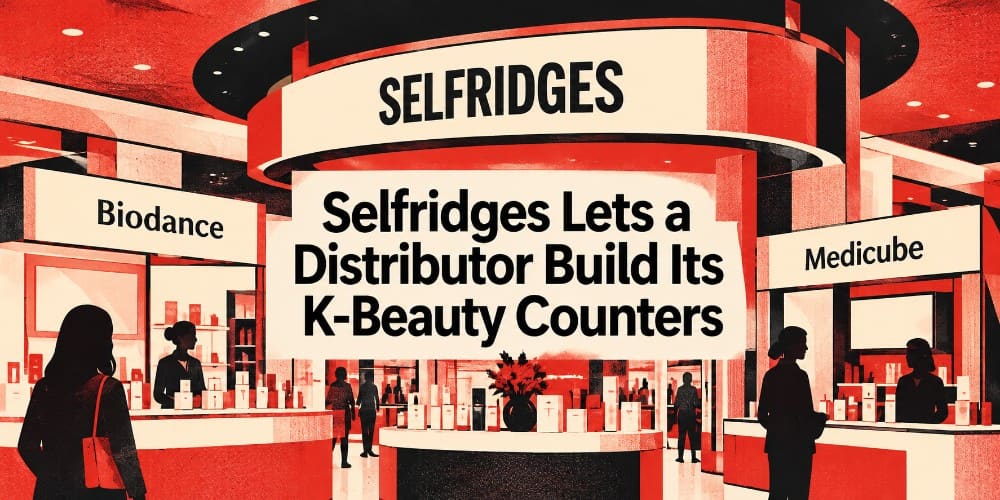
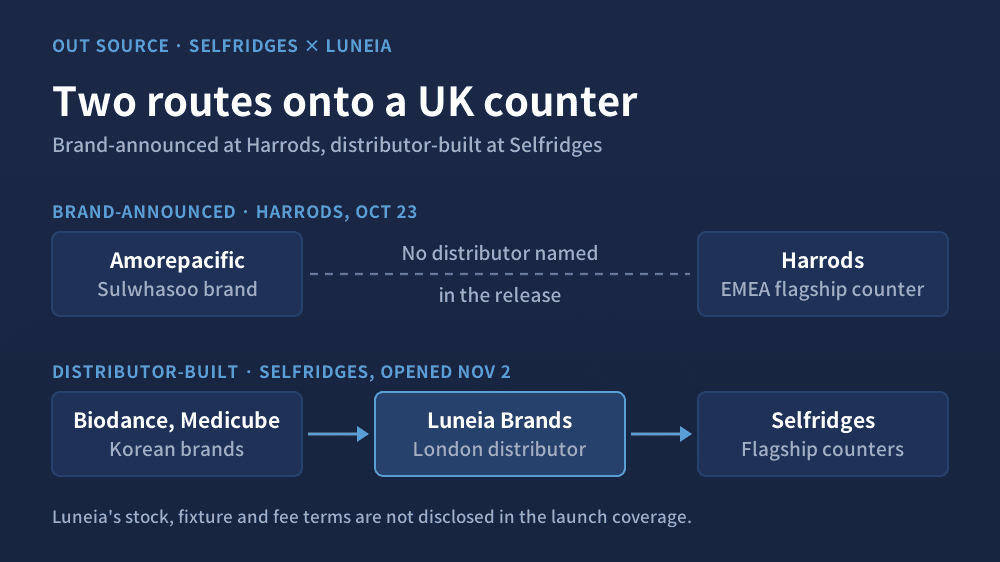
On November 2, 2026, Selfridges opened permanent Biodance and Medicube counters on the ground floor of its Oxford Street flagship. Selfridges approached Luneia Brands, a London distributor founded in 2020, to conceptualize and deliver them, and they are the first permanent counters Luneia has built. One headline calls the launch a world first. Nothing published says who paid for the fixtures. By its own description, the company that built the counters is also the one that supplies the stock.
What opened at Selfridges on November 2?
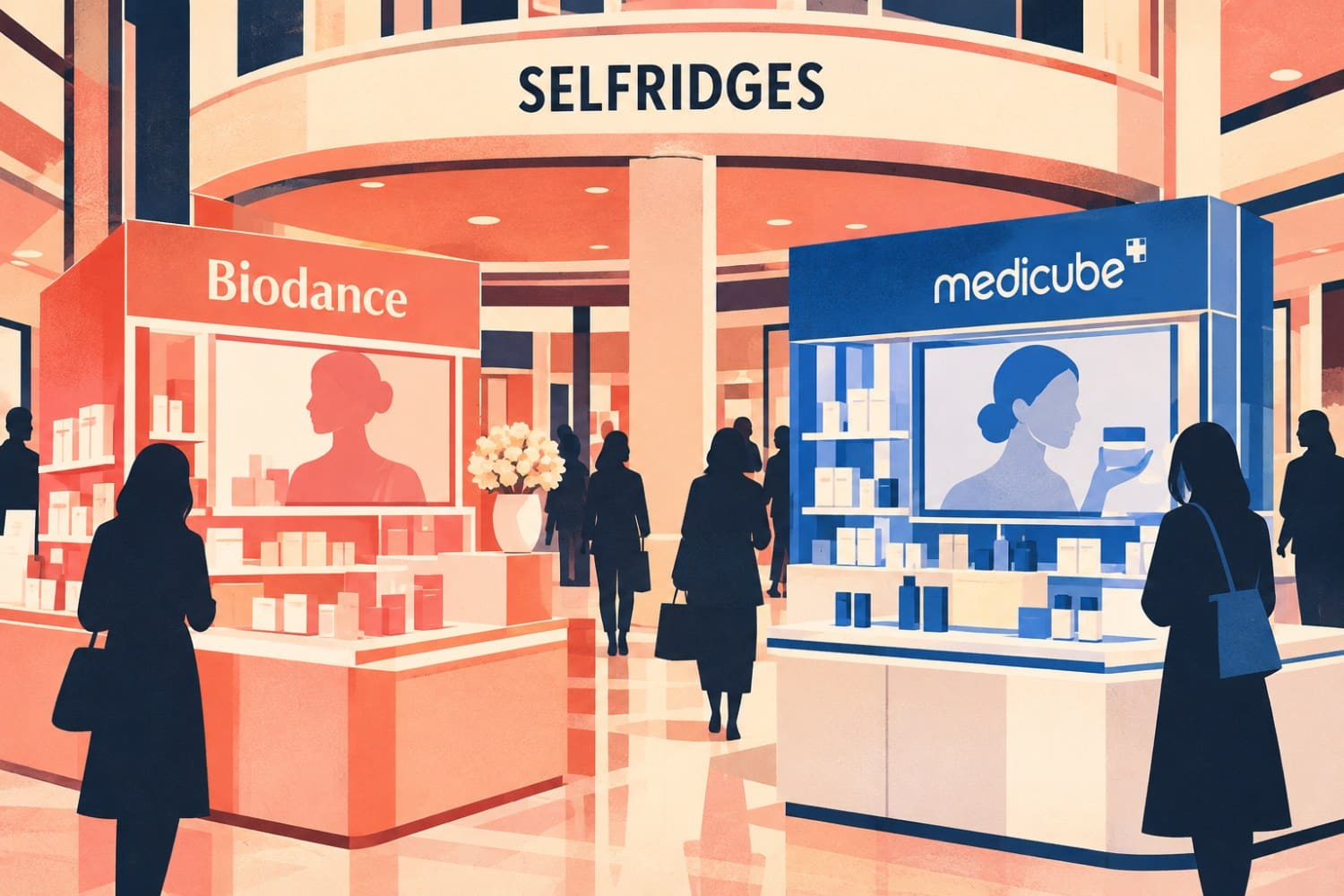
The counters sit in The Beauty Workshop, a new K-beauty destination in the Ground Floor North Central Beauty Hall of the Oxford Street store. Launch coverage describes Biodance's counter as its first permanent counter anywhere in the world and Medicube's as its first in Europe, after permanent counters in South Korea and Mexico. Both carry the largest physical ranges either brand currently sells in the UK, and first-to-market launches are planned throughout 2027.
Medicube's counter includes a dedicated devices bar built around its AGE-R technology, with demonstrations and personalized consultations. Biodance runs sampling, demonstrations and consultations across its skincare range. Six more Korean brands sit in the destination: Beauty of Joseon, SKIN1004, Axis-Y, Thank You Farmer, VT Cosmetics and Dr. Reju-All.
The sales milestones in the coverage are brand figures. Medicube's parent, APR, puts global sales of its AGE-R devices above 6 million. Biodance puts its worldwide hydrogel mask sales above 350 million; one outlet printed 360 million for the same figure, and the lower number is the one repeated elsewhere.
Who is Luneia Brands, and why did Selfridges call it?
A distributor is a company that imports foreign brands' products and sells them to local retailers. Luneia's website says it was founded in London in 2020 by Gemma Murari and Anjun, and describes itself as a brand's in-country team: sales, marketing, operations, UK labeling and compliance support, and logistics. It serves department stores, health and beauty chains, online retailers, TV shopping and travel retail.
Murari said in a launch interview that the relationship with Selfridges began with Thank You Farmer and grew as demand for Korean skincare rose. Before this launch, Luneia's K-beauty work ran through travel retail. Its brands fly with easyJet, and its website says Medicube, Biodance and Thank You Farmer launched on European cruise ships through Harding+.
Murari said Selfridges recognized Luneia as a reliable, commercial and trend-led partner. The counters are Luneia's first permanent counter development.
What does a distributor deliver that a brand does not?
Luneia's website describes its retailer offer as a curated pipeline of high-growth brands, with a focus on Korean skincare, supplied with UK-held stock, firsts and exclusives, and sell-through support such as marketing funding and trained counter teams. Sell-through is the share of delivered goods that customers actually buy. Those are the company's own descriptions, not published terms of the Selfridges deal.
Launch coverage adds the physical layer: counters designed as immersive spaces for discovery and education, elevated visual merchandising, hands-on demonstrations and bespoke consultations. Luneia also co-developed a Medicube facial sold exclusively at the Selfridges Trafford Centre store. Coverage reports it outperformed forecast fourfold and built a two-month waiting list. Those figures come from the companies involved.
Selfridges' beauty buyer, Jade Mainprize, said the store wants long-term partnerships with these brands.
Who pays for a permanent counter?
A permanent counter costs more than a pop-up. Murari said the investment is significantly higher because it includes capital expenditure on the fixture itself, the physical unit built into the floor. Interview coverage adds staffing, training, merchandising and activations to the bill, and frames permanent retail as needing returns that social media engagement alone does not supply.
Nothing published says who funds the fixture, who owns the inventory, or how Luneia is paid. Neither Selfridges nor Luneia has disclosed margins or contract terms. Luneia's website says it supplies retailers with UK-held stock and marketing funding. Whether that describes this deal is not stated.
What is public is the scorecard. Selfridges and Luneia will track sales productivity, repeat purchases, customer loyalty, basket sizes and average transaction values. Murari called the project a test bed and a litmus test for permanent K-beauty retail in other markets.
Is this really a first?
The launch headline calls the counters a world first, and Murari said this is the first time K-beauty has been elevated this way in UK luxury retail. Those are Luneia's and the outlet's words, not an audited record. Biodance's counter and Medicube's European counter are firsts for those brands by launch coverage. As a UK category claim, the record is crowded. Selfridges' own buyer acknowledged that K-beauty entering the UK market is not new.
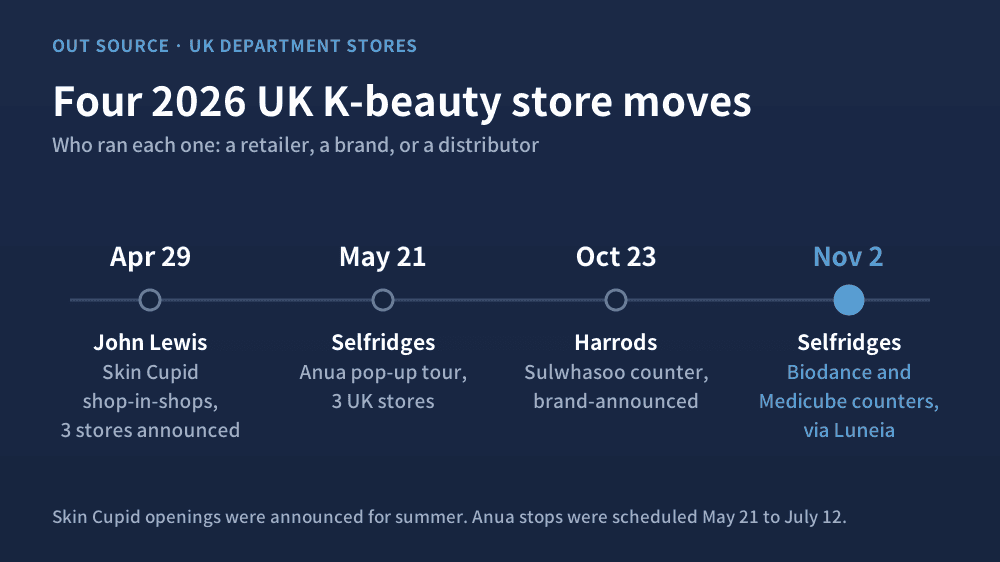
Ten days before the Selfridges opening, Amorepacific's Sulwhasoo arrived at Harrods, on October 23, 2026. The company's release calls the counter the brand's flagship destination for the EMEA region and the release does not mention a distributor. In April, John Lewis announced an exclusive partnership with Skin Cupid for three Korean beauty shop-in-shops in Cambridge, Kingston and Leeds, with openings set for the summer and no dates given. A shop-in-shop is a branded counter space run inside a department store. Selfridges itself ran Anua pop-ups at Oxford Street, the Bullring in Birmingham and the Trafford Centre on a schedule running May 21 to July 12. Anua's UK account manager called the tour the brand's first-ever UK pop-up, and no distributor was named.
The defensible claim is narrower than the headline. These are permanent counters for two brands, built by a distributor rather than announced by a brand. The Harrods launch shows the brand-led route runs in parallel.
Why would a brand accept a middleman at this price?
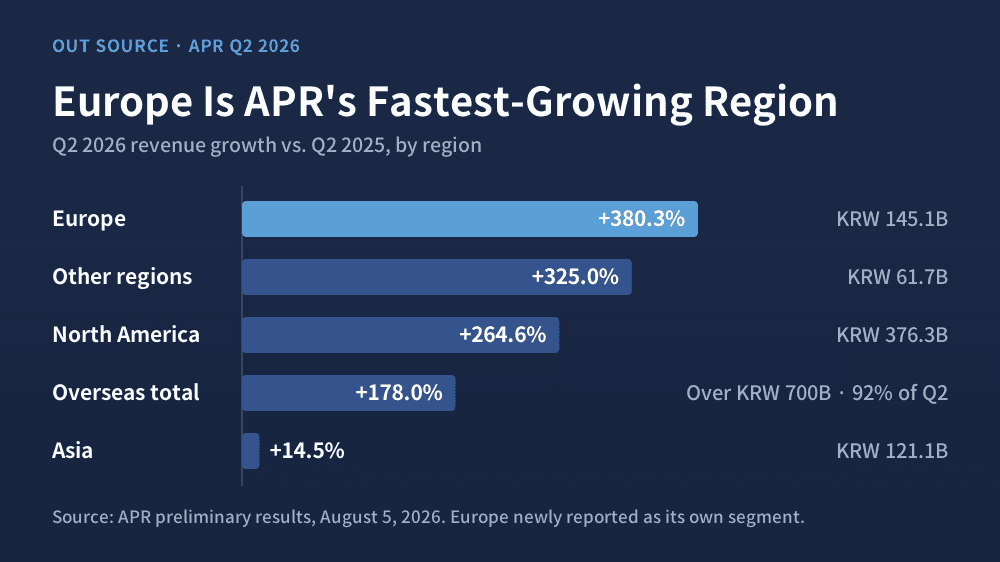
APR, Medicube's parent, is growing faster in Europe than anywhere else it reports. Its preliminary results of August 5, 2026 put second-quarter European revenue at 145.1 billion won, up 380.3% from a year earlier, and showed Europe as a standalone segment for the first time. Dollar figures here use roughly 1,415 won per dollar, the rate implied by the Korea Times' August 2026 conversion, which makes that quarter about US$103 million.
First-half European sales reached 228.9 billion won (about US$161.8 million), up roughly 363%, and APR raised its full-year European target to 500 billion won (about US$353 million) on an August earnings call. APR entered Europe's offline retail in early 2025, added Sephora stores in March 2026, and first-half offline sales in Europe ran more than nine times the prior year's level.
Access is not the constraint. Britain is one of five countries where APR opened official Amazon storefronts in late 2025, and Murari said shoppers can already order the same products on Amazon with next-day or same-day delivery. A counter competes on discovery and service, which a brand without a UK team has to buy from someone. A distributor sells exactly that team. The cost to the brand, in margin and control, is undisclosed.
What does Selfridges gain by outsourcing the concept?
A department store's problem with K-beauty is churn. Murari said a growing number of smaller K-beauty brands are highly disposable, replaced by the next trend, because the barriers to creating a brand in Korea are low. A store that builds a counter around one brand carries that brand's cycle.
A distributor spreads the cycle across a portfolio. Launch coverage lists eight Korean brands that Luneia supports in The Beauty Workshop, Biodance and Medicube among them. Murari said she does not see K-beauty as a bubble that will burst and expects it to evolve, with haircare and bodycare the next promising areas. That outlook is the distributor's. Selfridges' stated ambition, per its buyer, is long-term partnerships.
What is still unproven?
Every term that decides whether the model repeats is undisclosed: the fixture split, margins, stock ownership and sell-through. The Trafford Centre facial result is Luneia's claim. The brand sales milestones are brand figures, and coverage of the same launch prints two different totals for Biodance masks.
The counters opened on November 2 and have no sell-through record. Selfridges and Luneia have named the metrics they will watch. They have not named a date for results.
What does the structure mean for the rest of the market?
For manufacturers and brands, the choice is explicit. A brand with a UK team keeps its counter in-house, as Sulwhasoo does at Harrods. A brand without one buys a team from a distributor, on terms nobody has published.
For brands and buyers, one partner can fill a fixture with a portfolio and absorb brand churn, and the brand gets a counter it did not have to staff. The buyer's cost is dependence on one supplier's roster.
For regulators and investors, the structure moves the compliance conversation. Luneia lists UK labeling and compliance support among its services, which places a UK company between the brand and the rule on every pack. APR's European growth line, meanwhile, depends on partner terms that no one outside the deal has seen.
The counter is the visible part. The contract is the story, and it is not public.