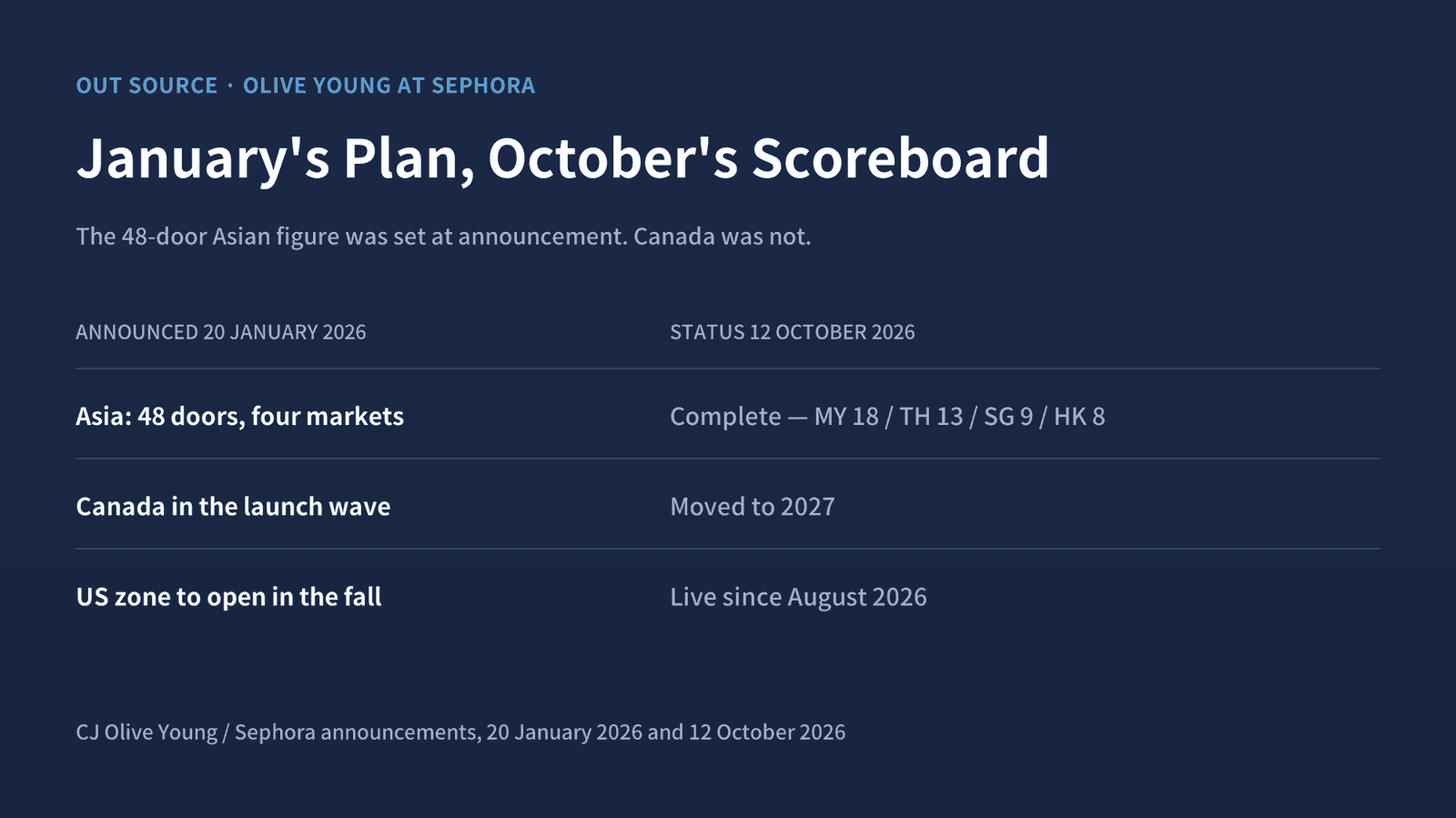
CJ Olive Young's curated K-beauty zone is now in 48 Sephora stores across Malaysia, Thailand, Singapore and Hong Kong. The January announcement that created the partnership already specified that number and those four markets. What moved between January and October is Canada, dropped from the launch wave into 2027. The completed rollout is not Olive Young winning Sephora's shelf. It is Sephora filling the part of its shelf it had not already filled by signing brands directly.
What did the 12 October announcement actually add?
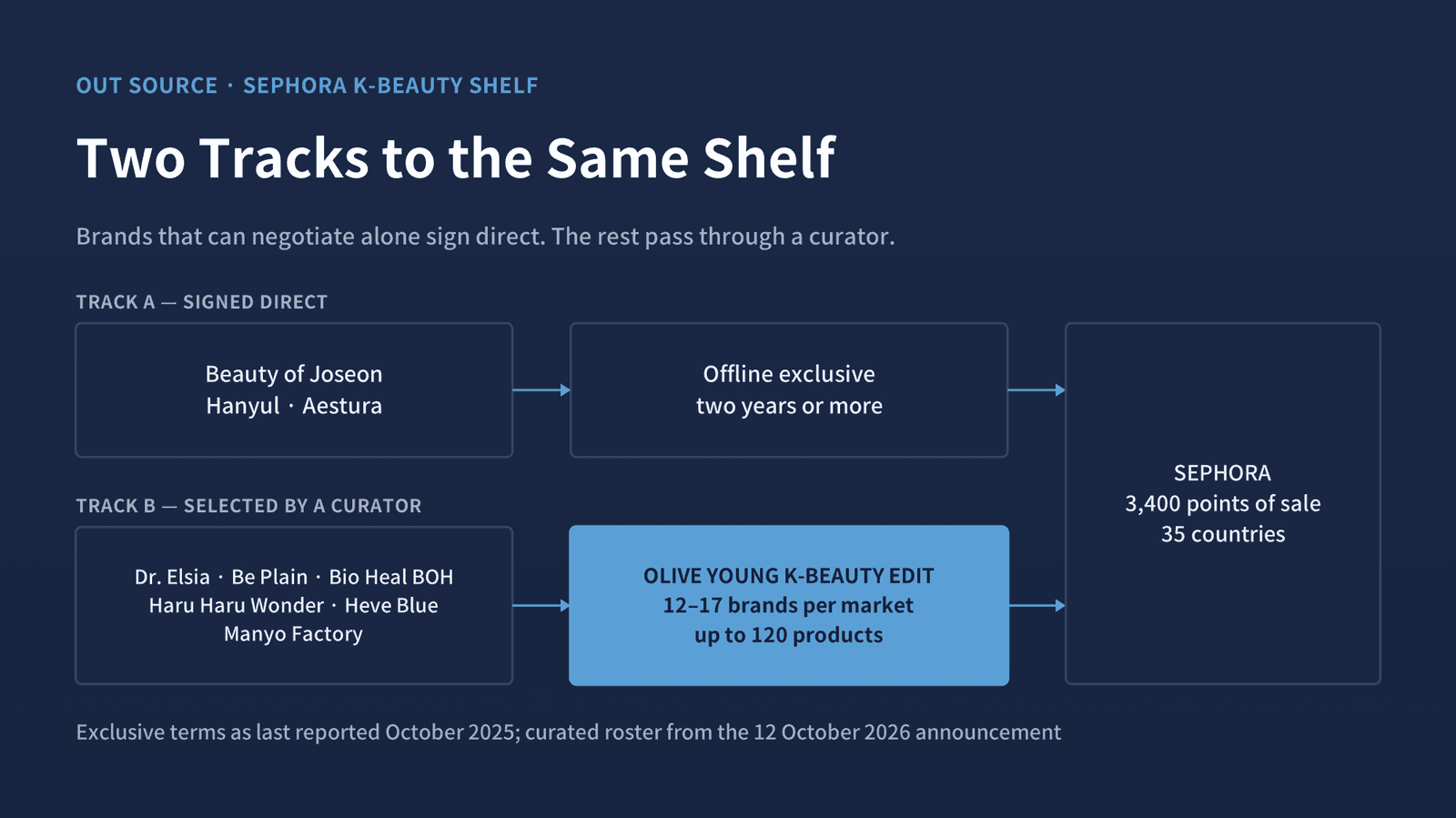
CJ Olive Young's announcement states that the Olive Young K-Beauty Edit, a dedicated display zone of Korean beauty products, has completed its rollout across Sephora's online and offline channels in four Asian markets. The door count is 48: 18 in Malaysia, 13 in Thailand, nine in Singapore and eight in Hong Kong. Each market carries 12 to 17 brands and up to roughly 120 products, weighted toward cleansers, serums and creams, which the company attributes to local climate and ultraviolet exposure.
The January partnership release named the same four markets. Reporting at the time of that announcement put the Asian leg at 48 locations. The figure announced in October is the figure committed in January. What the announcement confirms is delivery against a schedule, not an enlargement of one.
Why does the per-market brand count matter more than the door count?
The Korean-language announcement places the 12-to-17 brand range at the market level. English renderings of it have placed the same range at store level, which describes a different business entirely: 48 stores each making an independent selection would imply hundreds of brand slots. One assortment per market, replicated across that market's doors, implies at the outer bound 68 brand slots across the four markets before any overlap between them is counted.
Distribution and assortment are being announced as though they were one number. They are not. A brand selected for Malaysia reaches 18 doors. A brand selected for Hong Kong reaches eight. A brand not selected reaches none, in any of the four.
Which brands came through the curator, and which did Sephora sign itself?
The announcement names six brands as drawing early response in Asia: Dr. Elsia, Manyo Factory, Bio Heal BOH, Be Plain, Haru Haru Wonder and Heve Blue. The United States zone, live since August 2026, is described around Rejuran, Arencia and Torriden.
The K-beauty names with the largest existing recognition in American stores appear on neither list. When offline exclusives — arrangements under which a single chain holds sole physical-retail rights to a brand — were last reported in October 2025, Sephora held them for Beauty of Joseon, Hanyul and Aestura, and Ulta Beauty held comparable terms for Medicube and Anua, with durations reported at two years or more. Sephora is running two sourcing tracks into one category. It signs the brands it wants by name, and it buys selection for the tier beneath them.
What happened to Canada?
The January release put the debut in the United States, Canada, Hong Kong and Southeast Asia, scheduled for the autumn. Reporting at the time described the North American leg as 650 stores across the United States and Canada. The October announcement lists Canada alongside Australia, the United Kingdom and the Middle East as 2027 markets.
Asia landed on the announced schedule and at the announced size. Canada moved out of the launch wave. No reason has been given for the change, and the 650-store figure has not been restated.
What is Olive Young selling that Sephora cannot buy from a brand directly?
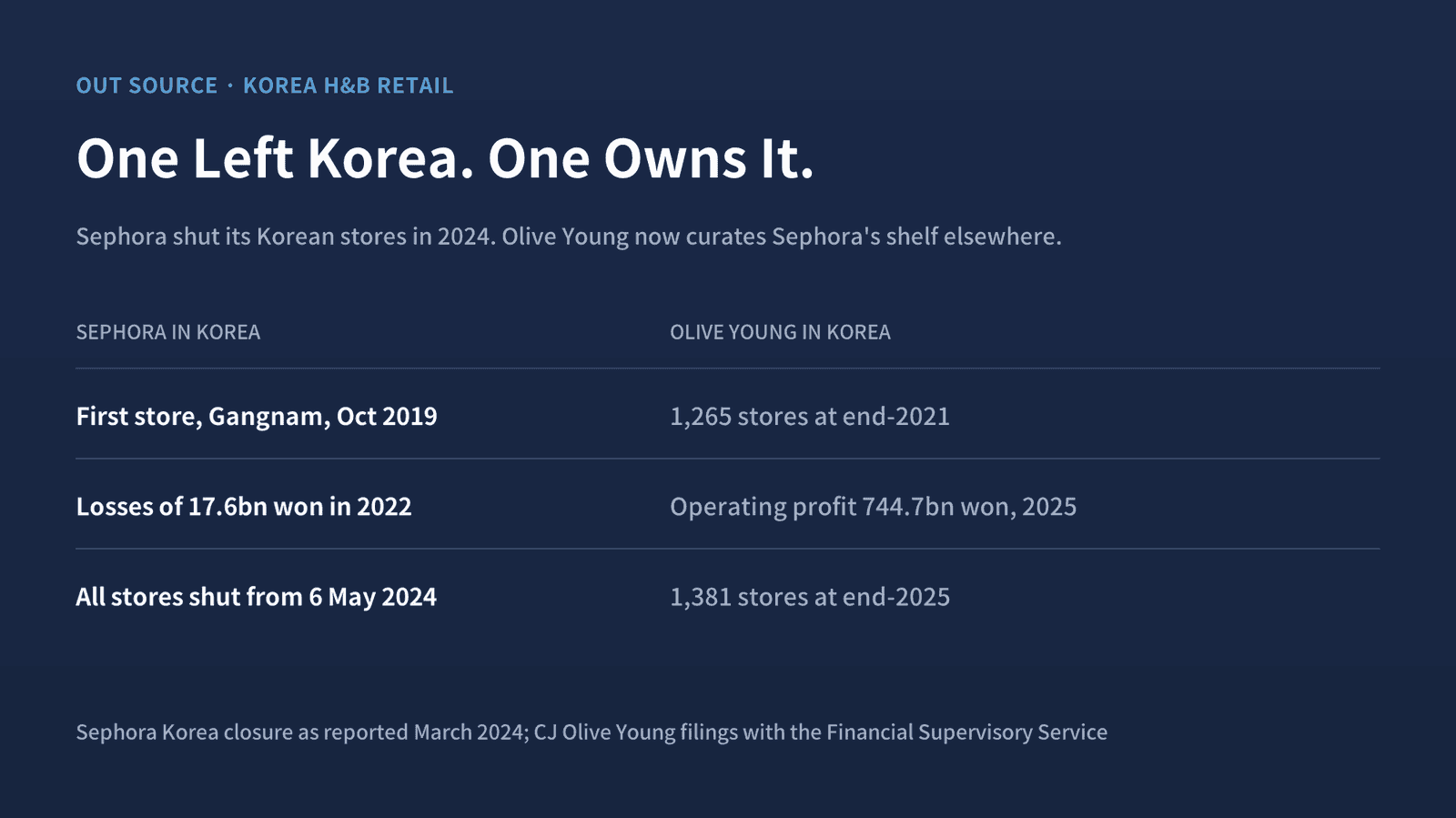
Selection, and the observation behind it. Olive Young's filings with the Financial Supervisory Service put 2025 revenue at 5.8335 trillion won ($4.36 billion at 1,337.7 won to the dollar, the rate on 12 October 2026), up 21.8 per cent, and operating profit at 744.7 billion won ($557 million), up 22.5 per cent. Store count stood at 1,381 at the end of 2025, and its share of the domestic beauty market reached 20.2 per cent that year, up 4.9 percentage points.
The figure that matters to a foreign retailer is a different one. Sales to foreign visitors inside Korea came to about 1 trillion won from January to November 2025 and accounted for 28 per cent of sales in 2025, against 21 per cent in 2024. Olive Young watches non-Korean consumers buy Korean brands at scale, inside Korea, before that demand reaches a shelf outside it. The January release describes the zone as curated by Olive Young and credits the company's curation capability. That capability is the deliverable.
How does the retailer that outlasted Sephora in Korea end up stocking its shelves?
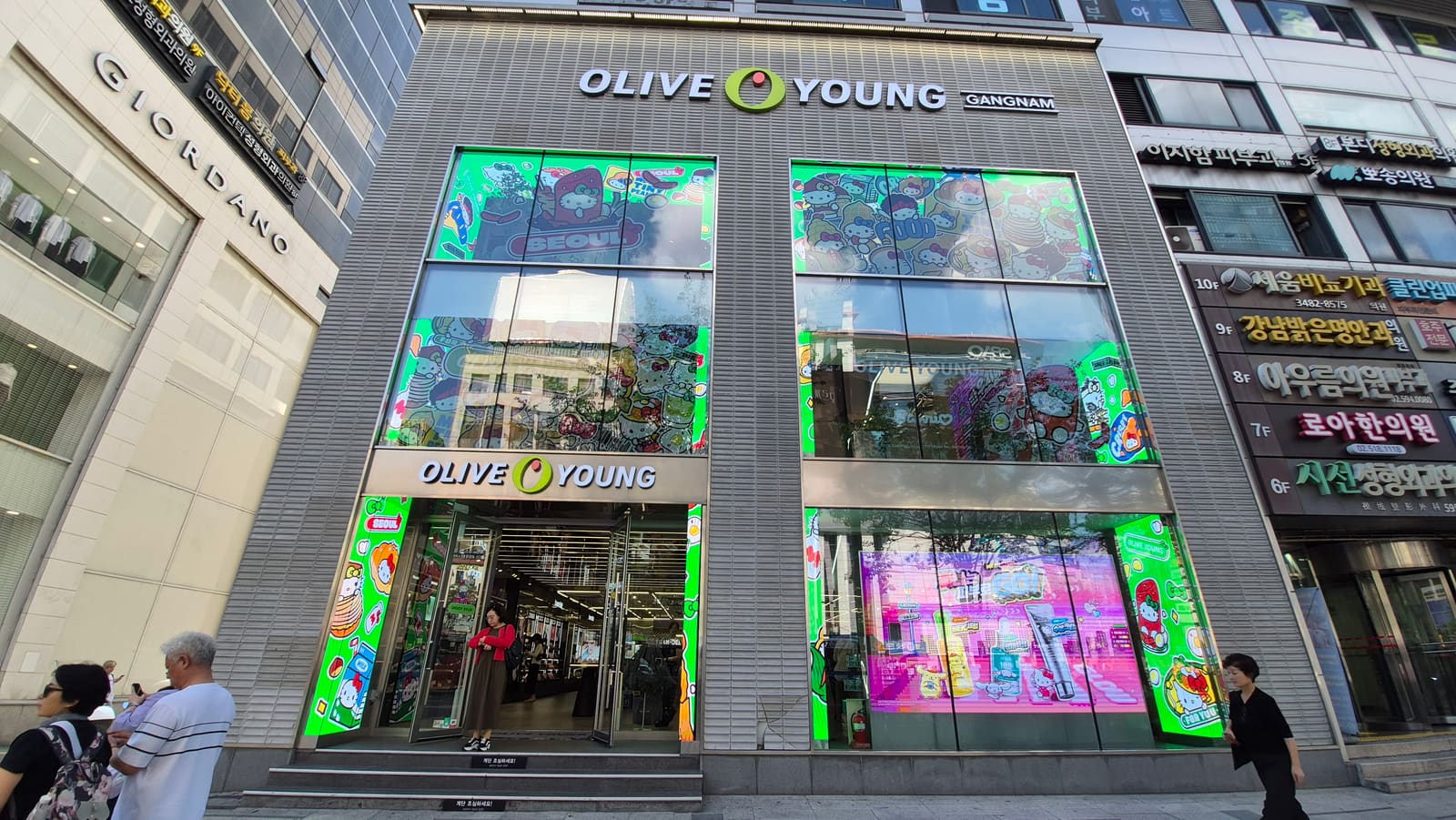
Sephora opened its first Korean store in Gangnam in October 2019. Losses were reported at 12.4 billion won in 2020, 14.5 billion won in 2021 and 17.6 billion won in 2022. In March 2024 it announced its exit, with a phased closure of stores, app and online platform beginning 6 May 2024. Across the same stretch Olive Young went from 1,265 stores at the end of 2021 to 1,339 at the end of 2022.
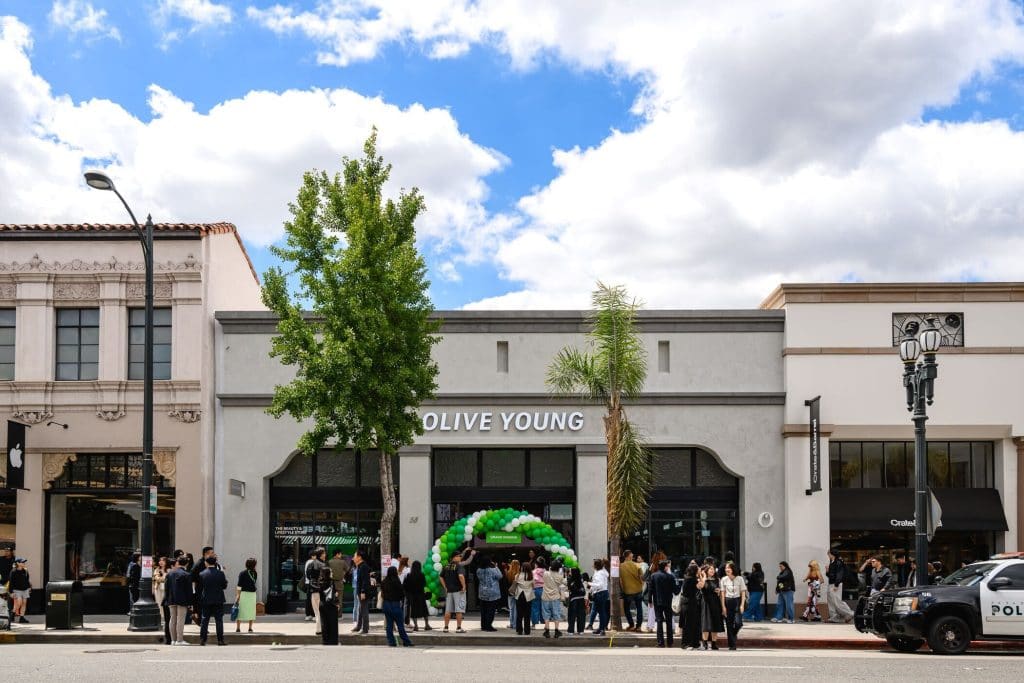
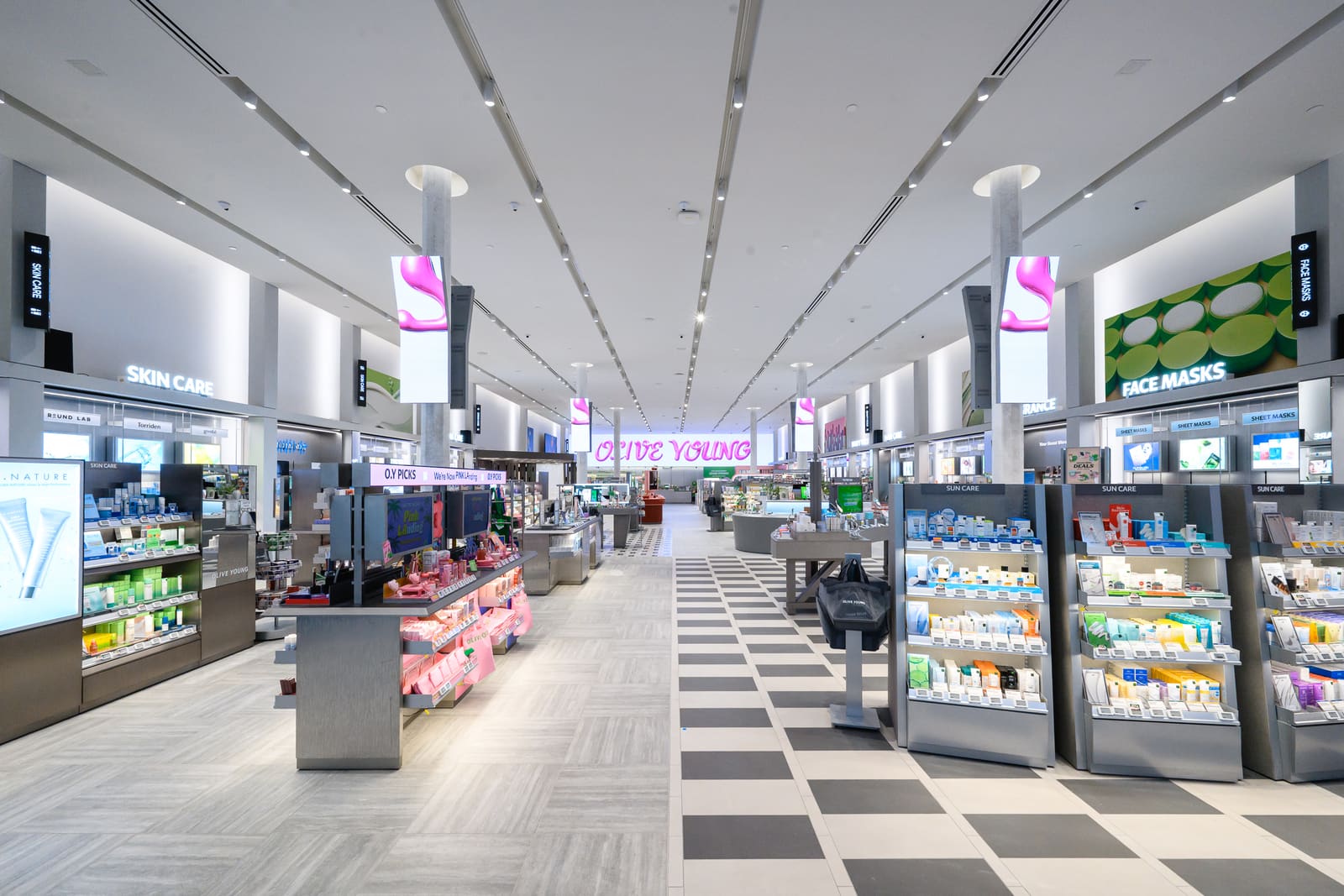
The partnership functions because the two companies are not competing where it operates. Olive Young has no stores in Malaysia, Thailand, Singapore or Hong Kong. In the United States they overlap. Olive Young's first American store, at 58 West Colorado Boulevard in Pasadena, California, runs to 8,647 square feet and carries about 400 brands and 5,000 SKUs, with a company announcement dated 29 May 2026 and a stated plan to expand to New York and then southern and central regions.
What does a curated slot cost the brand that takes one?
The January release discloses no revenue split, contract length or exclusivity. The structure is observable without them. A brand inside the zone does not hold the relationship with Sephora; it holds a place on Olive Young's shortlist, and that shortlist is revisited by the curator rather than by contract. The directly signed brands hold a term reported at two years or more. One arrangement is a duration. The other is a judgement.
Korea has a record of what that judgement looks like under pressure. In December 2023 the Fair Trade Commission fined Olive Young 1.896 billion won ($1.42 million) under the Large Retail Business Act, ordered corrective measures and referred the company to prosecutors. The findings: from 2019, suppliers were required not to run the same items in competing chains' promotions; between March 2019 and June 2021 regular supply prices were not restored after discount events, a gap totalling 800.48 million won; and from January 2017 to December 2022 suppliers were charged roughly 1 to 3 per cent of net purchases for sales information. The commission closed the separate market-dominance strand without a finding, stating that whether Olive Young is market-dominant was unclear given a changing cosmetics distribution market, and said the effects of its Exclusive Brand policy — privileges for suppliers that do not deal with rivals — warranted continued monitoring.
Does the arrangement survive Olive Young's own expansion?
Pasadena carries about 400 brands. The Sephora zone carries 12 to 17 per market. Olive Young is a supplier of selection to a retailer it competes with in one market and not in four others. When its American strategy was last reported, in October 2025, it was described as turning toward smaller Korean brands not yet sold in the United States. The curated roster matches that description. Rejuran, Arencia and Torriden are not the names Sephora and Ulta locked up first.
Where does this leave the rest of the industry?
Three positions sit differently. For manufacturers and ODMs — the contract developers and manufacturers that produce most Korean beauty products on behalf of brand owners — the demand signal has changed shape. A curated slot across 18 Malaysian doors and a two-year exclusive across an American chain's 1,400-plus stores are not the same order to plan capacity against. The term sets the volume, not the headline.
For brands and buyers there are two prices of admission. Negotiating directly costs recognition the brand must already possess. Being curated costs the absence of it, paid in dependence on another company's shortlist. A brand that carries its own demand has no reason to enter through a curator.
For regulators and investors, the 2023 decision left the dominance question open on the ground that Korean cosmetics distribution was in flux. What has happened since is that the selection power in question began operating inside foreign retailers. Korea's half-year export figures record $7.0 billion in the first half of 2026, up 27.3 per cent, with the United States at $1.45 billion and China at $1.01 billion. Those figures record what shipped. They do not record who chose it.
Forty-eight doors is the distribution. Twelve to 17 brands is the decision. The decision is the asset.