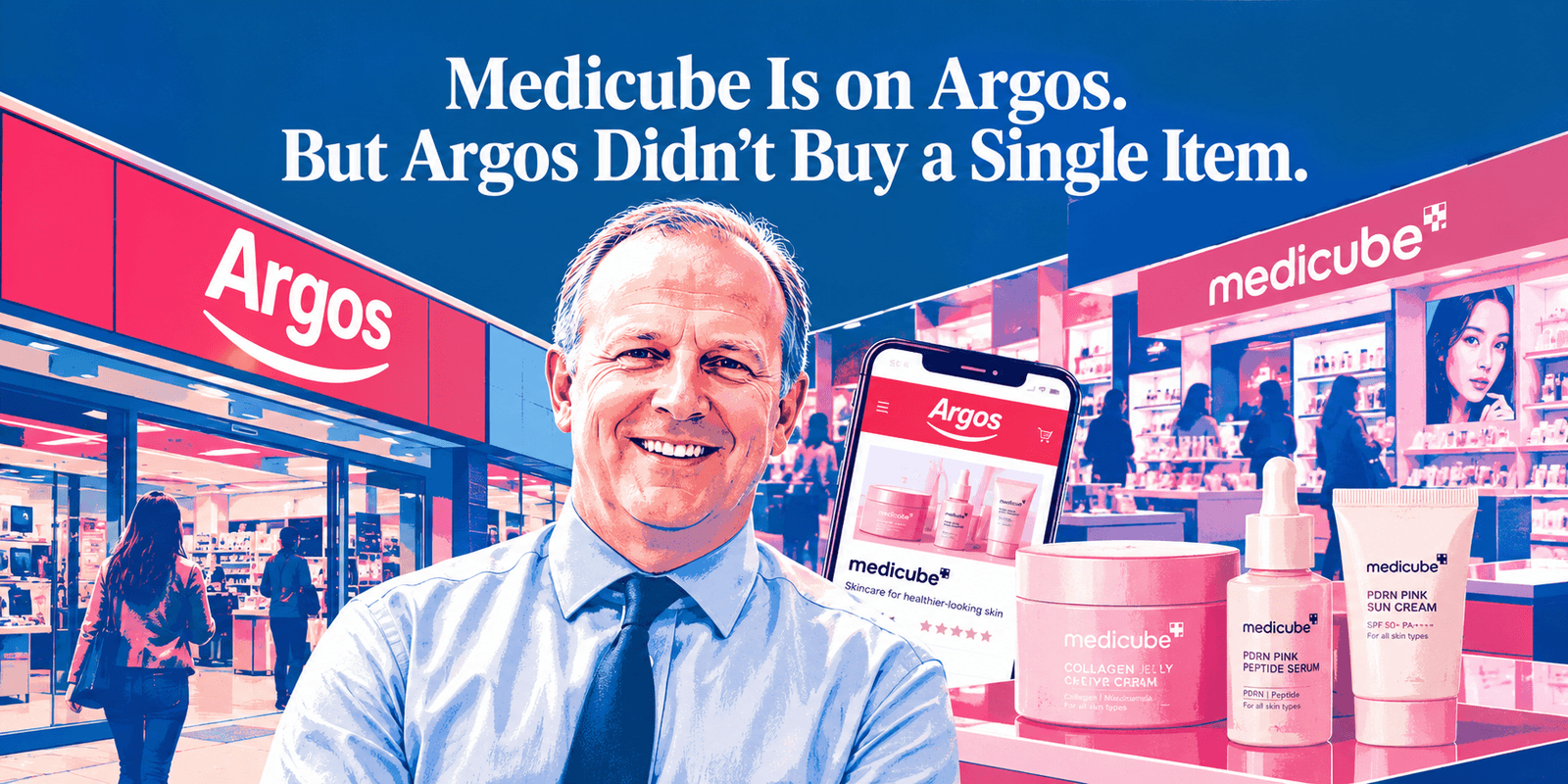
Argos is taking its third-party range from more than 70,000 products to more than 130,000 by the end of 2026, and its managing director calls it the biggest expansion of the range in the company's history. Clause 1.4 of the Trusted Sellers terms describes the same business differently: Argos supplies the platform, the order routing and the payment collection, and is not the seller of those products. Medicube landed inside that clause.
What did Argos actually announce?
Argos began its Trusted Sellers marketplace as a trial with 40 selected partners in July 2026. A marketplace, in retail usage, is a shopfront where approved outside sellers list their own stock on the host retailer's website rather than selling it to that retailer first. By the start of August almost 80 brands and retailers were trading on it, running through Mirakl, the marketplace software that operates the platform underneath. The trial covered furniture, home and toys.
The October expansion adds health and beauty, gifting and electricals, and lifts the third-party range from more than 70,000 products to more than 130,000 by the end of 2026. Four beauty brands were named at launch: Medicube, Clarins, Dermalogica and Bondi Sands. Graham Biggart, managing director at Argos, said the company is "looking forward to the biggest expansion of our range in our history," and that "because we review every partner, customers can trust that every product meets the standards they expect from Argos."
Medicube is the flagship skincare and device brand of APR, the Korean beauty company listed in Seoul. Nothing published establishes this as the brand's first appearance on a British general-merchandise marketplace, so no such claim is made here.
Who is the seller when a Medicube item sells on Argos?
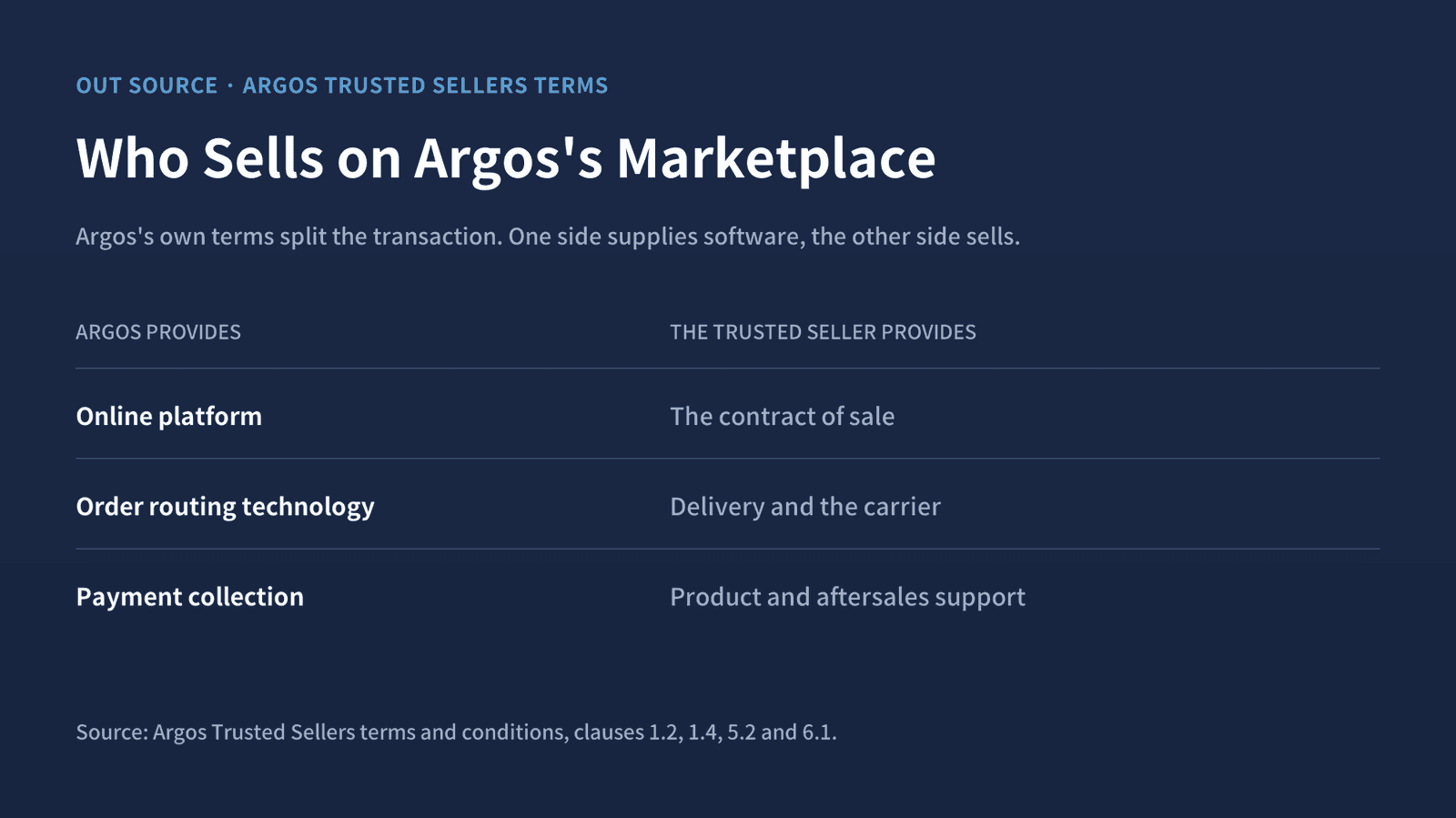
Not Argos. The Trusted Sellers terms settle this in the first clause that matters. Clause 1.2 states that where a customer buys a product from a Trusted Seller, the contract is with that Trusted Seller and not with Argos. Clause 1.4 sets out what Argos does supply — the online platform, order routing technology and payment collection facilities — and then says plainly that Argos is not the manufacturer, supplier or seller of those products.
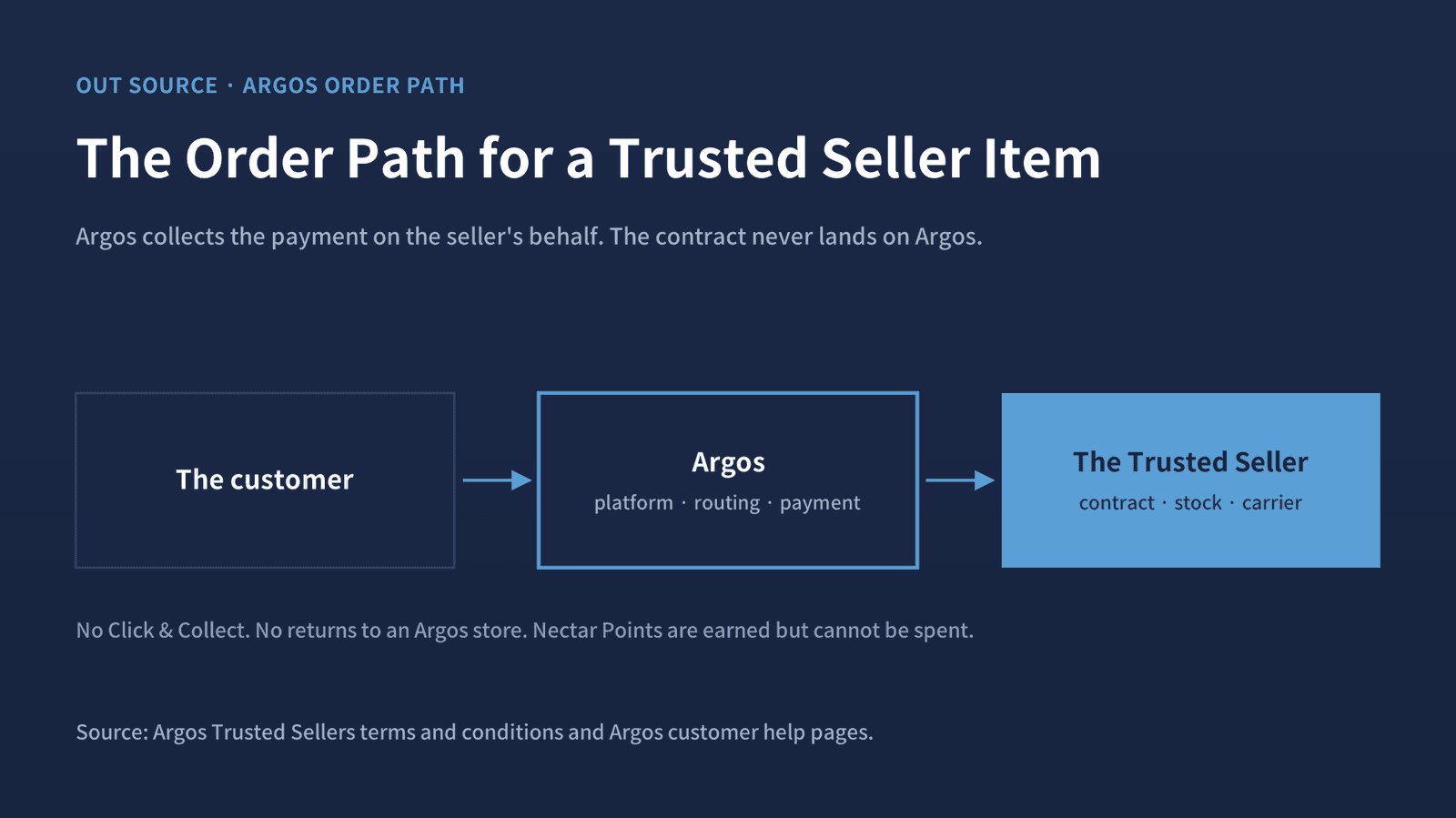
The rest follows from that split. Clause 5.2 has Argos collecting payment on the Trusted Seller's behalf, so the money passing through the Argos checkout is the seller's money in transit. Clause 6.1 puts delivery with the Trusted Seller or its carrier. Clause 1.5 places legal compliance of the listings and the contracts, including product safety and accurate descriptions, with the seller. Argos reviews partners; it does not stand behind the goods.
This is the standard architecture of every third-party marketplace, and it is unremarkable on its own. It becomes worth stating because the announcement and the terms describe the same event in incompatible vocabulary. One says Argos is expanding its range. The other says Argos is not selling any of it.
Why does a retailer expand by 60,000 products it never buys?
Because the alternative is unaffordable. Argos recorded underlying operating profit of £9m in its most recent financial year. Sainsbury's bought the chain for £1.4bn in 2016 and agreed on 31 July 2026 to sell it to Swift Partners for at least £120m — at least £70m at completion, £50m deferred across the following three years, plus proceeds from the sale of an Argos distribution centre. The seller's own announcement books a non-cash impairment of around £350m against the transaction. Completion is expected in February 2027, with full separation by February 2029.
Swift Partners is a company formed for the purchase, with Richard Pennycook as executive chair three days a week, alongside Trevor Strain, Matt Truman and the retail investor True Capital. Buying 60,000 additional products into inventory would require working capital, buying terms, warehouse space and markdown risk. Listing them requires a feed and an onboarding process. For a business of this size, carrying this history, the marketplace is the only route to a range expansion of that scale, and the expansion was announced while the sale was still awaiting completion.
What does the shopper give up at checkout?
Almost everything that distinguishes Argos from a web page. Trusted Seller items are home delivery only. They are not available for Click & Collect, which removes the 1,100-plus collection points that the business counts among its assets. They cannot be returned to an Argos store. Nectar Points are earned on these orders but cannot be spent on them, and Argos Pay and gift cards are not accepted.
Customer service moves too. Argos directs buyers of marketplace items to contact the seller through the order details page and asks them not to approach its own support teams, on the stated grounds that its team will not be equipped to answer the questions. The protections that remain are the statutory ones and the platform's own window: 30 days from delivery to request a return, a refund due within 14 days of the goods arriving back with the seller, and the remedies of the Consumer Rights Act 2015 for faulty goods.
What the Argos name supplies on these pages is traffic and a vetting badge. The operating system behind the badge belongs to whoever holds the listing.

Is Medicube's listing a direct one?
That question has no published answer. The accounts of the expansion name the brands that have arrived in health and beauty; none of them names the legal entities selling those brands. Under the terms, the entity that holds the listing is the contracting party, the recipient of the payment, the arranger of delivery and the bearer of the compliance obligations. Whether that entity is APR, a European subsidiary, or an independent distributor with stock in a British warehouse changes who is accountable for every one of those functions.
So "Medicube is on Argos" and "APR sells on Argos" are two different statements, and nothing on the public record establishes the second one. Treating the brand's appearance as a corporate distribution agreement assumes a fact that has not been disclosed.
What does Medicube's UK footprint look like away from Argos?
Consistent with the same pattern. The brand holds a Space NK page on the British site with 39 products listed, which is a buying relationship: Space NK stocks what it sells. Alongside that, a retail staffing agency describes supplying brand ambassadors to run Medicube Brand Spaces across five Space NK stores — Bluewater, Leicester Highcross, Kingston Bentall's, Canterbury Whitefriars and Chelmsford Bond Street — on an eight-week rollout through August and September 2026. That description is the agency's own, and the agency's own account also has its staff keeping the stock replenished across weekend shifts.
A specialist beauty retailer buying the range, a temporary staffed presence inside that retailer's stores, and a marketplace listing on a generalist's website are three different things. Only the first commits a British buyer's budget.

How does APR describe Europe in its own numbers?
APR reported second-quarter 2026 revenue of 767.5bn won (about $571m) and operating profit of 190.6bn won (about $142m), a 24.8% operating margin. Revenue rose 134.2% and operating profit 134.5% against the same quarter of 2025. First-half revenue reached 1.3609 trillion won (about $1.01bn). Overseas sales were 92% of the quarter's revenue, rising 178% year on year. All won-to-dollar conversions in this article use 1,343 won to the dollar, the mid rate on 9 October 2026.
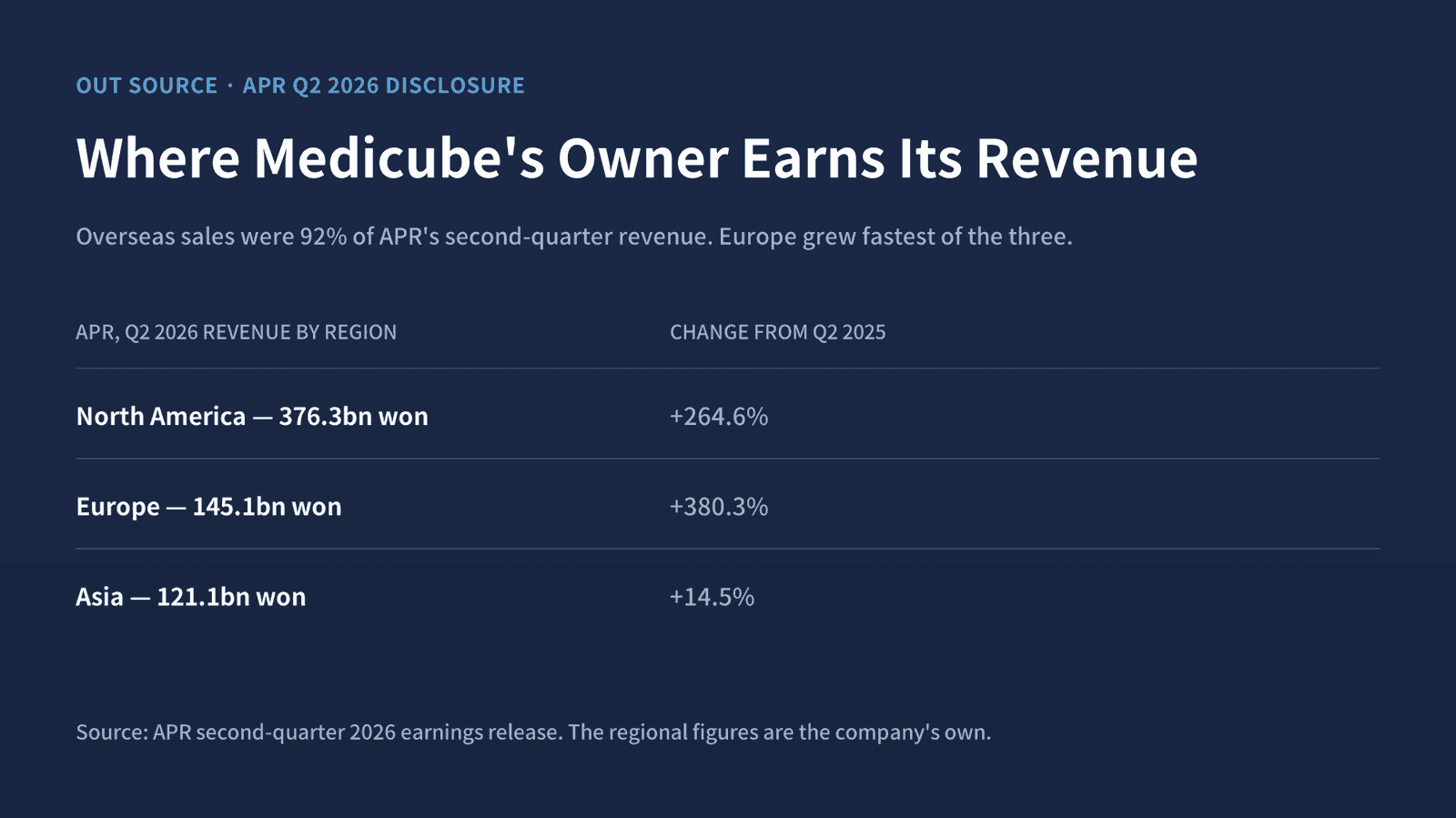
The regional split is where the European story sits. North America contributed 376.3bn won (about $280m), up 264.6%. Europe contributed 145.1bn won (about $108m), up 380.3% — the fastest-growing region of the three disclosed. Asia contributed 121.1bn won (about $90m), up 14.5%. North America and Europe together moved from 40% of revenue to 68% in a year.
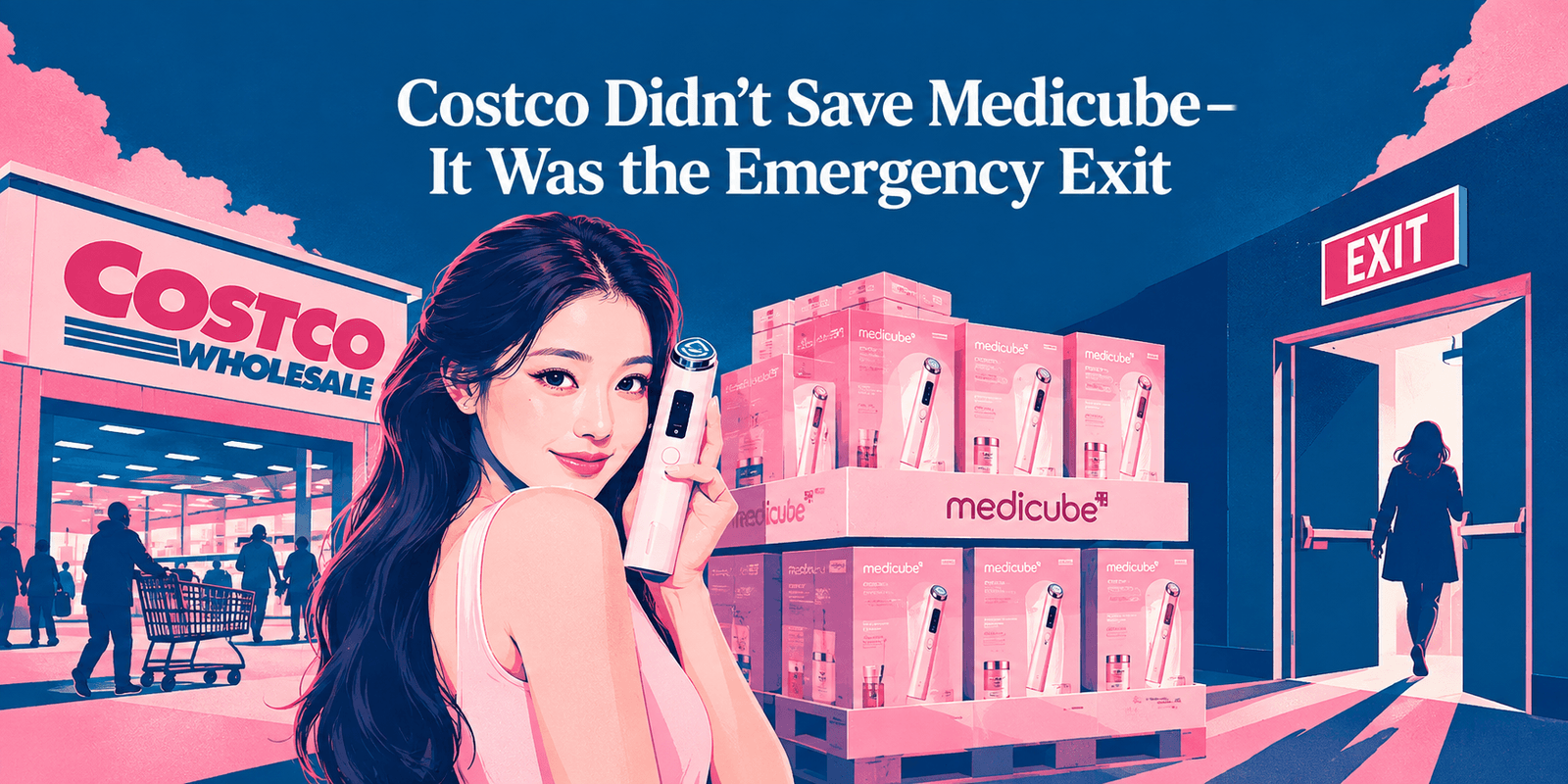
The company's own account of how Europe was won names the channels: Amazon and TikTok Shop, across the United Kingdom, France, Germany, Italy and Spain. Online marketplaces. The same disclosure describes offline expansion only for North America, naming Target and Walmart and an expected Costco entry in the second half of 2026. For Europe, it makes no offline retail claim at all.
Why do the United States and the United Kingdom produce different kinds of news?
Because the two markets are being entered by different mechanisms, and the trade press reports both with the same verb. In the United States the unit of news is the door. Medicube reached Target stores nationwide with 13 SKUs in store by 12 April 2026. A rollout to around 3,200 Walmart stores was reported in May 2026 as planned for June; Walmart declined to comment at the time, and no confirmation of the completed rollout has been published since.
A door count means a buyer signed, a planogram exists and inventory sits inside the retailer's system at the retailer's risk. A listing count means a feed was accepted. Both get written up as entering a retailer. Only one of them involves the retailer buying anything.
What does this change about the way distribution gets counted?
The three groups reading these announcements should read them differently, because the announcement means something different to each.
For manufacturers and contract developers, a marketplace listing generates no production commitment. Door counts drive forecasts because a purchase order sits behind them; listing counts carry no order at all. Capacity planned against announcement volume will overshoot, and the overshoot will not be visible until the sell-through data arrives.
For brands and buyers, the marketplace route buys reach without buying terms, which is its advantage and its exposure. A listing nobody inside the retailer argued for is a listing nobody inside the retailer will defend. Ranking is set by relevance, availability, ratings and performance, with paid placement labelled alongside — the same mechanics as any other marketplace, and the same removal risk.
For regulators and investors, the obligations move with the listing. Product safety, accurate description and consumer-law remedies attach to the entity on the listing, not to the household name at the top of the page. A cosmetic sold into a British home under a familiar retailer's branding is governed by a company the shopper never sees and the retailer does not indemnify.
Retail reporting still assumes that reaching a retailer means a retailer bought something. On the fastest-growing part of Argos, nobody did.