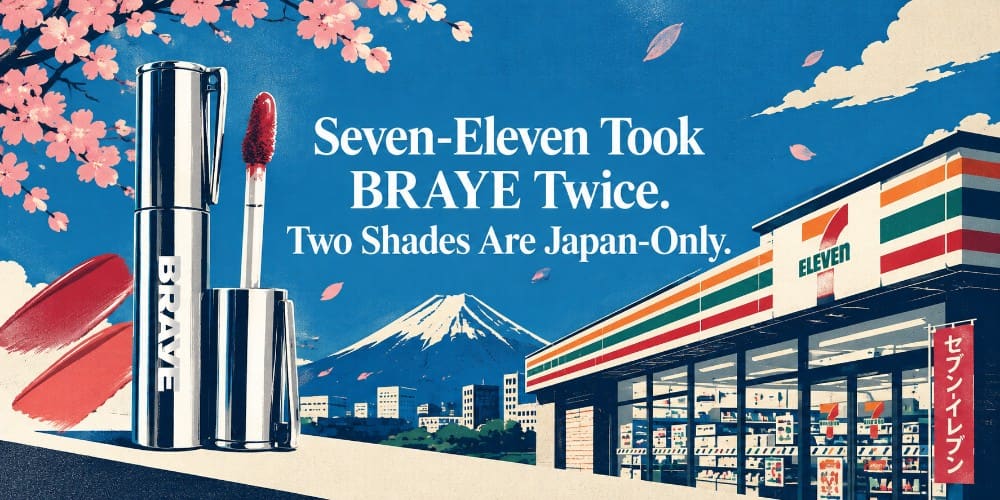
Six shades of lip tint went into Seven-Eleven stores across Japan on September 5, 2026. Two of them, 14 HAZELIT and 15 MELONIC, exist nowhere else. The brand is BRAYE, launched in Korea in May 2024 by a company whose other products are chicken breast snacks and vinegar soda. Twelve months after its first convenience store run, BRAYE did not ship Korean inventory into Japan a second time. It shipped a product built for one Japanese chain.
How fast did BRAYE get from a Seoul pop-up to a Japanese shelf?
BRAYE launched in Korea in May 2024 with a pop-up. Japanese retail sales began on November 29, 2024, rolling out through Loft, PLAZA, @cosme, Hands and Shop In. Seven months separate those two dates.
That is fast by any measure, and it is worth being precise about why. The brand did not build a Japanese subsidiary, hire a local team or negotiate chain by chain. It signed one Japanese company, Food Cosme, as its exclusive distributor, and inherited that company’s existing relationships with the variety store chains where Japanese shoppers go looking for Korean cosmetics. The brand supplied the product and the identity. The distributor supplied the doors.
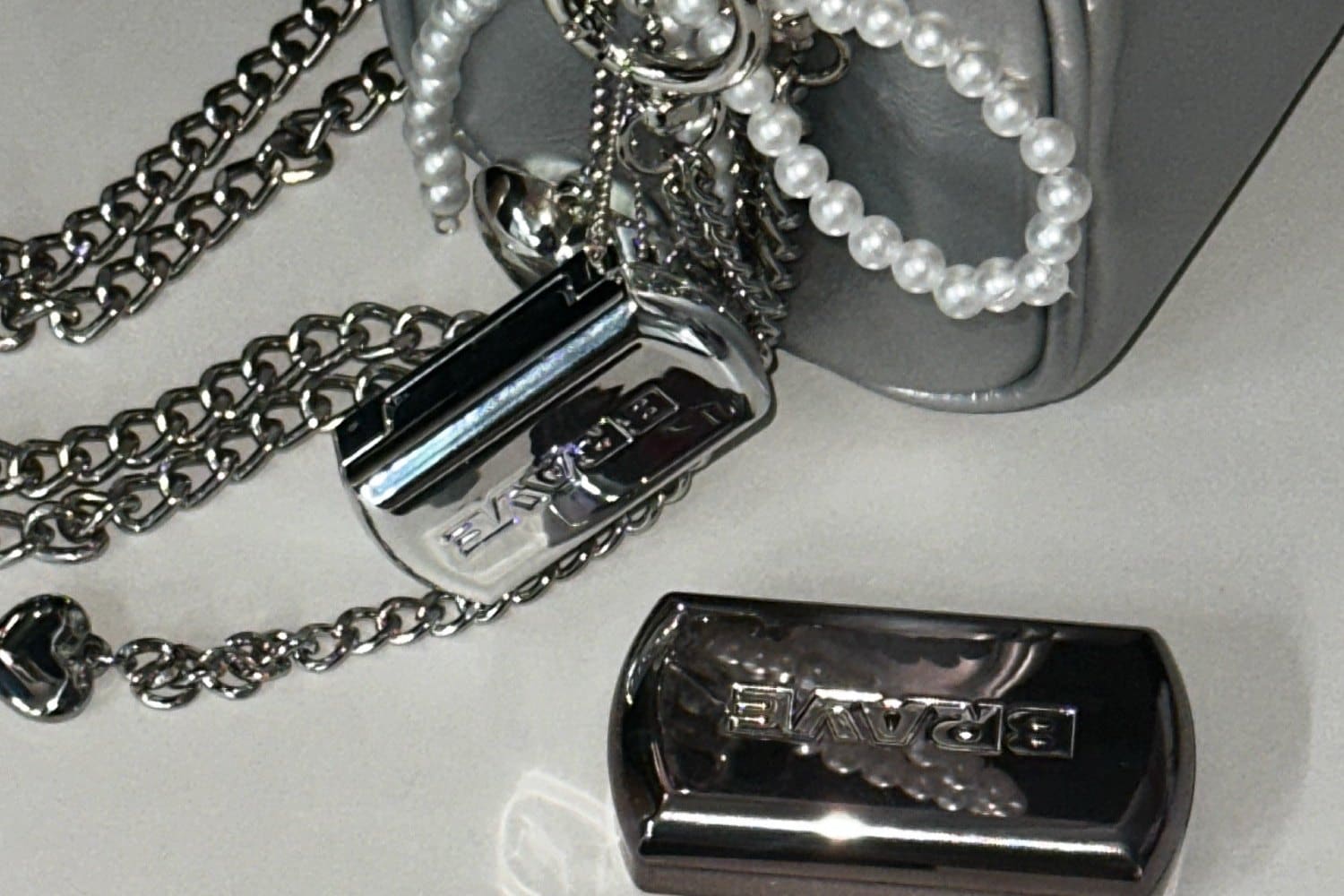
The product itself was built to be noticed. Lip Sleek ships with a roughly 61-centimeter chain so it can be worn as a necklace or across the body, at 2,990 yen including tax, or US$19.07, across ten shades in Japan. Yen figures in this article are converted at 156.77 to the US dollar and won figures at 1,325.6, both October 22, 2026 closes. A lip product designed to hang visibly off a bag is doing two jobs: it is cosmetics, and it is advertising carried by the customer.
What does an advance release at Seven-Eleven actually mean?
On August 30, 2025, Food Cosme put Lip Sleek Mini into Seven-Eleven stores nationwide. The release describes it as a 先行発売, an advance release, meaning the convenience store got the product before the brand’s other Japanese channels did.
That ordering is the part worth stopping on. A chain does not take first call on a new item from an unfamiliar foreign brand as a favor. It takes first call when it wants the traffic that exclusivity generates, which means the buyer had already formed a view about what this brand does for a specific shopper.
The format matched that view. Lip Sleek Mini ran 1.3 grams, 1,100 yen before tax and 1,210 yen after, or US$7.72, across eight shades, in a silver case with a mirror inside and a ball chain for clipping onto a bag. The release framed accessory cosmetics as a 2025 trend. Quantities were limited and the release stated plainly that sales end when stock runs out.
What changed between the first run and the second?
A teaser release on August 31, 2026 announced BRAYE’s return to convenience stores without naming the product. The full release followed on September 4, and the item reached stores on September 5.
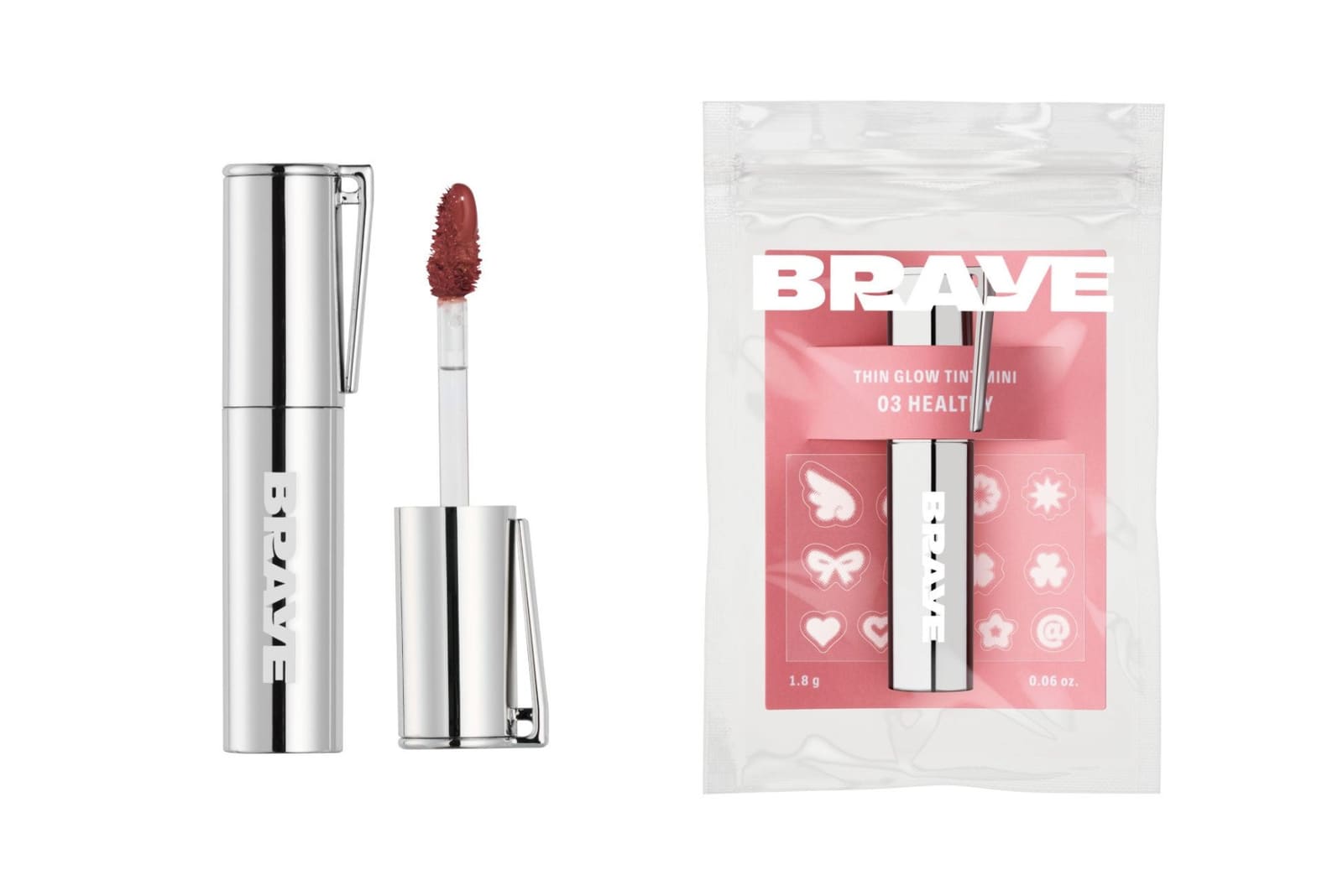
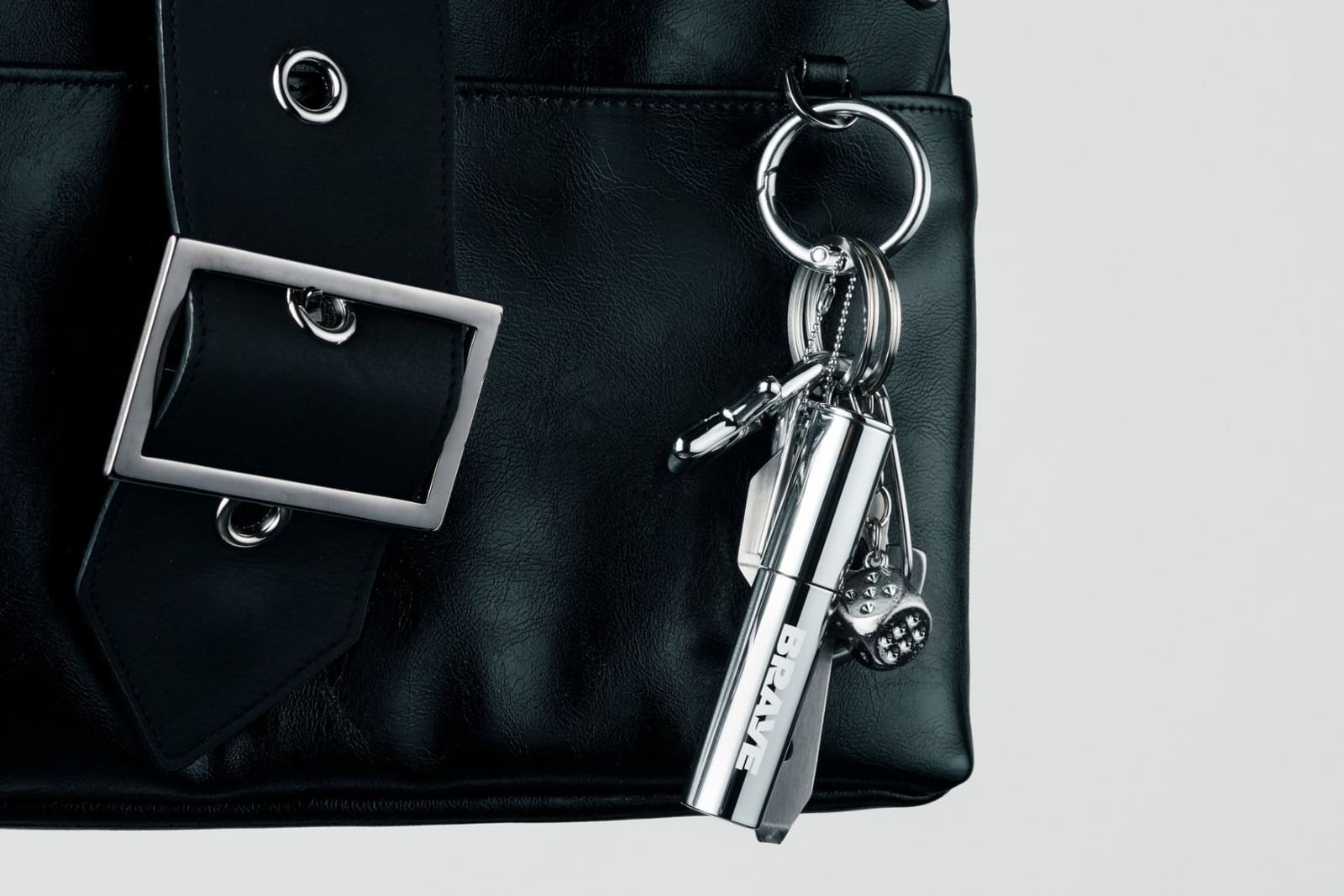
Almost everything about the second product is different. Thin Glow Tint Mini is a slim pen rather than a case, at 900 yen before tax and 990 yen after, or US$6.31, in six shades rather than eight. The ball chain is gone; the cap carries a hole so the customer can attach a keychain they already own. Customizable stickers are included. The release claims more than 20% moisturizing essence content and a high-refractive oil for a glazed finish.
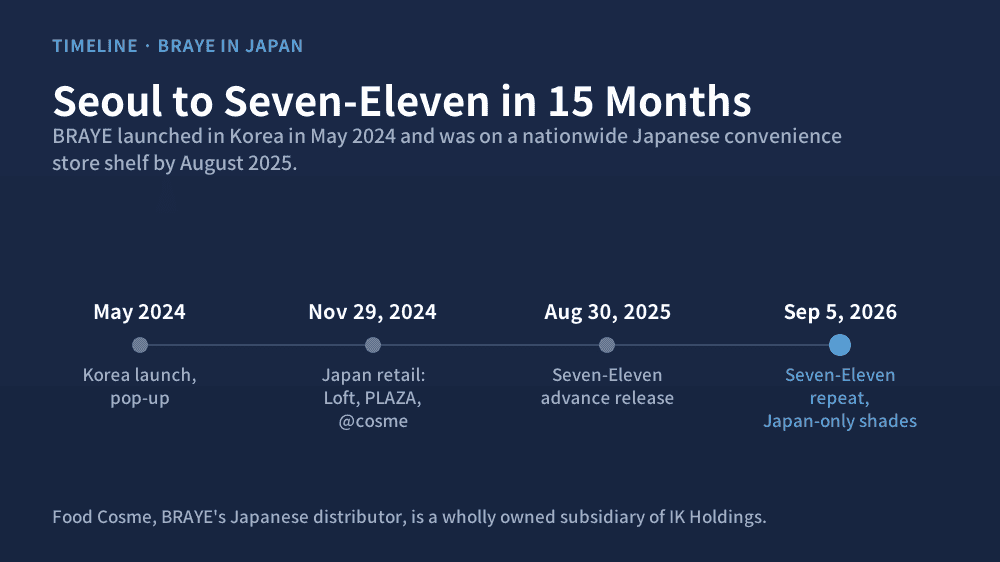
Read the two releases side by side and the same brand is solving two different problems. In 2025 the problem was getting noticed, so the product was a visible object on a bag. In 2026 the problem was repeat purchase at a price a shopper does not think about, so the product got cheaper, thinner and easier to carry.
Why do two of the six shades exist only in Japan?
The September 2026 lineup is four established shades plus two created for Seven-Eleven. A Japanese beauty writer who bought them on September 18, 2026 identified them as 14 HAZELIT, a softer brown than she expected, and 15 MELONIC, a pink more neutral than it appears, and described both as Japan-limited. She also reported her local store nearly out of stock at that point.
Creating two shades for one retailer in one country is not a marketing gesture. It means a separate formulation run, separate packaging artwork, separate registration and separate inventory that cannot be sold anywhere else. A brand accepts that cost when the door count justifies it, and when the retailer has asked for something it can own.
This is the detail that separates BRAYE from a brand that simply exports. Shade selection is where a cosmetics company encodes its reading of a specific market’s skin tones and taste. Doing it for a convenience store chain says the brand treats that chain as a market, not as a clearance channel.
Why 990 yen and not 1,210?
The second product came in 220 yen below the first. That is not a discount on the same item, because the items are different, but the price point was chosen rather than inherited.
990 yen sits under the 1,000-yen line, which is where a Japanese convenience store purchase stops being a decision and becomes an impulse. The customer is already at the register. The shelf is small, there are no testers and no staff to consult, and the competing claim on that same coin is a drink and a rice ball.
Japanese retail trade coverage of convenience store cosmetics describes exactly this mechanism: mini sizes and limited editions lower the cost of trying something, which is how the channel recruits younger customers, and Korean cosmetics in particular drive 目的買い, purpose-driven buying, where the shopper enters for one specific item. BRAYE built to that brief rather than negotiating against it.
Who actually puts a Korean lip tint on 21,927 shelves?
Seven-Eleven Japan’s own corporate data puts its domestic network at 21,927 stores for the year ended February 2026, averaging 913 customers a day at each one. That is the scale a brand reaches by signing one distribution agreement.
The distributor is Food Cosme, founded June 1, 2009, based in Ginza, Tokyo, with capital of 45 million yen, or US$287,000, and 40 employees as of June 2026. It holds exclusive or sole Japanese distribution for SKINFOOD, hince, AROMATICA, klairs, BRAYE, PINKWONDER and CHASIN’RABBITS, runs its own stores and wholesales to variety shops.
Food Cosme is a wholly owned subsidiary of IK Holdings, a Nagoya company founded in May 1982, listed on the Tokyo Stock Exchange Standard Market and the Nagoya Premier Market under 2722, with capital of 620.94 million yen. That listing is the useful part for anyone outside the deal. A Korean brand’s Japanese distribution normally sits behind a private company and cannot be examined. Here it files.
How big is the business BRAYE’s distributor built?
IK Holdings has disclosed Korean cosmetics revenue across all its channels by fiscal year, each ending in May. It ran 969 million yen in the year to May 2022, or US$6.18 million. It reached 4.042 billion yen, or US$25.8 million, in the year to May 2025. That is 4.2 times in three years.
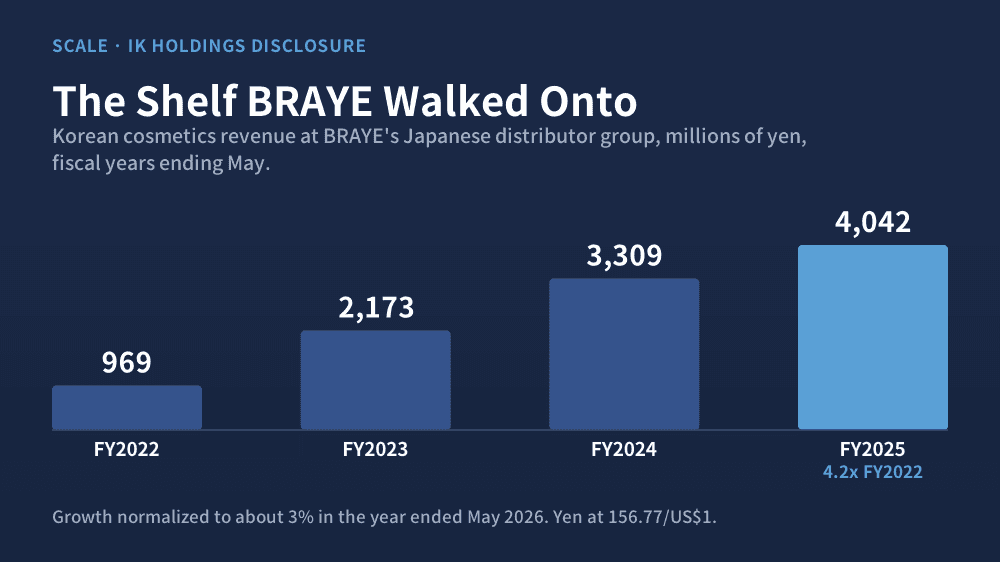
The curve then flattened. In the half year to November 2025 the category grew 9.3% to 2.26 billion yen, against roughly 130% growth in the same half a year earlier. For the full year to May 2026 it grew about 3% against a plan of 20%, and the company told investors it had been slow to add brands.
That context makes BRAYE’s September 2026 repeat a sharper result, not a softer one. Winning a second nationwide run from a chain like Seven-Eleven is straightforward when a category is compounding at triple digits and every buyer wants a Korean item on the shelf. Winning it in a year when the distributor’s whole Korean portfolio moved 3% means the chain re-ordered this brand on its own merits.
What did the Qoo10 corner three weeks later change?
On September 26, 2026, three weeks after BRAYE’s second launch, Seven-Eleven opened Qoo10 Pick, a dedicated Korean cosmetics corner built from marketplace purchase data. It launched with eight brands, ten items and 21 variants: AOU, GROWUS, SKIN&LAB, SKIN1004, Cen24, tiptoe, 23YEARSOLD and Parnell, priced from 330 to 1,650 yen.
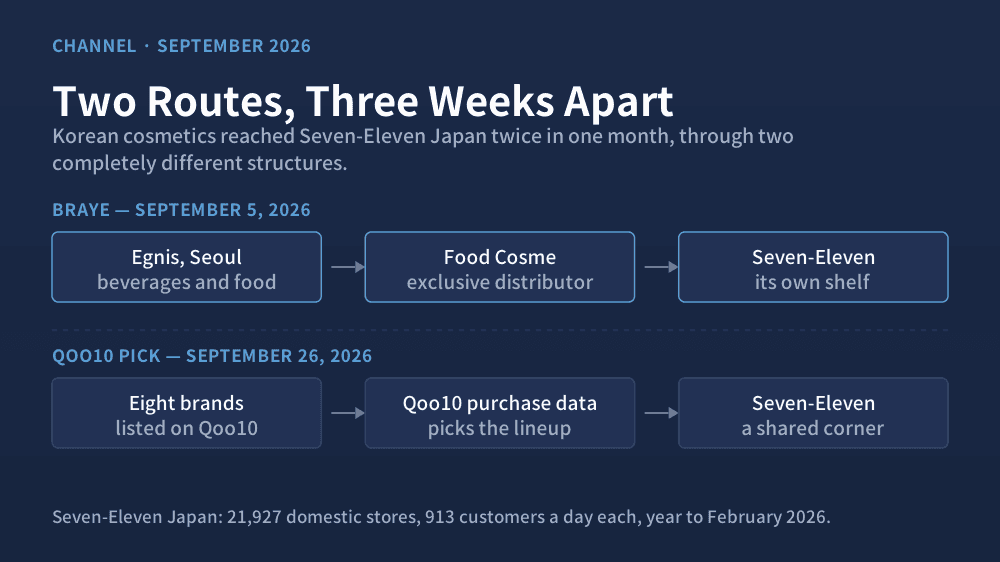
BRAYE is not on that list, and that is the point. Two structurally different routes now reach the same chain. One is a marketplace selecting brands by what already sells online, which gives the retailer data and the brands a shared shelf. The other is an exclusive distribution agreement, which costs the brand margin and control but delivers its own space, its own shade development and first call on a launch.
BRAYE holds the second kind, and it held it before the first kind existed at this chain. A brand inside a platform-curated corner is one of 21 variants chosen by somebody else’s algorithm and replaceable the moment the data shifts. A brand with its own convenience store run has a relationship with a buyer.
What is BRAYE’s parent building toward?
Egnis reported 2025 revenue of 193.2 billion won, or US$145.7 million, a company record, with operating profit of 6.2 billion won and a return to profitability. Revenue was 14.6 billion won in 2021, so the four-year trajectory is more than thirteenfold. The company has set a 2026 revenue target of 300 billion won, or US$226.4 million, and says it is accelerating IPO preparation.
Its established businesses are food and drink: CLOOP beverages, whose revenue rose 23 times in three years; Aesabi Soda, with more than 48 million bottles sold; Hankki Tongsal, which the company puts at about 30% of the online chicken breast market; and LabNosh. Beauty is named as the next growth engine, and Egnis has since added a beauty device line and skincare.
BRAYE’s own revenue has not been disclosed, and Korean coverage describing the brand as having sold out after entering Japan is the company’s account. The Japanese releases make no sales claim at all beyond limited quantities. What is documented is structural rather than financial, and for a company heading toward a listing, structure is what an investor can verify: a brand that reached Japanese retail in seven months, took a nationwide convenience store advance release in fifteen, and earned a repeat with market-specific product in twenty-eight.
What does this case actually teach?
That a food company can build a cosmetics brand is not the lesson. Manufacturing is outsourced in both categories, and the transferable skill from vinegar soda and protein snacks is reading what a shopper picks up without thinking.
The lesson is about the shape of the product. BRAYE did not win a convenience store shelf by being a good Korean lip tint. It won by answering a specific retail brief: under 1,000 yen, small enough for a pocket, attachable to something the customer already carries, and carrying two shades that chain can claim as its own. Every one of those decisions costs money and narrows the product’s use elsewhere.
Most brands entering Japan do the opposite. They ship the hero SKU that worked in Seoul, in its Korean size at its Korean price, and treat any channel that asks for changes as a channel that does not understand the brand. The convenience store is now one of the largest cosmetics discovery surfaces in Japan, and it is specific about what fits on it.
BRAYE rebuilt the product twice in twelve months. That is why it got asked back.