On November 18, 2026, KOTRA seated Walmart's buyers across from about five Korean manufacturers, not five Korean brands. The notice asked for haircare, body care and lotion, English-language materials and FDA-registered products. In January the same agency had put 57 Korean cosmetics companies in front of 12 Walmart buyers. Walmart's interest in Korean beauty did not change between the two sessions. What it is buying did: the formula and the factory, with the label left for Walmart to fill.
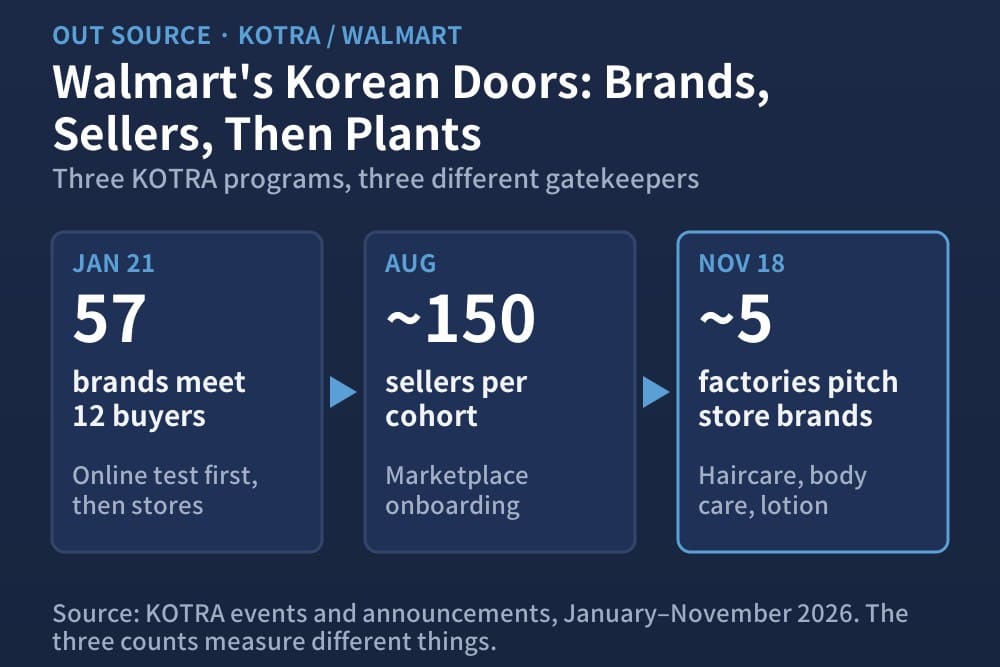
▲ Walmart's three doors for Korea: 57 brands met buyers in January, about 150 sellers per cohort joined the marketplace in August, and about 5 factories were invited in November.
What did Walmart ask Korea for on November 18?
KOTRA, Korea's state trade and investment promotion agency, scheduled a private-brand sourcing consultation for Walmart on November 18, 2026, from 2:30 p.m. to 4:30 p.m. at its Seoul headquarters. A private brand, also called private label or store brand, is a product sold under the retailer's own name and made by an outside manufacturer.
The notice restricts the session to three personal-care categories: haircare, body care and lotion. Applicants needed English-language company and product materials and products registered with the U.S. Food and Drug Administration. Applications ran from November 4 to November 11, and the notice set the intake at about five companies.
The noun in the notice is manufacturer. Walmart did not ask to meet brands. It asked to meet the plants that make products for them, and that one word decides who sits across the table.
Why does five matter after 57 in January?
On January 21, 2026, KOTRA ran a Walmart Marketplace and Sourcing Plaza session in Seoul. Twelve Walmart buyers, six of them vice presidents, held one-on-one meetings with 57 Korean cosmetics companies that KOTRA had screened in advance. Walmart asked that the participants' names stay private. The plan KOTRA described was to test consumer response on Walmart's online marketplace first and consider physical stores afterward.
In August, KOTRA opened a second door. Its Power Seller Development Program offered Walmart Marketplace account setup, logistics and marketing support to cohorts of about 150 companies, with up to 300,000 won of marketing costs reimbursed for the first 10 companies in each intake. That is about $225 at the November 20, 2026 close of 1,336.2 won per dollar, the rate used throughout this article. Walmart supplies the platform. Products that sell well there can be considered for placement in its more than 4,600 U.S. stores.
November is the third door, and it has a different gatekeeper. The three numbers measure different things: 57 companies meeting buyers, about 150 per cohort learning to sell on a platform, about five plants pitching a retailer that will print its own name on the bottle. The first two doors screen what a company sells. The third screens what a plant can supply.
What changes when a retailer buys a formula instead of a brand?
A brand sale and a private-label sale divide the same bottle differently. In a brand sale, the manufacturer's customer is the brand, which pays for development, builds recognition and carries the risk of a launch that does not sell. In a private-label sale, the retailer is the brand. It sets the shelf price, owns the label and chooses the plant.
The manufacturer's product is then the formula and the production run. It earns on volume and reliability, and it gives up the one asset a brand keeps: a name a shopper can ask for. The plant behind a store-brand shampoo stays invisible to the person who buys it. That is the design of the arrangement, not a side effect.
For Walmart the logic runs the other way. Korean brands have spent years teaching U.S. shoppers what a good formula feels like on the scalp and on the skin. A buyer that wants that experience at a store-brand price does not need the brand. It needs the plant that already knows how to make it.
Why haircare, body care and lotion?
The three categories in the notice are replenishment products. A shopper finishes a bottle and buys another, and the retailer sells the second bottle without a new story. Facial skincare and color makeup, the categories that built K-beauty's reputation abroad, are absent from the list.
Haircare supplies the numbers. Korea Customs Service data show shampoo exports of $179.57 million for January through September 2026, up 39% and already above the $178.07 million shipped in all of 2025. The United States took $40.85 million of that, up 83.1%, and passed China as the largest market for Korean shampoo. The U.S. share of the nine-month total is 23%.
The category is still small. NH Investment & Securities analyst Jung Jiyoon puts haircare at 4% of Korean cosmetics exports. She said that treating the scalp and hair like skin, a trend called skinification, is gaining traction worldwide, and she expects haircare export growth in 2027 to outpace overall export growth.
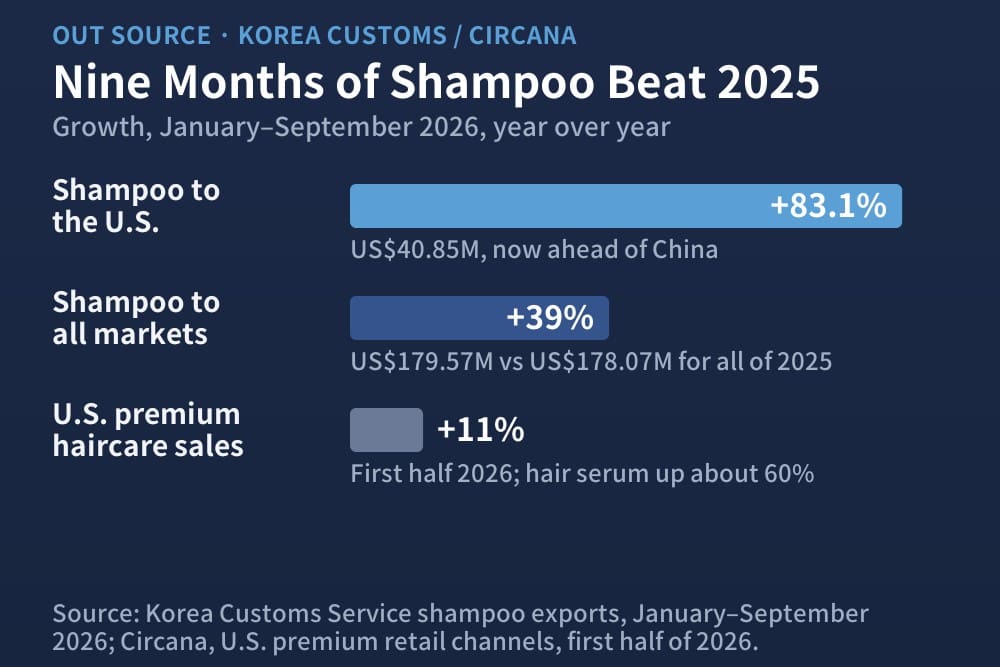
▲ Korean shampoo exports reached $179.57 million in nine months, more than the $178.07 million shipped in all of 2025.
What does "FDA-registered" screen out?
The U.S. Modernization of Cosmetics Regulation Act of 2022 (MoCRA) puts two duties on a cosmetics supply chain. Manufacturers and processors must register their facilities with the FDA and renew the registration every two years. A responsible person, defined as the manufacturer, packer or distributor whose name appears on the label, must list each marketed product with the FDA, including its ingredients, and update the listing annually.
The notice asks for FDA-registered products. A Korean plant that has never shipped to the United States has to build that paperwork before it can take a seat, and with an intake of about five companies, the requirement is the filter. A plant with U.S. customers walks in with the registration already done.
Private label moves the second duty. The definition of the responsible person follows the name on the label, and a store-brand label carries the retailer's name. The plant sells Walmart two things: a formula and a current facility registration.
Where does premium innovation go once a mass retailer wants it?
Circana data for U.S. premium retail channels show haircare sales up 11% in the first half of 2026 and hair serum sales up about 60%. Those are prestige-shelf numbers. Walmart is not a prestige shelf, and a mass buyer shopping for a store-brand serum starts from the formulas that already win in premium channels.
Korean contract manufacturers develop formulas for brands as well as fill their orders, so they know how to make the products now selling at premium prices. The November session is where those formulas get a second life at a different price. A premium launch builds a formula's reputation, and a store-brand contract builds its volume.
How large is the U.S. opening for Korean plants?
Korea's cosmetics exports reached $11.1 billion in the first nine months of 2026, up 31.1%, according to the Ministry of Food and Drug Safety. The United States took $2.35 billion, up 40.6%, a 21.1% share. China took $1.58 billion, up 0.4%, a 14.2% share.
The growth sits in the United States, and the volume of the U.S. beauty market sits in mass retail. A brand reaches mass retail through a launch and a sales team. A plant reaches it through a registration, a price quote and spare capacity. The second route suits an industry whose strength is manufacturing.
What does the sequence mean for the industry?
In ten months, Walmart's approach to Korea moved from the brand to the seller to the plant. Each step trades visibility for volume. A Korean manufacturer that passes the third door becomes a supplier to the shelf its own customers' brands compete on, and the brands on that shelf start sharing a factory with the retailer's label.
The label changes. The formula stays Korean.