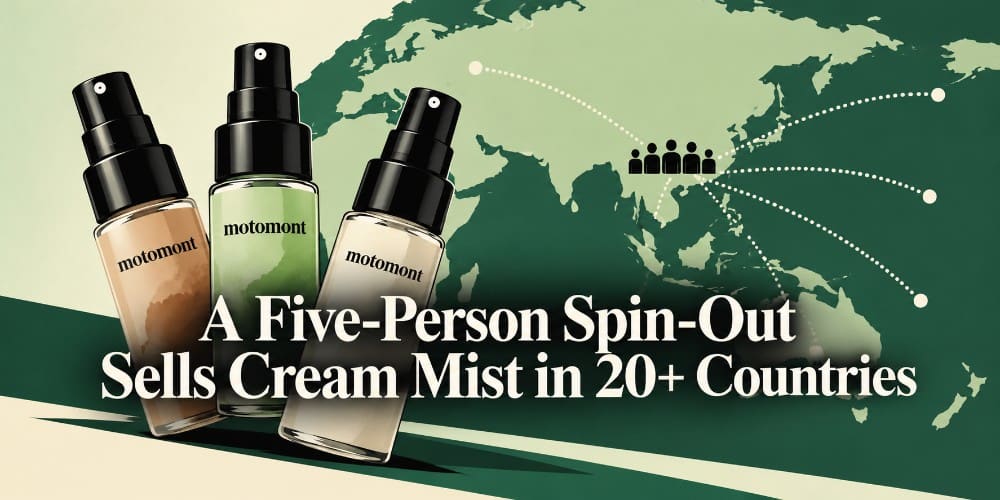
Hightempo Waltz, the five-person company behind Motomont, announced a pre-A round on November 9, 2026, led by Suigeneris Partners. Its milk tea cream mist, launched in January 2025, has sold more than 300,000 units, and October exports alone reached 11 countries and over US$120,000. The round funds a route, not a formula: a global sales network, marketing and new products, built on Amazon storefronts, regional wholesalers and, from year-end, Globus, MISS A and about 300 Italian stores.
What did a five-person team build in 18 months?
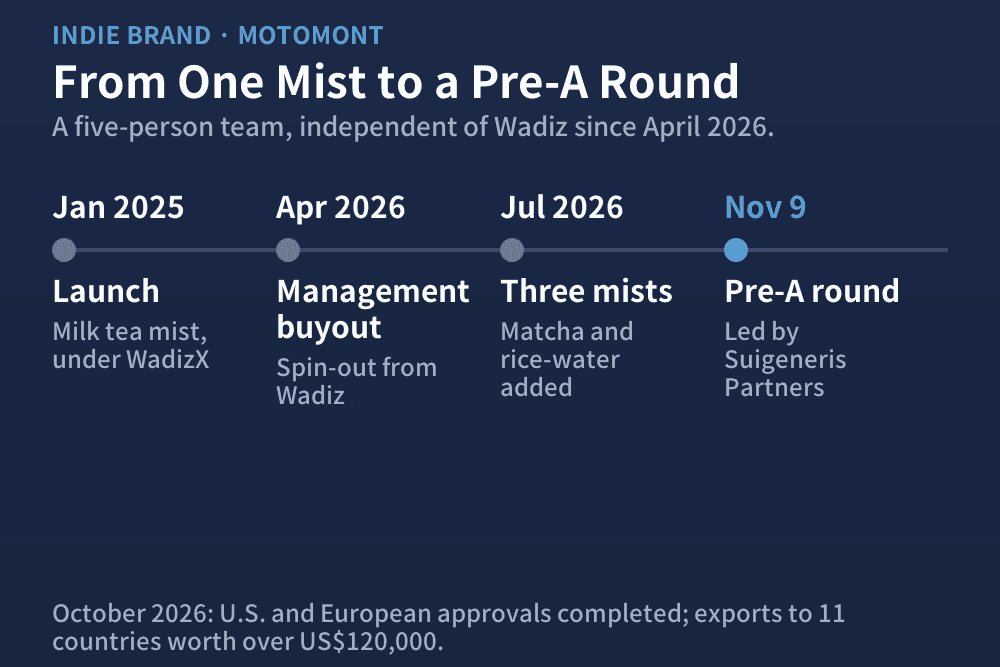
Motomont launched in January 2025 as a brand under WadizX, the brand-incubation arm of the crowdfunding platform Wadiz. For most of the following 18 months it sold one product, a milk tea mist. Cream mist is the term Motomont uses for its facial mist format, and the company now treats the format as a category rather than a single item.
In July 2026 it added a matcha mist and a rice-water mist, making three products. Cumulative sales have passed 300,000 units, and exports reach more than 20 countries. The company employs five people, so the sales figure works out to 60,000 units for every person on the payroll.
That ratio explains the whole story. A five-person team cannot staff 20 markets. It can only sell to companies that already have staff in them, which makes the brand's real product a way of selling, not a bottle.

Why does a one-product brand reach 20 countries?
Kim Han-jae, chief executive of Suigeneris Partners, the lead investor, pointed to export deals with about 20 countries from a single product as proof of the brand's speed and its potential to build a new category. Speed is the operative word. One product family means one price list, one story and one training session for every distributor.
A distributor evaluating a hero product wants to know whether it sells and whether it can be reordered. A brand with a single product family answers both quickly, because there is nothing else on the call. The same simplicity that limits a catalog shortens the sales cycle.
The cost is concentration. Every export order rides on one format, which is why the July 2026 line extension matters. Matcha and rice-water mists are new variants of the same format, not a new category, and they let existing distributors reorder without relearning the brand.

Where did the first overseas revenue come from?
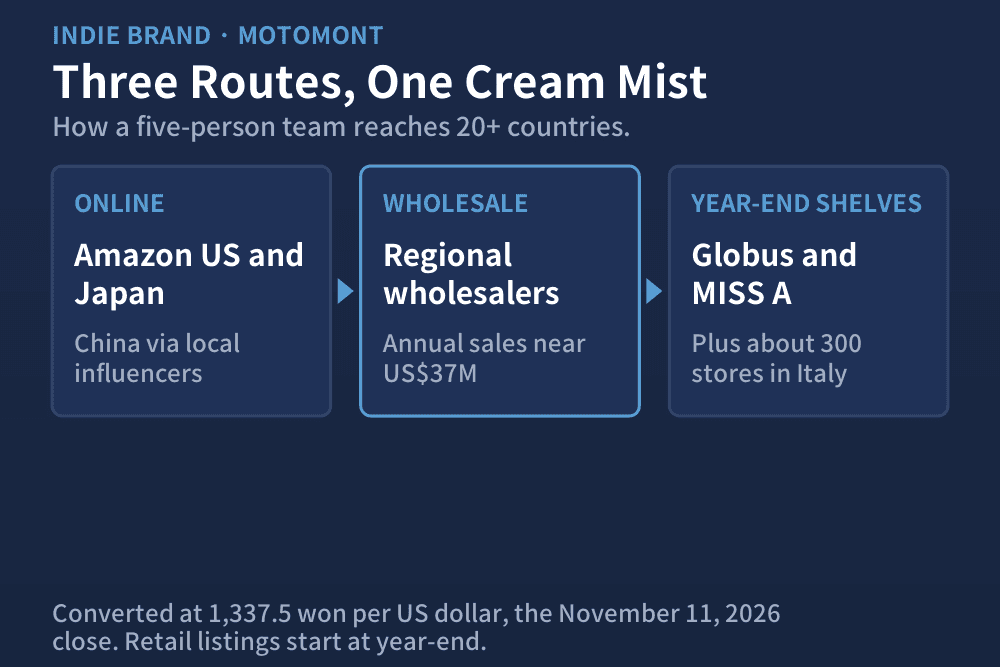
Hightempo Waltz said overseas revenue stands at about 350 million won (about US$262,000 at 1,337.5 won per dollar, the November 11, 2026 close), roughly half of it from China. Early Chinese hygiene registration, the registration a cosmetic needs before it can be sold in China, and local influencers, known as wanghong, carried those sales.
The brand also entered Amazon in the United States and Japan. Both routes share a feature: a platform or a person with an audience does the selling. A registration filed in advance and a creator who sells by video need no sales staff on the ground, which is exactly the kind of channel a five-person team can afford.
The first overseas revenue, in short, came from channels that scale with the platform, not with headcount. The question for the next stage is what scales with headcount when headcount is fixed.
What changed in October 2026?
Motomont completed the approvals needed to enter the United States and Europe in October 2026. That month it exported to 11 countries, worth over US$120,000, an average of about US$11,000 per country. The figure is small per market and large in aggregate for a team of five.
Brand awareness is building in Poland, the Netherlands, Lithuania and the Czech Republic, and the company plans local marketing there. Four markets means four local marketing plans: the work in Europe is done market by market.
The approvals are the gate. Before October, exports moved through channels that needed no local clearance. After October, shelves in regulated retail are available. A brand that clears the gate on the same month it records an 11-country export month has aligned its paperwork with its pipeline.
How does a five-person team sell to Europe?
In September 2025, founder Hwang In-beom visited K-beauty stores in Paris and signed five local retailers. Today the brand works with mid-to-large regional wholesalers whose annual sales are roughly 50 billion won, about US$37 million. Hightempo Waltz also sends staff to sell directly in local markets alongside its export partners.
A wholesaler buys in volume and resells to retailers, so one wholesaler contract carries the relationships of many stores. Five signed retailers in Paris prove that shoppers want the product. A wholesaler with US$37 million in annual sales converts that proof into coverage that five people cannot build store by store.
The structure is a division of labor. The brand's staff sell to buyers who own the shelves. The buyers' staff sell to shoppers. Five people at the top of a long chain can reach a very large number of doors, as long as they spend their time on the contracts, not on the doors.
What does the year-end retail lineup show?
From year-end, Hightempo Waltz is pursuing listings at three places: Globus, the Swiss luxury department store; about 300 stores across Italy; and MISS A, a U.S. beauty retail channel. These are plans, and each listing is the start of the sales work, not the end of it.
The three sit on three different tiers of retail. A luxury department store asks for a brand story and a premium image. A 300-store network asks for reliable stock across hundreds of shelves. A U.S. channel asks for approvals, which Motomont completed in October. One mist family is being fitted to three different sets of demands.
A listing is a promise to stock, not a sale. The test comes in the reorders. A brand with 300,000 units behind it and a wholesaler layer in front of it is better placed to pass that test than one that arrives with a launch and no pipeline.
What does the break from Wadiz change?
Hwang joined Wadiz as an intern in 2014 and rose to the CBO role, spending over a decade growing small brands through crowdfunding operations, PR and business development. Motomont was the first project in which he applied that experience to a brand of his own.
In April 2026, with Wadiz's agreement, he completed a management buyout, an MBO, in which the managers of a business buy it from its parent. The company was renamed Hightempo Waltz, a name that joins hightempo, for quick execution, with waltz. Seven months later it announced its pre-A round.
The order of events is independence in April and outside capital in November. A brand that grew up inside a platform now answers to its own management and its own investors. For a founder whose skill is launching small brands fast, that is the structure in which speed pays directly.
Where does the cream mist go next?
The plan is to widen the format. Hightempo Waltz intends to build what it calls a borderless cream mist brand covering hair and body care, launch companion products, and develop a berry body mist for North American consumers. The funds go to a global sales network, marketing and new products.
Hwang's stated goal is to make Motomont a leading global cream mist brand within two to three years, with 2027 as the year of major global expansion. That sets the pre-A round as the funding for a specific sequence: hold the 20 markets, add shelves in the regulated ones, then widen the range.
Korea's cosmetics exports reached US$11.43 billion in 2025. The long tail of that industry is built by teams like this one: one format, a wholesaler layer and a handful of marquee shelves. The formula travels with every brand. The route is what each brand has to build for itself.